 Add to Chrome
 Add to Firefox
 Add to Edge
FreeForm: Reduced-Order Deformable Simulation from Particle-Based Skinning Eigenmodes
May 28, 2026
We present a novel formulation for mesh-free, reduced-order simulation of deformable hyperelastic objects. Existing work in reduced-order elastodynamic simulation represents the input geometry by either meshes, which can be difficult to obtain due to challenges in scanning and triangulating complex shapes, or by neural fields that require per-shape optimization. We propose to adopt a Reproducing Kernel Particle Method (RKPM) representation, which enables the construction of reduced-order skinning weights by solving a generalized eigensystem on the Hessian matrix of the elastic energy. We demonstrate that this formulation not only leads to a 40x training speedup compared with the per-shape optimization of neural fields, but also achieves lower simulation error when evaluated against the converged results of finite element method. We show our simulation results on a wide variety of objects in different representations including meshes and Gaussian splats, as well as the application of our method in the downstream task of robot simulation.

Isaac Lab: A GPU-Accelerated Simulation Framework for Multi-Modal Robot Learning
Nov 06, 2025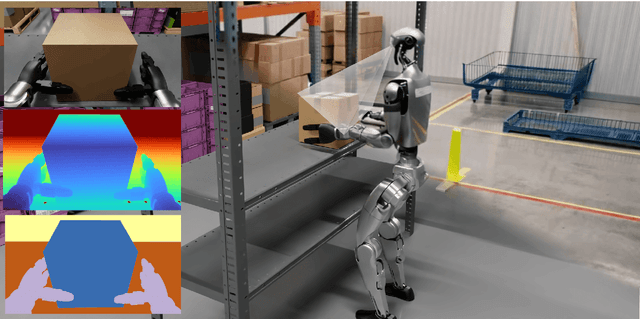
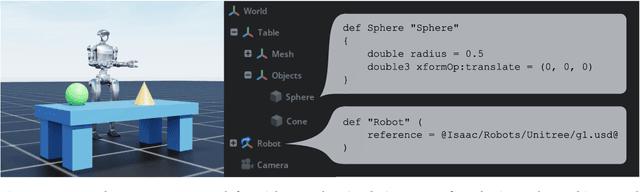
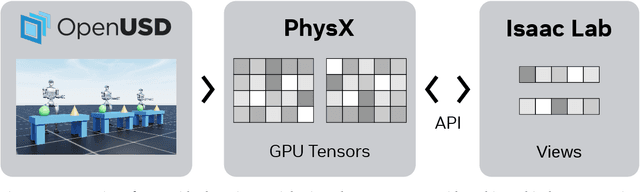
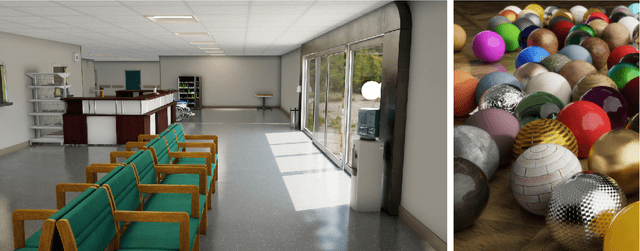
We present Isaac Lab, the natural successor to Isaac Gym, which extends the paradigm of GPU-native robotics simulation into the era of large-scale multi-modal learning. Isaac Lab combines high-fidelity GPU parallel physics, photorealistic rendering, and a modular, composable architecture for designing environments and training robot policies. Beyond physics and rendering, the framework integrates actuator models, multi-frequency sensor simulation, data collection pipelines, and domain randomization tools, unifying best practices for reinforcement and imitation learning at scale within a single extensible platform. We highlight its application to a diverse set of challenges, including whole-body control, cross-embodiment mobility, contact-rich and dexterous manipulation, and the integration of human demonstrations for skill acquisition. Finally, we discuss upcoming integration with the differentiable, GPU-accelerated Newton physics engine, which promises new opportunities for scalable, data-efficient, and gradient-based approaches to robot learning. We believe Isaac Lab's combination of advanced simulation capabilities, rich sensing, and data-center scale execution will help unlock the next generation of breakthroughs in robotics research.
VoMP: Predicting Volumetric Mechanical Property Fields
Oct 27, 2025Physical simulation relies on spatially-varying mechanical properties, often laboriously hand-crafted. VoMP is a feed-forward method trained to predict Young's modulus ($E$), Poisson's ratio ($\nu$), and density ($\rho$) throughout the volume of 3D objects, in any representation that can be rendered and voxelized. VoMP aggregates per-voxel multi-view features and passes them to our trained Geometry Transformer to predict per-voxel material latent codes. These latents reside on a manifold of physically plausible materials, which we learn from a real-world dataset, guaranteeing the validity of decoded per-voxel materials. To obtain object-level training data, we propose an annotation pipeline combining knowledge from segmented 3D datasets, material databases, and a vision-language model, along with a new benchmark. Experiments show that VoMP estimates accurate volumetric properties, far outperforming prior art in accuracy and speed.