 Add to Chrome
 Add to Firefox
 Add to Edge
How Do VLMs Behave When Blind or Misled? Behavioral Evaluation of VLMs on Scientific Figures
Aug 13, 2026
Existing vision-language model (VLM) benchmarks emphasize perception and reasoning accuracy (how well VLMs describe and reason about what they see in an image), with limited attention to behavioral reliability under uncertainty (how they behave when visual evidence is missing or misleading). We introduce SciFigBench, a diagnostic VLM benchmark for scientific figure understanding that jointly evaluates perception, reasoning, and behavioral reliability under uncertainty. It contains 250 figures with high-quality human annotations across three evaluation aspects, totaling 600+ hours of annotation effort. We further extend these figures via image transformations, reasoning questions, resistance probes, caption-bias probes, and confirmed selective-blur targets, producing over 34,000 evaluation setups for stress testing. We further propose the Admittance-Resistance-Inductance (A-R-I) framework to evaluate whether models acknowledge insufficient evidence, resist misleading context, and infer cautiously from partial information. Our results reveal substantial behavioral differences among models. GPT-5.2 achieves the highest description quality (MQM 91.6) with strong reasoning accuracy (78.4%), yet hallucinates unreadable content in 96% of cases, whereas Gemini 3.1 Pro, a comparably capable model (MQM 90.2, reasoning 81.0%), admits uncertainty in 71% of such cases and achieves the strongest resistance score (0.91). These findings show that high perception and reasoning accuracy alone do not guarantee behavioral reliability, a dimension critical for deployment in scientific workflows.

Who Annotates in NLP? A Large-scale Assessment of Human Annotation Reporting between 2018 and 2025
Jun 01, 2026Human annotation is the empirical foundation of much NLP research, from dataset construction to model evaluation, but papers often leave unclear who produced the annotations and how the annotation process was controlled. We provide the first large-scale, task-level audit of human annotation reporting across major NLP venues, asking which annotation details are documented, which are missing, and how reporting varies across time, topic, venue, and intended use of human judgment. We introduce a unified taxonomy of annotation-reporting practices and validate an LLM-assisted extraction pipeline against Annotated-gold, a human-adjudicated gold standard of 41 papers and 72 annotation tasks, where the best model reaches human-comparable agreement with adjudicated labels, with Krippendorff's alpha of 0.606 versus 0.585 for human-human agreement. Using this pipeline, we construct Annotated-llm, a dataset covering ACL-venue papers from 2018-2025, with 2,667 extracted annotation tasks from 1,603 papers, and find that papers frequently report operational details such as recruitment strategies, annotator expertise, and annotation volume, but often omit details needed to assess annotation validity, including training, language proficiency, compensation, socio-demographics, adjudication, and agreement values, especially in model-evaluation studies. Our results show that annotation reporting in NLP has improved over time but remains uneven, and they establish a scalable framework and bare-minimum reporting recommendations for making human annotation more reliable, reproducible, and interpretable.
TikZilla: Scaling Text-to-TikZ with High-Quality Data and Reinforcement Learning
Mar 03, 2026Large language models (LLMs) are increasingly used to assist scientists across diverse workflows. A key challenge is generating high-quality figures from textual descriptions, often represented as TikZ programs that can be rendered as scientific images. Prior research has proposed a variety of datasets and modeling approaches for this task. However, existing datasets for Text-to-TikZ are too small and noisy to capture the complexity of TikZ, causing mismatches between text and rendered figures. Moreover, prior approaches rely solely on supervised fine-tuning (SFT), which does not expose the model to the rendered semantics of the figure, often resulting in errors such as looping, irrelevant content, and incorrect spatial relations. To address these issues, we construct DaTikZ-V4, a dataset more than four times larger and substantially higher in quality than DaTikZ-V3, enriched with LLM-generated figure descriptions. Using this dataset, we train TikZilla, a family of small open-source Qwen models (3B and 8B) with a two-stage pipeline of SFT followed by reinforcement learning (RL). For RL, we leverage an image encoder trained via inverse graphics to provide semantically faithful reward signals. Extensive human evaluations with over 1,000 judgments show that TikZilla improves by 1.5-2 points over its base models on a 5-point scale, surpasses GPT-4o by 0.5 points, and matches GPT-5 in the image-based evaluation, while operating at much smaller model sizes. Code, data, and models will be made available.
DeepSeek vs. o3-mini: How Well can Reasoning LLMs Evaluate MT and Summarization?
Apr 10, 2025Reasoning-enabled large language models (LLMs) have recently demonstrated impressive performance in complex logical and mathematical tasks, yet their effectiveness in evaluating natural language generation remains unexplored. This study systematically compares reasoning-based LLMs (DeepSeek-R1 and OpenAI o3) with their non-reasoning counterparts across machine translation (MT) and text summarization (TS) evaluation tasks. We evaluate eight models across three architectural categories, including state-of-the-art reasoning models, their distilled variants (ranging from 8B to 70B parameters), and equivalent conventional, non-reasoning LLMs. Our experiments on WMT23 and SummEval benchmarks reveal that the benefits of reasoning capabilities are highly model and task-dependent: while OpenAI o3-mini models show consistent performance improvements with increased reasoning intensity, DeepSeek-R1 underperforms compared to its non-reasoning variant, with exception to certain aspects of TS evaluation. Correlation analysis demonstrates that increased reasoning token usage positively correlates with evaluation quality in o3-mini models. Furthermore, our results show that distillation of reasoning capabilities maintains reasonable performance in medium-sized models (32B) but degrades substantially in smaller variants (8B). This work provides the first comprehensive assessment of reasoning LLMs for NLG evaluation and offers insights into their practical use.
Transforming Science with Large Language Models: A Survey on AI-assisted Scientific Discovery, Experimentation, Content Generation, and Evaluation
Feb 07, 2025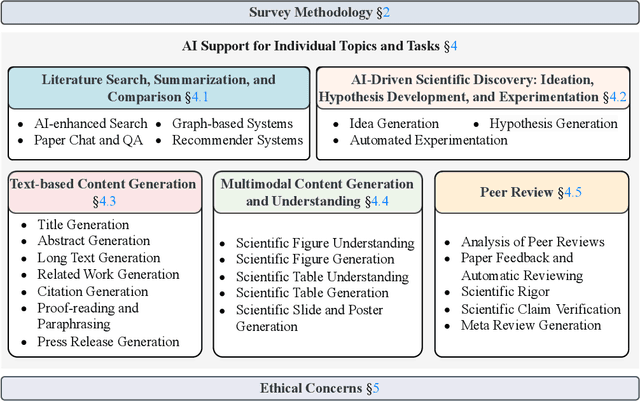
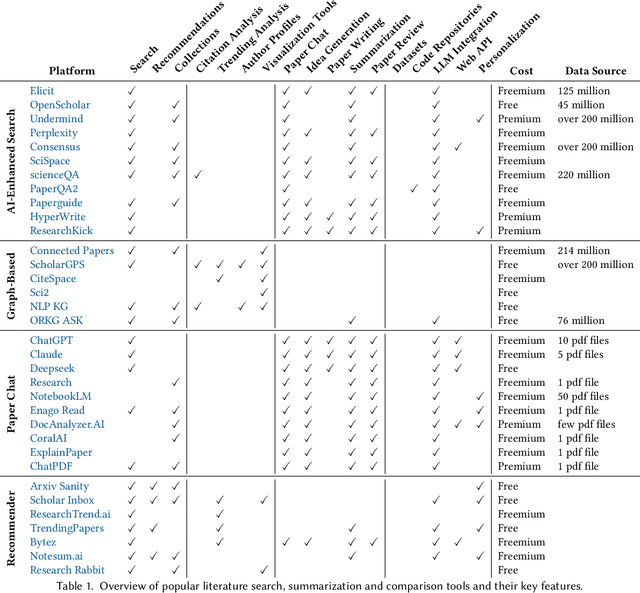
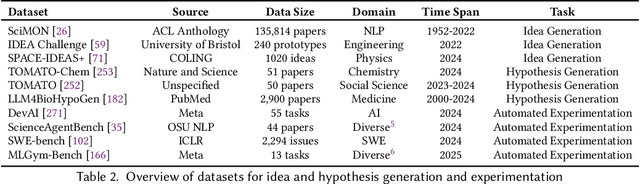
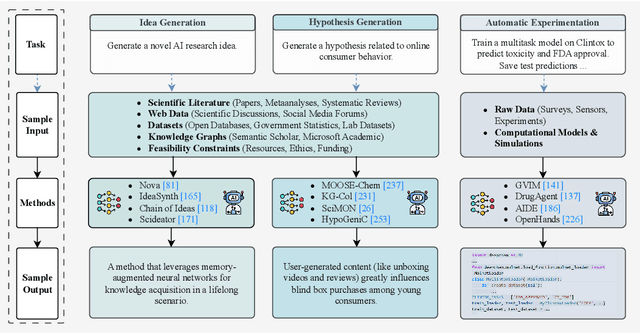
With the advent of large multimodal language models, science is now at a threshold of an AI-based technological transformation. Recently, a plethora of new AI models and tools has been proposed, promising to empower researchers and academics worldwide to conduct their research more effectively and efficiently. This includes all aspects of the research cycle, especially (1) searching for relevant literature; (2) generating research ideas and conducting experimentation; generating (3) text-based and (4) multimodal content (e.g., scientific figures and diagrams); and (5) AI-based automatic peer review. In this survey, we provide an in-depth overview over these exciting recent developments, which promise to fundamentally alter the scientific research process for good. Our survey covers the five aspects outlined above, indicating relevant datasets, methods and results (including evaluation) as well as limitations and scope for future research. Ethical concerns regarding shortcomings of these tools and potential for misuse (fake science, plagiarism, harms to research integrity) take a particularly prominent place in our discussion. We hope that our survey will not only become a reference guide for newcomers to the field but also a catalyst for new AI-based initiatives in the area of "AI4Science".