 Add to Chrome
 Add to Firefox
 Add to Edge
Beyond Reproduction: A Paired-Task Framework for Assessing LLM Comprehension and Creativity in Literary Translation
Apr 20, 2026
Large language models (LLMs) are increasingly used for creative tasks such as literary translation. Yet translational creativity remains underexplored and is rarely evaluated at scale, while source-text comprehension is typically studied in isolation, despite the fact that, in professional translation, comprehension and creativity are tightly intertwined. We address these gaps with a paired-task framework applied to literary excerpts from 11 books. Task 1 assesses source-text comprehension, and Task 2 evaluates translational creativity through Units of Creative Potential (UCPs), such as metaphors and wordplay. Using a scalable evaluation setup that combines expert human annotations with UCP-based automatic scoring, we benchmark 23 models and four creativity-oriented prompts. Our findings show that strong comprehension does not translate into human-level creativity: models often produce literal or contextually inappropriate renderings, with particularly large gaps for the more distant English-Chinese language pair. Creativity-oriented prompts yield only modest gains, and only one model, Mistral-Large, comes close to human-level creativity (0.167 vs. 0.246). Across all model-prompt combinations, only three exceed a creativity score of 0.1, while the rest remain at or near zero.

LiTransProQA: an LLM-based Literary Translation evaluation metric with Professional Question Answering
May 09, 2025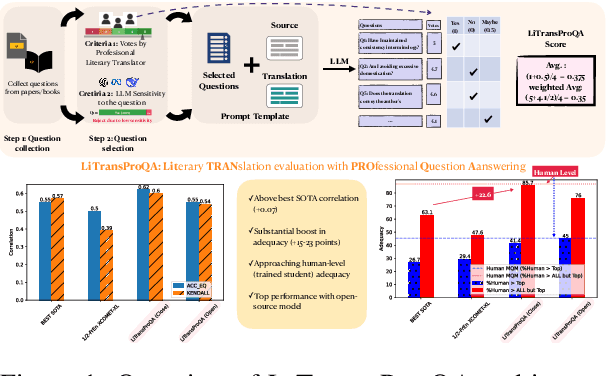
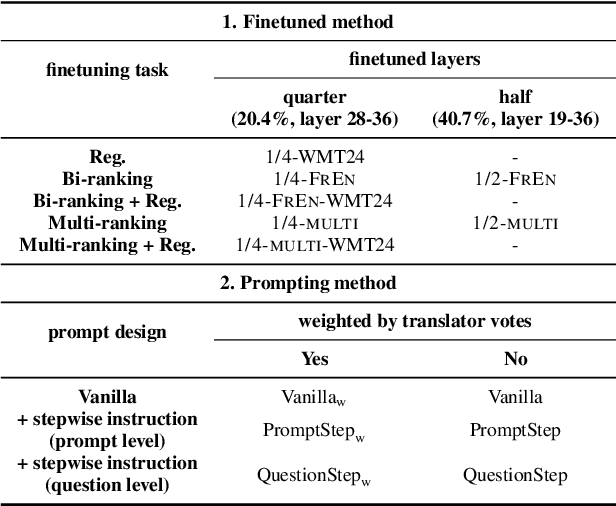
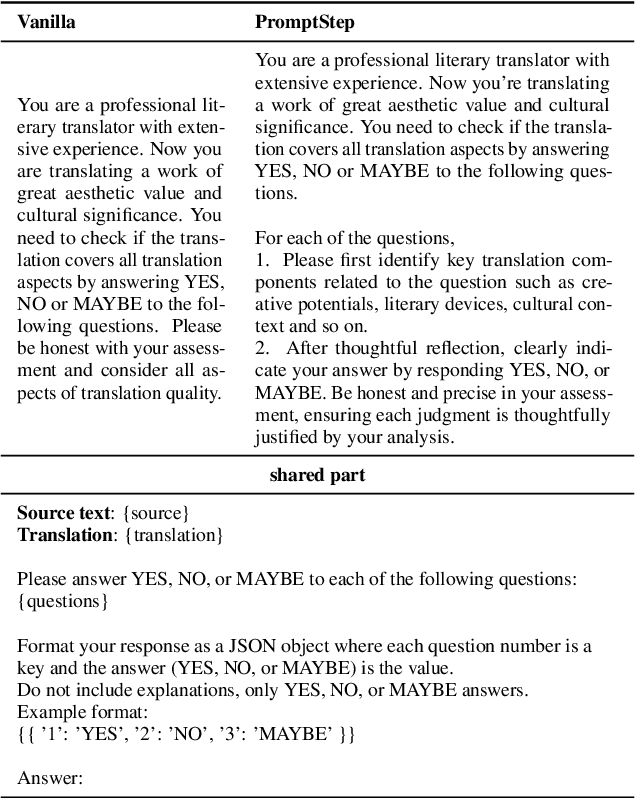
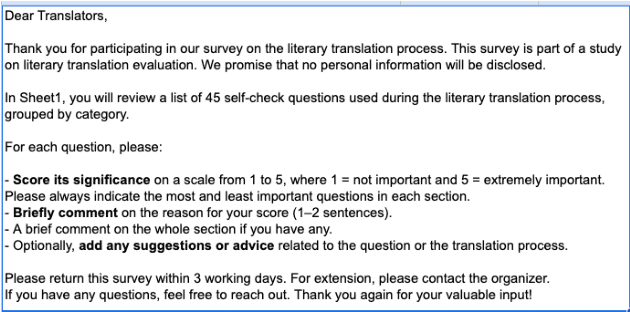
The impact of Large Language Models (LLMs) has extended into literary domains. However, existing evaluation metrics prioritize mechanical accuracy over artistic expression and tend to overrate machine translation (MT) as being superior to experienced professional human translation. In the long run, this bias could result in a permanent decline in translation quality and cultural authenticity. In response to the urgent need for a specialized literary evaluation metric, we introduce LiTransProQA, a novel, reference-free, LLM-based question-answering framework designed specifically for literary translation evaluation. LiTransProQA uniquely integrates insights from professional literary translators and researchers, focusing on critical elements in literary quality assessment such as literary devices, cultural understanding, and authorial voice. Our extensive evaluation shows that while literary-finetuned XCOMET-XL yields marginal gains, LiTransProQA substantially outperforms current metrics, achieving up to 0.07 gain in correlation (ACC-EQ and Kendall's tau) and surpassing the best state-of-the-art metrics by over 15 points in adequacy assessments. Incorporating professional translator insights as weights further improves performance, highlighting the value of translator inputs. Notably, LiTransProQA approaches human-level evaluation performance comparable to trained linguistic annotators. It demonstrates broad applicability to open-source models such as LLaMA3.3-70b and Qwen2.5-32b, indicating its potential as an accessible and training-free literary evaluation metric and a valuable tool for evaluating texts that require local processing due to copyright or ethical considerations.
TransProQA: an LLM-based literary Translation evaluation metric with Professional Question Answering
May 08, 2025The impact of Large Language Models (LLMs) has extended into literary domains. However, existing evaluation metrics prioritize mechanical accuracy over artistic expression and tend to overrate machine translation (MT) as being superior to experienced professional human translation. In the long run, this bias could result in a permanent decline in translation quality and cultural authenticity. In response to the urgent need for a specialized literary evaluation metric, we introduce TransProQA, a novel, reference-free, LLM-based question-answering (QA) framework designed specifically for literary translation evaluation. TransProQA uniquely integrates insights from professional literary translators and researchers, focusing on critical elements in literary quality assessment such as literary devices, cultural understanding, and authorial voice. Our extensive evaluation shows that while literary-finetuned XCOMET-XL yields marginal gains, TransProQA substantially outperforms current metrics, achieving up to 0.07 gain in correlation (ACC-EQ and Kendall's tau) and surpassing the best state-of-the-art (SOTA) metrics by over 15 points in adequacy assessments. Incorporating professional translator insights as weights further improves performance, highlighting the value of translator inputs. Notably, TransProQA approaches human-level evaluation performance comparable to trained linguistic annotators. It demonstrates broad applicability to open-source models such as LLaMA3.3-70b and Qwen2.5-32b, indicating its potential as an accessible and training-free literary evaluation metric and a valuable tool for evaluating texts that require local processing due to copyright or ethical considerations.