 Add to Chrome
 Add to Firefox
 Add to Edge
Hide to Guide: Learning via Semantic Masking
May 24, 2026
Reinforcement learning with verifiable rewards (RLVR) has become a powerful paradigm for improving language models on reasoning-intensive tasks, but its effectiveness is often limited by exploration. For example, models often fail on hard problems, leaving little useful reward signal. External expert traces offer a natural source of guidance, yet they may also expose reward-relevant content along the critical path to the verifier target, such as final answers, intermediate values, executable implementations, or answer-related entities. This content can create an unintended reward hacking channel, allowing the policy to obtain reward by copying the trace rather than learning the underlying reasoning or agentic behavior. Existing guided-RL methods reduce this risk by using partial trajectories, but they mainly control how much expert information is shown heuristically rather than which parts should be hidden. To this end, we propose Semantic Masked Expert Policy Optimization (SMEPO), a fine-grained semantic masking strategy for expert-guided RLVR. Instead of truncating traces coarsely or revealing them unchanged, SMEPO masks reward-relevant semantic spans along the critical path while preserving the expert's decomposition, plan, and procedural structure. This turns hard problems from reasoning from scratch into a fill-in-the-blank process: the policy can follow the expert's problem-solving route, but must still reconstruct the missing values, code, or entities by itself. SMEPO is simple to apply and requires no changes to the reward function or RL objective. Across diverse domains, including math, code, and agentic search, SMEPO improves accuracy by up to 3.2 points over GRPO and reduces training time by up to 4.2x. The code is available at https://github.com/mit-han-lab/SMEPO.

ForeAct: Steering Your VLA with Efficient Visual Foresight Planning
Feb 12, 2026Vision-Language-Action (VLA) models convert high-level language instructions into concrete, executable actions, a task that is especially challenging in open-world environments. We present Visual Foresight Planning (ForeAct), a general and efficient planner that guides a VLA step-by-step using imagined future observations and subtask descriptions. With an imagined future observation, the VLA can focus on visuo-motor inference rather than high-level semantic reasoning, leading to improved accuracy and generalization. Our planner comprises a highly efficient foresight image generation module that predicts a high-quality 640$\times$480 future observation from the current visual input and language instruction within only 0.33s on an H100 GPU, together with a vision-language model that reasons over the task and produces subtask descriptions for both the generator and the VLA. Importantly, state-of-the-art VLAs can integrate our planner seamlessly by simply augmenting their visual inputs, without any architectural modification. The foresight generator is pretrained on over 1 million multi-task, cross-embodiment episodes, enabling it to learn robust embodied dynamics. We evaluate our framework on a benchmark that consists of 11 diverse, multi-step real-world tasks. It achieves an average success rate of 87.4%, demonstrating a +40.9% absolute improvement over the $π_0$ baseline (46.5%) and a +30.3% absolute improvement over $π_0$ augmented with textual subtask guidance (57.1%).
Locality-aware Parallel Decoding for Efficient Autoregressive Image Generation
Jul 02, 2025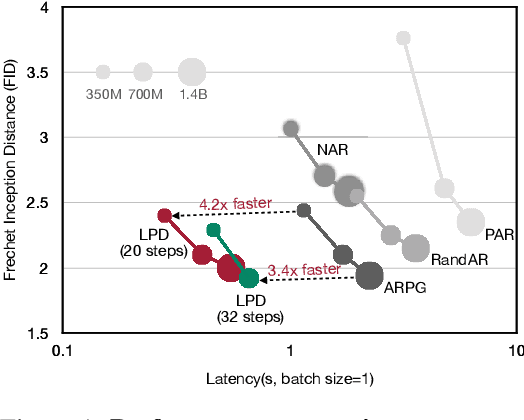
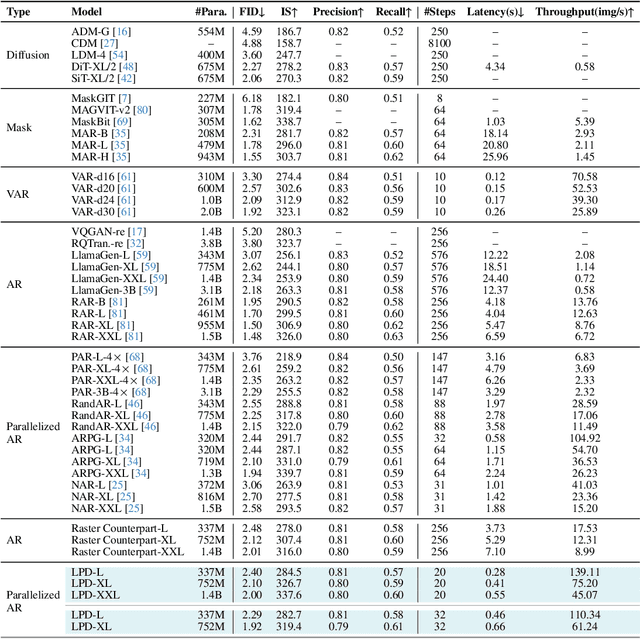
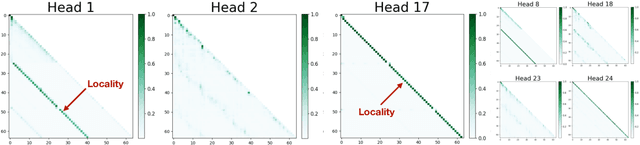
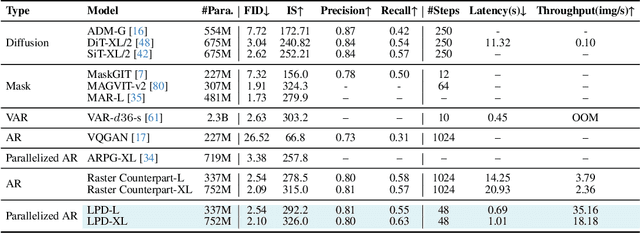
We present Locality-aware Parallel Decoding (LPD) to accelerate autoregressive image generation. Traditional autoregressive image generation relies on next-patch prediction, a memory-bound process that leads to high latency. Existing works have tried to parallelize next-patch prediction by shifting to multi-patch prediction to accelerate the process, but only achieved limited parallelization. To achieve high parallelization while maintaining generation quality, we introduce two key techniques: (1) Flexible Parallelized Autoregressive Modeling, a novel architecture that enables arbitrary generation ordering and degrees of parallelization. It uses learnable position query tokens to guide generation at target positions while ensuring mutual visibility among concurrently generated tokens for consistent parallel decoding. (2) Locality-aware Generation Ordering, a novel schedule that forms groups to minimize intra-group dependencies and maximize contextual support, enhancing generation quality. With these designs, we reduce the generation steps from 256 to 20 (256$\times$256 res.) and 1024 to 48 (512$\times$512 res.) without compromising quality on the ImageNet class-conditional generation, and achieving at least 3.4$\times$ lower latency than previous parallelized autoregressive models.