 Add to Chrome
 Add to Firefox
 Add to Edge
BiSCo-LLM: Lookup-Free Binary Spherical Coding for Extreme Low-Bit Large Language Model Compression
Jul 09, 2026
Large language models (LLMs) are increasingly constrained by memory capacity, weight bandwidth, and checkpoint storage during deployment. Existing low-bit compression methods mainly follow two directions. Scalar or group-wise quantization is simple and compatible with efficient low-precision kernels, but its representation capacity becomes limited when the target budget approaches 2 bits per weight. Vector-quantized weight compression provides a richer block-level representation, but usually introduces explicit codebooks, index lookup, and additional storage accounting. This paper presents BiSCo-LLM, a codebook-free binary spherical coding framework for extreme low-bit LLM weight compression. The core pipeline is built on three components. First, local weight chunks are mapped onto a unit hypersphere and binarized into compact spherical codes, so that the main payload is a bit-packed sign stream rather than explicit VQ centroids. Second, a residual BSQ stage encodes the reconstruction error left by the base spherical codec, providing an explicit rate-distortion path without stored codebooks. Third, category-wise recovery distillation is performed after replacing each Transformer module category, reducing the mismatch between local weight reconstruction and assembled model behavior. A small 8-bit protected-channel path is used as an auxiliary stabilization mechanism for sensitive channels and is counted separately from the BSQ payload. The reported storage budget includes binary codes, neural decoders, protected-channel payloads, LoRA adapters, and metadata.

MODE: Modality-Decomposed Expert-Level Mixed-Precision Quantization for MoE Multimodal LLMs
Jun 15, 2026Mixture-of-Experts Multimodal Large Language Models (MoE-MLLMs) offer remarkable performance but incur prohibitive GPU memory costs, making compression essential. Among PTQ methods, expert-level mixed-precision quantization has proven effective for MoE-LLMs, yet suffers notable degradation on MoE-MLLMs due to two overlooked biases in expert importance estimation. (1) At the cross-modal level, the numerical dominance of vision tokens causes expert selection frequency to be dominated by vision tokens, masking experts that are critical to the text modality; (2) at the intra-vision level, the large proportion of redundant vision tokens further skew frequency statistics, obscuring experts critical for informative visual content. To bridge gaps, we propose MODE, a modality-decomposed expert-level mixed-precision quantization framework for MoE-MLLMs that decomposes expert selection frequency by modality, filters redundant vision tokens to obtain denoised visual frequency, and further evaluates quantization sensitivity per modality as a complementary signal to frequency-based estimation. These signals are integrated into an Integer Linear Programming formulation to assign per-expert bit-widths under a given budget. Extensive experiments show that MODE is particularly well-suited for MoE-MLLMs, limiting average performance loss to within 2.9% at W3A16, with larger gains at the extreme 2-bit setting.
IntraSlice: Towards High-Performance Structural Pruning with Block-Intra PCA for LLMs
Feb 02, 2026Large Language Models (LLMs) achieve strong performance across diverse tasks but face deployment challenges due to their massive size. Structured pruning offers acceleration benefits but leads to significant performance degradation. Recent PCA-based pruning methods have alleviated this issue by retaining key activation components, but are only applied between modules in order to fuse the transformation matrix, which introduces extra parameters and severely disrupts activation distributions due to residual connections. To address these issues, we propose IntraSlice, a framework that applies block-wise module-intra PCA compression pruning. By leveraging the structural characteristics of Transformer modules, we design an approximate PCA method whose transformation matrices can be fully fused into the model without additional parameters. We also introduce a PCA-based global pruning ratio estimator that further considers the distribution of compressed activations, building on conventional module importance. We validate our method on Llama2, Llama3, and Phi series across various language benchmarks. Experimental results demonstrate that our approach achieves superior compression performance compared to recent baselines at the same compression ratio or inference speed.
Certain Head, Uncertain Tail: Expert-Sample for Test-Time Scaling in Fine-Grained MoE
Feb 02, 2026Test-time scaling improves LLM performance by generating multiple candidate solutions, yet token-level sampling requires temperature tuning that trades off diversity against stability. Fine-grained MoE, featuring hundreds of well-trained experts per layer and multi-expert activation per token, offers an unexplored alternative through its rich routing space. We empirically characterize fine-grained MoE routing and uncover an informative pattern: router scores exhibit a certain head of high-confidence experts followed by an uncertain tail of low-confidence candidates. While single-run greedy accuracy remains stable when fewer experts are activated, multi-sample pass@n degrades significantly-suggesting that the certain head governs core reasoning capability while the uncertain tail correlates with reasoning diversity. Motivated by these findings, we propose Expert-Sample, a training-free method that preserves high-confidence selections while injecting controlled stochasticity into the uncertain tail, enabling diverse generation without destabilizing outputs. Evaluated on multiple fine-grained MoE models across math, knowledge reasoning, and code tasks, Expert-Sample consistently improves pass@n and verification-based accuracy. On Qwen3-30B-A3B-Instruct evaluated on GPQA-Diamond with 32 parallel samples, pass@32 rises from 85.4% to 91.9%, and accuracy improves from 59.1% to 62.6% with Best-of-N verification.
Block Rotation is All You Need for MXFP4 Quantization
Nov 06, 2025Large language models (LLMs) have achieved remarkable success, but their rapidly growing scale imposes prohibitive costs in memory, computation, and energy. Post-training quantization (PTQ) is a promising solution for efficient deployment, yet achieving accurate W4A4 quantization remains an open challenge. While most existing methods are designed for INT4 formats, the emergence of MXFP4 -- a new FP4 format with various hardware support (NVIDIA, AMD, Intel)-- raises questions about the applicability of current techniques. In this work, we establish a comprehensive benchmark of PTQ methods under the MXFP4 format. Through systematic evaluation, we find that methods like GPTQ consistently deliver strong performance, whereas rotation-based approaches, which are almost used by all state-of-the-art approaches, suffer from severe incompatibility with MXFP4. We further provide the first in-depth analysis of this conflict, tracing its root to a fundamental mismatch between MXFP4's PoT (power-of-two) block scaling and the redistribution of outlier energy via global rotation. Building on this insight, we propose a simple yet effective block rotation strategy that adapts rotation-based methods to MXFP4, leading to substantial accuracy improvements across diverse LLMs. Our findings not only offer clear guidance for practitioners but also set a foundation for advancing PTQ research under emerging low-precision formats.
DartQuant: Efficient Rotational Distribution Calibration for LLM Quantization
Nov 06, 2025Quantization plays a crucial role in accelerating the inference of large-scale models, and rotational matrices have been shown to effectively improve quantization performance by smoothing outliers. However, end-to-end fine-tuning of rotational optimization algorithms incurs high computational costs and is prone to overfitting. To address this challenge, we propose an efficient distribution-aware rotational calibration method, DartQuant, which reduces the complexity of rotational optimization by constraining the distribution of the activations after rotation. This approach also effectively reduces reliance on task-specific losses, thereby mitigating the risk of overfitting. Additionally, we introduce the QR-Orth optimization scheme, which replaces expensive alternating optimization with a more efficient solution. In a variety of model quantization experiments, DartQuant demonstrates superior performance. Compared to existing methods, it achieves 47$\times$ acceleration and 10$\times$ memory savings for rotational optimization on a 70B model. Furthermore, it is the first to successfully complete rotational calibration for a 70B model on a single 3090 GPU, making quantization of large language models feasible in resource-constrained environments. Code is available at https://github.com/CAS-CLab/DartQuant.git.
A Conditional Denoising Diffusion Probabilistic Model for Point Cloud Upsampling
Dec 03, 2023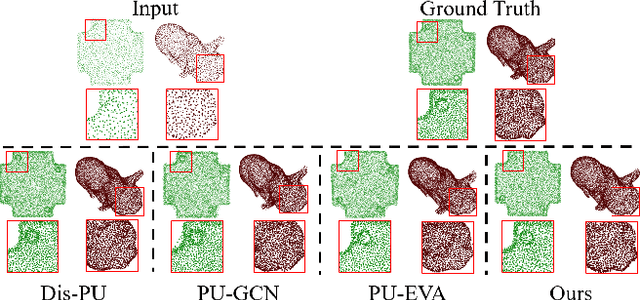
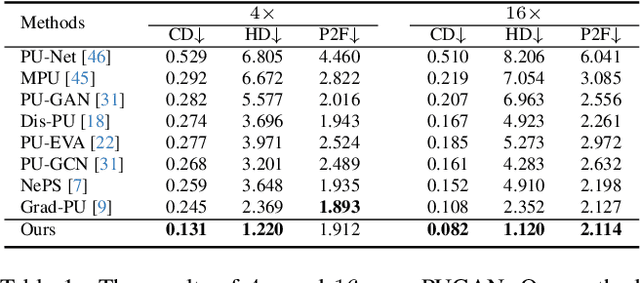
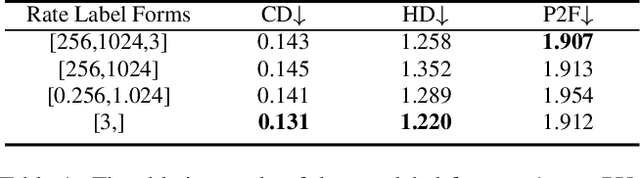

Point cloud upsampling (PCU) enriches the representation of raw point clouds, significantly improving the performance in downstream tasks such as classification and reconstruction. Most of the existing point cloud upsampling methods focus on sparse point cloud feature extraction and upsampling module design. In a different way, we dive deeper into directly modelling the gradient of data distribution from dense point clouds. In this paper, we proposed a conditional denoising diffusion probability model (DDPM) for point cloud upsampling, called PUDM. Specifically, PUDM treats the sparse point cloud as a condition, and iteratively learns the transformation relationship between the dense point cloud and the noise. Simultaneously, PUDM aligns with a dual mapping paradigm to further improve the discernment of point features. In this context, PUDM enables learning complex geometry details in the ground truth through the dominant features, while avoiding an additional upsampling module design. Furthermore, to generate high-quality arbitrary-scale point clouds during inference, PUDM exploits the prior knowledge of the scale between sparse point clouds and dense point clouds during training by parameterizing a rate factor. Moreover, PUDM exhibits strong noise robustness in experimental results. In the quantitative and qualitative evaluations on PU1K and PUGAN, PUDM significantly outperformed existing methods in terms of Chamfer Distance (CD) and Hausdorff Distance (HD), achieving state of the art (SOTA) performance.