 Add to Chrome
 Add to Firefox
 Add to Edge
Towards Deep Learning Models Resistant to Transfer-based Adversarial Attacks via Data-centric Robust Learning
Oct 15, 2023
Transfer-based adversarial attacks raise a severe threat to real-world deep learning systems since they do not require access to target models. Adversarial training (AT), which is recognized as the strongest defense against white-box attacks, has also guaranteed high robustness to (black-box) transfer-based attacks. However, AT suffers from heavy computational overhead since it optimizes the adversarial examples during the whole training process. In this paper, we demonstrate that such heavy optimization is not necessary for AT against transfer-based attacks. Instead, a one-shot adversarial augmentation prior to training is sufficient, and we name this new defense paradigm Data-centric Robust Learning (DRL). Our experimental results show that DRL outperforms widely-used AT techniques (e.g., PGD-AT, TRADES, EAT, and FAT) in terms of black-box robustness and even surpasses the top-1 defense on RobustBench when combined with diverse data augmentations and loss regularizations. We also identify other benefits of DRL, for instance, the model generalization capability and robust fairness.

Multi-Modal Knowledge Graph Transformer Framework for Multi-Modal Entity Alignment
Oct 10, 2023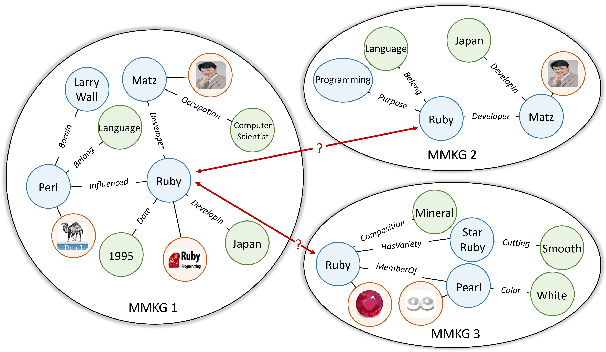
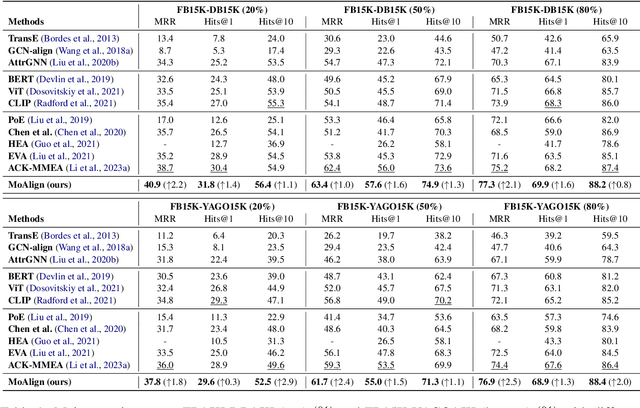
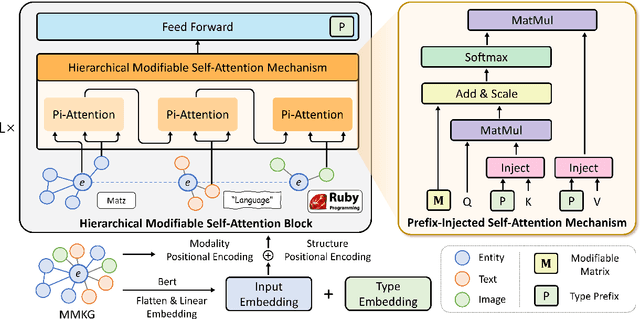
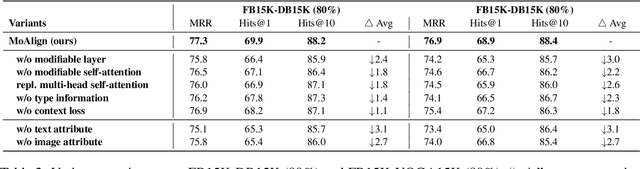
Multi-Modal Entity Alignment (MMEA) is a critical task that aims to identify equivalent entity pairs across multi-modal knowledge graphs (MMKGs). However, this task faces challenges due to the presence of different types of information, including neighboring entities, multi-modal attributes, and entity types. Directly incorporating the above information (e.g., concatenation or attention) can lead to an unaligned information space. To address these challenges, we propose a novel MMEA transformer, called MoAlign, that hierarchically introduces neighbor features, multi-modal attributes, and entity types to enhance the alignment task. Taking advantage of the transformer's ability to better integrate multiple information, we design a hierarchical modifiable self-attention block in a transformer encoder to preserve the unique semantics of different information. Furthermore, we design two entity-type prefix injection methods to integrate entity-type information using type prefixes, which help to restrict the global information of entities not present in the MMKGs. Our extensive experiments on benchmark datasets demonstrate that our approach outperforms strong competitors and achieves excellent entity alignment performance.
Exploiting Facial Relationships and Feature Aggregation for Multi-Face Forgery Detection
Oct 07, 2023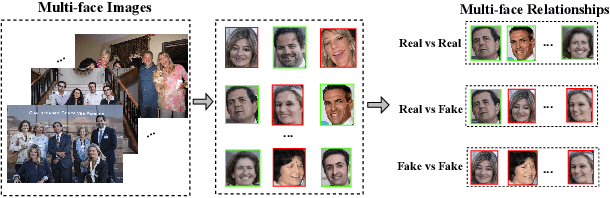
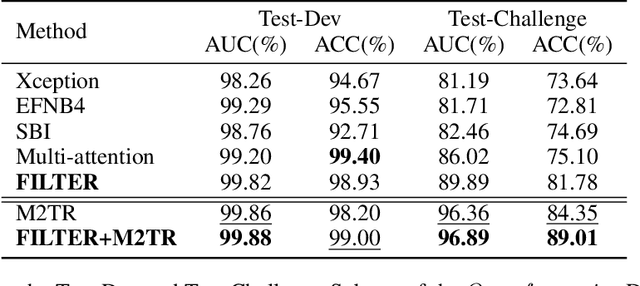
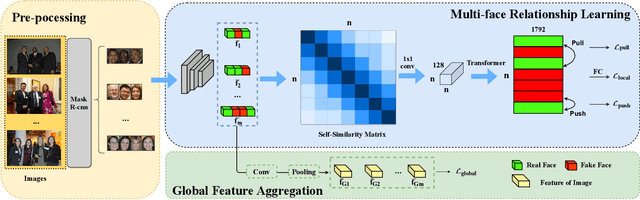
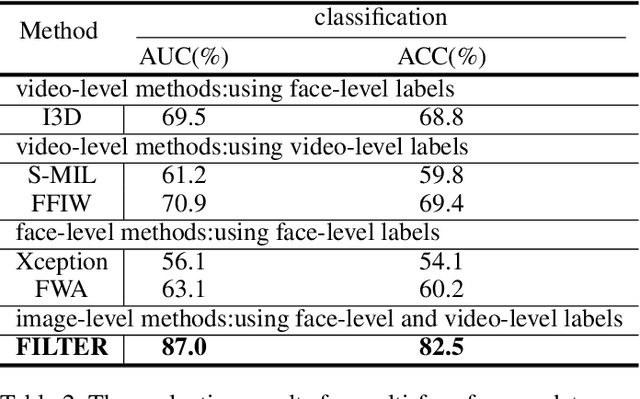
Face forgery techniques have emerged as a forefront concern, and numerous detection approaches have been proposed to address this challenge. However, existing methods predominantly concentrate on single-face manipulation detection, leaving the more intricate and realistic realm of multi-face forgeries relatively unexplored. This paper proposes a novel framework explicitly tailored for multi-face forgery detection,filling a critical gap in the current research. The framework mainly involves two modules:(i) a facial relationships learning module, which generates distinguishable local features for each face within images,(ii) a global feature aggregation module that leverages the mutual constraints between global and local information to enhance forgery detection accuracy.Our experimental results on two publicly available multi-face forgery datasets demonstrate that the proposed approach achieves state-of-the-art performance in multi-face forgery detection scenarios.
Incorporating Neuro-Inspired Adaptability for Continual Learning in Artificial Intelligence
Aug 29, 2023
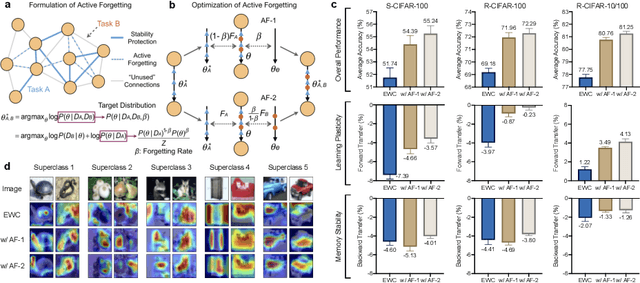

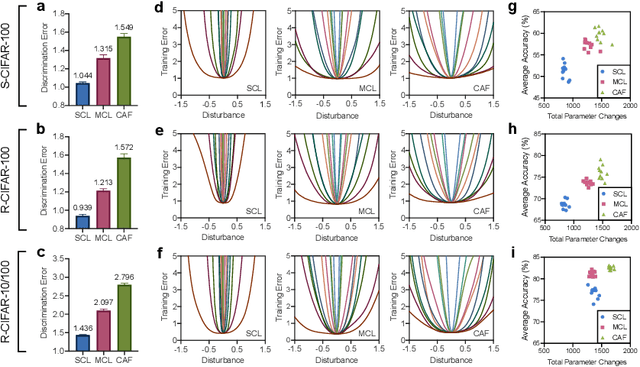
Continual learning aims to empower artificial intelligence (AI) with strong adaptability to the real world. For this purpose, a desirable solution should properly balance memory stability with learning plasticity, and acquire sufficient compatibility to capture the observed distributions. Existing advances mainly focus on preserving memory stability to overcome catastrophic forgetting, but remain difficult to flexibly accommodate incremental changes as biological intelligence (BI) does. By modeling a robust Drosophila learning system that actively regulates forgetting with multiple learning modules, here we propose a generic approach that appropriately attenuates old memories in parameter distributions to improve learning plasticity, and accordingly coordinates a multi-learner architecture to ensure solution compatibility. Through extensive theoretical and empirical validation, our approach not only clearly enhances the performance of continual learning, especially over synaptic regularization methods in task-incremental settings, but also potentially advances the understanding of neurological adaptive mechanisms, serving as a novel paradigm to progress AI and BI together.
Privileged Anatomical and Protocol Discrimination in Trackerless 3D Ultrasound Reconstruction
Aug 20, 2023Three-dimensional (3D) freehand ultrasound (US) reconstruction without using any additional external tracking device has seen recent advances with deep neural networks (DNNs). In this paper, we first investigated two identified contributing factors of the learned inter-frame correlation that enable the DNN-based reconstruction: anatomy and protocol. We propose to incorporate the ability to represent these two factors - readily available during training - as the privileged information to improve existing DNN-based methods. This is implemented in a new multi-task method, where the anatomical and protocol discrimination are used as auxiliary tasks. We further develop a differentiable network architecture to optimise the branching location of these auxiliary tasks, which controls the ratio between shared and task-specific network parameters, for maximising the benefits from the two auxiliary tasks. Experimental results, on a dataset with 38 forearms of 19 volunteers acquired with 6 different scanning protocols, show that 1) both anatomical and protocol variances are enabling factors for DNN-based US reconstruction; 2) learning how to discriminate different subjects (anatomical variance) and predefined types of scanning paths (protocol variance) both significantly improve frame prediction accuracy, volume reconstruction overlap, accumulated tracking error and final drift, using the proposed algorithm.
Hard Adversarial Example Mining for Improving Robust Fairness
Aug 03, 2023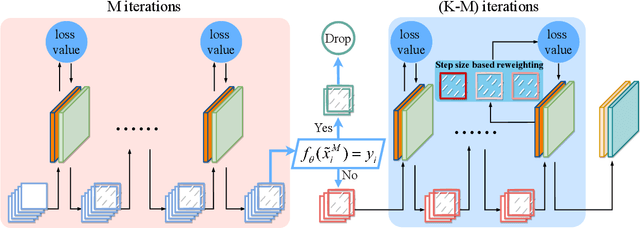
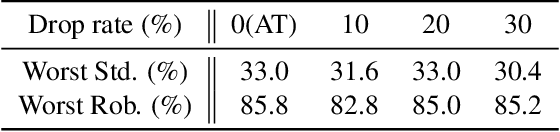
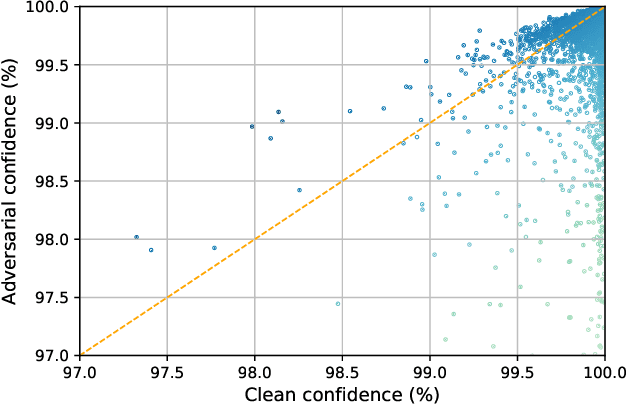
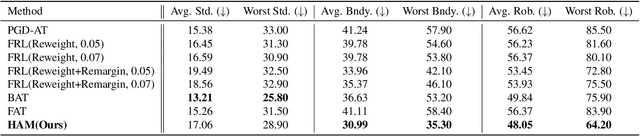
Adversarial training (AT) is widely considered the state-of-the-art technique for improving the robustness of deep neural networks (DNNs) against adversarial examples (AE). Nevertheless, recent studies have revealed that adversarially trained models are prone to unfairness problems, restricting their applicability. In this paper, we empirically observe that this limitation may be attributed to serious adversarial confidence overfitting, i.e., certain adversarial examples with overconfidence. To alleviate this problem, we propose HAM, a straightforward yet effective framework via adaptive Hard Adversarial example Mining.HAM concentrates on mining hard adversarial examples while discarding the easy ones in an adaptive fashion. Specifically, HAM identifies hard AEs in terms of their step sizes needed to cross the decision boundary when calculating loss value. Besides, an early-dropping mechanism is incorporated to discard the easy examples at the initial stages of AE generation, resulting in efficient AT. Extensive experimental results on CIFAR-10, SVHN, and Imagenette demonstrate that HAM achieves significant improvement in robust fairness while reducing computational cost compared to several state-of-the-art adversarial training methods. The code will be made publicly available.
Counterfactual Explanation for Fairness in Recommendation
Jul 10, 2023Fairness-aware recommendation eliminates discrimination issues to build trustworthy recommendation systems.Explaining the causes of unfair recommendations is critical, as it promotes fairness diagnostics, and thus secures users' trust in recommendation models. Existing fairness explanation methods suffer high computation burdens due to the large-scale search space and the greedy nature of the explanation search process. Besides, they perform score-based optimizations with continuous values, which are not applicable to discrete attributes such as gender and race. In this work, we adopt the novel paradigm of counterfactual explanation from causal inference to explore how minimal alterations in explanations change model fairness, to abandon the greedy search for explanations. We use real-world attributes from Heterogeneous Information Networks (HINs) to empower counterfactual reasoning on discrete attributes. We propose a novel Counterfactual Explanation for Fairness (CFairER) that generates attribute-level counterfactual explanations from HINs for recommendation fairness. Our CFairER conducts off-policy reinforcement learning to seek high-quality counterfactual explanations, with an attentive action pruning reducing the search space of candidate counterfactuals. The counterfactual explanations help to provide rational and proximate explanations for model fairness, while the attentive action pruning narrows the search space of attributes. Extensive experiments demonstrate our proposed model can generate faithful explanations while maintaining favorable recommendation performance.
Exploring Antitrust and Platform Power in Generative AI
Jul 10, 2023The concentration of power in a few digital technology companies has become a subject of increasing interest in both academic and non-academic discussions. One of the most noteworthy contributions to the debate is Lina Khan's Amazon's Antitrust Paradox. In this work, Khan contends that Amazon has systematically exerted its dominance in online retail to eliminate competitors and subsequently charge above-market prices. This work contributed to Khan's appointment as the chair of the US Federal Trade Commission (FTC), one of the most influential antitrust organisations. Today, several ongoing antitrust lawsuits in the US and Europe involve major technology companies like Apple, Google/Alphabet, and Facebook/Meta. In the realm of generative AI, we are once again witnessing the same companies taking the lead in technological advancements, leaving little room for others to compete. This article examines the market dominance of these corporations in the technology stack behind generative AI from an antitrust law perspective.
Causal Neural Graph Collaborative Filtering
Jul 10, 2023

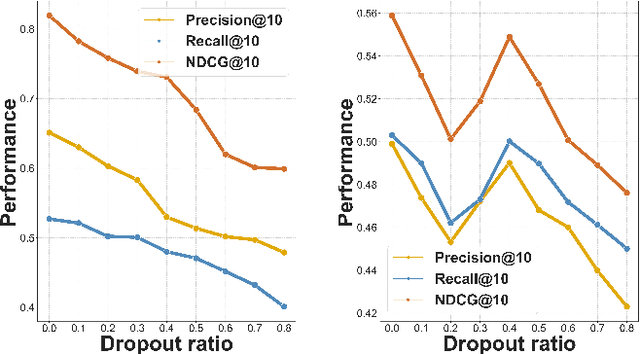
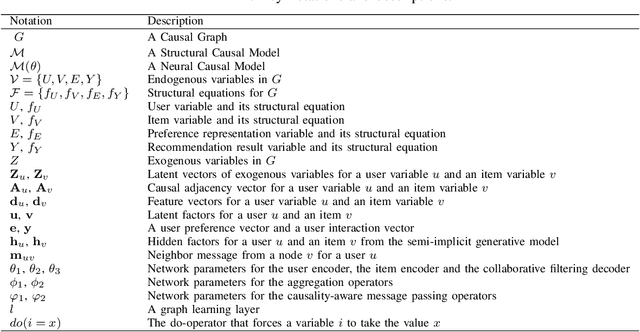
Graph collaborative filtering (GCF) has gained considerable attention in recommendation systems by leveraging graph learning techniques to enhance collaborative filtering (CF) models. One classical approach in GCF is to learn user and item embeddings by modeling complex graph relations and utilizing these embeddings for CF models. However, the quality of the embeddings significantly impacts the recommendation performance of GCF models. In this paper, we argue that existing graph learning methods are insufficient in generating satisfactory embeddings for CF models. This is because they aggregate neighboring node messages directly, which can result in incorrect estimations of user-item correlations. To overcome this limitation, we propose a novel approach that incorporates causal modeling to explicitly encode the causal effects of neighboring nodes on the target node. This approach enables us to identify spurious correlations and uncover the root causes of user preferences. We introduce Causal Neural Graph Collaborative Filtering (CNGCF), the first causality-aware graph learning framework for CF. CNGCF integrates causal modeling into the graph representation learning process, explicitly coupling causal effects between node pairs into the core message-passing process of graph learning. As a result, CNGCF yields causality-aware embeddings that promote robust recommendations. Our extensive experiments demonstrate that CNGCF provides precise recommendations that align with user preferences. Therefore, our proposed framework can address the limitations of existing GCF models and offer a more effective solution for recommendation systems.
BPNet: Bézier Primitive Segmentation on 3D Point Clouds
Jul 08, 2023This paper proposes BPNet, a novel end-to-end deep learning framework to learn B\'ezier primitive segmentation on 3D point clouds. The existing works treat different primitive types separately, thus limiting them to finite shape categories. To address this issue, we seek a generalized primitive segmentation on point clouds. Taking inspiration from B\'ezier decomposition on NURBS models, we transfer it to guide point cloud segmentation casting off primitive types. A joint optimization framework is proposed to learn B\'ezier primitive segmentation and geometric fitting simultaneously on a cascaded architecture. Specifically, we introduce a soft voting regularizer to improve primitive segmentation and propose an auto-weight embedding module to cluster point features, making the network more robust and generic. We also introduce a reconstruction module where we successfully process multiple CAD models with different primitives simultaneously. We conducted extensive experiments on the synthetic ABC dataset and real-scan datasets to validate and compare our approach with different baseline methods. Experiments show superior performance over previous work in terms of segmentation, with a substantially faster inference speed.