 Add to Chrome
 Add to Firefox
 Add to Edge
Bayesian adaptively-weighted ensembles for few-shot abdominal segmentation
Aug 06, 2026
Few-shot learning has emerged as a promising approach for anatomical segmentation when labelled data are scarce. However, different few-shot learning algorithms exhibit complementary strengths and weaknesses, with performance varying across anatomical targets and institutions. Existing few-shot segmentation ensembles, that combine predictions from multiple algorithms, typically employ fixed weighting schemes and therefore cannot adjust model contributions according to the target domain. In this work, we propose a Bayesian adaptively-weighted ensemble framework for segmentation under label scarcity and domain shift. Multiple few-shot segmentation algorithms are first adapted using a small labelled support set. Bayesian optimisation is then used to automatically identify ensemble weights that maximise segmentation performance on a target-domain validation set. The learned weights are subsequently fixed and applied to combine predictions on previously unseen query images from the target domain. The proposed framework is evaluated on the Cross-institution Male Pelvic Structures dataset using held-out anatomical structures and institutions to simulate simultaneous label scarcity and institutional domain shift. Results demonstrate statistically significant improvements over individual few-shot learners, fixed-weight ensembles, training-from-scratch baselines and recent state-of-the-art ensembling approaches. By adapting model contributions to the target anatomy and institutional domain, the proposed framework provides a practical mechanism for deploying segmentation systems to new clinical sites under severe annotation constraints.

Active few-shot segmentation by reinforcing data selection
Jul 24, 2026Few-shot learning enables medical image segmentation models to adapt to new tasks using only a small number of labelled examples. However, adaptation performance depends strongly on which examples are selected for the support set. Effective support sets should capture relevant variation within the target domain and be informative for adaptation, with constituent samples providing complementary information. Despite this, existing active data selection approaches largely prioritise samples individually and do not explicitly account for interactions between examples. In this work, we propose a reinforcement learning framework for support-set selection in few-shot medical image segmentation, enabling support sets to be optimised jointly rather than through independent sample scoring. Given a pool of unlabelled candidate images, an agent directly predicts a support set that maximises downstream segmentation performance. Experiments on a cross-institutional pelvic MRI dataset demonstrate improvements over random selection and current state-of-the-art methods. Our findings highlight the importance of support-set complementarity for effective adaptation and demonstrate the potential of reinforcement learning for optimising adaptation sets.
Interpretable Probabilistic Medical Image Segmentation via Gaussian Process with Explicit Modelling of Annotation Bias and Variability
Jun 22, 2026Deep learning-based medical image segmentation models are trained using annotations that exhibit systematic bias and variability across raters. While probabilistic multi-rater approaches can emulate annotator-specific delineations, annotator characteristics are typically encoded implicitly in deep latent feature space, making direct analysis of their influence on predictive distributions less straightforward. We propose a logit-space probabilistic segmentation framework based on stochastic variational Gaussian Process that explicitly decomposes predictions into an image-dependent reference logit distribution and annotator specific perturbations parameterised by bias and variance. This formulation enables more explicit analysis on how intra- and inter-rater variability propagate to predictive distributions. We evaluate the method on a multi-annotator medical image dataset, which shows that explicitly modelling annotator specific perturbations improves uncertainty calibration while maintaining comparable segmentation accuracy, compared with state-of-the-art multi-rater probabilistic segmentation method. The learned bias and variance parameters quantitatively reflect annotator-specific behaviour. Furthermore, controlled perturbation experiments over bias and variance demonstrate how changes in annotator parameters systematically influence predictive performance. The code used in this paper is made publicly available at https://github.com/QiLi111/GPS-Var.
CT-Guided Spatially-varying Regularization for Voxel-Wise Deformable Whole-Body PET Registration
Apr 24, 2026Whole-body Positron Emission Tomography (PET) registration is essential for multi-parametric tumor characterization and assessment of metastatic disease progression. In deep learning-based deformable registration, the dense displacement field (DDF) regularizer is crucial for stabilizing optimization and preventing unrealistic deformations in large 3D volumes. A key challenge in whole-body deformable registration is anatomical heterogeneity, rigid structures (e.g., bones) should undergo stronger regularization, whereas soft tissues require more flexible deformation and weaker constraints. In this work, we propose a simple yet effective CT-guided spatially-varying regularization strategy for whole-body cross-tracer deformable PET registration. The key idea is to use the paired CT volume from the PET/CT acquisition to construct a voxel-wise regularization map for the DDF, replacing the conventional single global regularization weight. This yields anatomy-adaptive regularization strength across rigid and soft tissues. The proposed method is evaluated on a real clinical cross-tracer PET/CT dataset of 296 patients involving 18F-PSMA and 18F-FDG, showing that the proposed method achieves statistically significant improvements over weakly-supervised registration baseline in both whole-body registration performance and organ-wise alignment.
On the Degrees of Freedom of Gridded Control Points in Learning-Based Medical Image Registration
Mar 15, 2026Many registration problems are ill-posed in homogeneous or noisy regions, and dense voxel-wise decoders can be unnecessarily high-dimensional. A sparse control-point parameterisation provides a compact, smooth deformation representation while reducing memory and improving stability. This work investigates the required control points for learning-based registration network development. We present GridReg, a learning-based registration framework that replaces dense voxel-wise decoding with displacement predictions at a sparse grid of control points. This design substantially cuts the parameter count and memory while retaining registration accuracy. Multiscale 3D encoder feature maps are flattened into a 1D token sequence with positional encoding to retain spatial context. The model then predicts a sparse gridded deformation field using a cross-attention module. We further introduce grid-adaptive training, enabling an adaptive model to operate at multiple grid sizes at inference without retraining. This work quantitatively demonstrates the benefits of using sparse grids. Using three data sets for registering prostate gland, pelvic organs and neurological structures, the results suggested a significant improvement with the usage of grid-controled displacement field. Alternatively, the superior registration performance was obtained using the proposed approach, with a similar or less computational cost, compared with existing algorithms that predict DDFs or displacements sampled on scattered key points.
Orientation-Robust Latent Motion Trajectory Learning for Annotation-free Cardiac Phase Detection in Fetal Echocardiography
Feb 06, 2026Fetal echocardiography is essential for detecting congenital heart disease (CHD), facilitating pregnancy management, optimized delivery planning, and timely postnatal interventions. Among standard imaging planes, the four-chamber (4CH) view provides comprehensive information for CHD diagnosis, where clinicians carefully inspect the end-diastolic (ED) and end-systolic (ES) phases to evaluate cardiac structure and motion. Automated detection of these cardiac phases is thus a critical component toward fully automated CHD analysis. Yet, in the absence of fetal electrocardiography (ECG), manual identification of ED and ES frames remains a labor-intensive bottleneck. We present ORBIT (Orientation-Robust Beat Inference from Trajectories), a self-supervised framework that identifies cardiac phases without manual annotations under various fetal heart orientation. ORBIT employs registration as self-supervision task and learns a latent motion trajectory of cardiac deformation, whose turning points capture transitions between cardiac relaxation and contraction, enabling accurate and orientation-robust localization of ED and ES frames across diverse fetal positions. Trained exclusively on normal fetal echocardiography videos, ORBIT achieves consistent performance on both normal (MAE = 1.9 frames for ED and 1.6 for ES) and CHD cases (MAE = 2.4 frames for ED and 2.1 for ES), outperforming existing annotation-free approaches constrained by fixed orientation assumptions. These results highlight the potential of ORBIT to facilitate robust cardiac phase detection directly from 4CH fetal echocardiography.
Learning to learn skill assessment for fetal ultrasound scanning
Dec 30, 2025Traditionally, ultrasound skill assessment has relied on expert supervision and feedback, a process known for its subjectivity and time-intensive nature. Previous works on quantitative and automated skill assessment have predominantly employed supervised learning methods, often limiting the analysis to predetermined or assumed factors considered influential in determining skill levels. In this work, we propose a novel bi-level optimisation framework that assesses fetal ultrasound skills by how well a task is performed on the acquired fetal ultrasound images, without using manually predefined skill ratings. The framework consists of a clinical task predictor and a skill predictor, which are optimised jointly by refining the two networks simultaneously. We validate the proposed method on real-world clinical ultrasound videos of scanning the fetal head. The results demonstrate the feasibility of predicting ultrasound skills by the proposed framework, which quantifies optimised task performance as a skill indicator.
Neural Collapse-Inspired Multi-Label Federated Learning under Label-Distribution Skew
Sep 16, 2025Federated Learning (FL) enables collaborative model training across distributed clients while preserving data privacy. However, the performance of deep learning often deteriorates in FL due to decentralized and heterogeneous data. This challenge is further amplified in multi-label scenarios, where data exhibit complex characteristics such as label co-occurrence, inter-label dependency, and discrepancies between local and global label relationships. While most existing FL research primarily focuses on single-label classification, many real-world applications, particularly in domains such as medical imaging, often involve multi-label settings. In this paper, we address this important yet underexplored scenario in FL, where clients hold multi-label data with skewed label distributions. Neural Collapse (NC) describes a geometric structure in the latent feature space where features of each class collapse to their class mean with vanishing intra-class variance, and the class means form a maximally separated configuration. Motivated by this theory, we propose a method to align feature distributions across clients and to learn high-quality, well-clustered representations. To make the NC-structure applicable to multi-label settings, where image-level features may contain multiple semantic concepts, we introduce a feature disentanglement module that extracts semantically specific features. The clustering of these disentangled class-wise features is guided by a predefined shared NC structure, which mitigates potential conflicts between client models due to diverse local data distributions. In addition, we design regularisation losses to encourage compact clustering in the latent feature space. Experiments conducted on four benchmark datasets across eight diverse settings demonstrate that our approach outperforms existing methods, validating its effectiveness in this challenging FL scenario.
Federated Continual 3D Segmentation With Single-round Communication
Mar 19, 2025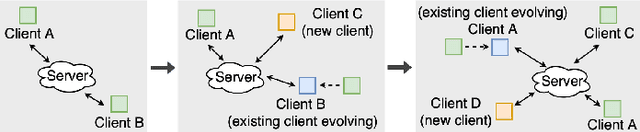
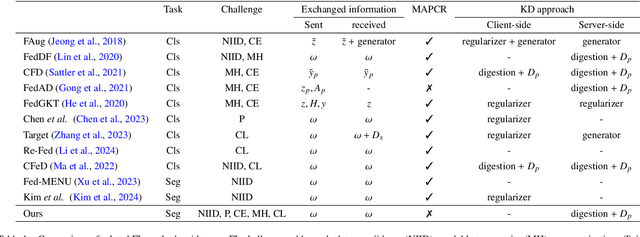

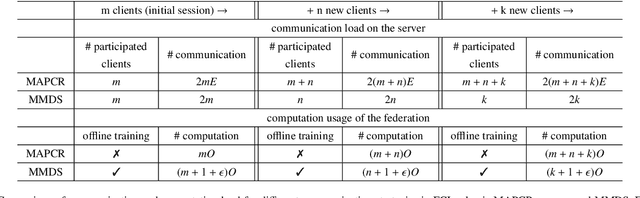
Federated learning seeks to foster collaboration among distributed clients while preserving the privacy of their local data. Traditionally, federated learning methods assume a fixed setting in which client data and learning objectives remain constant. However, in real-world scenarios, new clients may join, and existing clients may expand the segmentation label set as task requirements evolve. In such a dynamic federated analysis setup, the conventional federated communication strategy of model aggregation per communication round is suboptimal. As new clients join, this strategy requires retraining, linearly increasing communication and computation overhead. It also imposes requirements for synchronized communication, which is difficult to achieve among distributed clients. In this paper, we propose a federated continual learning strategy that employs a one-time model aggregation at the server through multi-model distillation. This approach builds and updates the global model while eliminating the need for frequent server communication. When integrating new data streams or onboarding new clients, this approach efficiently reuses previous client models, avoiding the need to retrain the global model across the entire federation. By minimizing communication load and bypassing the need to put unchanged clients online, our approach relaxes synchronization requirements among clients, providing an efficient and scalable federated analysis framework suited for real-world applications. Using multi-class 3D abdominal CT segmentation as an application task, we demonstrate the effectiveness of the proposed approach.
Tell2Reg: Establishing spatial correspondence between images by the same language prompts
Feb 05, 2025Spatial correspondence can be represented by pairs of segmented regions, such that the image registration networks aim to segment corresponding regions rather than predicting displacement fields or transformation parameters. In this work, we show that such a corresponding region pair can be predicted by the same language prompt on two different images using the pre-trained large multimodal models based on GroundingDINO and SAM. This enables a fully automated and training-free registration algorithm, potentially generalisable to a wide range of image registration tasks. In this paper, we present experimental results using one of the challenging tasks, registering inter-subject prostate MR images, which involves both highly variable intensity and morphology between patients. Tell2Reg is training-free, eliminating the need for costly and time-consuming data curation and labelling that was previously required for this registration task. This approach outperforms unsupervised learning-based registration methods tested, and has a performance comparable to weakly-supervised methods. Additional qualitative results are also presented to suggest that, for the first time, there is a potential correlation between language semantics and spatial correspondence, including the spatial invariance in language-prompted regions and the difference in language prompts between the obtained local and global correspondences. Code is available at https://github.com/yanwenCi/Tell2Reg.git.