 Add to Chrome
 Add to Firefox
 Add to Edge
SDF-Pack: Towards Compact Bin Packing with Signed-Distance-Field Minimization
Jul 14, 2023
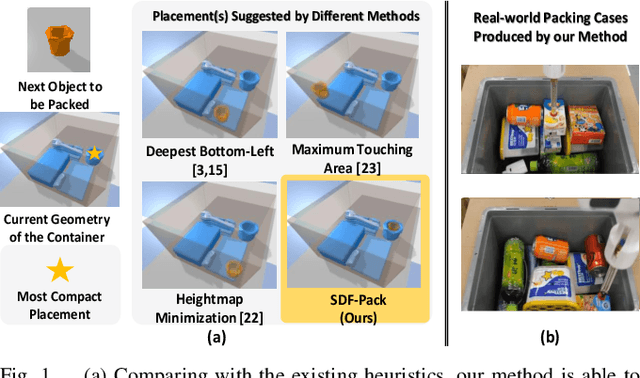
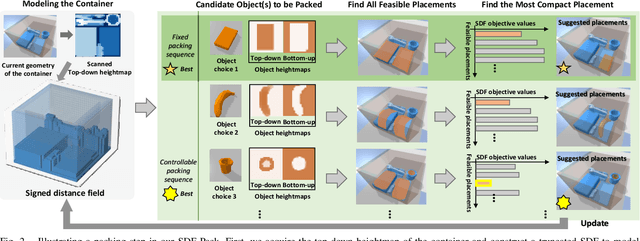
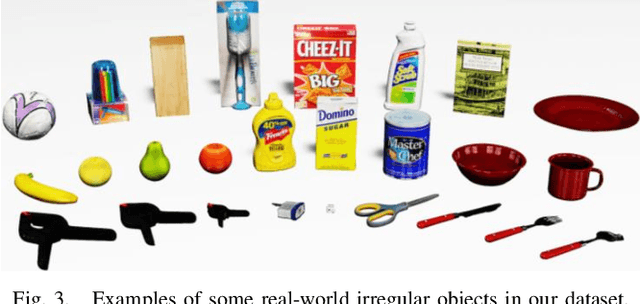
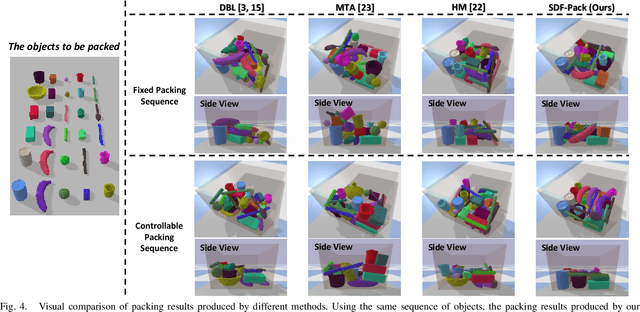
Robotic bin packing is very challenging, especially when considering practical needs such as object variety and packing compactness. This paper presents SDF-Pack, a new approach based on signed distance field (SDF) to model the geometric condition of objects in a container and compute the object placement locations and packing orders for achieving a more compact bin packing. Our method adopts a truncated SDF representation to localize the computation, and based on it, we formulate the SDF minimization heuristic to find optimized placements to compactly pack objects with the existing ones. To further improve space utilization, if the packing sequence is controllable, our method can suggest which object to be packed next. Experimental results on a large variety of everyday objects show that our method can consistently achieve higher packing compactness over 1,000 packing cases, enabling us to pack more objects into the container, compared with the existing heuristics under various packing settings.

Deep Omni-supervised Learning for Rib Fracture Detection from Chest Radiology Images
Jun 23, 2023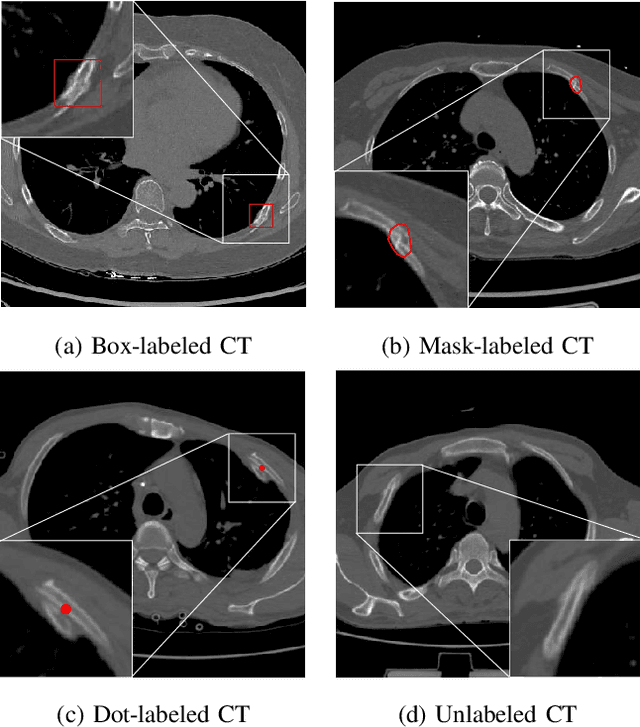
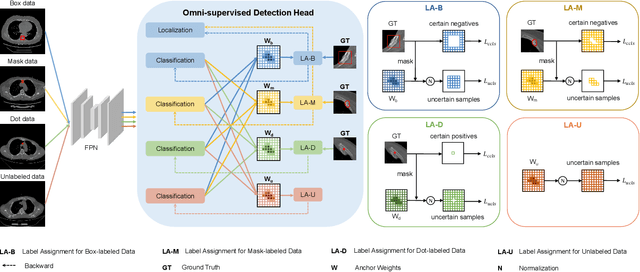
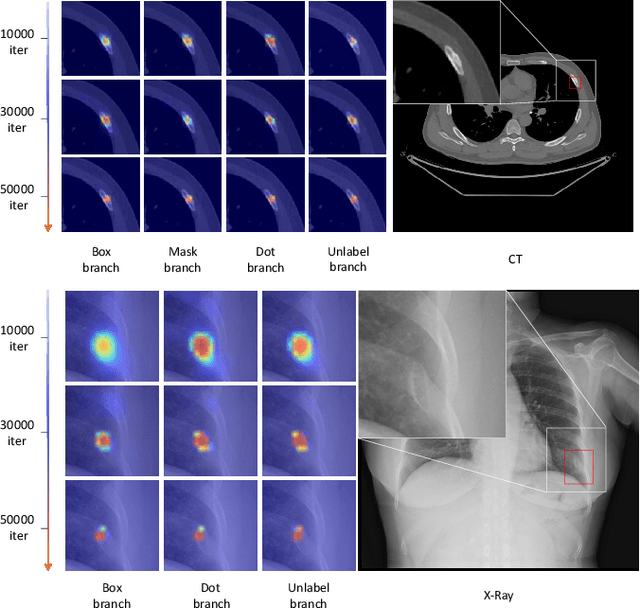
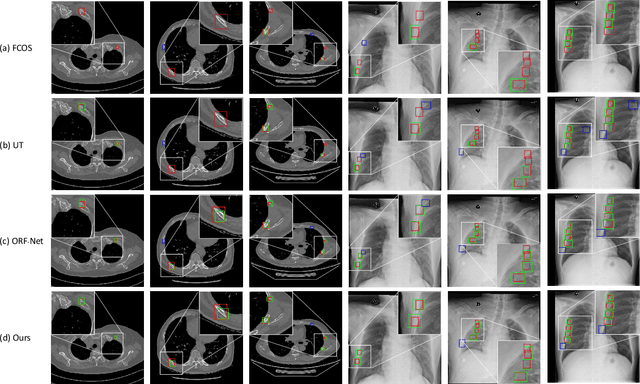
Deep learning (DL)-based rib fracture detection has shown promise of playing an important role in preventing mortality and improving patient outcome. Normally, developing DL-based object detection models requires huge amount of bounding box annotation. However, annotating medical data is time-consuming and expertise-demanding, making obtaining a large amount of fine-grained annotations extremely infeasible. This poses pressing need of developing label-efficient detection models to alleviate radiologists' labeling burden. To tackle this challenge, the literature of object detection has witnessed an increase of weakly-supervised and semi-supervised approaches, yet still lacks a unified framework that leverages various forms of fully-labeled, weakly-labeled, and unlabeled data. In this paper, we present a novel omni-supervised object detection network, ORF-Netv2, to leverage as much available supervision as possible. Specifically, a multi-branch omni-supervised detection head is introduced with each branch trained with a specific type of supervision. A co-training-based dynamic label assignment strategy is then proposed to enable flexibly and robustly learning from the weakly-labeled and unlabeled data. Extensively evaluation was conducted for the proposed framework with three rib fracture datasets on both chest CT and X-ray. By leveraging all forms of supervision, ORF-Netv2 achieves mAPs of 34.7, 44.7, and 19.4 on the three datasets, respectively, surpassing the baseline detector which uses only box annotations by mAP gains of 3.8, 4.8, and 5.0, respectively. Furthermore, ORF-Netv2 consistently outperforms other competitive label-efficient methods over various scenarios, showing a promising framework for label-efficient fracture detection.
3DSAM-adapter: Holistic Adaptation of SAM from 2D to 3D for Promptable Medical Image Segmentation
Jun 23, 2023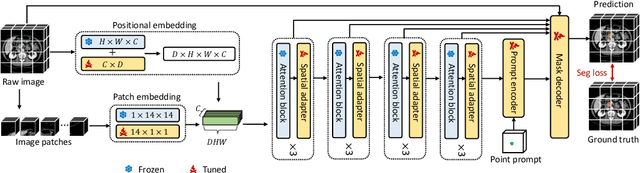

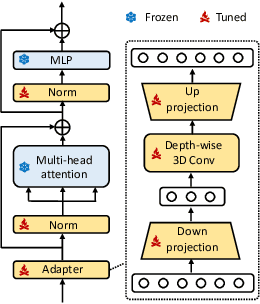

Despite that the segment anything model (SAM) achieved impressive results on general-purpose semantic segmentation with strong generalization ability on daily images, its demonstrated performance on medical image segmentation is less precise and not stable, especially when dealing with tumor segmentation tasks that involve objects of small sizes, irregular shapes, and low contrast. Notably, the original SAM architecture is designed for 2D natural images, therefore would not be able to extract the 3D spatial information from volumetric medical data effectively. In this paper, we propose a novel adaptation method for transferring SAM from 2D to 3D for promptable medical image segmentation. Through a holistically designed scheme for architecture modification, we transfer the SAM to support volumetric inputs while retaining the majority of its pre-trained parameters for reuse. The fine-tuning process is conducted in a parameter-efficient manner, wherein most of the pre-trained parameters remain frozen, and only a few lightweight spatial adapters are introduced and tuned. Regardless of the domain gap between natural and medical data and the disparity in the spatial arrangement between 2D and 3D, the transformer trained on natural images can effectively capture the spatial patterns present in volumetric medical images with only lightweight adaptations. We conduct experiments on four open-source tumor segmentation datasets, and with a single click prompt, our model can outperform domain state-of-the-art medical image segmentation models on 3 out of 4 tasks, specifically by 8.25%, 29.87%, and 10.11% for kidney tumor, pancreas tumor, colon cancer segmentation, and achieve similar performance for liver tumor segmentation. We also compare our adaptation method with existing popular adapters, and observed significant performance improvement on most datasets.
Scale-aware Super-resolution Network with Dual Affinity Learning for Lesion Segmentation from Medical Images
May 30, 2023Convolutional Neural Networks (CNNs) have shown remarkable progress in medical image segmentation. However, lesion segmentation remains a challenge to state-of-the-art CNN-based algorithms due to the variance in scales and shapes. On the one hand, tiny lesions are hard to be delineated precisely from the medical images which are often of low resolutions. On the other hand, segmenting large-size lesions requires large receptive fields, which exacerbates the first challenge. In this paper, we present a scale-aware super-resolution network to adaptively segment lesions of various sizes from the low-resolution medical images. Our proposed network contains dual branches to simultaneously conduct lesion mask super-resolution and lesion image super-resolution. The image super-resolution branch will provide more detailed features for the segmentation branch, i.e., the mask super-resolution branch, for fine-grained segmentation. Meanwhile, we introduce scale-aware dilated convolution blocks into the multi-task decoders to adaptively adjust the receptive fields of the convolutional kernels according to the lesion sizes. To guide the segmentation branch to learn from richer high-resolution features, we propose a feature affinity module and a scale affinity module to enhance the multi-task learning of the dual branches. On multiple challenging lesion segmentation datasets, our proposed network achieved consistent improvements compared to other state-of-the-art methods.
DPPMask: Masked Image Modeling with Determinantal Point Processes
Mar 25, 2023
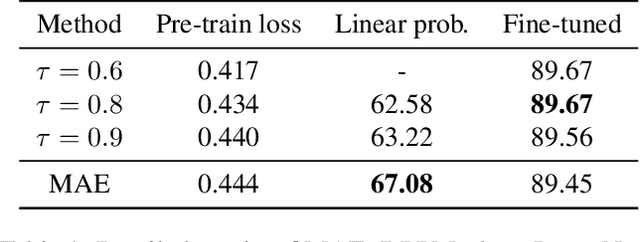

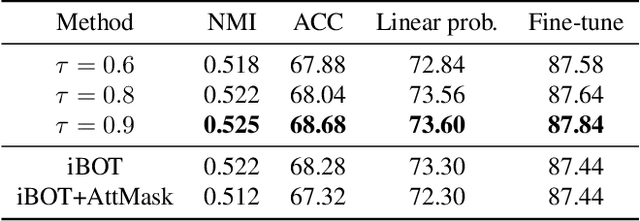
Masked Image Modeling (MIM) has achieved impressive representative performance with the aim of reconstructing randomly masked images. Despite the empirical success, most previous works have neglected the important fact that it is unreasonable to force the model to reconstruct something beyond recovery, such as those masked objects. In this work, we show that uniformly random masking widely used in previous works unavoidably loses some key objects and changes original semantic information, resulting in a misalignment problem and hurting the representative learning eventually. To address this issue, we augment MIM with a new masking strategy namely the DPPMask by substituting the random process with Determinantal Point Process (DPPs) to reduce the semantic change of the image after masking. Our method is simple yet effective and requires no extra learnable parameters when implemented within various frameworks. In particular, we evaluate our method on two representative MIM frameworks, MAE and iBOT. We show that DPPMask surpassed random sampling under both lower and higher masking ratios, indicating that DPPMask makes the reconstruction task more reasonable. We further test our method on the background challenge and multi-class classification tasks, showing that our method is more robust at various tasks.
Adaptive Negative Evidential Deep Learning for Open-set Semi-supervised Learning
Mar 21, 2023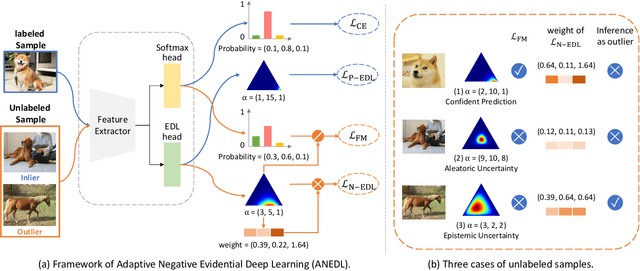

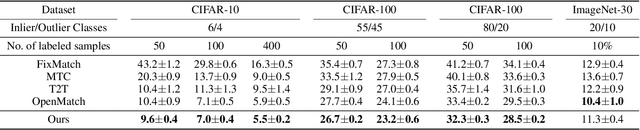
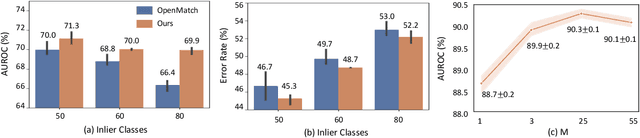
Semi-supervised learning (SSL) methods assume that labeled data, unlabeled data and test data are from the same distribution. Open-set semi-supervised learning (Open-set SSL) considers a more practical scenario, where unlabeled data and test data contain new categories (outliers) not observed in labeled data (inliers). Most previous works focused on outlier detection via binary classifiers, which suffer from insufficient scalability and inability to distinguish different types of uncertainty. In this paper, we propose a novel framework, Adaptive Negative Evidential Deep Learning (ANEDL) to tackle these limitations. Concretely, we first introduce evidential deep learning (EDL) as an outlier detector to quantify different types of uncertainty, and design different uncertainty metrics for self-training and inference. Furthermore, we propose a novel adaptive negative optimization strategy, making EDL more tailored to the unlabeled dataset containing both inliers and outliers. As demonstrated empirically, our proposed method outperforms existing state-of-the-art methods across four datasets.
Video Dehazing via a Multi-Range Temporal Alignment Network with Physical Prior
Mar 17, 2023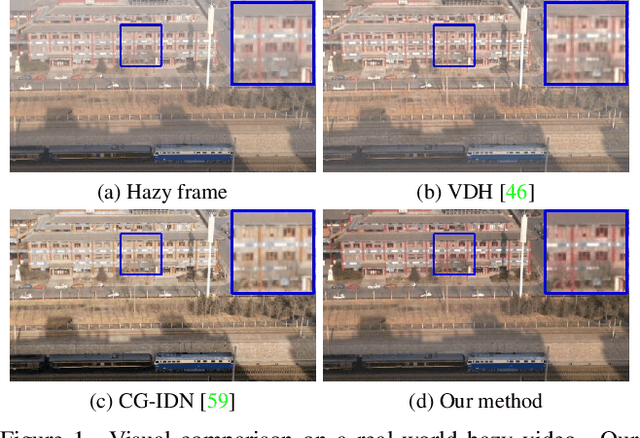
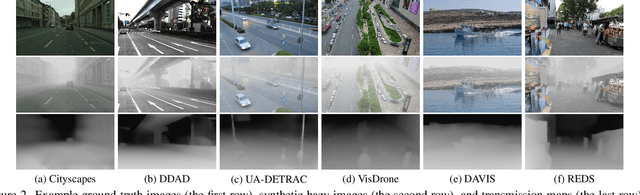
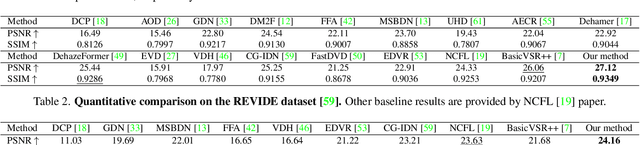
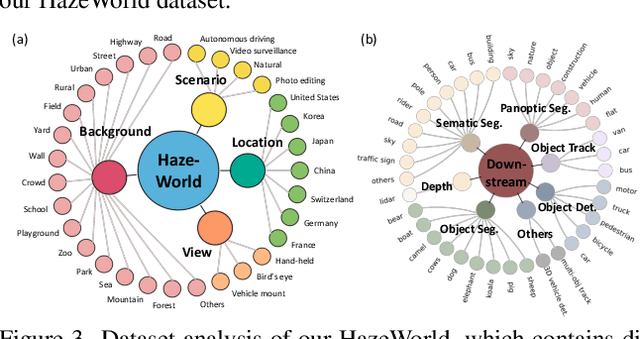
Video dehazing aims to recover haze-free frames with high visibility and contrast. This paper presents a novel framework to effectively explore the physical haze priors and aggregate temporal information. Specifically, we design a memory-based physical prior guidance module to encode the prior-related features into long-range memory. Besides, we formulate a multi-range scene radiance recovery module to capture space-time dependencies in multiple space-time ranges, which helps to effectively aggregate temporal information from adjacent frames. Moreover, we construct the first large-scale outdoor video dehazing benchmark dataset, which contains videos in various real-world scenarios. Experimental results on both synthetic and real conditions show the superiority of our proposed method.
Uncertainty Estimation by Fisher Information-based Evidential Deep Learning
Mar 13, 2023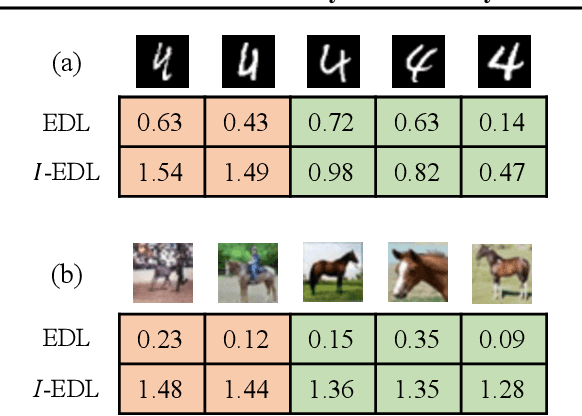
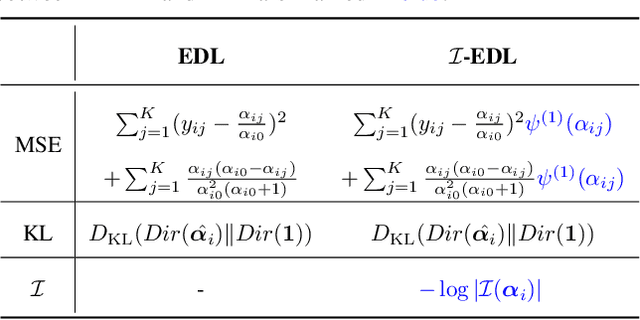

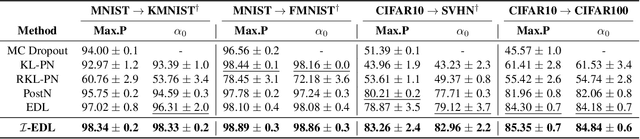
Uncertainty estimation is a key factor that makes deep learning reliable in practical applications. Recently proposed evidential neural networks explicitly account for different uncertainties by treating the network's outputs as evidence to parameterize the Dirichlet distribution, and achieve impressive performance in uncertainty estimation. However, for high data uncertainty samples but annotated with the one-hot label, the evidence-learning process for those mislabeled classes is over-penalized and remains hindered. To address this problem, we propose a novel method, Fisher Information-based Evidential Deep Learning ($\mathcal{I}$-EDL). In particular, we introduce Fisher Information Matrix (FIM) to measure the informativeness of evidence carried by each sample, according to which we can dynamically reweight the objective loss terms to make the network more focused on the representation learning of uncertain classes. The generalization ability of our network is further improved by optimizing the PAC-Bayesian bound. As demonstrated empirically, our proposed method consistently outperforms traditional EDL-related algorithms in multiple uncertainty estimation tasks, especially in the more challenging few-shot classification settings.
PointPatchMix: Point Cloud Mixing with Patch Scoring
Mar 12, 2023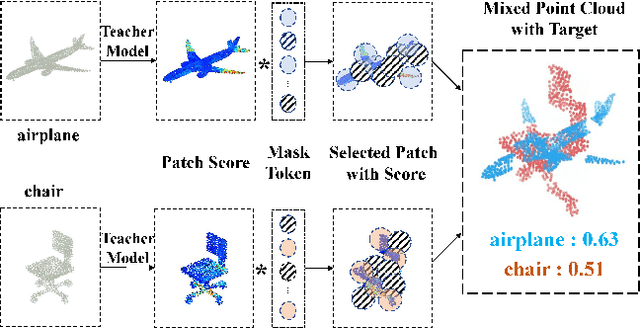
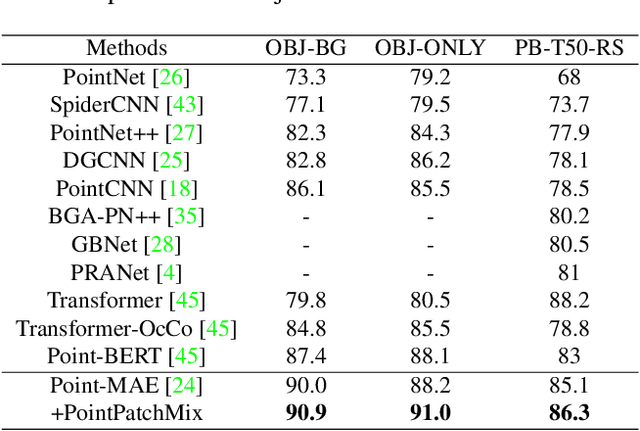
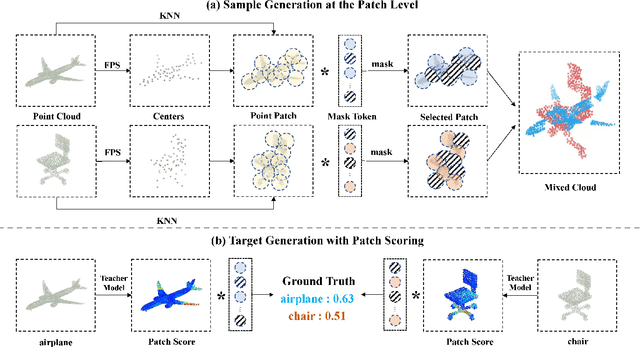
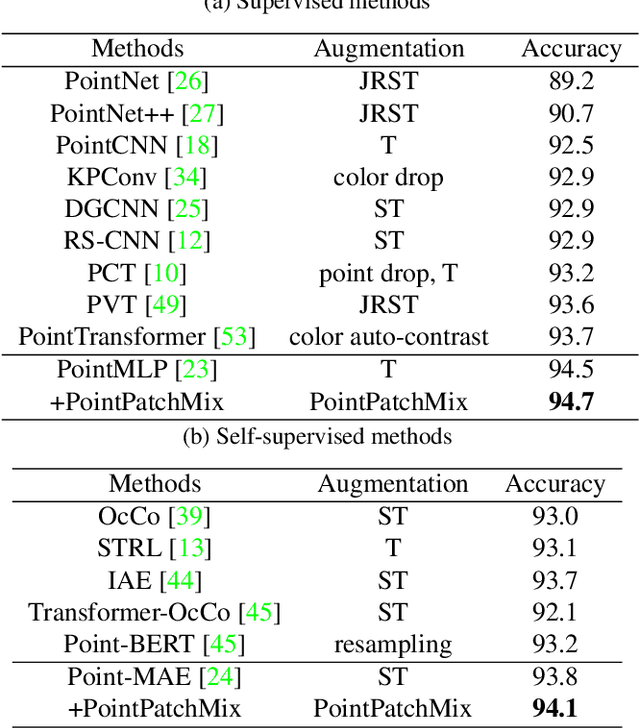
Data augmentation is an effective regularization strategy for mitigating overfitting in deep neural networks, and it plays a crucial role in 3D vision tasks, where the point cloud data is relatively limited. While mixing-based augmentation has shown promise for point clouds, previous methods mix point clouds either on block level or point level, which has constrained their ability to strike a balance between generating diverse training samples and preserving the local characteristics of point clouds. Additionally, the varying importance of each part of the point clouds has not been fully considered, cause not all parts contribute equally to the classification task, and some parts may contain unimportant or redundant information. To overcome these challenges, we propose PointPatchMix, a novel approach that mixes point clouds at the patch level and integrates a patch scoring module to generate content-based targets for mixed point clouds. Our approach preserves local features at the patch level, while the patch scoring module assigns targets based on the content-based significance score from a pre-trained teacher model. We evaluate PointPatchMix on two benchmark datasets, ModelNet40 and ScanObjectNN, and demonstrate significant improvements over various baselines in both synthetic and real-world datasets, as well as few-shot settings. With Point-MAE as our baseline, our model surpasses previous methods by a significant margin, achieving 86.3% accuracy on ScanObjectNN and 94.1% accuracy on ModelNet40. Furthermore, our approach shows strong generalization across multiple architectures and enhances the robustness of the baseline model.
Traj-MAE: Masked Autoencoders for Trajectory Prediction
Mar 12, 2023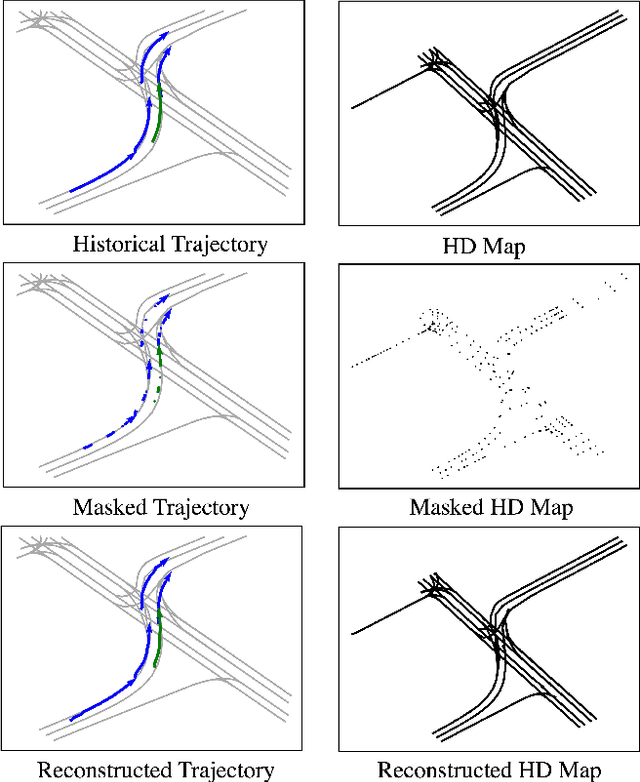
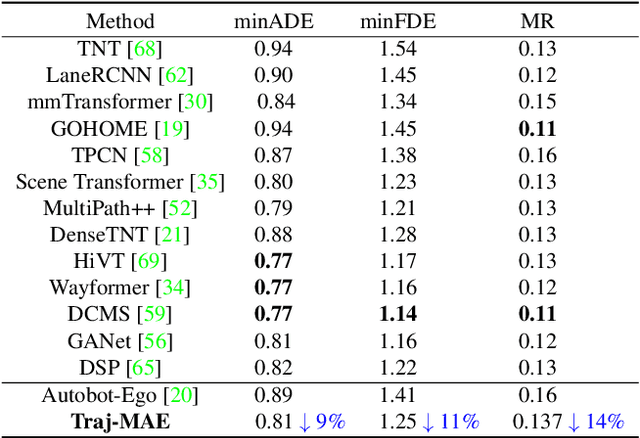
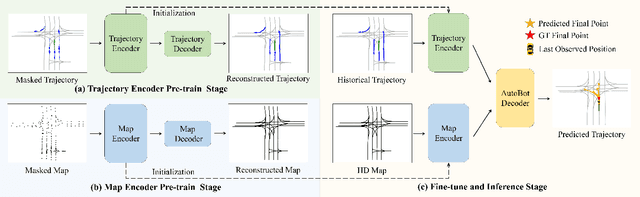
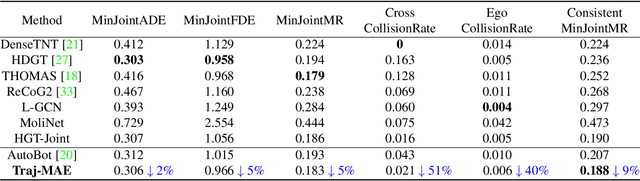
Trajectory prediction has been a crucial task in building a reliable autonomous driving system by anticipating possible dangers. One key issue is to generate consistent trajectory predictions without colliding. To overcome the challenge, we propose an efficient masked autoencoder for trajectory prediction (Traj-MAE) that better represents the complicated behaviors of agents in the driving environment. Specifically, our Traj-MAE employs diverse masking strategies to pre-train the trajectory encoder and map encoder, allowing for the capture of social and temporal information among agents while leveraging the effect of environment from multiple granularities. To address the catastrophic forgetting problem that arises when pre-training the network with multiple masking strategies, we introduce a continual pre-training framework, which can help Traj-MAE learn valuable and diverse information from various strategies efficiently. Our experimental results in both multi-agent and single-agent settings demonstrate that Traj-MAE achieves competitive results with state-of-the-art methods and significantly outperforms our baseline model.