 Add to Chrome
 Add to Firefox
 Add to Edge
CogRec: Structure-Cognitive Fast-and-Slow Reasoning for Generative Recommendation
Jul 27, 2026
Semantic-ID-based generative recommendation represents each item as a hierarchical discrete token sequence and reformulates next-item prediction as constrained sequence generation. Existing methods, however, mainly use Semantic IDs as target sequences to be memorized, leaving the hierarchy, intra-layer relations, and item neighborhoods underused as an explicit reasoning space. Explicit reasoning-enhanced generative methods often produce a natural-language rationale before the item identifier, but this rationale is only weakly coupled with the discrete SID space in which the final prediction is made. We propose CogRec, a structure-cognitive fast-and-slow reasoning framework that grounds intermediate reasoning in the same SID topology used for target generation. CogRec augments the vertical SID hierarchy with intra-layer semantic graphs and item-level neighborhoods, and introduces SID Routing to represent recommendation reasoning through layer-wise Match, LateralJump, and Explore operations. Exact matching implements fast semantic localization, whereas lateral and exploratory operations instantiate slower structural navigation. A supervised multi-stage pipeline aligns the newly introduced SID tokens, establishes direct SID generation, and trains natural-language and SID-routing reasoning branches from a shared checkpoint under the same trie-constrained output space. Experiments on three public sequential-recommendation benchmarks show that SID Routing improves its corresponding direct-generation, indicate that structure-grounded reasoning is most useful when prefix matching is insufficient but learnable SID-space transitions remain available, whereas long or weakly supported routes introduce additional decoding cost and accumulated errors. Code is available at https://github.com/caskcsg/CogRec

HoloRec: Holistic Encoding and Interleaved Reasoning for Generative Recommendation
Jun 13, 2026Generative recommendation models that formulate the task as sequence generation overcome the objective fragmentation problem of traditional cascade architectures, yet existing approaches still suffer from flat semantic representations lacking hierarchical structure for multi-step reasoning and an externally constructed chain-of-thought (CoT) that requires expensive annotations and remains disconnected from the generation objective. We propose HoloRec, an endogenous chain-of-thought recommendation mechanism that unifies representation, reasoning, and generation by constructing a hierarchical semantic encoding matrix via multi-granularity nested residual quantization optimized by a holistic reconstruction loss. HoloRec supports two inference modes: a non-thinking mode that uses lightweight multi-granularity supervised alignment for fast prediction, and a thinking mode that employs an interleaved reasoning scheme to generate CoT steps on the fly, directly embedding reasoning into the generation process without external data. Experiments on multiple public recommendation datasets demonstrate that HoloRec consistently outperforms baselines, with especially significant gains in sparse scenarios, and the thinking mode achieves better accuracy than the non-thinking mode with only modest inference overhead.
ExPosST: Explicit Positioning with Adaptive Masking for LLM-Based Simultaneous Machine Translation
Mar 16, 2026Large language models (LLMs) have recently demonstrated promising performance in simultaneous machine translation (SimulMT). However, applying decoder-only LLMs to SimulMT introduces a positional mismatch, which leads to a dilemma between decoding efficiency and positional consistency. Existing approaches often rely on specific positional encodings or carefully designed prompting schemes, and thus fail to simultaneously achieve inference efficiency, positional consistency, and broad model compatibility. In this work, we propose ExPosST, a general framework that resolves this dilemma through explicit position allocation. ExPosST reserves fixed positional slots for incoming source tokens, enabling efficient decoding with KV cache across different positional encoding methods. To further bridge the gap between fine-tuning and inference, we introduce a policy-consistent fine-tuning strategy that aligns training with inference-time decoding behavior. Experiments across multiple language pairs demonstrate that ExPosST effectively supports simultaneous translation under diverse policies.
Boundary-Aware Multi-Behavior Dynamic Graph Transformer for Sequential Recommendation
Feb 11, 2026In the landscape of contemporary recommender systems, user-item interactions are inherently dynamic and sequential, often characterized by various behaviors. Prior research has explored the modeling of user preferences through sequential interactions and the user-item interaction graph, utilizing advanced techniques such as graph neural networks and transformer-based architectures. However, these methods typically fall short in simultaneously accounting for the dynamic nature of graph topologies and the sequential pattern of interactions in user preference models. Moreover, they often fail to adequately capture the multiple user behavior boundaries during model optimization. To tackle these challenges, we introduce a boundary-aware Multi-Behavioral Dynamic Graph Transformer (MB-DGT) model that dynamically refines the graph structure to reflect the evolving patterns of user behaviors and interactions. Our model involves a transformer-based dynamic graph aggregator for user preference modeling, which assimilates the changing graph structure and the sequence of user behaviors. This integration yields a more comprehensive and dynamic representation of user preferences. For model optimization, we implement a user-specific multi-behavior loss function that delineates the interest boundaries among different behaviors, thereby enriching the personalized learning of user preferences. Comprehensive experiments across three datasets indicate that our model consistently delivers remarkable recommendation performance.
Fine-tuning Large Language Models for Domain-specific Machine Translation
Feb 23, 2024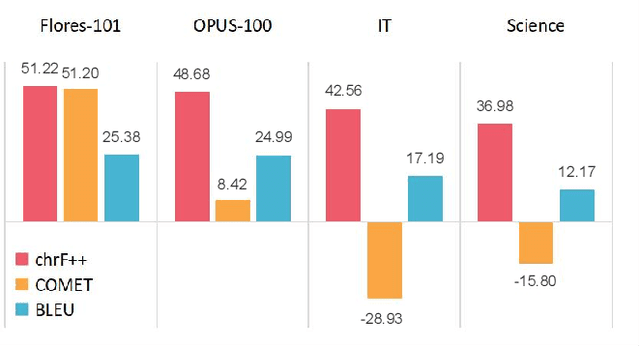
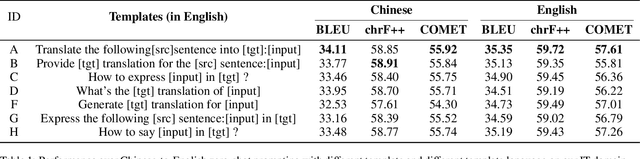
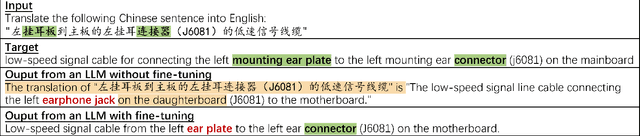
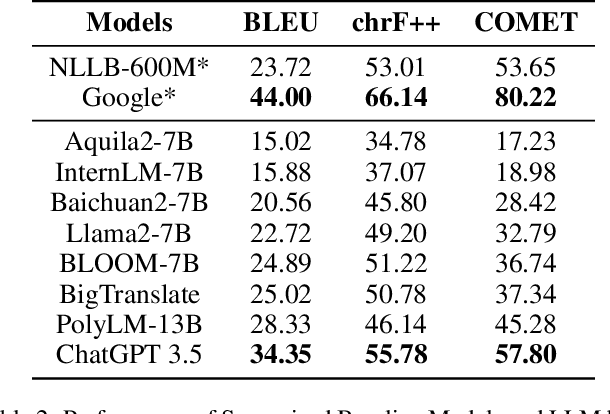
Large language models (LLMs) have made significant progress in machine translation (MT). However, their potential in domain-specific MT remains under-explored. Current LLM-based MT systems still face several challenges. First, for LLMs with in-context learning, their effectiveness is highly sensitive to input translation examples, and processing them can increase inference costs. They often require extra post-processing due to over-generation. Second, LLMs with fine-tuning on domain-specific data often require high training costs for domain adaptation, and may weaken the zero-shot MT capabilities of LLMs due to over-specialization. The aforementioned methods can struggle to translate rare words in domain transfer scenarios. To address these challenges, this paper proposes a prompt-oriented fine-tuning method, denoted as LlamaIT, to effectively and efficiently fine-tune a general-purpose LLM for domain-specific MT tasks. First, we construct a task-specific mix-domain dataset, which is then used to fine-tune the LLM with LoRA. This can eliminate the need for input translation examples, post-processing, or over-specialization. By zero-shot prompting with instructions, we adapt the MT tasks to the target domain at inference time. To further elicit the MT capability for rare words, we construct new prompts by incorporating domain-specific bilingual vocabulary. We also conduct extensive experiments on both publicly available and self-constructed datasets. The results show that our LlamaIT can significantly enhance the domain-specific MT capabilities of the LLM, meanwhile preserving its zero-shot MT capabilities.