 Add to Chrome
 Add to Firefox
 Add to Edge
D2VBench: Benchmarking Large Language Models with Value Dilemmas in Daily Scenarios
Jul 22, 2026
With the wide application of large language models (LLMs) in real-world scenarios, the value implication of their outputs is crucial. However, existing evaluation benchmarks suffer from insufficient coverage of value dilemmas in daily scenarios involving multiple value conflicts and simplistic evaluation formalisms that fail to assess LLMs' value alignment. To address these issues, we propose D2VBench, a value alignment benchmark comprising 10,000 instances of real daily dilemma scenarios constructed through a multi-stage collaboration between LLMs and humans, grounded in 158 manually annotated fine-grained value concepts. For evaluation on the benchmark, we present a hybrid evaluation paradigm that integrates multiple-choice questions with open-ended questions. We conduct comprehensive evaluations on eight mainstream LLMs. Experimental results demonstrate that D2VBench exhibits high reliability and robustness, effectively reflecting the LLMs' alignment across different value categories and dimensions, and providing a more realistic and fine-grained tool for research on value alignment. The dataset is available at https://github.com/tjunlp-lab/D2VBench.

Pancasila-Dilemmas: Evaluating Large Language Models on Indonesian Human Value Dilemmas Grounded in Pancasila
Jul 20, 2026The value alignment of large language models (LLMs) is crucial for ensuring responses align with human intention and value preferences. However, most evaluations of value alignment focus on Western or universal values, while assessments grounded in the value systems of specific countries remain scarce. In this paper, we introduce Pancasila-Dilemmas, an evaluation dataset of 1,834 questions derived from Indonesian news, classified by 5 values of Pancasila: Religion, Humanity, Unity, Democracy, and Social Justice. This dataset reflects daily life in Indonesia, making it suitable for measuring the value alignment of LLMs deployed for Indonesia. To ensure a more rigorous evaluation, we choose scenarios containing dilemmas. The dataset is proofread by native speakers and answered by 5 diverse Indonesian citizens. We evaluate 50 closed- and open-source LLMs on our dataset. Results reveal that all evaluated LLMs achieves less than 0.5 Probability Match Score (PMS) and 0.72 Max-Vote Agreement Score (MVAS). Compared by each values, LLMs mostly struggle in Religion and Unity dilemma cases. This highlights a significant gap in capturing Indonesian values. The dataset is publicly available at https://github.com/tjunlp-lab/Pancasila-Dilemmas.
Beyond Value Benchmarks: Measuring Value-Structure Alignment in Large Language Models via Symmetric Q-Sorts
Jun 20, 2026Large Language Models (LLMs) are increasingly deployed in contexts requiring complex moral reasoning and value trade-offs. However, existing evaluations typically rely on item-level behavioral metrics, which fail to capture how models structurally prioritize competing values as a cohesive system. To address this, we propose a symmetric human-LLM evaluation framework, grounded in Q methodology, to measure value-structure alignment. Under our protocol, humans and models sort an identical 140-item moral statement set into a shared nine-column forced distribution; for LLMs, we elicit strict rankings and deterministically map them to Q-sort buckets. Using a human reference sample ($N=35$), we establish a stable three-factor reference geometry specific to this instrument and sample. We evaluate 12 LLMs across four model families via 240 replicated Q-sorts at two temperature settings, quantifying structural alignment via Procrustes similarity ($φ$) and RSA-based Spearman correlation ($ρ$). Our results reveal significant cross-family heterogeneity, model-specific sensitivity to generation stochasticity and localized misalignment, which demonstrate that favorable global scores can obscure underlying regional distortions. While rank- and bucket-based analyses remain highly consistent, prompt phrasing introduces notable variance. Ultimately, assessing value-structure alignment provides a crucial structural complement to traditional itemwise moral benchmarks.
StreamMemBench: Streaming Evaluation of Agent Memory for Future-Oriented Assistance
Jun 12, 2026A central role of personal-agent memory is to turn stored information and prior interactions into future-oriented assistance. In daily use, useful cues come from what the agent observes and how the user interacts with the agent, and the agent must carry them forward from the current request to similar future tasks. Existing memory benchmarks usually test dialogue recall or task improvement in isolation, leaving the trajectory from streaming observations to later assistance largely untested. We introduce StreamMemBench, a streaming benchmark that constructs a two-step task sequence around each evidence anchor from EgoLife egocentric streams. The initial task tests evidence use, while the follow-up task tests whether feedback and interaction experience are reused. Four metrics diagnose evidence recall, initial evidence use, feedback incorporation, and follow-up reuse. Experiments with eight memory systems across two backbones show that current systems often fail to use observed evidence or turn feedback into reliable follow-up behavior, even when evidence is stored or feedback is incorporated locally. StreamMemBench is publicly available at https://github.com/landian60/StreamMemBench.
DVMap: Fine-Grained Pluralistic Value Alignment via High-Consensus Demographic-Value Mapping
May 14, 2026Current Large Language Models (LLMs) typically rely on coarse-grained national labels for pluralistic value alignment. However, such macro-level supervision often obscures intra-country value heterogeneity, yielding a loose alignment. We argue that resolving this limitation requires shifting from national labels to multi-dimensional demographic constraints, which can identify groups with predictable, high-consensus value preference. To this end, we propose DVMap (High-Consensus Demographic-Value Mapping), a framework for fine-grained pluralistic value alignment. In this framework, we first present a demographic archetype extraction strategy to construct a high-quality value alignment corpus of 56,152 samples from the World Values Survey (WVS) by strictly retaining respondents with consistent value preferences under identical demographics. Over this corpus, we introduce a Structured Chain-of-Thought (CoT) mechanism that explicitly guides LLMs to reason about demographic-value correlations. Subsequently, we employ Group Relative Policy Optimization (GRPO) to achieve adaptive anchoring of value distributions. To rigorously evaluate generalization, we further establish a triple-generalization benchmark (spanning cross-demographic, cross-country, and cross-value) comprising 21,553 samples. Experimental results demonstrate that DVMap effectively learns the manifold mapping from demographics to values, exhibiting strong generalization and robustness. On cross-demographic tests, Qwen3-8B-DVMap achieves 48.6% accuracy, surpassing the advanced open-source LLM DeepSeek-v3.2 (45.1%). The source code and dataset are available at https://github.com/EnlightenedAI/DVMap.
DEP: A Decentralized Large Language Model Evaluation Protocol
Mar 01, 2026With the rapid development of Large Language Models (LLMs), a large number of benchmarks have been proposed. However, most benchmarks lack unified evaluation standard and require the manual implementation of custom scripts, making results hard to ensure consistency and reproducibility. Furthermore, mainstream evaluation frameworks are centralized, with datasets and answers, which increases the risk of benchmark leakage. To address these issues, we propose a Decentralized Evaluation Protocol (DEP), a decentralized yet unified and standardized evaluation framework through a matching server without constraining benchmarks. The server can be mounted locally or deployed remotely, and once adapted, it can be reused over the long term. By decoupling users, LLMs, and benchmarks, DEP enables modular, plug-and-play evaluation: benchmark files and evaluation logic stay exclusively on the server side. In remote setting, users cannot access the ground truth, thereby achieving data isolation and leak-proof evaluation. To facilitate practical adoption, we develop DEP Toolkit, a protocol-compatible toolkit that supports features such as breakpoint resume, concurrent requests, and congestion control. We also provide detailed documentation for adapting new benchmarks to DEP. Using DEP toolkit, we evaluate multiple LLMs across benchmarks. Experimental results verify the effectiveness of DEP and show that it reduces the cost of deploying benchmark evaluations. As of February 2026, we have adapted over 60 benchmarks and continue to promote community co-construction to support unified evaluation across various tasks and domains.
Finding the Translation Switch: Discovering and Exploiting the Task-Initiation Features in LLMs
Jan 16, 2026Large Language Models (LLMs) frequently exhibit strong translation abilities, even without task-specific fine-tuning. However, the internal mechanisms governing this innate capability remain largely opaque. To demystify this process, we leverage Sparse Autoencoders (SAEs) and introduce a novel framework for identifying task-specific features. Our method first recalls features that are frequently co-activated on translation inputs and then filters them for functional coherence using a PCA-based consistency metric. This framework successfully isolates a small set of **translation initiation** features. Causal interventions demonstrate that amplifying these features steers the model towards correct translation, while ablating them induces hallucinations and off-task outputs, confirming they represent a core component of the model's innate translation competency. Moving from analysis to application, we leverage this mechanistic insight to propose a new data selection strategy for efficient fine-tuning. Specifically, we prioritize training on **mechanistically hard** samples-those that fail to naturally activate the translation initiation features. Experiments show this approach significantly improves data efficiency and suppresses hallucinations. Furthermore, we find these mechanisms are transferable to larger models of the same family. Our work not only decodes a core component of the translation mechanism in LLMs but also provides a blueprint for using internal model mechanism to create more robust and efficient models. The codes are available at https://github.com/flamewei123/AAAI26-translation-Initiation-Features.
Revisiting Entropy in Reinforcement Learning for Large Reasoning Models
Nov 08, 2025Reinforcement learning with verifiable rewards (RLVR) has emerged as a predominant approach for enhancing the reasoning capabilities of large language models (LLMs). However, the entropy of LLMs usually collapses during RLVR training, causing premature convergence to suboptimal local minima and hinder further performance improvement. Although various approaches have been proposed to mitigate entropy collapse, a comprehensive study of entropy in RLVR remains lacking. To address this gap, we conduct extensive experiments to investigate the entropy dynamics of LLMs trained with RLVR and analyze how model entropy correlates with response diversity, calibration, and performance across various benchmarks. Our findings reveal that the number of off-policy updates, the diversity of training data, and the clipping thresholds in the optimization objective are critical factors influencing the entropy of LLMs trained with RLVR. Moreover, we theoretically and empirically demonstrate that tokens with positive advantages are the primary contributors to entropy collapse, and that model entropy can be effectively regulated by adjusting the relative loss weights of tokens with positive and negative advantages during training.
LHMKE: A Large-scale Holistic Multi-subject Knowledge Evaluation Benchmark for Chinese Large Language Models
Mar 19, 2024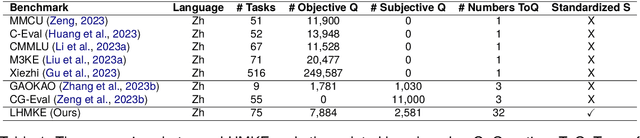
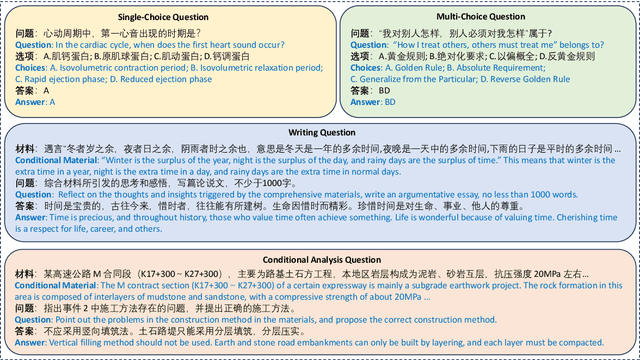
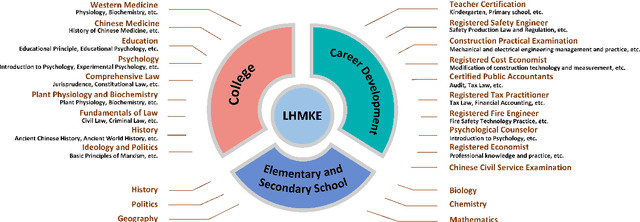
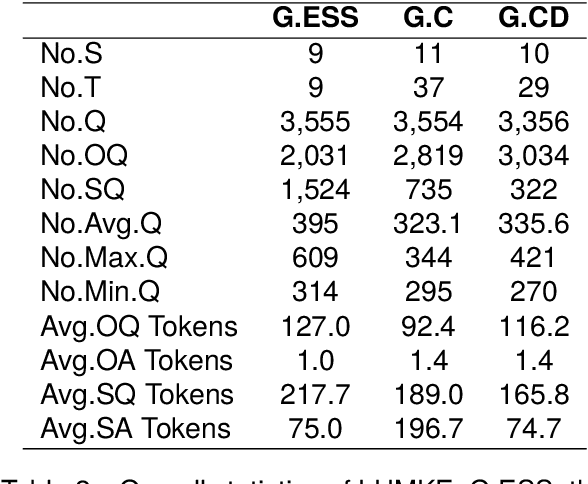
Chinese Large Language Models (LLMs) have recently demonstrated impressive capabilities across various NLP benchmarks and real-world applications. However, the existing benchmarks for comprehensively evaluating these LLMs are still insufficient, particularly in terms of measuring knowledge that LLMs capture. Current datasets collect questions from Chinese examinations across different subjects and educational levels to address this issue. Yet, these benchmarks primarily focus on objective questions such as multiple-choice questions, leading to a lack of diversity in question types. To tackle this problem, we propose LHMKE, a Large-scale, Holistic, and Multi-subject Knowledge Evaluation benchmark in this paper. LHMKE is designed to provide a comprehensive evaluation of the knowledge acquisition capabilities of Chinese LLMs. It encompasses 10,465 questions across 75 tasks covering 30 subjects, ranging from primary school to professional certification exams. Notably, LHMKE includes both objective and subjective questions, offering a more holistic evaluation of the knowledge level of LLMs. We have assessed 11 Chinese LLMs under the zero-shot setting, which aligns with real examinations, and compared their performance across different subjects. We also conduct an in-depth analysis to check whether GPT-4 can automatically score subjective predictions. Our findings suggest that LHMKE is a challenging and advanced testbed for Chinese LLMs.
Do Large Language Models Mirror Cognitive Language Processing?
Feb 28, 2024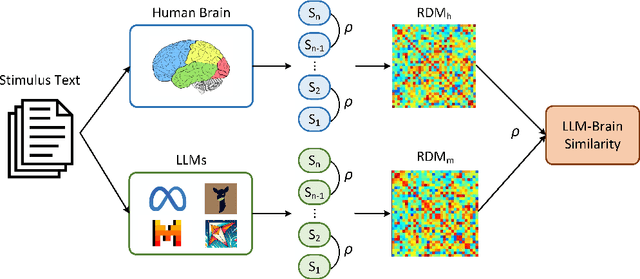
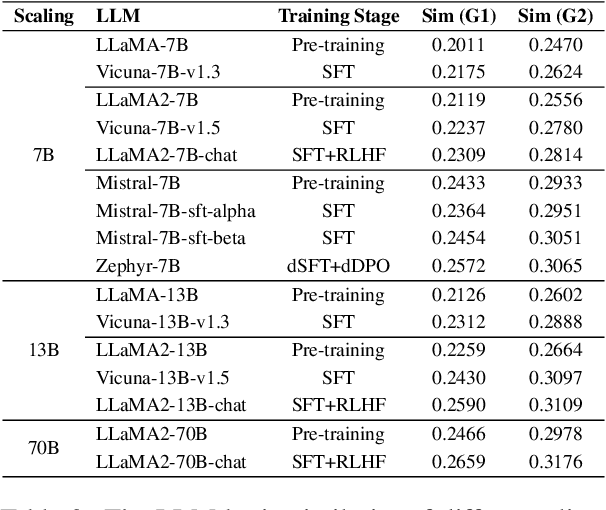
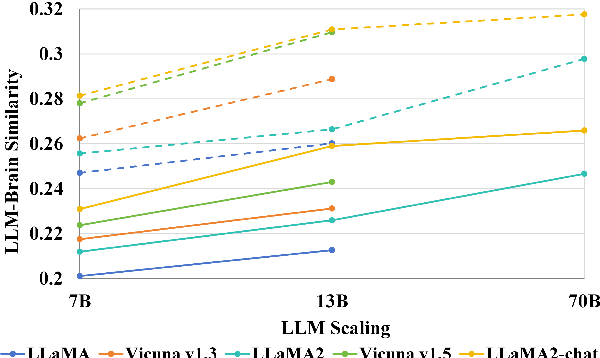
Large language models (LLMs) have demonstrated remarkable capabilities in text comprehension and logical reasoning, achiving or even surpassing human-level performance in numerous cognition tasks. As LLMs are trained from massive textual outputs of human language cognition, it is natural to ask whether LLMs mirror cognitive language processing. Or to what extend LLMs resemble cognitive language processing? In this paper, we propose a novel method that bridge between LLM representations and human cognition signals to evaluate how effectively LLMs simulate cognitive language processing. We employ Representational Similarity Analysis (RSA) to mearsure the alignment between 16 mainstream LLMs and fMRI signals of the brain. We empirically investigate the impact of a variety of factors (e.g., model scaling, alignment training, instruction appending) on such LLM-brain alignment. Experimental results indicate that model scaling is positively correlated with LLM-brain similarity, and alignment training can significantly improve LLM-brain similarity. Additionally, the performance of a wide range of LLM evaluations (e.g., MMLU, Chatbot Arena) is highly correlated with the LLM-brain similarity.