 Add to Chrome
 Add to Firefox
 Add to Edge
AssistPDA: An Online Video Surveillance Assistant for Video Anomaly Prediction, Detection, and Analysis
Mar 27, 2025
The rapid advancements in large language models (LLMs) have spurred growing interest in LLM-based video anomaly detection (VAD). However, existing approaches predominantly focus on video-level anomaly question answering or offline detection, ignoring the real-time nature essential for practical VAD applications. To bridge this gap and facilitate the practical deployment of LLM-based VAD, we introduce AssistPDA, the first online video anomaly surveillance assistant that unifies video anomaly prediction, detection, and analysis (VAPDA) within a single framework. AssistPDA enables real-time inference on streaming videos while supporting interactive user engagement. Notably, we introduce a novel event-level anomaly prediction task, enabling proactive anomaly forecasting before anomalies fully unfold. To enhance the ability to model intricate spatiotemporal relationships in anomaly events, we propose a Spatio-Temporal Relation Distillation (STRD) module. STRD transfers the long-term spatiotemporal modeling capabilities of vision-language models (VLMs) from offline settings to real-time scenarios. Thus it equips AssistPDA with a robust understanding of complex temporal dependencies and long-sequence memory. Additionally, we construct VAPDA-127K, the first large-scale benchmark designed for VLM-based online VAPDA. Extensive experiments demonstrate that AssistPDA outperforms existing offline VLM-based approaches, setting a new state-of-the-art for real-time VAPDA. Our dataset and code will be open-sourced to facilitate further research in the community.

HVI: A New Color Space for Low-light Image Enhancement
Feb 28, 2025


Low-Light Image Enhancement (LLIE) is a crucial computer vision task that aims to restore detailed visual information from corrupted low-light images. Many existing LLIE methods are based on standard RGB (sRGB) space, which often produce color bias and brightness artifacts due to inherent high color sensitivity in sRGB. While converting the images using Hue, Saturation and Value (HSV) color space helps resolve the brightness issue, it introduces significant red and black noise artifacts. To address this issue, we propose a new color space for LLIE, namely Horizontal/Vertical-Intensity (HVI), defined by polarized HS maps and learnable intensity. The former enforces small distances for red coordinates to remove the red artifacts, while the latter compresses the low-light regions to remove the black artifacts. To fully leverage the chromatic and intensity information, a novel Color and Intensity Decoupling Network (CIDNet) is further introduced to learn accurate photometric mapping function under different lighting conditions in the HVI space. Comprehensive results from benchmark and ablation experiments show that the proposed HVI color space with CIDNet outperforms the state-of-the-art methods on 10 datasets. The code is available at https://github.com/Fediory/HVI-CIDNet.
Learning Counterfactual Outcomes Under Rank Preservation
Feb 10, 2025Counterfactual inference aims to estimate the counterfactual outcome at the individual level given knowledge of an observed treatment and the factual outcome, with broad applications in fields such as epidemiology, econometrics, and management science. Previous methods rely on a known structural causal model (SCM) or assume the homogeneity of the exogenous variable and strict monotonicity between the outcome and exogenous variable. In this paper, we propose a principled approach for identifying and estimating the counterfactual outcome. We first introduce a simple and intuitive rank preservation assumption to identify the counterfactual outcome without relying on a known structural causal model. Building on this, we propose a novel ideal loss for theoretically unbiased learning of the counterfactual outcome and further develop a kernel-based estimator for its empirical estimation. Our theoretical analysis shows that the rank preservation assumption is not stronger than the homogeneity and strict monotonicity assumptions, and shows that the proposed ideal loss is convex, and the proposed estimator is unbiased. Extensive semi-synthetic and real-world experiments are conducted to demonstrate the effectiveness of the proposed method.
Optimal Policy Adaptation under Covariate Shift
Jan 14, 2025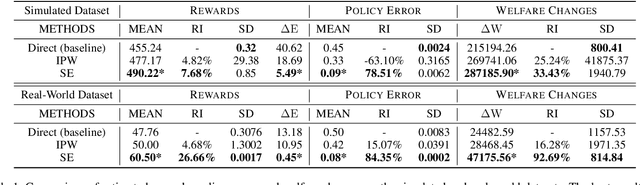

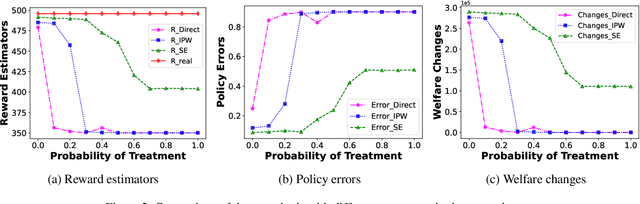
Transfer learning of prediction models has been extensively studied, while the corresponding policy learning approaches are rarely discussed. In this paper, we propose principled approaches for learning the optimal policy in the target domain by leveraging two datasets: one with full information from the source domain and the other from the target domain with only covariates. First, under the setting of covariate shift, we formulate the problem from a perspective of causality and present the identifiability assumptions for the reward induced by a given policy. Then, we derive the efficient influence function and the semiparametric efficiency bound for the reward. Based on this, we construct a doubly robust and semiparametric efficient estimator for the reward and then learn the optimal policy by optimizing the estimated reward. Moreover, we theoretically analyze the bias and the generalization error bound for the learned policy. Furthermore, in the presence of both covariate and concept shifts, we propose a novel sensitivity analysis method to evaluate the robustness of the proposed policy learning approach. Extensive experiments demonstrate that the approach not only estimates the reward more accurately but also yields a policy that closely approximates the theoretically optimal policy.
A Bayesian Framework for Clustered Federated Learning
Oct 22, 2024One of the main challenges of federated learning (FL) is handling non-independent and identically distributed (non-IID) client data, which may occur in practice due to unbalanced datasets and use of different data sources across clients. Knowledge sharing and model personalization are key strategies for addressing this issue. Clustered federated learning is a class of FL methods that groups clients that observe similarly distributed data into clusters, such that every client is typically associated with one data distribution and participates in training a model for that distribution along their cluster peers. In this paper, we present a unified Bayesian framework for clustered FL which associates clients to clusters. Then we propose several practical algorithms to handle the, otherwise growing, data associations in a way that trades off performance and computational complexity. This work provides insights on client-cluster associations and enables client knowledge sharing in new ways. The proposed framework circumvents the need for unique client-cluster associations, which is seen to increase the performance of the resulting models in a variety of experiments.
Bayesian data fusion for distributed learning
Oct 20, 2024One of the main challenges of federated learning (FL) is handling non-independent and identically distributed (non-IID) client data, which may occur in practice due to unbalanced datasets and use of different data sources across clients. Knowledge sharing and model personalization are key strategies for addressing this issue. Clustered federated learning is a class of FL methods that groups clients that observe similarly distributed data into clusters, such that every client is typically associated with one data distribution and participates in training a model for that distribution along their cluster peers. In this paper, we present a unified Bayesian framework for clustered FL which associates clients to clusters. Then we propose several practical algorithms to handle the, otherwise growing, data associations in a way that trades off performance and computational complexity. This work provides insights on client-cluster associations and enables client knowledge sharing in new ways. The proposed framework circumvents the need for unique client-cluster associations, which is seen to increase the performance of the resulting models in a variety of experiments.
Symmetry Nonnegative Matrix Factorization Algorithm Based on Self-paced Learning
Oct 20, 2024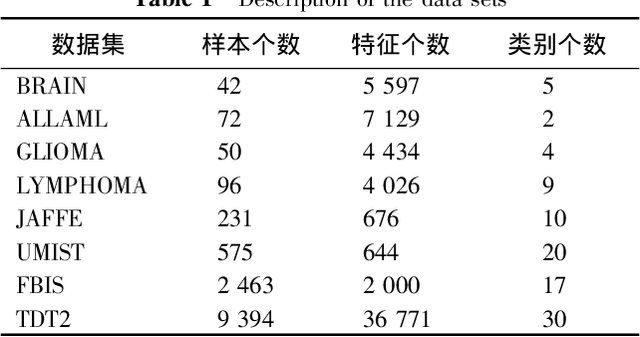
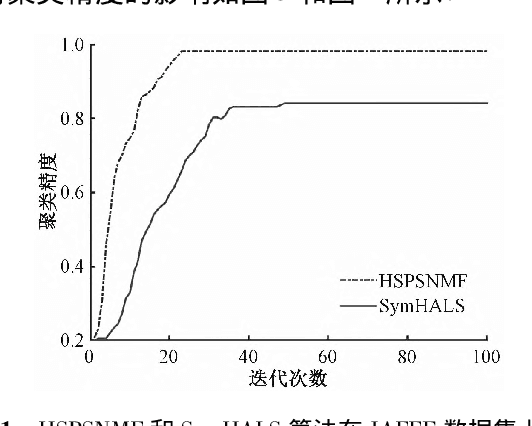
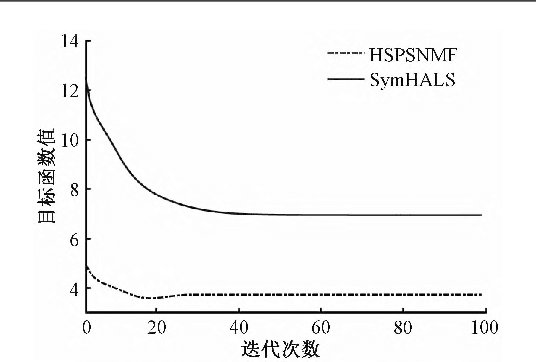
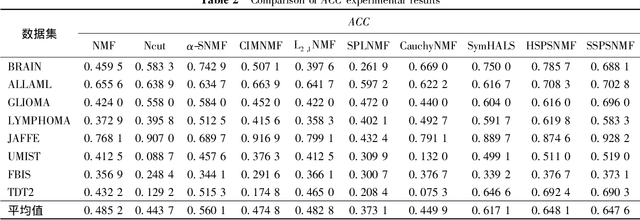
A symmetric nonnegative matrix factorization algorithm based on self-paced learning was proposed to improve the clustering performance of the model. It could make the model better distinguish normal samples from abnormal samples in an error-driven way. A weight variable that could measure the degree of difficulty to all samples was assigned in this method, and the variable was constrained by adopting both hard-weighting and soft-weighting strategies to ensure the rationality of the model. Cluster analysis was carried out on multiple data sets such as images and texts, and the experimental results showed the effectiveness of the proposed algorithm.
* in Chinese language
Unsupervised feature selection algorithm framework based on neighborhood interval disturbance fusion
Oct 20, 2024Feature selection technology is a key technology of data dimensionality reduction. Becauseof the lack of label information of collected data samples, unsupervised feature selection has attracted more attention. The universality and stability of many unsupervised feature selection algorithms are very low and greatly affected by the dataset structure. For this reason, many researchers have been keen to improve the stability of the algorithm. This paper attempts to preprocess the data set and use an interval method to approximate the data set, experimentally verifying the advantages and disadvantages of the new interval data set. This paper deals with these data sets from the global perspective and proposes a new algorithm-unsupervised feature selection algorithm based on neighborhood interval disturbance fusion(NIDF). This method can realize the joint learning of the final score of the feature and the approximate data interval. By comparing with the original unsupervised feature selection methods and several existing feature selection frameworks, the superiority of the proposed model is verified.
* in Chinese language
Out-of-Bounding-Box Triggers: A Stealthy Approach to Cheat Object Detectors
Oct 14, 2024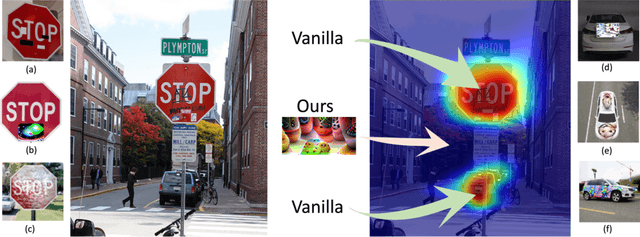
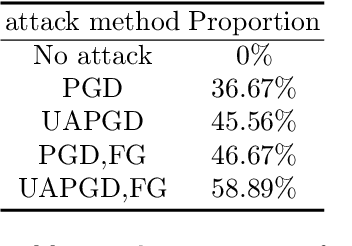
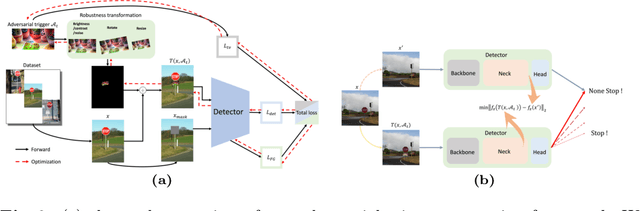
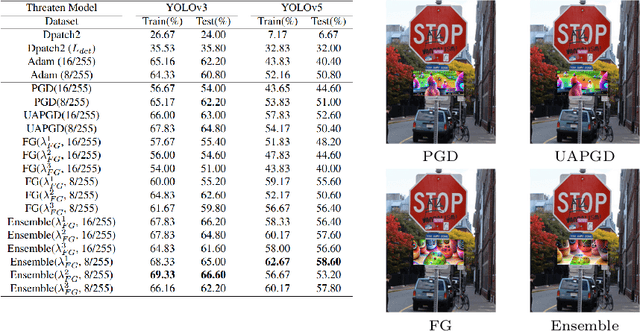
In recent years, the study of adversarial robustness in object detection systems, particularly those based on deep neural networks (DNNs), has become a pivotal area of research. Traditional physical attacks targeting object detectors, such as adversarial patches and texture manipulations, directly manipulate the surface of the object. While these methods are effective, their overt manipulation of objects may draw attention in real-world applications. To address this, this paper introduces a more subtle approach: an inconspicuous adversarial trigger that operates outside the bounding boxes, rendering the object undetectable to the model. We further enhance this approach by proposing the Feature Guidance (FG) technique and the Universal Auto-PGD (UAPGD) optimization strategy for crafting high-quality triggers. The effectiveness of our method is validated through extensive empirical testing, demonstrating its high performance in both digital and physical environments. The code and video will be available at: https://github.com/linToTao/Out-of-bbox-attack.
Proactive Recommendation in Social Networks: Steering User Interest via Neighbor Influence
Sep 13, 2024
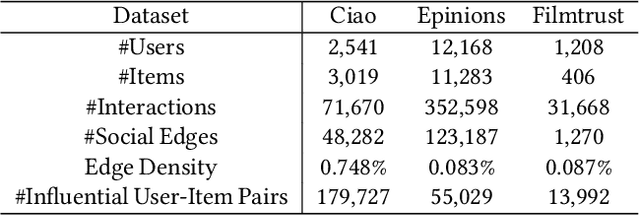
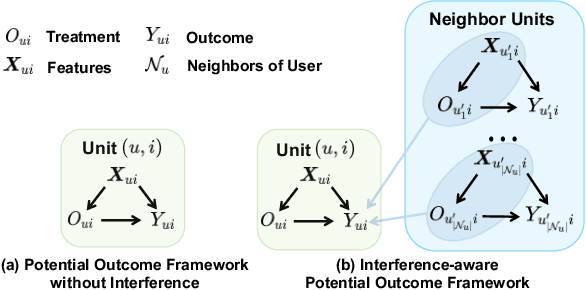
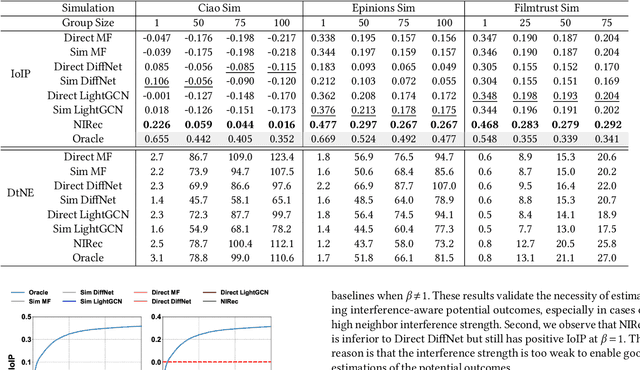
Recommending items solely catering to users' historical interests narrows users' horizons. Recent works have considered steering target users beyond their historical interests by directly adjusting items exposed to them. However, the recommended items for direct steering might not align perfectly with users' interests evolution, detrimentally affecting target users' experience. To avoid this issue, we propose a new task named Proactive Recommendation in Social Networks (PRSN) that indirectly steers users' interest by utilizing the influence of social neighbors, i.e., indirect steering by adjusting the exposure of a target item to target users' neighbors. The key to PRSN lies in answering an interventional question: what would a target user's feedback be on a target item if the item is exposed to the user's different neighbors? To answer this question, we resort to causal inference and formalize PRSN as: (1) estimating the potential feedback of a user on an item, under the network interference by the item's exposure to the user's neighbors; and (2) adjusting the exposure of a target item to target users' neighbors to trade off steering performance and the damage to the neighbors' experience. To this end, we propose a Neighbor Interference Recommendation (NIRec) framework with two key modules: (1)an interference representation-based estimation module for modeling potential feedback; and (2) a post-learning-based optimization module for optimizing a target item's exposure to trade off steering performance and the neighbors' experience by greedy search. We conduct extensive semi-simulation experiments based on three real-world datasets, validating the steering effectiveness of NIRec.