 Add to Chrome
 Add to Firefox
 Add to Edge
MotionScape: A Large-Scale Real-World Highly Dynamic UAV Video Dataset for World Models
Apr 09, 2026
Recent advances in world models have demonstrated strong capabilities in simulating physical reality, making them an increasingly important foundation for embodied intelligence. For UAV agents in particular, accurate prediction of complex 3D dynamics is essential for autonomous navigation and robust decision-making in unconstrained environments. However, under the highly dynamic camera trajectories typical of UAV views, existing world models often struggle to maintain spatiotemporal physical consistency. A key reason lies in the distribution bias of current training data: most existing datasets exhibit restricted 2.5D motion patterns, such as ground-constrained autonomous driving scenes or relatively smooth human-centric egocentric videos, and therefore lack realistic high-dynamic 6-DoF UAV motion priors. To address this gap, we present MotionScape, a large-scale real-world UAV-view video dataset with highly dynamic motion for world modeling. MotionScape contains over 30 hours of 4K UAV-view videos, totaling more than 4.5M frames. This novel dataset features semantically and geometrically aligned training samples, where diverse real-world UAV videos are tightly coupled with accurate 6-DoF camera trajectories and fine-grained natural language descriptions. To build the dataset, we develop an automated multi-stage processing pipeline that integrates CLIP-based relevance filtering, temporal segmentation, robust visual SLAM for trajectory recovery, and large-language-model-driven semantic annotation. Extensive experiments show that incorporating such semantically and geometrically aligned annotations effectively improves the ability of existing world models to simulate complex 3D dynamics and handle large viewpoint shifts, thereby benefiting decision-making and planning for UAV agents in complex environments. The dataset is publicly available at https://github.com/Thelegendzz/MotionScape

RAPTOR: Real-Time High-Resolution UAV Video Prediction with Efficient Video Attention
Dec 25, 2025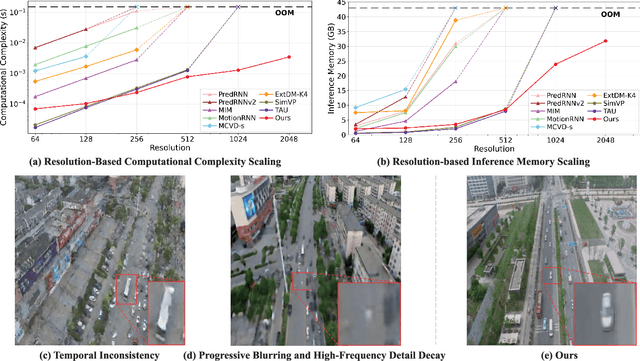
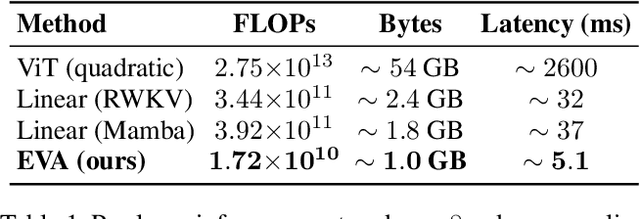
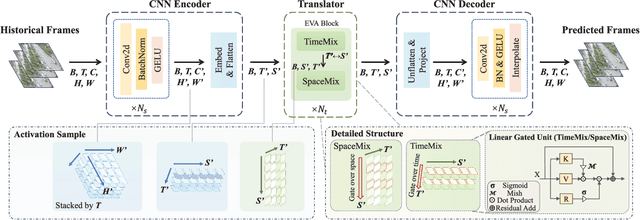
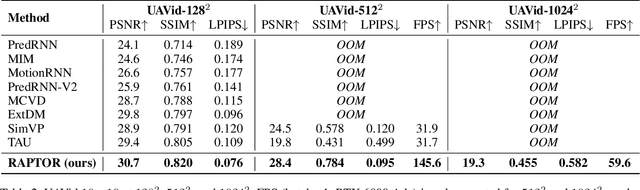
Video prediction is plagued by a fundamental trilemma: achieving high-resolution and perceptual quality typically comes at the cost of real-time speed, hindering its use in latency-critical applications. This challenge is most acute for autonomous UAVs in dense urban environments, where foreseeing events from high-resolution imagery is non-negotiable for safety. Existing methods, reliant on iterative generation (diffusion, autoregressive models) or quadratic-complexity attention, fail to meet these stringent demands on edge hardware. To break this long-standing trade-off, we introduce RAPTOR, a video prediction architecture that achieves real-time, high-resolution performance. RAPTOR's single-pass design avoids the error accumulation and latency of iterative approaches. Its core innovation is Efficient Video Attention (EVA), a novel translator module that factorizes spatiotemporal modeling. Instead of processing flattened spacetime tokens with $O((ST)^2)$ or $O(ST)$ complexity, EVA alternates operations along the spatial (S) and temporal (T) axes. This factorization reduces the time complexity to $O(S + T)$ and memory complexity to $O(max(S, T))$, enabling global context modeling at $512^2$ resolution and beyond, operating directly on dense feature maps with a patch-free design. Complementing this architecture is a 3-stage training curriculum that progressively refines predictions from coarse structure to sharp, temporally coherent details. Experiments show RAPTOR is the first predictor to exceed 30 FPS on a Jetson AGX Orin for $512^2$ video, setting a new state-of-the-art on UAVid, KTH, and a custom high-resolution dataset in PSNR, SSIM, and LPIPS. Critically, RAPTOR boosts the mission success rate in a real-world UAV navigation task by 18/%, paving the way for safer and more anticipatory embodied agents.