 Add to Chrome
 Add to Firefox
 Add to Edge
Robust Secure Beamforming for Movable Antenna Enhanced Integrated Sensing and Communications
Jun 05, 2026
In this letter, we investigate robust beamforming design for a movable antenna (MA)-enhanced secure integrated sensing and communications (ISAC) system with imperfect eaves?dropping channel state information (CSI). To improve radar sensing performance, we formulate a radar signal-to-interference?plus-noise ratio (SINR) maximization problem by jointly opti?mizing the transmit beamforming and antenna placement while ensuring communication data security. However, the resulting op?timization problem is inherently intractable due to the nonlinea mapping from antenna positions to channel coefficients, as well as the eavesdropper (Eve) channel uncertainty. To handle these challenges, we propose a block coordinate descent (BCD)-based algorithm incorporating successive convex approximation (SCA) and fractional programming (FP) techniques. Simulation results show that our proposed algorithm exhibits fast convergence and achieves a significant improvement in the radar SINR while guaranteeing communication security.

Movable Antenna Enhanced Dual-Functional Radar-Communication: A Symbol-Level Precoding Approach
May 27, 2026This letter investigates a symbol-level precoder design for movable antenna (MA)-enhanced dual-functional radar-communication (DFRC) systems. To enhance radar sensing capabilities, we formulate an optimization problem aimed at maximizing the minimum radar signal-to-interference-plus-noise ratio (SINR) across multiple targets in a cluttered environment. Our approach jointly designs the space-time transmitted waveforms, receiving filters, and antenna placement. However, the resulting problem is intractable to solve due to practical waveform constraints and the non-linear mapping from antenna positions to the corresponding channel coefficients. To address these challenges, we develop a bi-level optimization framework by leveraging deep reinforcement learning (DRL). Specifically, the twin delayed deep deterministic policy gradient (TD3) algorithm is employed in the outer layer to optimize antenna placement, while penalty convex-concave procedure (CCP) and majorization-minimization (MM) techniques are incorporated in the inner layer for regularizing waveform design. Simulation results demonstrate that the proposed method significantly improves radar SINR and achieves a superior sensing-communication trade-off compared to benchmark schemes.
Waveform Design for 6G ISAC Systems Under Full-Duplex Residual Self-Interference
May 04, 2026In this paper, the waveform design for 6G integrated sensing and communication (ISAC) systems is investigated, with a particular focus on the practical limitations imposed by imperfect full-duplex radios. Under such imperfections, continuous communication waveforms, such as OFDM, suffer from severe full-duplex residual self-interference (RSI) for radar sensing, which significantly restricts the long-range sensing capabilities required by emerging low-altitude wireless networks (LAWN). To address this challenge, we propose a novel time-division ISAC waveform that integrates a specially developed dual-power phase-coded pulse for sensing into the communication frame under full-duplex RSI. Specifically, the dual-power sensing pulse consists of a high-power sequence followed by a low-power sequence, effectively exploiting imperfect full-duplex operations to achieve reliable long-range sensing while eliminating the detection blind range inherent to conventional half-duplex pulse radars. Furthermore, a complementary and inverse-phase sequence group is designed to ensure perfect autocorrelation and robust cross-correlation sidelobe suppression, so as to enhance multi-target detection capability. As for sensing signal processing, a parameterized mismatched filter is developed and optimized to maximize the detection performance, tailored to the proposed pulse structure. In addition, we design a hierarchical one-dimensional CFAR-CA detector that can exploit the perfect range-domain autocorrelation characteristics of the proposed waveform to further improve the detection performance. Extensive simulations demonstrate that the proposed design significantly improves the maximum detection range and multi-target detection capability compared to existing OFDM and LFM pulse baselines, while effectively covering the blind range for targets with small RCS.
Heterogeneous Mixture-of-Experts for Energy-Efficient Multimodal ISAC in Highly Mobile Networks
Apr 08, 2026The integration of multimodal sensing and millimeter-wave (mmWave) communications is a key enabler for highly mobile vehicle-to-infrastructure (V2I) networks. However, continuous high-resolution visual sensing incurs prohibitive computational energy, while delayed sensing information worsens beam misalignment. In this paper, we establish a physics-aware multimodel integrated sensing and communication (M-ISAC) framework that quantifies the mathematical trade-off between sensing energy and communication reliability using the semantic age of information (AoI). To address the coupled challenges of temporal AoI evolution and instantaneous non-convex constant modulus constraints, we propose a novel reinforcement learning approach empowered by a heterogeneous mixture-of-experts (RL-H-MoE) architecture. By strictly decoupling the temporal scheduling and spatial phase mapping, the RL-H-MoE avoids prevalent gradient conflicts in multi-task learning. Extensive simulations demonstrate that the proposed architecture achieves an optimal event-triggered sensing policy, significantly minimizing the long-term system cost while guaranteeing ultra-low sensing errors and reliable physical-layer link connectivity.
Sparse Gain Radio Map Reconstruction With Geometry Priors and Uncertainty-Guided Measurement Selection
Apr 07, 2026Radio maps are important for environment-aware wireless communication, network planning, and radio resource optimization. However, dense radio map construction remains challenging when only a limited number of measurements are available, especially in complex urban environments with strong blockages, irregular geometry, and restricted sensing accessibility. Existing methods have explored interpolation, low-rank cartography, deep completion, and channel knowledge map (CKM) construction, but many of these methods insufficiently exploit explicit geometric priors or overlook the value of predictive uncertainty for subsequent sensing. In this paper, we study sparse gain radio map reconstruction from a geometry-aware and active sensing perspective. We first construct \textbf{UrbanRT-RM}, a controllable ray-tracing benchmark with diverse urban layouts, multiple base-station deployments, and multiple sparse sampling modes. We then propose \textbf{GeoUQ-GFNet}, a lightweight network that jointly predicts a dense gain radio map and a spatial uncertainty map from sparse measurements and structured scene priors. The predicted uncertainty is further used to guide active measurement selection under limited sensing budgets. Extensive experiments show that our proposed GeoUQ-GFNet method achieves strong and consistent reconstruction performance across different scenes and transmitter placements generated using UrbanRT-RM. Moreover, uncertainty-guided querying provides more effective reconstruction improvement than non-adaptive sampling under the same additional measurement budget. These results demonstrate the effectiveness of combining geometry-aware learning, uncertainty estimation, and benchmark-driven evaluation for sparse radio map reconstruction in complex urban environments.
Movable Antenna Empowered Covert Dual-Functional Radar-Communication
Jan 21, 2026Movable antenna (MA) has emerged as a promising technology to flexibly reconfigure wireless channels by adjusting antenna placement. In this paper, we study a secured dual-functional radar-communication (DFRC) system aided by movable antennas. To enhance the communication security, we aim to maximize the achievable sum rate by jointly optimizing the transmitter beamforming vectors, receiving filter, and antenna placement, subject to radar signal-to-noise ratio (SINR) and transmission covertness constraints. We consider multiple Willies operating in both non-colluding and colluding modes. For noncolluding Willies, we first employ a Lagrangian dual transformation procedure to reformulate the challenging optimization problem into a more tractable form. Subsequently, we develop an efficient block coordinate descent (BCD) algorithm that integrates semidefinite relaxation (SDR), projected gradient descent (PGD), Dinkelbach transformation, and successive convex approximation (SCA) techniques to tackle the resulting problem. For colluding Willies, we first derive the minimum detection error probability (DEP) by characterizing the optimal detection statistic, which is proven to follow the generalized Erlang distribution. Then, we develop a minimum mean square error (MMSE)-based algorithm to address the colluding detection problem. We further provide a comprehensive complexity analysis on the unified design framework. Simulation results demonstrate that the proposed method can significantly improve the covert sum rate, and achieve a superior balance between communication and radar performance compared with existing benchmark schemes.
SKANet: A Cognitive Dual-Stream Framework with Adaptive Modality Fusion for Robust Compound GNSS Interference Classification
Jan 19, 2026As the electromagnetic environment becomes increasingly complex, Global Navigation Satellite Systems (GNSS) face growing threats from sophisticated jamming interference. Although Deep Learning (DL) effectively identifies basic interference, classifying compound interference remains difficult due to the superposition of diverse jamming sources. Existing single-domain approaches often suffer from performance degradation because transient burst signals and continuous global signals require conflicting feature extraction scales. We propose the Selective Kernel and Asymmetric convolution Network(SKANet), a cognitive deep learning framework built upon a dual-stream architecture that integrates Time-Frequency Images (TFIs) and Power Spectral Density (PSD). Distinct from conventional fusion methods that rely on static receptive fields, the proposed architecture incorporates a Multi-Branch Selective Kernel (SK) module combined with Asymmetric Convolution Blocks (ACBs). This mechanism enables the network to dynamically adjust its receptive fields, acting as an adaptive filter that simultaneously captures micro-scale transient features and macro-scale spectral trends within entangled compound signals. To complement this spatial-temporal adaptation, a Squeeze-and-Excitation (SE) mechanism is integrated at the fusion stage to adaptively recalibrate the contribution of heterogeneous features from each modality. Evaluations on a dataset of 405,000 samples demonstrate that SKANet achieves an overall accuracy of 96.99\%, exhibiting superior robustness for compound jamming classification, particularly under low Jamming-to-Noise Ratio (JNR) regimes.
PhyG-MoE: A Physics-Guided Mixture-of-Experts Framework for Energy-Efficient GNSS Interference Recognition
Jan 19, 2026Complex electromagnetic interference increasingly compromises Global Navigation Satellite Systems (GNSS), threatening the reliability of Space-Air-Ground Integrated Networks (SAGIN). Although deep learning has advanced interference recognition, current static models suffer from a \textbf{fundamental limitation}: they impose a fixed computational topology regardless of the input's physical entropy. This rigidity leads to severe resource mismatch, where simple primitives consume the same processing cost as chaotic, saturated mixtures. To resolve this, this paper introduces PhyG-MoE (Physics-Guided Mixture-of-Experts), a framework designed to \textbf{dynamically align model capacity with signal complexity}. Unlike static architectures, the proposed system employs a spectrum-based gating mechanism that routes signals based on their spectral feature entanglement. A high-capacity TransNeXt expert is activated on-demand to disentangle complex features in saturated scenarios, while lightweight experts handle fundamental signals to minimize latency. Evaluations on 21 jamming categories demonstrate that PhyG-MoE achieves an overall accuracy of 97.58\%. By resolving the intrinsic conflict between static computing and dynamic electromagnetic environments, the proposed framework significantly reduces computational overhead without performance degradation, offering a viable solution for resource-constrained cognitive receivers.
Crosstalk-Resilient Beamforming for Movable Antenna Enabled Integrated Sensing and Communication
Sep 03, 2025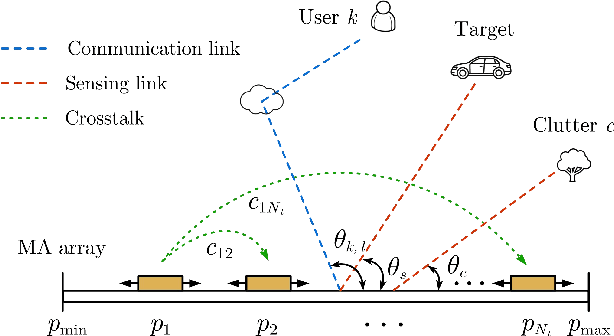
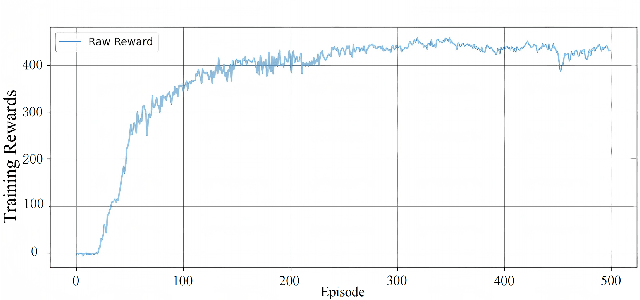
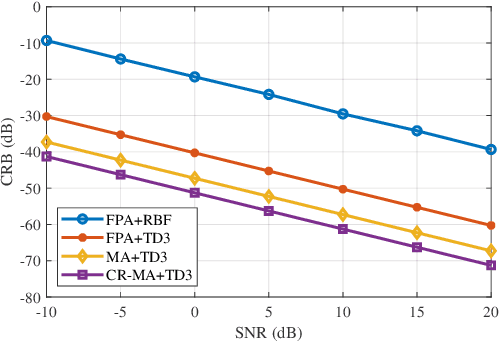
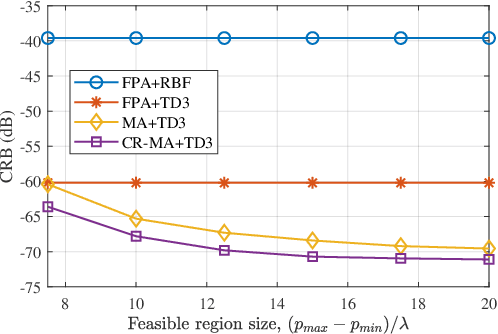
This paper investigates a movable antenna (MA) enabled integrated sensing and communication (ISAC) system under the influence of antenna crosstalk. First, it generalizes the antenna crosstalk model from the conventional fixed-position antenna (FPA) system to the MA scenario. Then, a Cramer-Rao bound (CRB) minimization problem driven by joint beamforming and antenna position design is presented. Specifically, to address this highly non-convex flexible beamforming problem, we deploy a deep reinforcement learning (DRL) approach to train a flexible beamforming agent. To ensure stability during training, a Twin Delayed Deep Deterministic Policy Gradient (TD3) algorithm is adopted to balance exploration with reward maximization for efficient and reliable learning. Numerical results demonstrate that the proposed crosstalk-resilient (CR) algorithm enhances the overall ISAC performance compared to other benchmark schemes.
Robust Transceiver Design for RIS Enhanced Dual-Functional Radar-Communication with Movable Antenna
Jun 09, 2025Movable antennas (MAs) have demonstrated significant potential in enhancing the performance of dual-functional radar-communication (DFRC) systems. In this paper, we explore an MA-aided DFRC system that utilizes a reconfigurable intelligent surface (RIS) to enhance signal coverage for communications in dead zones. To enhance the radar sensing performance in practical DFRC environments, we propose a unified robust transceiver design framework aimed at maximizing the minimum radar signal-to-interference-plus-noise ratio (SINR) in a cluttered environment. Our approach jointly optimizes transmit beamforming, receive filtering, antenna placement, and RIS reflecting coefficients under imperfect channel state information (CSI) for both sensing and communication channels. To deal with the channel uncertainty-constrained issue, we leverage the convex hull method to transform the primal problem into a more tractable form. We then introduce a two-layer block coordinate descent (BCD) algorithm, incorporating fractional programming (FP), successive convex approximation (SCA), S-Lemma, and penalty techniques to reformulate it into a series of semidefinite program (SDP) subproblems that can be efficiently solved. We provide a comprehensive analysis of the convergence and computational complexity for the proposed design framework. Simulation results demonstrate the robustness of the proposed method, and show that the MA-based design framework can significantly enhance the radar SINR performance while achieving an effective balance between the radar and communication performance.