 Add to Chrome
 Add to Firefox
 Add to Edge
Flexible Cylindrical Array-Aided Secure Wireless Communications
Apr 10, 2026
Flexible-geometry arrays based on movable antennas have shown considerable potential for improving wireless communication performance. In this letter, we investigate a multiuser multiple-input single-output (MU-MISO) downlink secure communication system aided by a flexible cylindrical array (FCLA) and artificial noise (AN), where each antenna element rotates along circular tracks while the circular slices move along a vertical axis. To guarantee transmission security, we aim to maximize the achievable sum rate at multiple legitimate information receivers by jointly optimizing transmit beamforming, AN covariance matrix, and antenna placement under secrecy constraints for an eavesdropper. While the resulting problem is intractable to solve, we develop a block coordinate descent (BCD)-based framework that combines the Lagrangian dual transform, tight semidefinite relaxation (SDR), and Nesterov-accelerated projected gradient descent (PGD). Numerical results show that the proposed algorithm converges rapidly and achieves significant sum-rate gains over benchmark schemes by exploiting the geometry flexibility of the array.

Sparse Gain Radio Map Reconstruction With Geometry Priors and Uncertainty-Guided Measurement Selection
Apr 07, 2026Radio maps are important for environment-aware wireless communication, network planning, and radio resource optimization. However, dense radio map construction remains challenging when only a limited number of measurements are available, especially in complex urban environments with strong blockages, irregular geometry, and restricted sensing accessibility. Existing methods have explored interpolation, low-rank cartography, deep completion, and channel knowledge map (CKM) construction, but many of these methods insufficiently exploit explicit geometric priors or overlook the value of predictive uncertainty for subsequent sensing. In this paper, we study sparse gain radio map reconstruction from a geometry-aware and active sensing perspective. We first construct \textbf{UrbanRT-RM}, a controllable ray-tracing benchmark with diverse urban layouts, multiple base-station deployments, and multiple sparse sampling modes. We then propose \textbf{GeoUQ-GFNet}, a lightweight network that jointly predicts a dense gain radio map and a spatial uncertainty map from sparse measurements and structured scene priors. The predicted uncertainty is further used to guide active measurement selection under limited sensing budgets. Extensive experiments show that our proposed GeoUQ-GFNet method achieves strong and consistent reconstruction performance across different scenes and transmitter placements generated using UrbanRT-RM. Moreover, uncertainty-guided querying provides more effective reconstruction improvement than non-adaptive sampling under the same additional measurement budget. These results demonstrate the effectiveness of combining geometry-aware learning, uncertainty estimation, and benchmark-driven evaluation for sparse radio map reconstruction in complex urban environments.
PhyG-MoE: A Physics-Guided Mixture-of-Experts Framework for Energy-Efficient GNSS Interference Recognition
Jan 19, 2026Complex electromagnetic interference increasingly compromises Global Navigation Satellite Systems (GNSS), threatening the reliability of Space-Air-Ground Integrated Networks (SAGIN). Although deep learning has advanced interference recognition, current static models suffer from a \textbf{fundamental limitation}: they impose a fixed computational topology regardless of the input's physical entropy. This rigidity leads to severe resource mismatch, where simple primitives consume the same processing cost as chaotic, saturated mixtures. To resolve this, this paper introduces PhyG-MoE (Physics-Guided Mixture-of-Experts), a framework designed to \textbf{dynamically align model capacity with signal complexity}. Unlike static architectures, the proposed system employs a spectrum-based gating mechanism that routes signals based on their spectral feature entanglement. A high-capacity TransNeXt expert is activated on-demand to disentangle complex features in saturated scenarios, while lightweight experts handle fundamental signals to minimize latency. Evaluations on 21 jamming categories demonstrate that PhyG-MoE achieves an overall accuracy of 97.58\%. By resolving the intrinsic conflict between static computing and dynamic electromagnetic environments, the proposed framework significantly reduces computational overhead without performance degradation, offering a viable solution for resource-constrained cognitive receivers.
Movable Antenna Enhanced MIMO Communications with Spatial Modulation
Jan 19, 2026Movable antenna (MA) has demonstrated great potential in enhancing wireless communication performance. In this paper, we investigate an MA-enabled multiple-input multiple-output (MIMO) communication system with spatial modulation (SM), which improves communication performance by utilizing flexible MA placement while reducing the cost of RF chains. To this end, we propose a joint transceiver design framework aimed at minimizing the bit error rate (BER) based on the maximum minimum distance (MMD) criterion. To address the intractable problem, we develop an efficient iterative algorithm based on alternating optimization (AO) and successive convex approximation (SCA) techniques. Simulation results demonstrate that the proposed algorithm achieves rapid convergence performance and significantly outperforms the existing benchmark schemes.
SKANet: A Cognitive Dual-Stream Framework with Adaptive Modality Fusion for Robust Compound GNSS Interference Classification
Jan 19, 2026As the electromagnetic environment becomes increasingly complex, Global Navigation Satellite Systems (GNSS) face growing threats from sophisticated jamming interference. Although Deep Learning (DL) effectively identifies basic interference, classifying compound interference remains difficult due to the superposition of diverse jamming sources. Existing single-domain approaches often suffer from performance degradation because transient burst signals and continuous global signals require conflicting feature extraction scales. We propose the Selective Kernel and Asymmetric convolution Network(SKANet), a cognitive deep learning framework built upon a dual-stream architecture that integrates Time-Frequency Images (TFIs) and Power Spectral Density (PSD). Distinct from conventional fusion methods that rely on static receptive fields, the proposed architecture incorporates a Multi-Branch Selective Kernel (SK) module combined with Asymmetric Convolution Blocks (ACBs). This mechanism enables the network to dynamically adjust its receptive fields, acting as an adaptive filter that simultaneously captures micro-scale transient features and macro-scale spectral trends within entangled compound signals. To complement this spatial-temporal adaptation, a Squeeze-and-Excitation (SE) mechanism is integrated at the fusion stage to adaptively recalibrate the contribution of heterogeneous features from each modality. Evaluations on a dataset of 405,000 samples demonstrate that SKANet achieves an overall accuracy of 96.99\%, exhibiting superior robustness for compound jamming classification, particularly under low Jamming-to-Noise Ratio (JNR) regimes.
Modeling and Optimization for Flexible Cylindrical Arrays-Enabled Wireless Communications
Mar 14, 2025Flexible-geometry arrays have garnered much attention in wireless communications, which dynamically adjust wireless channels to improve the system performance. In this paper, we propose a novel flexible-geometry array for a $360^\circ$ coverage, named flxible cylindrical array (FCLA), comprised of multiple flexible circular arrays (FCAs). The elements in each FCA can revolve around the circle track to change their horizontal positions, and the FCAs can move along the vertical axis to change the elements' heights. Considering that horizontal revolving can change the antenna orientation, we adopt both the omni-directional and the directional antenna patterns. Based on the regularized zero-forcing (RZF) precoding scheme, we formulate a particular compressive sensing (CS) problem incorporating joint precoding and antenna position optimization, and propose two effective methods, namely FCLA-J and FCLA-A, to solve it. Specifically, the first method involves jointly optimizing the element's revolving angle, height, and precoding coefficient within a single CS framework. The second method decouples the CS problem into two subproblems by utilizing an alternative sparse optimization approach for the revolving angle and height, thereby reducing time complexity. Simulation results reveal that, when utilizing directional radiation patterns, FCLA-J and FCLA-A achieve substantial performance improvements of 43.32\% and 25.42\%, respectively, compared to uniform cylindrical arrays (UCLAs) with RZF precoding.
Flexible Cylindrical Arrays with Movable Antennas for MISO System: Beamforming and Position Optimization
Jan 25, 2025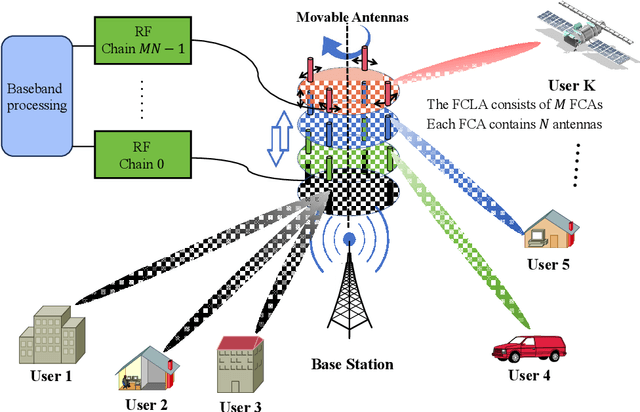
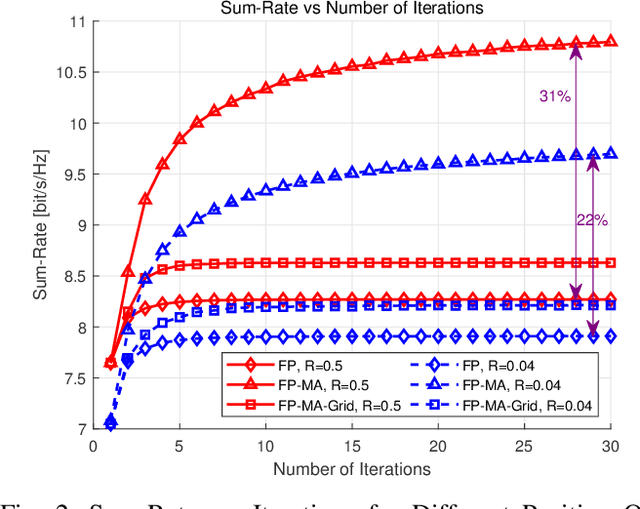
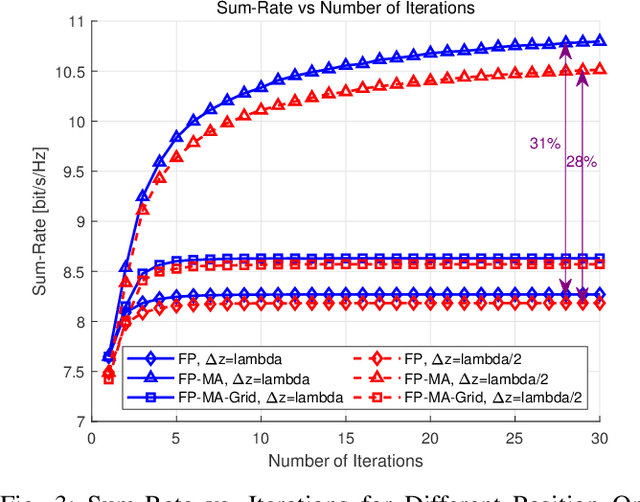
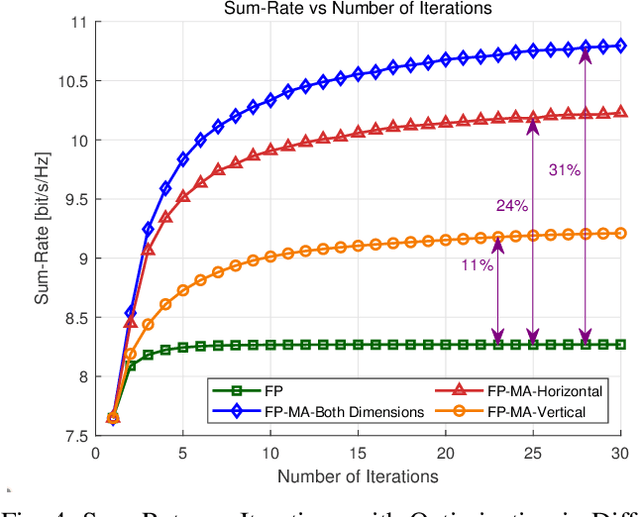
As wireless communication advances toward the 6G era, the demand for ultra-reliable, high-speed, and ubiquitous connectivity is driving the exploration of new degrees-of-freedom (DoFs) in communication systems. Among the key enabling technologies, Movable Antennas (MAs) integrated into Flexible Cylindrical Arrays (FCLA) have shown great potential in optimizing wireless communication by providing spatial flexibility. This paper proposes an innovative optimization framework that leverages the dynamic mobility of FCLAs to improve communication rates and overall system performance. By employing Fractional Programming (FP) for alternating optimization of beamforming and antenna positions, the system enhances throughput and resource utilization. Additionally, a novel Constrained Grid Search-Based Adaptive Moment Estimation Algorithm (CGS-Adam) is introduced to optimize antenna positions while adhering to antenna spacing constraints. Extensive simulations validate that the proposed system, utilizing movable antennas, significantly outperforms traditional fixed antenna optimization, achieving up to a 31\% performance gain in general scenarios. The integration of FCLAs in wireless networks represents a promising solution for future 6G systems, offering improved coverage, energy efficiency, and flexibility.
Flexible Antenna Arrays for Wireless Communications: Modeling and Performance Evaluation
Jul 06, 2024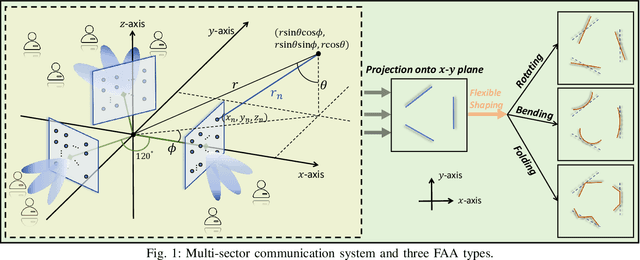
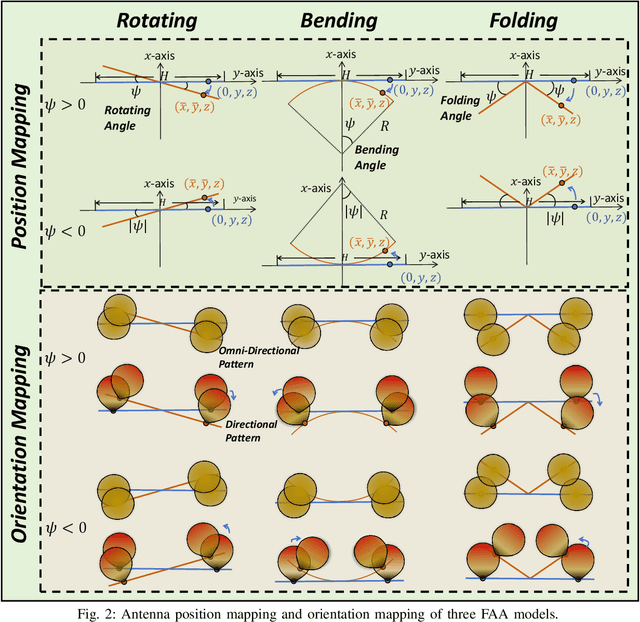
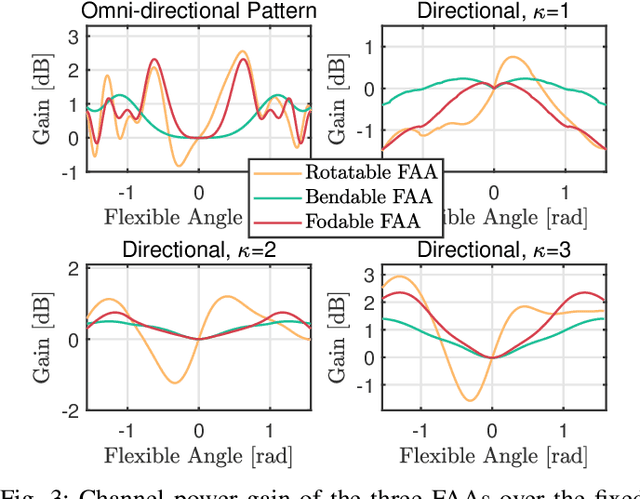
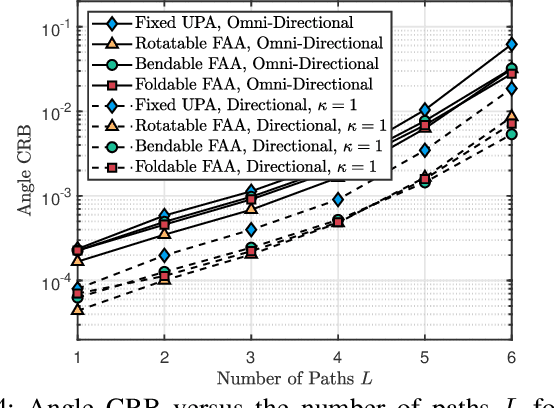
Flexible antenna arrays (FAAs), distinguished by their rotatable, bendable, and foldable properties, are extensively employed in flexible radio systems to achieve customized radiation patterns. This paper aims to illustrate that FAAs, capable of dynamically adjusting surface shapes, can enhance communication performances with both omni-directional and directional antenna patterns, in terms of multi-path channel power and channel angle Cram\'{e}r-Rao bounds. To this end, we develop a mathematical model that elucidates the impacts of the variations in antenna positions and orientations as the array transitions from a flat to a rotated, bent, and folded state, all contingent on the flexible degree-of-freedom. Moreover, since the array shape adjustment operates across the entire beamspace, especially with directional patterns, we discuss the sum-rate in the multi-sector base station that covers the $360^\circ$ communication area. Particularly, to thoroughly explore the multi-sector sum-rate, we propose separate flexible precoding (SFP), joint flexible precoding (JFP), and semi-joint flexible precoding (SJFP), respectively. In our numerical analysis comparing the optimized FAA to the fixed uniform planar array, we find that the bendable FAA achieves a remarkable $156\%$ sum-rate improvement compared to the fixed planar array in the case of JFP with the directional pattern. Furthermore, the rotatable FAA exhibits notably superior performance in SFP and SJFP cases with omni-directional patterns, with respective $35\%$ and $281\%$.
Dual-Robust Integrated Sensing and Communication: Beamforming under CSI Imperfection and Location Uncertainty
May 17, 2024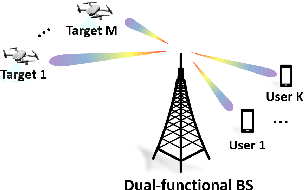
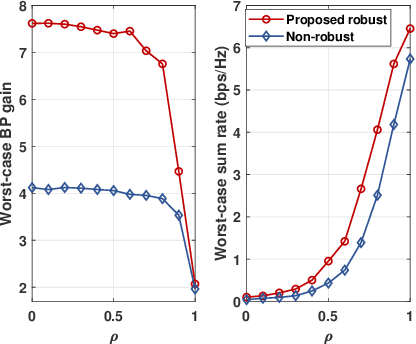
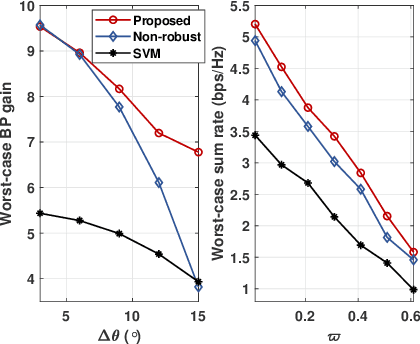
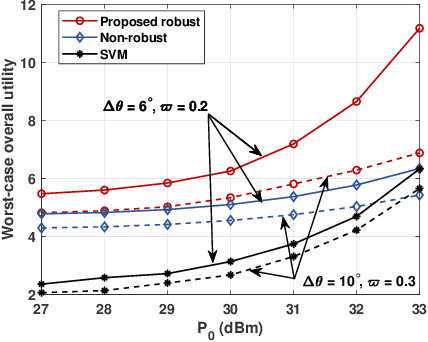
A dual-robust design of beamforming is investigated in an integrated sensing and communication (ISAC) system.Existing research on robust ISAC waveform design, while proposing solutions to imperfect channel state information (CSI), generally depends on prior knowledge of the target's approximate location to design waveforms. This approach, however, limits the precision in sensing the target's exact location. In this paper, considering both CSI imperfection and target location uncertainty, a novel framework of joint robust optimization is proposed by maximizing the weighted sum of worst-case data rate and beampattern gain. To address this challenging problem, we propose an efficient two-layer iteration algorithm based on S-Procedure and convex hull. Finally, numerical results verify the effectiveness and performance improvement of our dual-robust algorithm, as well as the trade-off between communication and sensing performance.
Flexible Beamforming for Movable Antenna-Enabled Integrated Sensing and Communication
May 17, 2024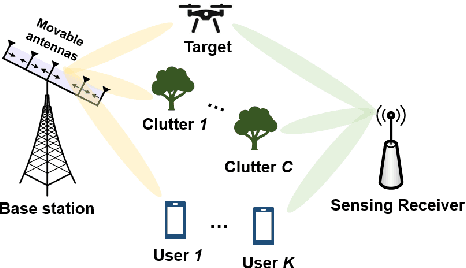
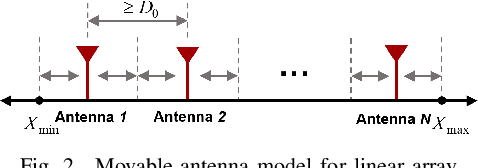
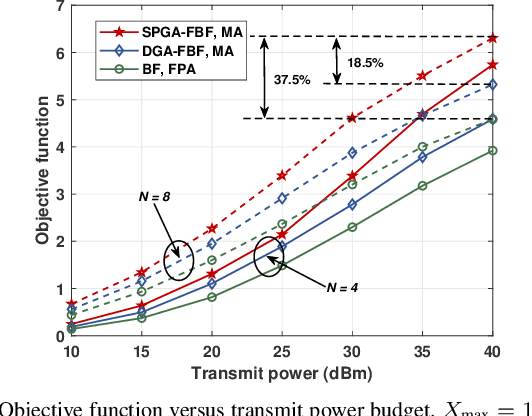
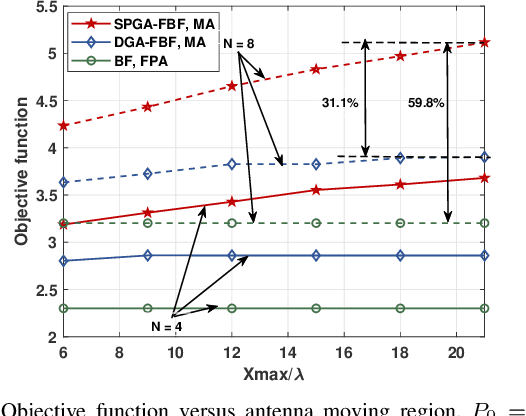
This paper investigates flexible beamforming design in an integrated sensing and communication (ISAC) network with movable antennas (MAs). A bistatic radar system is integrated into a multi-user multiple-input-single-output (MU-MISO) system, with the base station (BS) equipped with MAs. This enables array response reconfiguration by adjusting the positions of antennas. Thus, a joint beamforming and antenna position optimization problem, namely flexible beamforming, is proposed to maximize communication rate and sensing mutual information (MI). The fractional programming (FP) method is adopted to transform the non-convex objective function, and we alternatively update the beamforming matrix and antenna positions. Karush-Kuhn-Tucker (KKT) conditions are employed to derive the close-form solution of the beamforming matrix, while we propose an efficient search-based projected gradient ascent (SPGA) method to update the antenna positions. Simulation results demonstrate that MAs significantly enhance the ISAC performance when employing our proposed algorithm, achieving a 59.8% performance gain compared to fixed uniform arrays.