 Add to Chrome
 Add to Firefox
 Add to Edge
MR-LiDAR: A Multi-Resolution Roadside LiDAR Benchmark for Perception Diagnostics and Deployment Guidance
May 23, 2026
LiDAR model selection is a critical issue in roadside sensing systems, as it directly determines both perception capability and deployment cost. However, the lack of empirical benchmarks for comparing perception performance across different LiDAR configurations has greatly constrained scientific sensor selection and deployment planning. To address this gap, we present MR-LiDAR, a controlled multi-resolution LiDAR benchmark for roadside perception diagnostics. Using 16-, 32-, 80-, and 128-beam LiDARs in identical roadside scenarios, we collect point clouds and ground-truth annotations for diverse traffic participants, including vehicles and vulnerable road users (VRUs), across varying distances. This controlled design isolates intrinsic LiDAR specifications, particularly beam count and beam distribution, as the key variables for precise performance diagnostics. Based on MR-LiDAR, we conduct systematic empirical analyses to examine how beam count, beam distribution, target distance, object category, and vehicle occlusion affect LiDAR perception performance. The results reveal that all of these factors have substantial impacts. In particular, contrary to the common assumption that higher beam counts always yield better perception, we show that an 80-beam LiDAR with optimized beam distribution can match or even outperform a 128-beam LiDAR with uniform beam distribution. In addition, we provide a practical reference guide for LiDAR selection, including target point-count statistics and detection performance comparisons based on two widely used detection algorithms. This work offers a diagnostic benchmark and practical guidance for determining cost-effective LiDAR configurations in roadside perception applications.

Crosstalk-Resilient Beamforming for Movable Antenna Enabled Integrated Sensing and Communication
Sep 03, 2025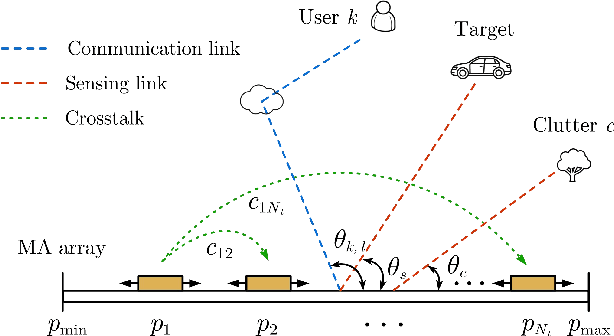
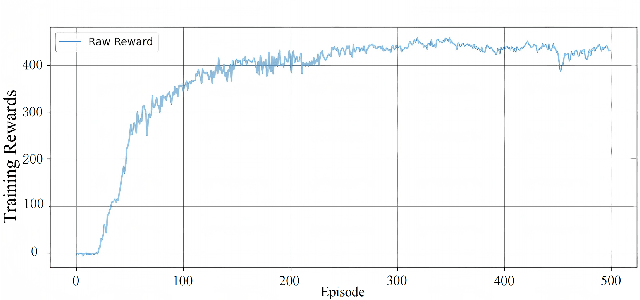
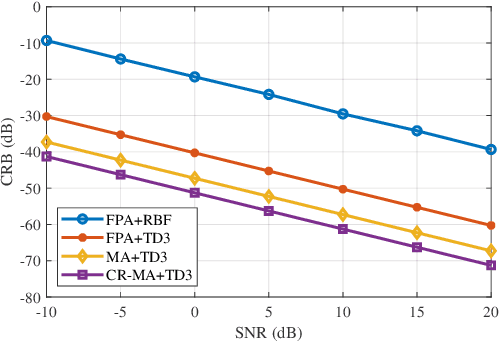
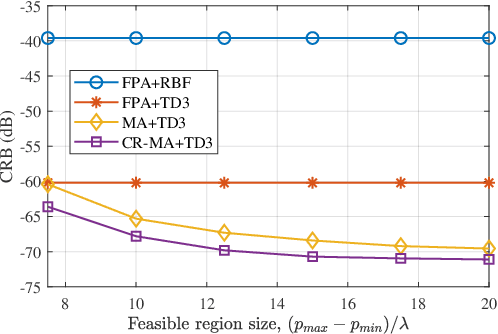
This paper investigates a movable antenna (MA) enabled integrated sensing and communication (ISAC) system under the influence of antenna crosstalk. First, it generalizes the antenna crosstalk model from the conventional fixed-position antenna (FPA) system to the MA scenario. Then, a Cramer-Rao bound (CRB) minimization problem driven by joint beamforming and antenna position design is presented. Specifically, to address this highly non-convex flexible beamforming problem, we deploy a deep reinforcement learning (DRL) approach to train a flexible beamforming agent. To ensure stability during training, a Twin Delayed Deep Deterministic Policy Gradient (TD3) algorithm is adopted to balance exploration with reward maximization for efficient and reliable learning. Numerical results demonstrate that the proposed crosstalk-resilient (CR) algorithm enhances the overall ISAC performance compared to other benchmark schemes.