 Add to Chrome
 Add to Firefox
 Add to Edge
CogBlender: Towards Continuous Cognitive Intervention in Text-to-Image Generation
Mar 10, 2026
Beyond conveying semantic information, an image can also manifest cognitive attributes that elicit specific cognitive processes from the viewer, such as memory encoding or emotional response. While modern text-to-image models excel at generating semantically coherent content, they remain limited in their ability to control such cognitive properties of images (e.g., valence, memorability), often failing to align with the specific psychological intent. To bridge this gap, we introduce CogBlender, a framework that enables continuous and multi-dimensional intervention of cognitive properties during text-to-image generation. Our approach is built upon a mapping between the Cognitive Space, representing the space of cognitive properties, and the Semantic Manifold, representing the manifold of the visual semantics. We define a set of Cognitive Anchors, serving as the boundary points for the cognitive space. Then we reformulate the velocity field within the flow-matching process by interpolating from the velocity field of different anchors. Consequently, the generative process is driven by the velocity field and dynamically steered by multi-dimensional cognitive scores, enabling precise, fine-grained, and continuous intervention. We validate the effectiveness of CogBlender across four representative cognitive dimensions: valence, arousal, dominance, and image memorability. Extensive experiments demonstrate that our method achieves effective cognitive intervention. Our work provides an effective paradigm for cognition-driven creative design.

Beyond Input-Output: Rethinking Creativity through Design-by-Analogy in Human-AI Collaboration
Feb 10, 2026While the proliferation of foundation models has significantly boosted individual productivity, it also introduces a potential challenge: the homogenization of creative content. In response, we revisit Design-by-Analogy (DbA), a cognitively grounded approach that fosters novel solutions by mapping inspiration across domains. However, prevailing perspectives often restrict DbA to early ideation or specific data modalities, while reducing AI-driven design to simplified input-output pipelines. Such conceptual limitations inadvertently foster widespread design fixation. To address this, we expand the understanding of DbA by embedding it into the entire creative process, thereby demonstrating its capacity to mitigate such fixation. Through a systematic review of 85 studies, we identify six forms of representation and classify techniques across seven stages of the creative process. We further discuss three major application domains: creative industries, intelligent manufacturing, and education and services, demonstrating DbA's practical relevance. Building on this synthesis, we frame DbA as a mediating technology for human-AI collaboration and outline the potential opportunities and inherent risks for advancing creativity support in HCI and design research.
* 20 pages, 9 figures. Accepted to the 2026 CHI Conference on Human Factors in Computing Systems
DensiCrafter: Physically-Constrained Generation and Fabrication of Self-Supporting Hollow Structures
Nov 12, 2025The rise of 3D generative models has enabled automatic 3D geometry and texture synthesis from multimodal inputs (e.g., text or images). However, these methods often ignore physical constraints and manufacturability considerations. In this work, we address the challenge of producing 3D designs that are both lightweight and self-supporting. We present DensiCrafter, a framework for generating lightweight, self-supporting 3D hollow structures by optimizing the density field. Starting from coarse voxel grids produced by Trellis, we interpret these as continuous density fields to optimize and introduce three differentiable, physically constrained, and simulation-free loss terms. Additionally, a mass regularization penalizes unnecessary material, while a restricted optimization domain preserves the outer surface. Our method seamlessly integrates with pretrained Trellis-based models (e.g., Trellis, DSO) without any architectural changes. In extensive evaluations, we achieve up to 43% reduction in material mass on the text-to-3D task. Compared to state-of-the-art baselines, our method could improve the stability and maintain high geometric fidelity. Real-world 3D-printing experiments confirm that our hollow designs can be reliably fabricated and could be self-supporting.
DataScout: Automatic Data Fact Retrieval for Statement Augmentation with an LLM-Based Agent
Apr 24, 2025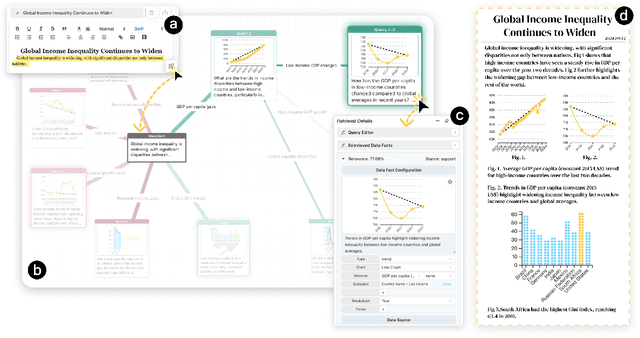
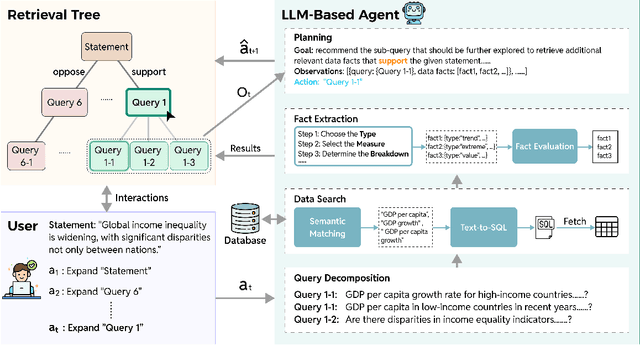
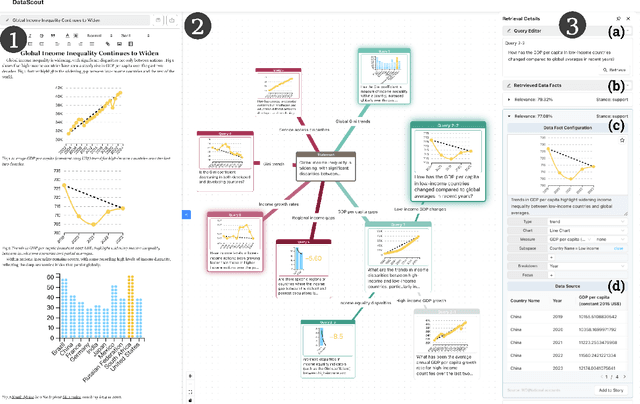
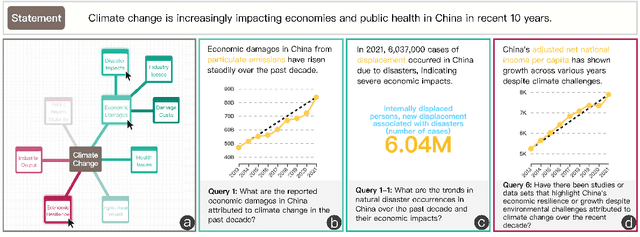
A data story typically integrates data facts from multiple perspectives and stances to construct a comprehensive and objective narrative. However, retrieving these facts demands time for data search and challenges the creator's analytical skills. In this work, we introduce DataScout, an interactive system that automatically performs reasoning and stance-based data facts retrieval to augment the user's statement. Particularly, DataScout leverages an LLM-based agent to construct a retrieval tree, enabling collaborative control of its expansion between users and the agent. The interface visualizes the retrieval tree as a mind map that eases users to intuitively steer the retrieval direction and effectively engage in reasoning and analysis. We evaluate the proposed system through case studies and in-depth expert interviews. Our evaluation demonstrates that DataScout can effectively retrieve multifaceted data facts from different stances, helping users verify their statements and enhance the credibility of their stories.
EmotiCrafter: Text-to-Emotional-Image Generation based on Valence-Arousal Model
Jan 10, 2025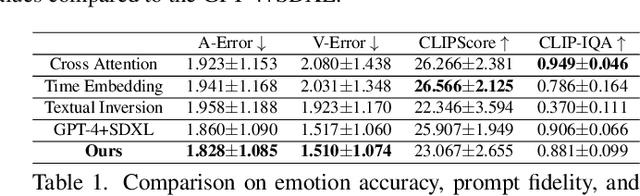
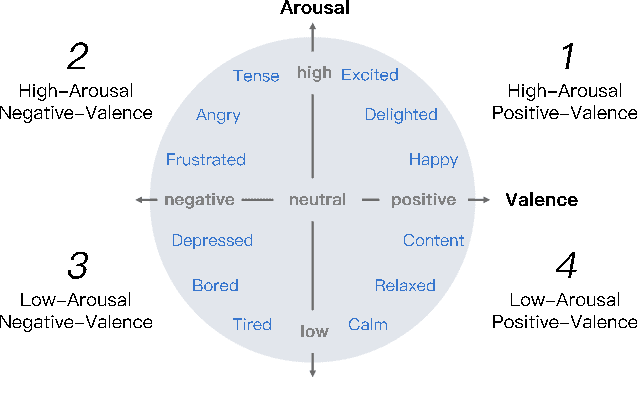
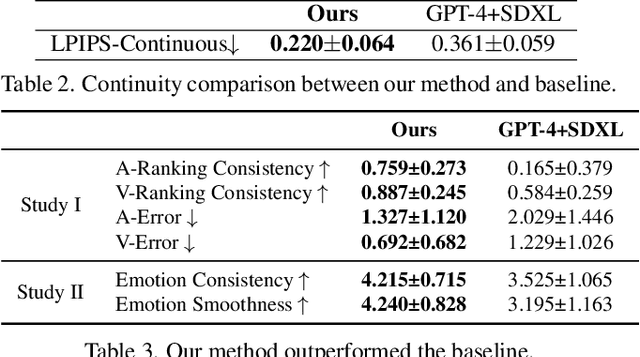
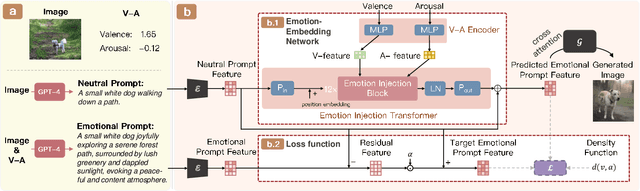
Recent research shows that emotions can enhance users' cognition and influence information communication. While research on visual emotion analysis is extensive, limited work has been done on helping users generate emotionally rich image content. Existing work on emotional image generation relies on discrete emotion categories, making it challenging to capture complex and subtle emotional nuances accurately. Additionally, these methods struggle to control the specific content of generated images based on text prompts. In this work, we introduce the new task of continuous emotional image content generation (C-EICG) and present EmotiCrafter, an emotional image generation model that generates images based on text prompts and Valence-Arousal values. Specifically, we propose a novel emotion-embedding mapping network that embeds Valence-Arousal values into textual features, enabling the capture of specific emotions in alignment with intended input prompts. Additionally, we introduce a loss function to enhance emotion expression. The experimental results show that our method effectively generates images representing specific emotions with the desired content and outperforms existing techniques.
Way to Specialist: Closing Loop Between Specialized LLM and Evolving Domain Knowledge Graph
Nov 28, 2024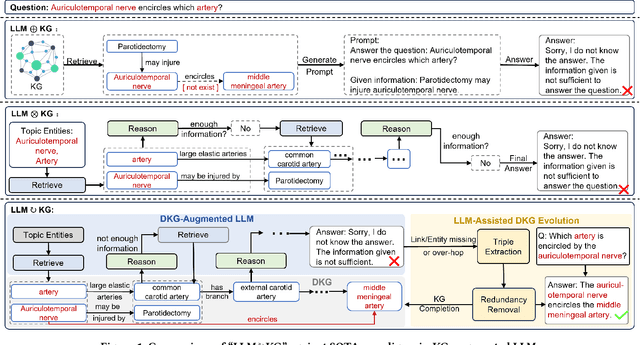
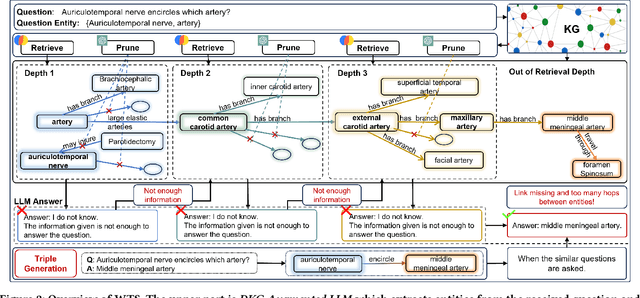

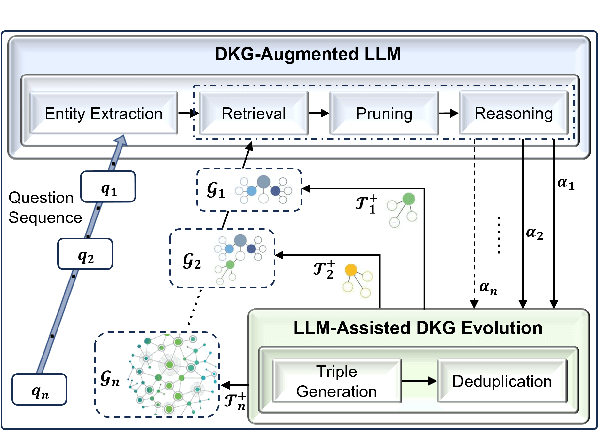
Large language models (LLMs) have demonstrated exceptional performance across a wide variety of domains. Nonetheless, generalist LLMs continue to fall short in reasoning tasks necessitating specialized knowledge. Prior investigations into specialized LLMs focused on domain-specific training, which entails substantial efforts in domain data acquisition and model parameter fine-tuning. To address these challenges, this paper proposes the Way-to-Specialist (WTS) framework, which synergizes retrieval-augmented generation with knowledge graphs (KGs) to enhance the specialized capability of LLMs in the absence of specialized training. In distinction to existing paradigms that merely utilize external knowledge from general KGs or static domain KGs to prompt LLM for enhanced domain-specific reasoning, WTS proposes an innovative "LLM$\circlearrowright$KG" paradigm, which achieves bidirectional enhancement between specialized LLM and domain knowledge graph (DKG). The proposed paradigm encompasses two closely coupled components: the DKG-Augmented LLM and the LLM-Assisted DKG Evolution. The former retrieves question-relevant domain knowledge from DKG and uses it to prompt LLM to enhance the reasoning capability for domain-specific tasks; the latter leverages LLM to generate new domain knowledge from processed tasks and use it to evolve DKG. WTS closes the loop between DKG-Augmented LLM and LLM-Assisted DKG Evolution, enabling continuous improvement in the domain specialization as it progressively answers and learns from domain-specific questions. We validate the performance of WTS on 6 datasets spanning 5 domains. The experimental results show that WTS surpasses the previous SOTA in 4 specialized domains and achieves a maximum performance improvement of 11.3%.
Visual Analysis of Multi-outcome Causal Graphs
Jul 31, 2024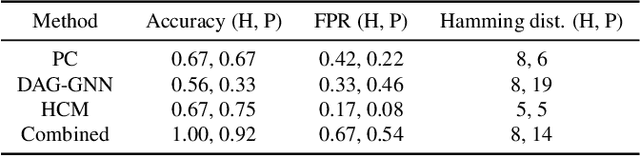
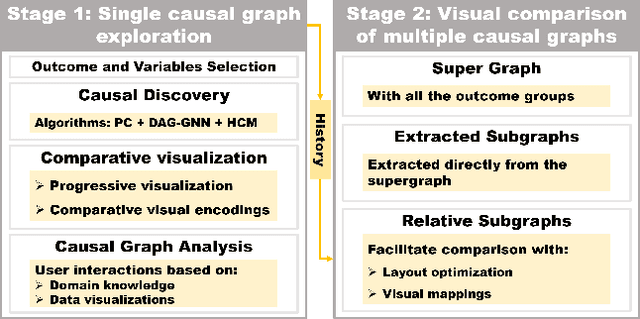
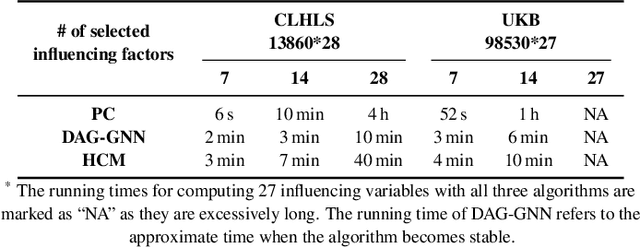
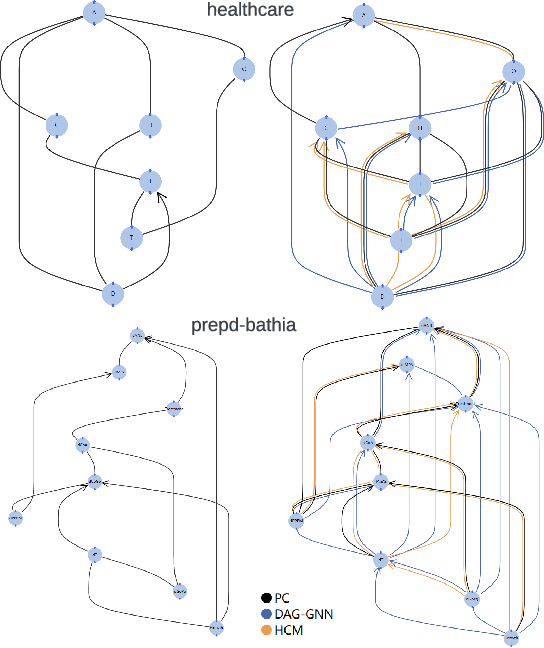
We introduce a visual analysis method for multiple causal graphs with different outcome variables, namely, multi-outcome causal graphs. Multi-outcome causal graphs are important in healthcare for understanding multimorbidity and comorbidity. To support the visual analysis, we collaborated with medical experts to devise two comparative visualization techniques at different stages of the analysis process. First, a progressive visualization method is proposed for comparing multiple state-of-the-art causal discovery algorithms. The method can handle mixed-type datasets comprising both continuous and categorical variables and assist in the creation of a fine-tuned causal graph of a single outcome. Second, a comparative graph layout technique and specialized visual encodings are devised for the quick comparison of multiple causal graphs. In our visual analysis approach, analysts start by building individual causal graphs for each outcome variable, and then, multi-outcome causal graphs are generated and visualized with our comparative technique for analyzing differences and commonalities of these causal graphs. Evaluation includes quantitative measurements on benchmark datasets, a case study with a medical expert, and expert user studies with real-world health research data.
Scalable Optimal Margin Distribution Machine
May 08, 2023Optimal margin Distribution Machine (ODM) is a newly proposed statistical learning framework rooting in the novel margin theory, which demonstrates better generalization performance than the traditional large margin based counterparts. Nonetheless, it suffers from the ubiquitous scalability problem regarding both computation time and memory as other kernel methods. This paper proposes a scalable ODM, which can achieve nearly ten times speedup compared to the original ODM training method. For nonlinear kernels, we propose a novel distribution-aware partition method to make the local ODM trained on each partition be close and converge fast to the global one. When linear kernel is applied, we extend a communication efficient SVRG method to accelerate the training further. Extensive empirical studies validate that our proposed method is highly computational efficient and almost never worsen the generalization.
Deep Co-Attention Network for Multi-View Subspace Learning
Feb 15, 2021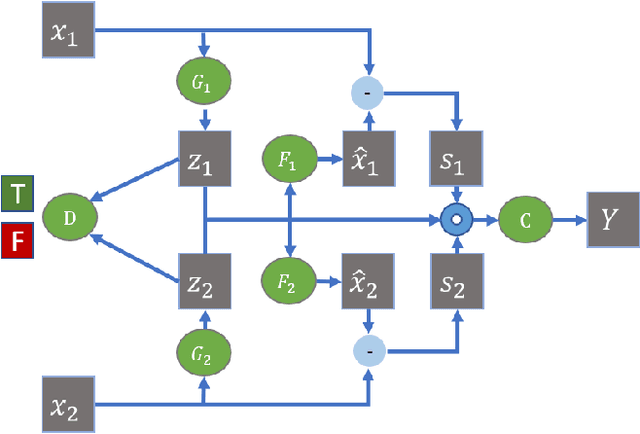
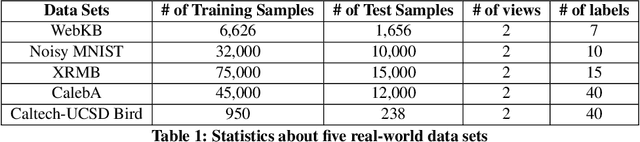
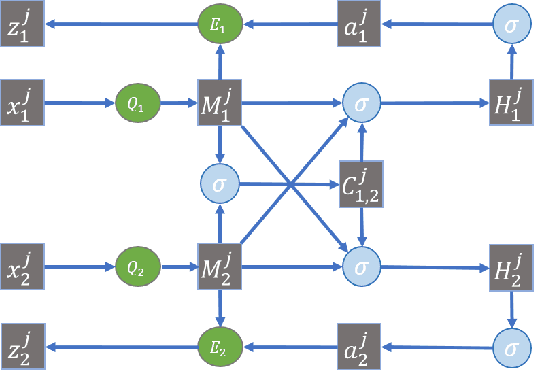
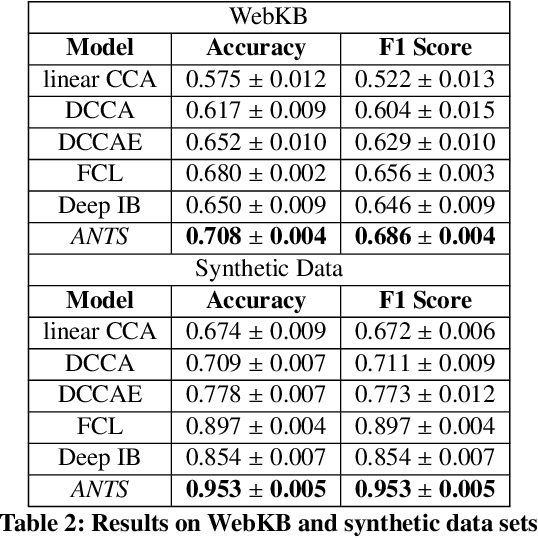
Many real-world applications involve data from multiple modalities and thus exhibit the view heterogeneity. For example, user modeling on social media might leverage both the topology of the underlying social network and the content of the users' posts; in the medical domain, multiple views could be X-ray images taken at different poses. To date, various techniques have been proposed to achieve promising results, such as canonical correlation analysis based methods, etc. In the meanwhile, it is critical for decision-makers to be able to understand the prediction results from these methods. For example, given the diagnostic result that a model provided based on the X-ray images of a patient at different poses, the doctor needs to know why the model made such a prediction. However, state-of-the-art techniques usually suffer from the inability to utilize the complementary information of each view and to explain the predictions in an interpretable manner. To address these issues, in this paper, we propose a deep co-attention network for multi-view subspace learning, which aims to extract both the common information and the complementary information in an adversarial setting and provide robust interpretations behind the prediction to the end-users via the co-attention mechanism. In particular, it uses a novel cross reconstruction loss and leverages the label information to guide the construction of the latent representation by incorporating the classifier into our model. This improves the quality of latent representation and accelerates the convergence speed. Finally, we develop an efficient iterative algorithm to find the optimal encoders and discriminator, which are evaluated extensively on synthetic and real-world data sets. We also conduct a case study to demonstrate how the proposed method robustly interprets the predictions on an image data set.
Visual Causality Analysis of Event Sequence Data
Sep 01, 2020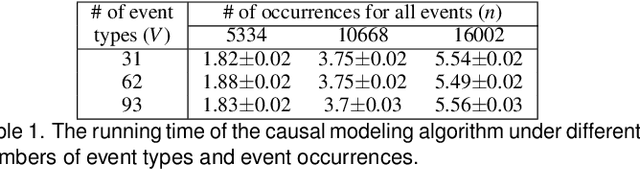
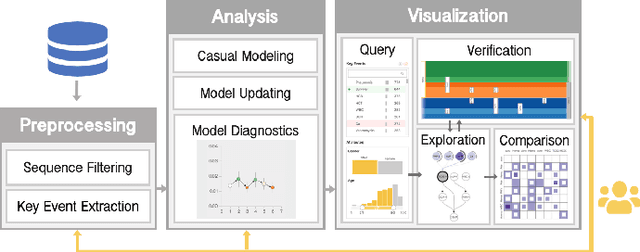
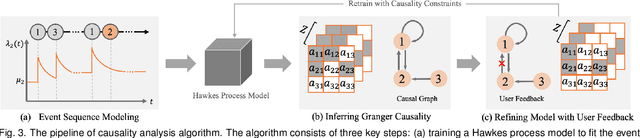
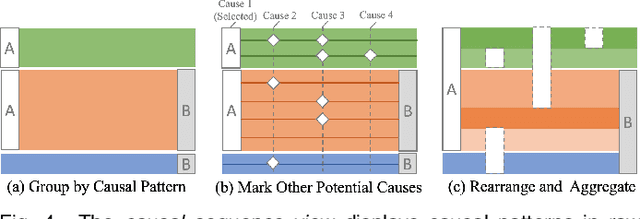
Causality is crucial to understanding the mechanisms behind complex systems and making decisions that lead to intended outcomes. Event sequence data is widely collected from many real-world processes, such as electronic health records, web clickstreams, and financial transactions, which transmit a great deal of information reflecting the causal relations among event types. Unfortunately, recovering causalities from observational event sequences is challenging, as the heterogeneous and high-dimensional event variables are often connected to rather complex underlying event excitation mechanisms that are hard to infer from limited observations. Many existing automated causal analysis techniques suffer from poor explainability and fail to include an adequate amount of human knowledge. In this paper, we introduce a visual analytics method for recovering causalities in event sequence data. We extend the Granger causality analysis algorithm on Hawkes processes to incorporate user feedback into causal model refinement. The visualization system includes an interactive causal analysis framework that supports bottom-up causal exploration, iterative causal verification and refinement, and causal comparison through a set of novel visualizations and interactions. We report two forms of evaluation: a quantitative evaluation of the model improvements resulting from the user-feedback mechanism, and a qualitative evaluation through case studies in different application domains to demonstrate the usefulness of the system.