 Add to Chrome
 Add to Firefox
 Add to Edge
CogBlender: Towards Continuous Cognitive Intervention in Text-to-Image Generation
Mar 10, 2026
Beyond conveying semantic information, an image can also manifest cognitive attributes that elicit specific cognitive processes from the viewer, such as memory encoding or emotional response. While modern text-to-image models excel at generating semantically coherent content, they remain limited in their ability to control such cognitive properties of images (e.g., valence, memorability), often failing to align with the specific psychological intent. To bridge this gap, we introduce CogBlender, a framework that enables continuous and multi-dimensional intervention of cognitive properties during text-to-image generation. Our approach is built upon a mapping between the Cognitive Space, representing the space of cognitive properties, and the Semantic Manifold, representing the manifold of the visual semantics. We define a set of Cognitive Anchors, serving as the boundary points for the cognitive space. Then we reformulate the velocity field within the flow-matching process by interpolating from the velocity field of different anchors. Consequently, the generative process is driven by the velocity field and dynamically steered by multi-dimensional cognitive scores, enabling precise, fine-grained, and continuous intervention. We validate the effectiveness of CogBlender across four representative cognitive dimensions: valence, arousal, dominance, and image memorability. Extensive experiments demonstrate that our method achieves effective cognitive intervention. Our work provides an effective paradigm for cognition-driven creative design.

DensiCrafter: Physically-Constrained Generation and Fabrication of Self-Supporting Hollow Structures
Nov 12, 2025The rise of 3D generative models has enabled automatic 3D geometry and texture synthesis from multimodal inputs (e.g., text or images). However, these methods often ignore physical constraints and manufacturability considerations. In this work, we address the challenge of producing 3D designs that are both lightweight and self-supporting. We present DensiCrafter, a framework for generating lightweight, self-supporting 3D hollow structures by optimizing the density field. Starting from coarse voxel grids produced by Trellis, we interpret these as continuous density fields to optimize and introduce three differentiable, physically constrained, and simulation-free loss terms. Additionally, a mass regularization penalizes unnecessary material, while a restricted optimization domain preserves the outer surface. Our method seamlessly integrates with pretrained Trellis-based models (e.g., Trellis, DSO) without any architectural changes. In extensive evaluations, we achieve up to 43% reduction in material mass on the text-to-3D task. Compared to state-of-the-art baselines, our method could improve the stability and maintain high geometric fidelity. Real-world 3D-printing experiments confirm that our hollow designs can be reliably fabricated and could be self-supporting.
EmotiCrafter: Text-to-Emotional-Image Generation based on Valence-Arousal Model
Jan 10, 2025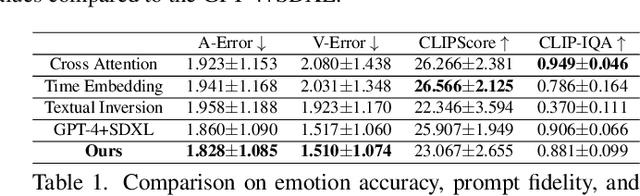
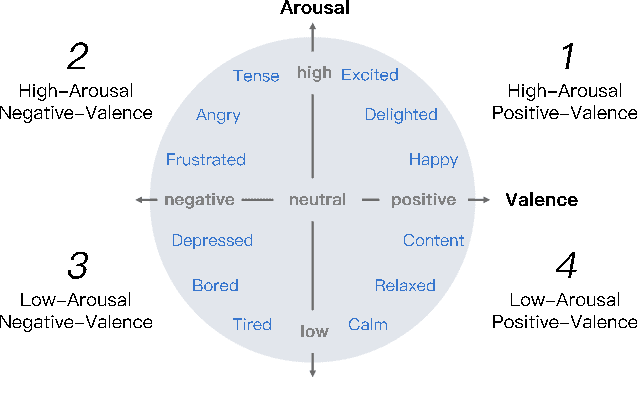
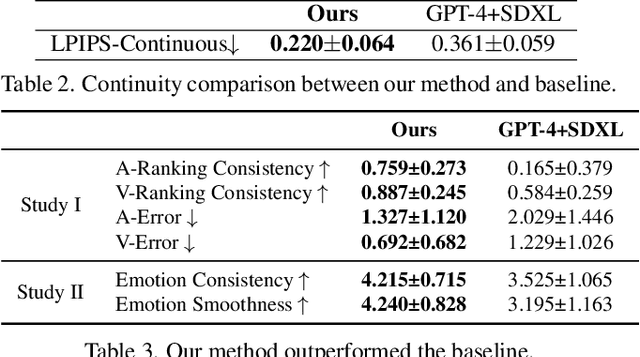
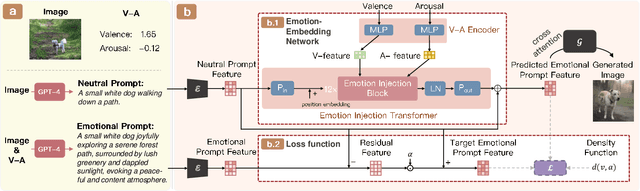
Recent research shows that emotions can enhance users' cognition and influence information communication. While research on visual emotion analysis is extensive, limited work has been done on helping users generate emotionally rich image content. Existing work on emotional image generation relies on discrete emotion categories, making it challenging to capture complex and subtle emotional nuances accurately. Additionally, these methods struggle to control the specific content of generated images based on text prompts. In this work, we introduce the new task of continuous emotional image content generation (C-EICG) and present EmotiCrafter, an emotional image generation model that generates images based on text prompts and Valence-Arousal values. Specifically, we propose a novel emotion-embedding mapping network that embeds Valence-Arousal values into textual features, enabling the capture of specific emotions in alignment with intended input prompts. Additionally, we introduce a loss function to enhance emotion expression. The experimental results show that our method effectively generates images representing specific emotions with the desired content and outperforms existing techniques.