 Add to Chrome
 Add to Firefox
 Add to Edge
Nested Fourier-enhanced neural operator for efficient modeling of radiation transfer in fires
Apr 15, 2026
Computational fluid dynamics (CFD) has become an essential tool for predicting fire behavior, yet maintaining both efficiency and accuracy remains challenging. A major source of computational cost in fire simulations is the modeling of radiation transfer, which is usually the dominant heat transfer mechanism in fires. Solving the high-dimensional radiative transfer equation (RTE) with traditional numerical methods can be a performance bottleneck. Here, we present a machine learning framework based on Fourier-enhanced multiple-input neural operators (Fourier-MIONet) as an efficient alternative to direct numerical integration of the RTE. We first investigate the performance of neural operator architectures for a small-scale 2D pool fire and find that Fourier-MIONet provides the most accurate radiative solution predictions. The approach is then extended to 3D CFD fire simulations, where the computational mesh is locally refined across multiple levels. In these high-resolution settings, monolithic surrogate models for direct field-to-field mapping become difficult to train and computationally inefficient. To address this issue, a nested Fourier-MIONet is proposed to predict radiation solutions across multiple mesh-refinement levels. We validate the approach on 3D McCaffrey pool fires simulated with FireFOAM, including fixed fire sizes and a unified model trained over a continuous range of heat release rates (HRRs). The proposed method achieves global relative errors of 2-4% for 3D varying-HRR scenarios while providing faster inference than the estimated cost of one finite-volume radiation solve in FireFOAM for the 16-solid-angle case. With fast and accurate inference, the surrogate makes higher-fidelity radiation treatments practical and enables the incorporation of more spectrally resolved radiation models into CFD fire simulations for engineering applications.

COAST: Intelligent Time-Adaptive Neural Operators
Feb 12, 2025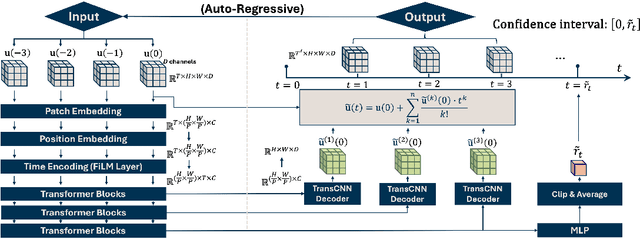
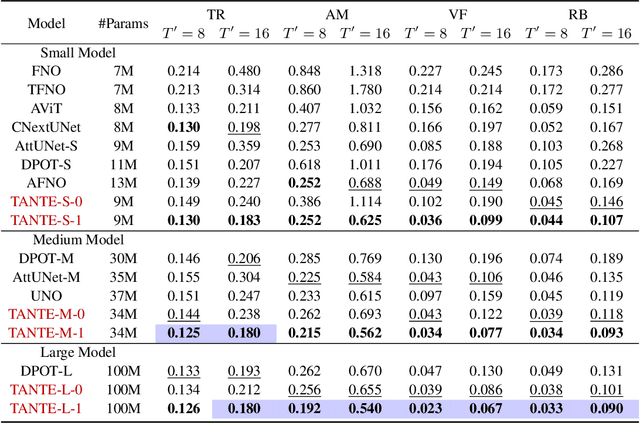
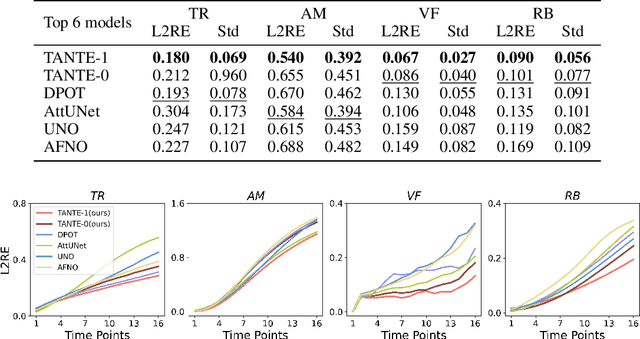
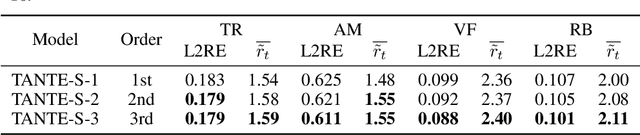
We introduce Causal Operator with Adaptive Solver Transformer (COAST), a novel neural operator learning method that leverages a causal language model (CLM) framework to dynamically adapt time steps. Our method predicts both the evolution of a system and its optimal time step, intelligently balancing computational efficiency and accuracy. We find that COAST generates variable step sizes that correlate with the underlying system intrinsicities, both within and across dynamical systems. Within a single trajectory, smaller steps are taken in regions of high complexity, while larger steps are employed in simpler regions. Across different systems, more complex dynamics receive more granular time steps. Benchmarked on diverse systems with varied dynamics, COAST consistently outperforms state-of-the-art methods, achieving superior performance in both efficiency and accuracy. This work underscores the potential of CLM-based intelligent adaptive solvers for scalable operator learning of dynamical systems.
Reliable extrapolation of deep neural operators informed by physics or sparse observations
Dec 13, 2022Deep neural operators can learn nonlinear mappings between infinite-dimensional function spaces via deep neural networks. As promising surrogate solvers of partial differential equations (PDEs) for real-time prediction, deep neural operators such as deep operator networks (DeepONets) provide a new simulation paradigm in science and engineering. Pure data-driven neural operators and deep learning models, in general, are usually limited to interpolation scenarios, where new predictions utilize inputs within the support of the training set. However, in the inference stage of real-world applications, the input may lie outside the support, i.e., extrapolation is required, which may result to large errors and unavoidable failure of deep learning models. Here, we address this challenge of extrapolation for deep neural operators. First, we systematically investigate the extrapolation behavior of DeepONets by quantifying the extrapolation complexity via the 2-Wasserstein distance between two function spaces and propose a new behavior of bias-variance trade-off for extrapolation with respect to model capacity. Subsequently, we develop a complete workflow, including extrapolation determination, and we propose five reliable learning methods that guarantee a safe prediction under extrapolation by requiring additional information -- the governing PDEs of the system or sparse new observations. The proposed methods are based on either fine-tuning a pre-trained DeepONet or multifidelity learning. We demonstrate the effectiveness of the proposed framework for various types of parametric PDEs. Our systematic comparisons provide practical guidelines for selecting a proper extrapolation method depending on the available information, desired accuracy, and required inference speed.