 Add to Chrome
 Add to Firefox
 Add to Edge
Minimax Optimal Estimator and Improved Error Rate for the MLE in Logistic Regression with Gaussian Design
Aug 18, 2026
We study finite-sample parameter estimation in logistic regression with Gaussian design, where the goal is to estimate $\mathbfθ^*\in \mathbb{R}^d$ with $R=\|\mathbfθ^*\|_2\ge 1$ from i.i.d. samples $\{(\mathbf{x}_i,y_i)\}_{i=1}^n,$ $\mathbf{x}_i \sim N(0,\mathbf{I}_d)$, $y_i\mid \mathbf{x}_i \sim \mathrm{Bernoulli}((1+\exp(-\mathbf{x}_i^\top \mathbfθ^*))^{-1})$. In this paper, we provide the first minimax optimal estimator, and improve on the best known finite-sample error rate for the maximum likelihood estimator (MLE). These two accomplishments are due to a minimax optimal estimator for the parameter norm $R$. First, we establish the minimax lower bound $Ω(\sqrt{R^3/n})$ for norm estimation. We then improve the best known norm estimation error rate of the MLE, i.e., $O(\sqrt{R^3d/n})$ from Chardon, Lerasle and Mourtada (2024), to $\tilde{O}(\sqrt{R^3/n}+R^2d/n)$. The additional term, $R^2d/n$, appears to be the intrinsic bias of the MLE, as evidenced by the high-dimensional asymptotic theory of Zhao, Sur and Candes (2022) and numerical examples. We show that, however, this additional term is not information-theoretically necessary. To this end, we construct an efficient debiased norm estimator that achieves the error rate $O(\sqrt{R^3/n})$ and is therefore minimax optimal. Combining this with the optimal direction estimator given by the MLE, we establish the minimax optimal rate $Θ(\sqrt{Rd/n}+\sqrt{R^3/n})$ for estimating $\mathbfθ^*$, as well as the improved finite-sample error rate $\tilde{O}(\sqrt{Rd/n}+\sqrt{R^3/n}+R^2d/n)$ for the MLE. Numerical experiments demonstrate that the proposed minimax optimal estimators outperform the MLE.

Near-Optimal Lower Bounds on One-Bit Compressed Sensing of Approximately Sparse Signals
Jul 07, 2026This paper provides the first near-optimal lower bounds for one-bit compressed sensing of approximately sparse signals lying in a scaled $\ell_1$ ball, which is a commonly adopted relaxation of the exactly $k$-sparse assumption. In prior works, the best known upper bounds on uniform Euclidean error are of order $\widetilde{O}((k/m)^{1/3})$, where $m$ is the number of measurements. Under sub-Gaussian matrices, we establish nearly matching lower bounds for both the canonical one-bit compressed sensing model and the uniformly dithered model. Our argument is to first embed a small Euclidean ball into the signal set, which is straightforward for the dithered model but relies on a lifting map for the canonical model, and then construct two signals in this small ball that are separated in Euclidean distance by at least $(k/m)^{1/3}$ (up to logarithmic factor) but are indistinguishable from the binary measurements. Moreover, our argument extends to approximately sparse signals that live in a properly scaled $\ell_q$ ball $(q\in [0,1])$, yielding a lower bound $\widetildeΩ((k/m)^{\frac{2-q}{2+q}})$ that smoothly bridges the cases of exact sparsity ($q=0$) and $\ell_1$ sparsity ($q=1$). Finally, we discuss the extensions of our lower bounds to sub-Weibull matrices, adversarial bit flipping, matrix recovery, and characterize the transition to the non-sparse case.
One-Bit Clustering for Two Component Sub-Gaussian Mixture Models
Jun 20, 2026Clustering is a fundamental problem in statistics and machine learning. We propose the first one-bit clustering method for two-component sub-Gaussian mixture models. The method uses only one bit per entry of each sample obtained via a dithered quantizer. Under a mild non-spikiness condition on the cluster centers, we show that a variant of Lloyd's algorithm achieves a misclassification rate that decays exponentially with a signal-to-noise ratio comparable to that in the unquantized setting. This result further implies exact recovery under an explicit separation condition, which exceeds the optimal threshold for unquantized data by only a logarithmic factor. When the dimension $p$ is sufficiently large, the non-spikiness condition can be enforced by applying a random rotation using a Haar distributed matrix prior to quantization. In particular, it holds with high probability when $p \gtrsim 1$ for partial recovery and $p \gtrsim \log n \log\log n$ for exact recovery, where $n$ is the sample size. We also establish a minimax lower bound, showing that the misclassification rate and separation condition exhibit sharp constants in general. Numerical results are provided to corroborate the theory and demonstrate the efficacy of the proposed method.
Finite-Sample Performance of Gradient Descent in Logistic Regression with Gaussian Design
Jun 19, 2026We consider the parameter estimation problem in logistic regression with Gaussian design: the estimation of a fixed unknown parameter $θ^*\in \mathbb{R}^d$ ($\|θ^*\|_2\ge 1$) from $n$ i.i.d. samples $\{(x_i,y_i)\}_{i=1}^n$, where $x_i\sim N(0,I_d)$ and $y_i|x_i \sim {\rm Bernoulli}(1/(1+\exp(-x_i^\top θ^*)))$. Our main aim is to characterize the finite-sample estimation performance and convergence behavior of gradient descent (GD) on the maximum likelihood objective (i.e., the logistic loss). Under small $O(1)$ stepsize and $0$ initialization, we show that GD linearly converges to a small neighborhood of $θ^*$ achieving an $\ell_2$ error of order $O(\sqrt{\|θ^*\|_2^5d/n})$. This substantially goes beyond existing theoretical results that lack non-asymptotic estimation error rate and exhibit much slower parameter convergence. We also establish a faster local linear convergence to the same statistical error under a large $Θ(\|θ^*\|_2)$ stepsize. The main technical component is to show that the gradient of the logistic loss satisfies a certain approximate invertibility condition (AIC). To that end, we uniformly control the deviation of the gradient from its population counterpart by covering and peeling arguments, and then show that the population GD is a contraction by a delicate analysis based on the eigenvalues of population Hessian matrices. Finally, we build upon the recent work Matsumoto and Mazumdar (2025) and devise a novel efficient estimator that attains a sharper rate in high dimensions. This indicates that the existing non-asymptotic guarantees exhibit sub-optimal dependence on $\|θ^*\|_2$, and that in many regimes $Θ(\sqrt{\|θ^*\|_2d/n})$ is the tight estimation error rate. Numerical examples are provided to corroborate our theoretical results.
Robust Mean Estimation under Quantization
Jan 11, 2026We consider the problem of mean estimation under quantization and adversarial corruption. We construct multivariate robust estimators that are optimal up to logarithmic factors in two different settings. The first is a one-bit setting, where each bit depends only on a single sample, and the second is a partial quantization setting, in which the estimator may use a small fraction of unquantized data.
Phase Transitions in Phase-Only Compressed Sensing
Jan 21, 2025The goal of phase-only compressed sensing is to recover a structured signal $\mathbf{x}$ from the phases $\mathbf{z} = {\rm sign}(\mathbf{\Phi}\mathbf{x})$ under some complex-valued sensing matrix $\mathbf{\Phi}$. Exact reconstruction of the signal's direction is possible: we can reformulate it as a linear compressed sensing problem and use basis pursuit (i.e., constrained norm minimization). For $\mathbf{\Phi}$ with i.i.d. complex-valued Gaussian entries, this paper shows that the phase transition is approximately located at the statistical dimension of the descent cone of a signal-dependent norm. Leveraging this insight, we derive asymptotically precise formulas for the phase transition locations in phase-only sensing of both sparse signals and low-rank matrices. Our results prove that the minimum number of measurements required for exact recovery is smaller for phase-only measurements than for traditional linear compressed sensing. For instance, in recovering a 1-sparse signal with sufficiently large dimension, phase-only compressed sensing requires approximately 68% of the measurements needed for linear compressed sensing. This result disproves earlier conjecture suggesting that the two phase transitions coincide. Our proof hinges on the Gaussian min-max theorem and the key observation that, up to a signal-dependent orthogonal transformation, the sensing matrix in the reformulated problem behaves as a nearly Gaussian matrix.
Interactive Medical Image Segmentation: A Benchmark Dataset and Baseline
Nov 19, 2024Interactive Medical Image Segmentation (IMIS) has long been constrained by the limited availability of large-scale, diverse, and densely annotated datasets, which hinders model generalization and consistent evaluation across different models. In this paper, we introduce the IMed-361M benchmark dataset, a significant advancement in general IMIS research. First, we collect and standardize over 6.4 million medical images and their corresponding ground truth masks from multiple data sources. Then, leveraging the strong object recognition capabilities of a vision foundational model, we automatically generated dense interactive masks for each image and ensured their quality through rigorous quality control and granularity management. Unlike previous datasets, which are limited by specific modalities or sparse annotations, IMed-361M spans 14 modalities and 204 segmentation targets, totaling 361 million masks-an average of 56 masks per image. Finally, we developed an IMIS baseline network on this dataset that supports high-quality mask generation through interactive inputs, including clicks, bounding boxes, text prompts, and their combinations. We evaluate its performance on medical image segmentation tasks from multiple perspectives, demonstrating superior accuracy and scalability compared to existing interactive segmentation models. To facilitate research on foundational models in medical computer vision, we release the IMed-361M and model at https://github.com/uni-medical/IMIS-Bench.
Generalized Eigenvalue Problems with Generative Priors
Nov 02, 2024Generalized eigenvalue problems (GEPs) find applications in various fields of science and engineering. For example, principal component analysis, Fisher's discriminant analysis, and canonical correlation analysis are specific instances of GEPs and are widely used in statistical data processing. In this work, we study GEPs under generative priors, assuming that the underlying leading generalized eigenvector lies within the range of a Lipschitz continuous generative model. Under appropriate conditions, we show that any optimal solution to the corresponding optimization problems attains the optimal statistical rate. Moreover, from a computational perspective, we propose an iterative algorithm called the Projected Rayleigh Flow Method (PRFM) to approximate the optimal solution. We theoretically demonstrate that under suitable assumptions, PRFM converges linearly to an estimated vector that achieves the optimal statistical rate. Numerical results are provided to demonstrate the effectiveness of the proposed method.
TEXEL: A neuromorphic processor with on-chip learning for beyond-CMOS device integration
Oct 21, 2024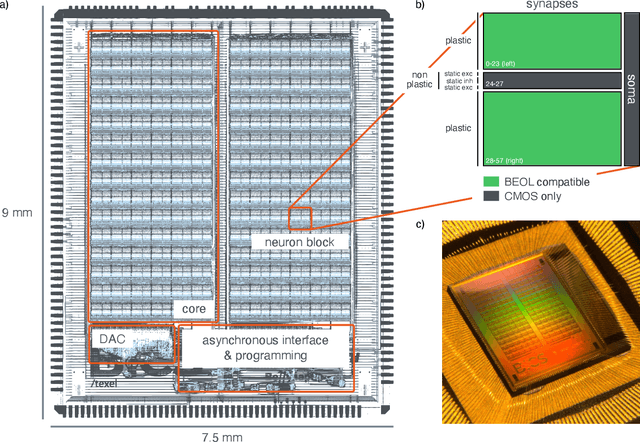
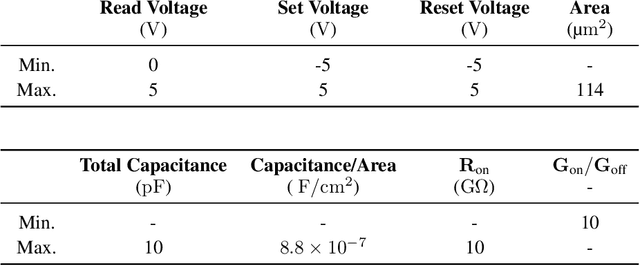
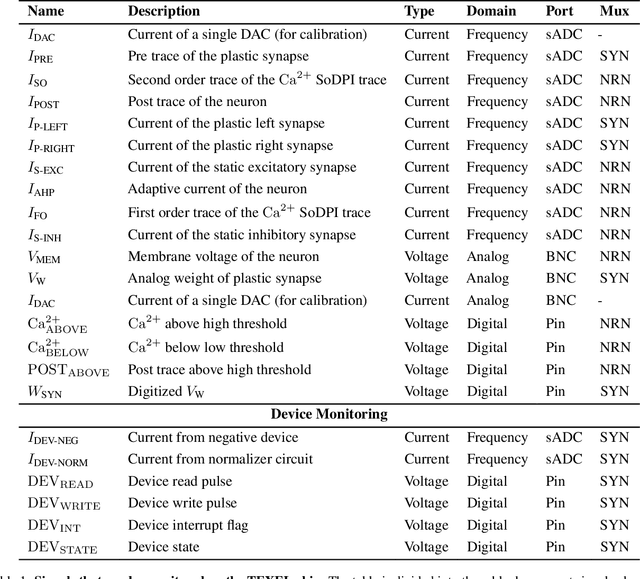
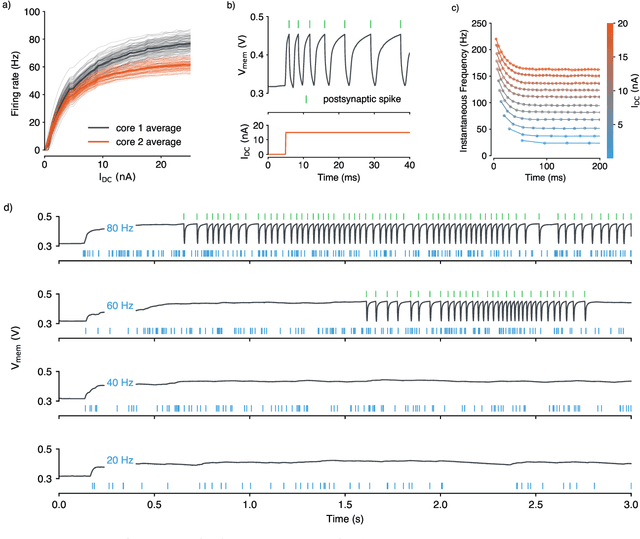
Recent advances in memory technologies, devices and materials have shown great potential for integration into neuromorphic electronic systems. However, a significant gap remains between the development of these materials and the realization of large-scale, fully functional systems. One key challenge is determining which devices and materials are best suited for specific functions and how they can be paired with CMOS circuitry. To address this, we introduce TEXEL, a mixed-signal neuromorphic architecture designed to explore the integration of on-chip learning circuits and novel two- and three-terminal devices. TEXEL serves as an accessible platform to bridge the gap between CMOS-based neuromorphic computation and the latest advancements in emerging devices. In this paper, we demonstrate the readiness of TEXEL for device integration through comprehensive chip measurements and simulations. TEXEL provides a practical system for testing bio-inspired learning algorithms alongside emerging devices, establishing a tangible link between brain-inspired computation and cutting-edge device research.
Robust Instance Optimal Phase-Only Compressed Sensing
Aug 12, 2024Phase-only compressed sensing (PO-CS) is concerned with the recovery of structured signals from the phases of complex measurements. Recent results show that structured signals in the standard sphere $\mathbb{S}^{n-1}$ can be exactly recovered from complex Gaussian phases, by recasting PO-CS as linear compressed sensing and then applying existing solvers such as basis pursuit. Known guarantees are either non-uniform or do not tolerate model error. We show that this linearization approach is more powerful than the prior results indicate. First, it achieves uniform instance optimality: Under complex Gaussian matrix with a near-optimal number of rows, this approach uniformly recovers all signals in $\mathbb{S}^{n-1}$ with errors proportional to the model errors of the signals. Specifically, for sparse recovery there exists an efficient estimator $\mathbf{x}^\sharp$ and some universal constant $C$ such that $\|\mathbf{x}^\sharp-\mathbf{x}\|_2\le \frac{C\sigma_s(\mathbf{x})_1}{\sqrt{s}}~(\forall\mathbf{x}\in\mathbb{S}^{n-1})$, where $\sigma_s(\mathbf{x})_1=\min_{\mathbf{u}\in\Sigma^n_s}\|\mathbf{u}-\mathbf{x}\|_1$ is the model error under $\ell_1$-norm. Second, the instance optimality is robust to small dense disturbances and sparse corruptions that arise before or after capturing the phases. As an extension, we also propose to recast sparsely corrupted PO-CS as a linear corrupted sensing problem and show that this achieves perfect reconstruction of the signals. Our results resemble the instance optimal guarantees in linear compressed sensing and, to our knowledge, are the first results of this kind for a non-linear sensing scenario.