 Add to Chrome
 Add to Firefox
 Add to Edge
Causally Debiased Latent Action Model for Embodied Action Conditioned World Models
Jul 10, 2026
Action-conditioned world models (ACWMs) aim to simulate future observations conditioned on embodied actions, offering a promising foundation for robot planning, policy evaluation, and data augmentation. However, learning controllable ACWMs requires large-scale action-labeled data, which remains costly to collect in the real world. Latent action models (LAMs) mitigate this bottleneck by inferring latent actions from unlabeled videos, but existing LAMs are typically trained with reconstruction-only objectives and therefore entangle action-relevant dynamics with action-irrelevant visual factors such as backgrounds and untouched objects. In this work, we identify this action-irrelevant bias as a key obstacle to controllable ACWMs and introduce evaluation metrics to measure latent-action bias, action following, and robustness. We propose CD-LAM, a causally debiased framework for LAM-based ACWMs. CD-LAM introduces three efficient fine-tuning objectives: embodiment-centric reconstruction, action-centric contrastive learning, and latent space calibration, which together encourage embodiment-focused, action-aware, and calibrated non-collapsed latent action representations. Experiments on 2B and 14B ACWM backbones show that CD-LAM substantially improves latent-action controllability, downstream robot-action following, visual fidelity, and adaptation efficiency, requiring only 6k fine-tuning steps and more than 12$\times$ fewer robot-action adaptation updates than the baseline.

ToolGym: an Open-world Tool-using Environment for Scalable Agent Testing and Data Curation
Jan 09, 2026Tool-using LLM agents still struggle in open-world settings with large tool pools, long-horizon objectives, wild constraints, and unreliable tool states. For scalable and realistic training and testing, we introduce an open-world tool-using environment, built on 5,571 format unified tools across 204 commonly used apps. It includes a task creation engine that synthesizes long-horizon, multi-tool workflows with wild constraints, and a state controller that injects interruptions and failures to stress-test robustness. On top of this environment, we develop a tool select-then-execute agent framework with a planner-actor decomposition to separate deliberate reasoning and self-correction from step-wise execution. Comprehensive evaluation of state-of-the-art LLMs reveals the misalignment between tool planning and execution abilities, the constraint following weakness of existing LLMs, and DeepSeek-v3.2's strongest robustness. Finally, we collect 1,170 trajectories from our environment to fine-tune LLMs, achieving superior performance to baselines using 119k samples, indicating the environment's value as both a realistic benchmark and a data engine for tool-using agents. Our code and data will be publicly released.
Efficient and generalizable nested Fourier-DeepONet for three-dimensional geological carbon sequestration
Sep 25, 2024
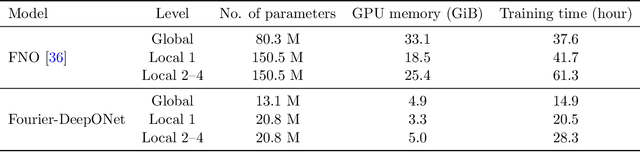

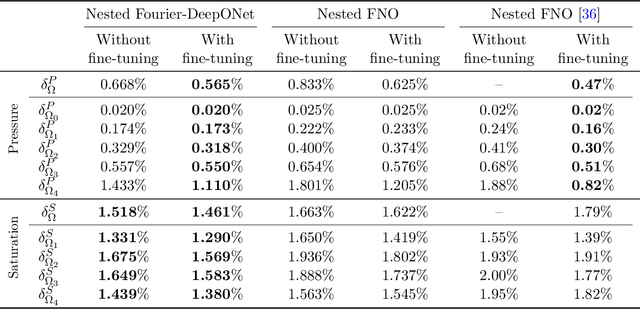
Geological carbon sequestration (GCS) involves injecting CO$_2$ into subsurface geological formations for permanent storage. Numerical simulations could guide decisions in GCS projects by predicting CO$_2$ migration pathways and the pressure distribution in storage formation. However, these simulations are often computationally expensive due to highly coupled physics and large spatial-temporal simulation domains. Surrogate modeling with data-driven machine learning has become a promising alternative to accelerate physics-based simulations. Among these, the Fourier neural operator (FNO) has been applied to three-dimensional synthetic subsurface models. Here, to further improve performance, we have developed a nested Fourier-DeepONet by combining the expressiveness of the FNO with the modularity of a deep operator network (DeepONet). This new framework is twice as efficient as a nested FNO for training and has at least 80% lower GPU memory requirement due to its flexibility to treat temporal coordinates separately. These performance improvements are achieved without compromising prediction accuracy. In addition, the generalization and extrapolation ability of nested Fourier-DeepONet beyond the training range has been thoroughly evaluated. Nested Fourier-DeepONet outperformed the nested FNO for extrapolation in time with more than 50% reduced error. It also exhibited good extrapolation accuracy beyond the training range in terms of reservoir properties, number of wells, and injection rate.