 Add to Chrome
 Add to Firefox
 Add to Edge
Factorized Learning for Temporally Grounded Video-Language Models
Dec 30, 2025
Recent video-language models have shown great potential for video understanding, but still struggle with accurate temporal grounding for event-level perception. We observe that two main factors in video understanding (i.e., temporal grounding and textual response) form a logical hierarchy: accurate temporal evidence grounding lays the foundation for reliable textual response. However, existing works typically handle these two tasks in a coupled manner without a clear logical structure, leading to sub-optimal objectives. We address this from a factorized learning perspective. We first propose D$^2$VLM, a framework that decouples the learning of these two tasks while also emphasizing their inherent dependency. We adopt a "grounding then answering with evidence referencing" paradigm and introduce evidence tokens for evidence grounding, which emphasize event-level visual semantic capture beyond the focus on timestamp representation in existing works. To further facilitate the learning of these two tasks, we introduce a novel factorized preference optimization (FPO) algorithm. Unlike standard preference optimization, FPO explicitly incorporates probabilistic temporal grounding modeling into the optimization objective, enabling preference learning for both temporal grounding and textual response. We also construct a synthetic dataset to address the lack of suitable datasets for factorized preference learning with explicit temporal grounding. Experiments on various tasks demonstrate the clear advantage of our approach. Our source code is available at https://github.com/nusnlp/d2vlm.

Mitty: Diffusion-based Human-to-Robot Video Generation
Dec 19, 2025Learning directly from human demonstration videos is a key milestone toward scalable and generalizable robot learning. Yet existing methods rely on intermediate representations such as keypoints or trajectories, introducing information loss and cumulative errors that harm temporal and visual consistency. We present Mitty, a Diffusion Transformer that enables video In-Context Learning for end-to-end Human2Robot video generation. Built on a pretrained video diffusion model, Mitty leverages strong visual-temporal priors to translate human demonstrations into robot-execution videos without action labels or intermediate abstractions. Demonstration videos are compressed into condition tokens and fused with robot denoising tokens through bidirectional attention during diffusion. To mitigate paired-data scarcity, we also develop an automatic synthesis pipeline that produces high-quality human-robot pairs from large egocentric datasets. Experiments on Human2Robot and EPIC-Kitchens show that Mitty delivers state-of-the-art results, strong generalization to unseen environments, and new insights for scalable robot learning from human observations.
EVOLVE-VLA: Test-Time Training from Environment Feedback for Vision-Language-Action Models
Dec 16, 2025Achieving truly adaptive embodied intelligence requires agents that learn not just by imitating static demonstrations, but by continuously improving through environmental interaction, which is akin to how humans master skills through practice. Vision-Language-Action (VLA) models have advanced robotic manipulation by leveraging large language models, yet remain fundamentally limited by Supervised Finetuning (SFT): requiring hundreds of demonstrations per task, rigidly memorizing trajectories, and failing to adapt when deployment conditions deviate from training. We introduce EVOLVE-VLA, a test-time training framework enabling VLAs to continuously adapt through environment interaction with minimal or zero task-specific demonstrations. The key technical challenge is replacing oracle reward signals (unavailable at test time) with autonomous feedback. We address this through a learned progress estimator providing dense feedback, and critically, we design our framework to ``tame'' this inherently noisy signal via two mechanisms: (1) an accumulative progress estimation mechanism smoothing noisy point-wise estimates, and (2) a progressive horizon extension strategy enabling gradual policy evolution. EVOLVE-VLA achieves substantial gains: +8.6\% on long-horizon tasks, +22.0\% in 1-shot learning, and enables cross-task generalization -- achieving 20.8\% success on unseen tasks without task-specific demonstrations training (vs. 0\% for pure SFT). Qualitative analysis reveals emergent capabilities absent in demonstrations, including error recovery and novel strategies. This work represents a critical step toward VLAs that truly learn and adapt, moving beyond static imitation toward continuous self-improvements.
OmniPSD: Layered PSD Generation with Diffusion Transformer
Dec 10, 2025Recent advances in diffusion models have greatly improved image generation and editing, yet generating or reconstructing layered PSD files with transparent alpha channels remains highly challenging. We propose OmniPSD, a unified diffusion framework built upon the Flux ecosystem that enables both text-to-PSD generation and image-to-PSD decomposition through in-context learning. For text-to-PSD generation, OmniPSD arranges multiple target layers spatially into a single canvas and learns their compositional relationships through spatial attention, producing semantically coherent and hierarchically structured layers. For image-to-PSD decomposition, it performs iterative in-context editing, progressively extracting and erasing textual and foreground components to reconstruct editable PSD layers from a single flattened image. An RGBA-VAE is employed as an auxiliary representation module to preserve transparency without affecting structure learning. Extensive experiments on our new RGBA-layered dataset demonstrate that OmniPSD achieves high-fidelity generation, structural consistency, and transparency awareness, offering a new paradigm for layered design generation and decomposition with diffusion transformers.
H2R-Grounder: A Paired-Data-Free Paradigm for Translating Human Interaction Videos into Physically Grounded Robot Videos
Dec 10, 2025
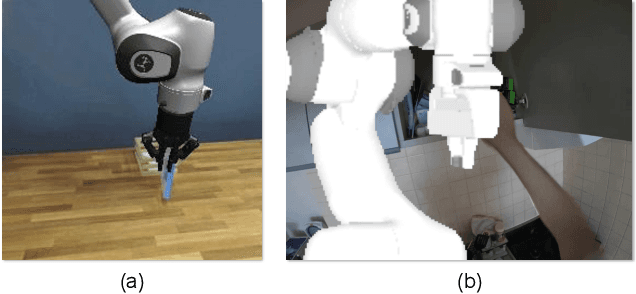

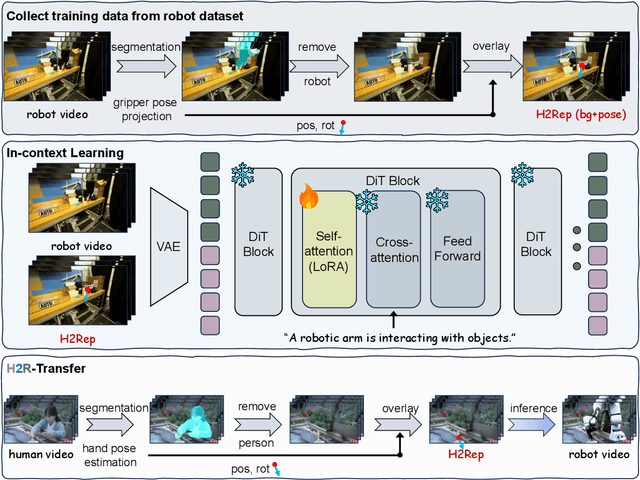
Robots that learn manipulation skills from everyday human videos could acquire broad capabilities without tedious robot data collection. We propose a video-to-video translation framework that converts ordinary human-object interaction videos into motion-consistent robot manipulation videos with realistic, physically grounded interactions. Our approach does not require any paired human-robot videos for training only a set of unpaired robot videos, making the system easy to scale. We introduce a transferable representation that bridges the embodiment gap: by inpainting the robot arm in training videos to obtain a clean background and overlaying a simple visual cue (a marker and arrow indicating the gripper's position and orientation), we can condition a generative model to insert the robot arm back into the scene. At test time, we apply the same process to human videos (inpainting the person and overlaying human pose cues) and generate high-quality robot videos that mimic the human's actions. We fine-tune a SOTA video diffusion model (Wan 2.2) in an in-context learning manner to ensure temporal coherence and leveraging of its rich prior knowledge. Empirical results demonstrate that our approach achieves significantly more realistic and grounded robot motions compared to baselines, pointing to a promising direction for scaling up robot learning from unlabeled human videos. Project page: https://showlab.github.io/H2R-Grounder/
Computer-Use Agents as Judges for Generative User Interface
Nov 19, 2025Computer-Use Agents (CUA) are becoming increasingly capable of autonomously operating digital environments through Graphical User Interfaces (GUI). Yet, most GUI remain designed primarily for humans--prioritizing aesthetics and usability--forcing agents to adopt human-oriented behaviors that are unnecessary for efficient task execution. At the same time, rapid advances in coding-oriented language models (Coder) have transformed automatic GUI design. This raises a fundamental question: Can CUA as judges to assist Coder for automatic GUI design? To investigate, we introduce AUI-Gym, a benchmark for Automatic GUI development spanning 52 applications across diverse domains. Using language models, we synthesize 1560 tasks that simulate real-world scenarios. To ensure task reliability, we further develop a verifier that programmatically checks whether each task is executable within its environment. Building on this, we propose a Coder-CUA in Collaboration framework: the Coder acts as Designer, generating and revising websites, while the CUA serves as Judge, evaluating functionality and refining designs. Success is measured not by visual appearance, but by task solvability and CUA navigation success rate. To turn CUA feedback into usable guidance, we design a CUA Dashboard that compresses multi-step navigation histories into concise visual summaries, offering interpretable guidance for iterative redesign. By positioning agents as both designers and judges, our framework shifts interface design toward agent-native efficiency and reliability. Our work takes a step toward shifting agents from passive use toward active participation in digital environments. Our code and dataset are available at https://github.com/showlab/AUI.
AUTO-Explorer: Automated Data Collection for GUI Agent
Nov 09, 2025Recent advancements in GUI agents have significantly expanded their ability to interpret natural language commands to manage software interfaces. However, acquiring GUI data remains a significant challenge. Existing methods often involve designing automated agents that browse URLs from the Common Crawl, using webpage HTML to collect screenshots and corresponding annotations, including the names and bounding boxes of UI elements. However, this method is difficult to apply to desktop software or some newly launched websites not included in the Common Crawl. While we expect the model to possess strong generalization capabilities to handle this, it is still crucial for personalized scenarios that require rapid and perfect adaptation to new software or websites. To address this, we propose an automated data collection method with minimal annotation costs, named Auto-Explorer. It incorporates a simple yet effective exploration mechanism that autonomously parses and explores GUI environments, gathering data efficiently. Additionally, to assess the quality of exploration, we have developed the UIXplore benchmark. This benchmark creates environments for explorer agents to discover and save software states. Using the data gathered, we fine-tune a multimodal large language model (MLLM) and establish a GUI element grounding testing set to evaluate the effectiveness of the exploration strategies. Our experiments demonstrate the superior performance of Auto-Explorer, showing that our method can quickly enhance the capabilities of an MLLM in explored software.
Paper2Video: Automatic Video Generation from Scientific Papers
Oct 06, 2025Academic presentation videos have become an essential medium for research communication, yet producing them remains highly labor-intensive, often requiring hours of slide design, recording, and editing for a short 2 to 10 minutes video. Unlike natural video, presentation video generation involves distinctive challenges: inputs from research papers, dense multi-modal information (text, figures, tables), and the need to coordinate multiple aligned channels such as slides, subtitles, speech, and human talker. To address these challenges, we introduce PaperTalker, the first benchmark of 101 research papers paired with author-created presentation videos, slides, and speaker metadata. We further design four tailored evaluation metrics--Meta Similarity, PresentArena, PresentQuiz, and IP Memory--to measure how videos convey the paper's information to the audience. Building on this foundation, we propose PaperTalker, the first multi-agent framework for academic presentation video generation. It integrates slide generation with effective layout refinement by a novel effective tree search visual choice, cursor grounding, subtitling, speech synthesis, and talking-head rendering, while parallelizing slide-wise generation for efficiency. Experiments on Paper2Video demonstrate that the presentation videos produced by our approach are more faithful and informative than existing baselines, establishing a practical step toward automated and ready-to-use academic video generation. Our dataset, agent, and code are available at https://github.com/showlab/Paper2Video.
CoFFT: Chain of Foresight-Focus Thought for Visual Language Models
Sep 26, 2025Despite significant advances in Vision Language Models (VLMs), they remain constrained by the complexity and redundancy of visual input. When images contain large amounts of irrelevant information, VLMs are susceptible to interference, thus generating excessive task-irrelevant reasoning processes or even hallucinations. This limitation stems from their inability to discover and process the required regions during reasoning precisely. To address this limitation, we present the Chain of Foresight-Focus Thought (CoFFT), a novel training-free approach that enhances VLMs' visual reasoning by emulating human visual cognition. Each Foresight-Focus Thought consists of three stages: (1) Diverse Sample Generation: generates diverse reasoning samples to explore potential reasoning paths, where each sample contains several reasoning steps; (2) Dual Foresight Decoding: rigorously evaluates these samples based on both visual focus and reasoning progression, adding the first step of optimal sample to the reasoning process; (3) Visual Focus Adjustment: precisely adjust visual focus toward regions most beneficial for future reasoning, before returning to stage (1) to generate subsequent reasoning samples until reaching the final answer. These stages function iteratively, creating an interdependent cycle where reasoning guides visual focus and visual focus informs subsequent reasoning. Empirical results across multiple benchmarks using Qwen2.5-VL, InternVL-2.5, and Llava-Next demonstrate consistent performance improvements of 3.1-5.8\% with controllable increasing computational overhead.
OptMark: Robust Multi-bit Diffusion Watermarking via Inference Time Optimization
Aug 29, 2025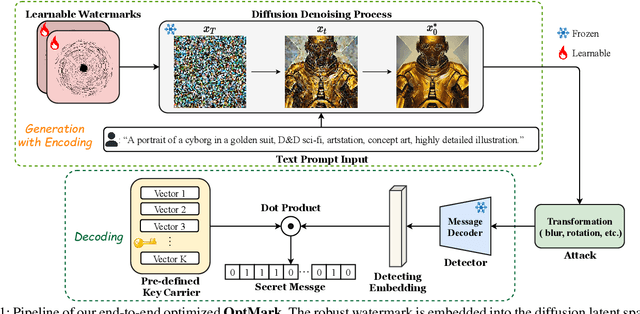
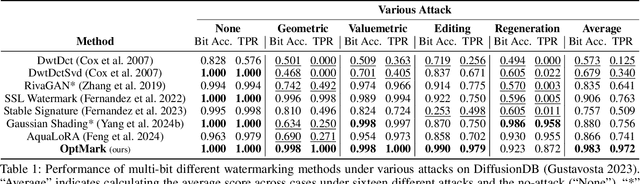
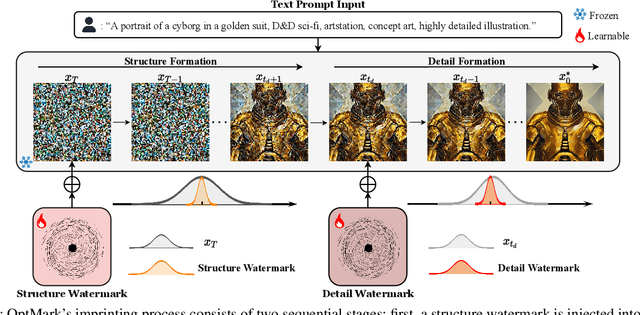
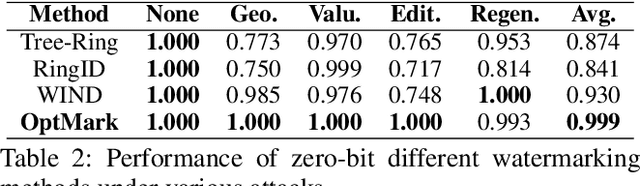
Watermarking diffusion-generated images is crucial for copyright protection and user tracking. However, current diffusion watermarking methods face significant limitations: zero-bit watermarking systems lack the capacity for large-scale user tracking, while multi-bit methods are highly sensitive to certain image transformations or generative attacks, resulting in a lack of comprehensive robustness. In this paper, we propose OptMark, an optimization-based approach that embeds a robust multi-bit watermark into the intermediate latents of the diffusion denoising process. OptMark strategically inserts a structural watermark early to resist generative attacks and a detail watermark late to withstand image transformations, with tailored regularization terms to preserve image quality and ensure imperceptibility. To address the challenge of memory consumption growing linearly with the number of denoising steps during optimization, OptMark incorporates adjoint gradient methods, reducing memory usage from O(N) to O(1). Experimental results demonstrate that OptMark achieves invisible multi-bit watermarking while ensuring robust resilience against valuemetric transformations, geometric transformations, editing, and regeneration attacks.