 Add to Chrome
 Add to Firefox
 Add to Edge
UI-Mate: Advancing Open-Weight Foundation GUI Agents with In-Context Demonstrations
Aug 16, 2026
Foundation GUI agents can automate complex digital tasks, but deployment is hindered by scarce and biased training data, ambiguous prompts, and unreliable execution. Routine workflows rely on user-specific tools and tacit conventions, so unstated instructions can produce arbitrary variations across runs. We present UI-Mate, a foundation GUI agent that integrates an environment-grounded training stack with in-context demonstration learning. UI-Mate makes three contributions: A Scalable Environment-Grounded Training Stack: A closed-loop data engine automates task generation, environment construction, rollout, filtering, capability balancing, SFT, and online RL across massively parallel environments via unified task-verifier bundles. In-Context Demonstration Learning: A mechanism that transforms multimodal demonstrations into flexible subtask-level workflows, follows relevant demonstrated steps, and re-plans from the live interface. OSWorkerBench Benchmark and Insights: A benchmark of 100 long-horizon office tasks across 41 applications that supports instruction-only and demonstration-guided evaluation. Its demonstration resources separate a 33-task self-demo setting, built from successful strong-agent rollouts of the same targets, from a 45-task variant-demo setting, built from human recordings of related but non-identical tasks. Experiments show that UI-Mate-27B sets a new open-weight state of the art on general computer-use benchmarks, scoring 77.0% on OSWorld-Verified and 66.2% on WindowsAgentArena. On OSWorkerBench, it reaches 41.0% strict success and 76.9% progress, outperforming its Qwen3.6-27B base by 17.7 and 24.5 points. On the 33-task self-demo subset, one demonstration raises strict success from 17.2% to 35.4% and progress from 67.9% to 81.1%, substantially improving long-horizon reliability. Project page: https://ui-mate.github.io.

Demo2Tutorial: From Human Experience to Multimodal Software Tutorials
Jun 02, 2026Human experience in digital environments offers a vast, underexplored resource of authentic, untrimmed interactions that contain rich procedural knowledge. We introduce Demo2Tutorial, a framework that transforms this experience captured via screen recordings and interaction logs into structured, multimodal software tutorials for teaching both humans and agents. Demo2Tutorial first collects human experience via a dedicated recorder, then parses raw experience using a multimodal Action Parser to reconstruct perception, action, and intent. A Step Planner then abstracts these steps into hierarchical task graphs representing goals and steps. Finally, a Tutorial Composer transforms the parsed experience into structured, reusable image-text instructions. We evaluate the tutorial generation quality on a new benchmark derived from official software documentation. We further demonstrate that this distilled representation benefits (i) human learning, by automatically generating multimodal tutorials, and (ii) agent learning, by improving downstream GUI-agent planning and generalization. Experiments show Demo2Tutorial produces high-quality tutorials that surpass human-authored ones and significantly outperform baseline methods, while enabling both faster human task completion and improved GUI agent planning, demonstrating that structured tutorials distilled from human experience can serve as effective knowledge representations for advancing both human learning and agent capabilities. Code and data will be available at https://github.com/showlab/Demo2Tutorial.
CutVerse: A Compositional GUI Agents Benchmark for Media Post-Production Editing
May 19, 2026While GUI agents have made significant progress in web navigation and basic operating system tasks, their capabilities in professional creative workflows remain largely underexplored. To bridge this gap, we introduce Cutverse, a benchmark designed to systematically evaluate autonomous GUI agents in realistic media post-production environments. We curate expert demonstrations across 7 professional applications (e.g., Premiere Pro, Photoshop), covering 186 complex, long-horizon tasks grounded in authentic editing workflows, involving dense multimodal interfaces and tightly coupled interaction sequences. To support scalable evaluation, we develop a lightweight parser that transforms raw screen recordings and low-level interaction logs into structured, compositional GUI action trajectories with precise grounding. Extensive evaluations reveal that existing agents achieve only 36.0\% task success on realistic media editing tasks, underscoring the challenges posed by complex, long-horizon media post-production workflows in our benchmark.While current models demonstrate promising spatial grounding, multimodal alignment, and coordinated action execution, they remain limited in long-horizon reliability and domain-specific planning.
ShowUI-Aloha: Human-Taught GUI Agent
Jan 12, 2026Graphical User Interfaces (GUIs) are central to human-computer interaction, yet automating complex GUI tasks remains a major challenge for autonomous agents, largely due to a lack of scalable, high-quality training data. While recordings of human demonstrations offer a rich data source, they are typically long, unstructured, and lack annotations, making them difficult for agents to learn from.To address this, we introduce ShowUI-Aloha, a comprehensive pipeline that transforms unstructured, in-the-wild human screen recordings from desktop environments into structured, actionable tasks. Our framework includes four key components: A recorder that captures screen video along with precise user interactions like mouse clicks, keystrokes, and scrolls. A learner that semantically interprets these raw interactions and the surrounding visual context, translating them into descriptive natural language captions. A planner that reads the parsed demonstrations, maintains task states, and dynamically formulates the next high-level action plan based on contextual reasoning. An executor that faithfully carries out these action plans at the OS level, performing precise clicks, drags, text inputs, and window operations with safety checks and real-time feedback. Together, these components provide a scalable solution for collecting and parsing real-world human data, demonstrating a viable path toward building general-purpose GUI agents that can learn effectively from simply observing humans.
AUTO-Explorer: Automated Data Collection for GUI Agent
Nov 09, 2025Recent advancements in GUI agents have significantly expanded their ability to interpret natural language commands to manage software interfaces. However, acquiring GUI data remains a significant challenge. Existing methods often involve designing automated agents that browse URLs from the Common Crawl, using webpage HTML to collect screenshots and corresponding annotations, including the names and bounding boxes of UI elements. However, this method is difficult to apply to desktop software or some newly launched websites not included in the Common Crawl. While we expect the model to possess strong generalization capabilities to handle this, it is still crucial for personalized scenarios that require rapid and perfect adaptation to new software or websites. To address this, we propose an automated data collection method with minimal annotation costs, named Auto-Explorer. It incorporates a simple yet effective exploration mechanism that autonomously parses and explores GUI environments, gathering data efficiently. Additionally, to assess the quality of exploration, we have developed the UIXplore benchmark. This benchmark creates environments for explorer agents to discover and save software states. Using the data gathered, we fine-tune a multimodal large language model (MLLM) and establish a GUI element grounding testing set to evaluate the effectiveness of the exploration strategies. Our experiments demonstrate the superior performance of Auto-Explorer, showing that our method can quickly enhance the capabilities of an MLLM in explored software.
GUI Action Narrator: Where and When Did That Action Take Place?
Jun 19, 2024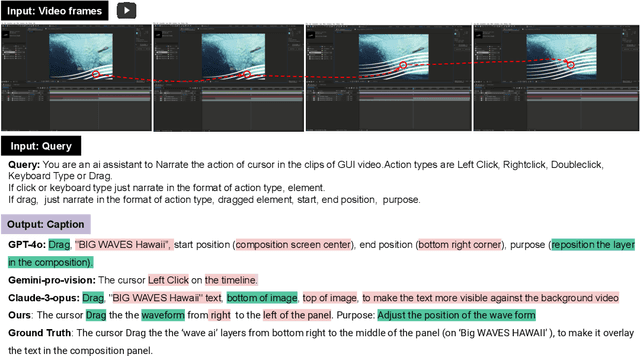
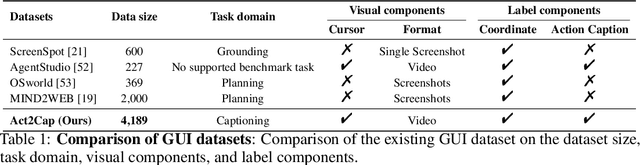
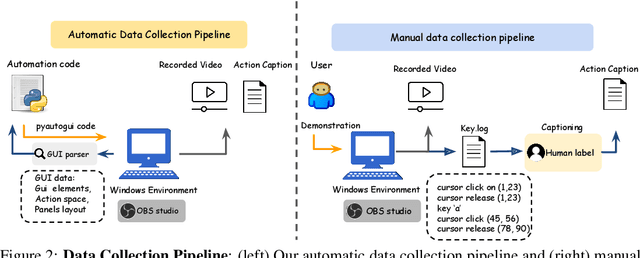

The advent of Multimodal LLMs has significantly enhanced image OCR recognition capabilities, making GUI automation a viable reality for increasing efficiency in digital tasks. One fundamental aspect of developing a GUI automation system is understanding primitive GUI actions. This comprehension is crucial as it enables agents to learn from user demonstrations, an essential element of automation. To rigorously evaluate such capabilities, we developed a video captioning benchmark for GUI actions, comprising 4,189 diverse video captioning samples. This task presents unique challenges compared to natural scene video captioning: 1) GUI screenshots typically contain denser information than natural scenes, and 2) events within GUIs are subtler and occur more rapidly, requiring precise attention to the appropriate time span and spatial region for accurate understanding. To address these challenges, we introduce our GUI action dataset \textbf{Act2Cap} as well as a simple yet effective framework, \textbf{GUI Narrator}, for GUI video captioning that utilizes the cursor as a visual prompt to enhance the interpretation of high-resolution screenshots. Specifically, a cursor detector is trained on our dataset, and a multimodal LLM model with mechanisms for selecting keyframes and key regions generates the captions. Experimental results indicate that even for today's most advanced multimodal models, such as GPT-4o, the task remains highly challenging. Additionally, our evaluations show that our strategy effectively enhances model performance, whether integrated into the fine-tuning of open-source models or employed as a prompting strategy in closed-source models.
ASSISTGUI: Task-Oriented Desktop Graphical User Interface Automation
Jan 01, 2024Graphical User Interface (GUI) automation holds significant promise for assisting users with complex tasks, thereby boosting human productivity. Existing works leveraging Large Language Model (LLM) or LLM-based AI agents have shown capabilities in automating tasks on Android and Web platforms. However, these tasks are primarily aimed at simple device usage and entertainment operations. This paper presents a novel benchmark, AssistGUI, to evaluate whether models are capable of manipulating the mouse and keyboard on the Windows platform in response to user-requested tasks. We carefully collected a set of 100 tasks from nine widely-used software applications, such as, After Effects and MS Word, each accompanied by the necessary project files for better evaluation. Moreover, we propose an advanced Actor-Critic Embodied Agent framework, which incorporates a sophisticated GUI parser driven by an LLM-agent and an enhanced reasoning mechanism adept at handling lengthy procedural tasks. Our experimental results reveal that our GUI Parser and Reasoning mechanism outshine existing methods in performance. Nevertheless, the potential remains substantial, with the best model attaining only a 46% success rate on our benchmark. We conclude with a thorough analysis of the current methods' limitations, setting the stage for future breakthroughs in this domain.