 Add to Chrome
 Add to Firefox
 Add to Edge
CutVerse: A Compositional GUI Agents Benchmark for Media Post-Production Editing
May 19, 2026
While GUI agents have made significant progress in web navigation and basic operating system tasks, their capabilities in professional creative workflows remain largely underexplored. To bridge this gap, we introduce Cutverse, a benchmark designed to systematically evaluate autonomous GUI agents in realistic media post-production environments. We curate expert demonstrations across 7 professional applications (e.g., Premiere Pro, Photoshop), covering 186 complex, long-horizon tasks grounded in authentic editing workflows, involving dense multimodal interfaces and tightly coupled interaction sequences. To support scalable evaluation, we develop a lightweight parser that transforms raw screen recordings and low-level interaction logs into structured, compositional GUI action trajectories with precise grounding. Extensive evaluations reveal that existing agents achieve only 36.0\% task success on realistic media editing tasks, underscoring the challenges posed by complex, long-horizon media post-production workflows in our benchmark.While current models demonstrate promising spatial grounding, multimodal alignment, and coordinated action execution, they remain limited in long-horizon reliability and domain-specific planning.

Dual-Latent Collaborative Decoding for Fidelity-Perception Balanced Image Compression
May 14, 2026Learned image compression (LIC) increasingly requires reconstructions that balance distortion fidelity and perceptual realism across a wide range of bitrates. However, most existing methods still rely on a single compressed latent representation to simultaneously carry structural details, semantic cues, and perceptual priors, requiring the same latent representation to serve multiple, potentially conflicting roles. This tension becomes evident across different latent paradigms: scalar-quantized (SQ) continuous latents provide rate-scalable fidelity but tend to lose perceptual details at low rates, while vector-quantized (VQ) discrete tokens preserve compact semantic cues but suffer from limited structural fidelity and bitrate scalability. To address this issue, we propose Mixture of Decoder Experts (MoDE), a dual-latent collaborative decoding framework that decomposes reconstruction responsibilities across complementary latent paradigms. Specifically, MoDE treats the SQ branch as a fidelity-oriented expert and the VQ branch as a perception-oriented expert, and coordinates them through two decoder-side modules: Expert-Specific Enhancement (ESE), which preserves branch-specific expert references, and Cross-Expert Modulation (CEM), which enables selective complementary transfer during reconstruction. The resulting framework supports selective cross-latent collaboration under a shared dual-stream bitstream and enables both fidelity-anchored and perception-anchored decoding. Extensive experiments demonstrate that MoDE achieves a more favorable fidelity-perception balance than representative distortion-oriented, perception-oriented, generative, and dual-latent baselines across a wide bitrate range, highlighting decoder-side expert collaboration as an effective design for wide-range fidelity-perception balanced LIC.
FlowAnchor: Stabilizing the Editing Signal for Inversion-Free Video Editing
Apr 24, 2026We propose FlowAnchor, a training-free framework for stable and efficient inversion-free, flow-based video editing. Inversion-free editing methods have recently shown impressive efficiency and structure preservation in images by directly steering the sampling trajectory with an editing signal. However, extending this paradigm to videos remains challenging, often failing in multi-object scenes or with increased frame counts. We identify the root cause as the instability of the editing signal in high-dimensional video latent spaces, which arises from imprecise spatial localization and length-induced magnitude attenuation. To overcome this challenge, FlowAnchor explicitly anchors both where to edit and how strongly to edit. It introduces Spatial-aware Attention Refinement, which enforces consistent alignment between textual guidance and spatial regions, and Adaptive Magnitude Modulation, which adaptively preserves sufficient editing strength. Together, these mechanisms stabilize the editing signal and guide the flow-based evolution toward the desired target distribution. Extensive experiments demonstrate that FlowAnchor achieves more faithful, temporally coherent, and computationally efficient video editing across challenging multi-object and fast-motion scenarios. The project page is available at https://cuc-mipg.github.io/FlowAnchor.github.io/.
Camera Artist: A Multi-Agent Framework for Cinematic Language Storytelling Video Generation
Apr 10, 2026We propose Camera Artist, a multi-agent framework that models a real-world filmmaking workflow to generate narrative videos with explicit cinematic language. While recent multi-agent systems have made substantial progress in automating filmmaking workflows from scripts to videos, they often lack explicit mechanisms to structure narrative progression across adjacent shots and deliberate use of cinematic language, resulting in fragmented storytelling and limited filmic quality. To address this, Camera Artist builds upon established agentic pipelines and introduces a dedicated Cinematography Shot Agent, which integrates recursive storyboard generation to strengthen shot-to-shot narrative continuity and cinematic language injection to produce more expressive, film-oriented shot designs. Extensive quantitative and qualitative results demonstrate that our approach consistently outperforms existing baselines in narrative consistency, dynamic expressiveness, and perceived film quality.
MLV-Edit: Towards Consistent and Highly Efficient Editing for Minute-Level Videos
Feb 02, 2026We propose MLV-Edit, a training-free, flow-based framework that address the unique challenges of minute-level video editing. While existing techniques excel in short-form video manipulation, scaling them to long-duration videos remains challenging due to prohibitive computational overhead and the difficulty of maintaining global temporal consistency across thousands of frames. To address this, MLV-Edit employs a divide-and-conquer strategy for segment-wise editing, facilitated by two core modules: Velocity Blend rectifies motion inconsistencies at segment boundaries by aligning the flow fields of adjacent chunks, eliminating flickering and boundary artifacts commonly observed in fragmented video processing; and Attention Sink anchors local segment features to global reference frames, effectively suppressing cumulative structural drift. Extensive quantitative and qualitative experiments demonstrate that MLV-Edit consistently outperforms state-of-the-art methods in terms of temporal stability and semantic fidelity.
IC-Effect: Precise and Efficient Video Effects Editing via In-Context Learning
Dec 17, 2025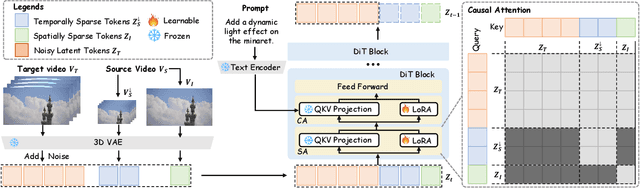

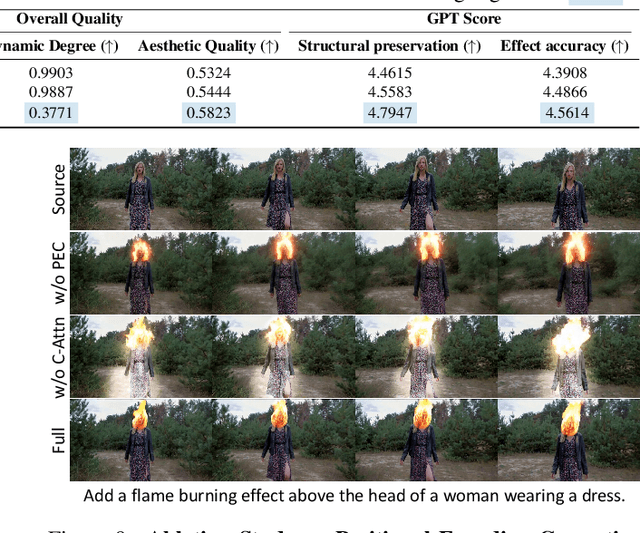
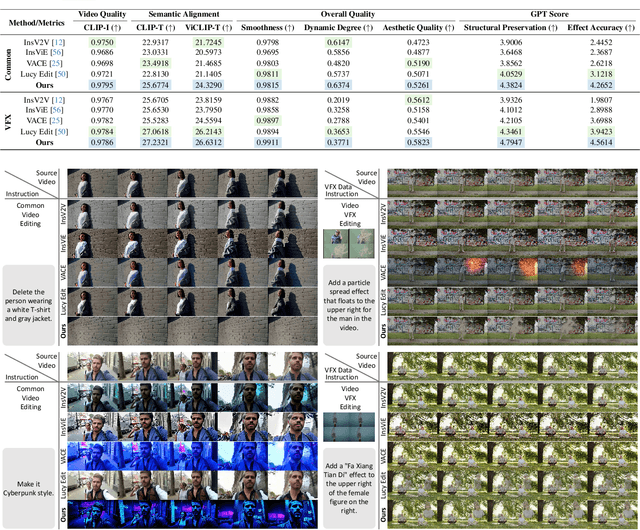
We propose \textbf{IC-Effect}, an instruction-guided, DiT-based framework for few-shot video VFX editing that synthesizes complex effects (\eg flames, particles and cartoon characters) while strictly preserving spatial and temporal consistency. Video VFX editing is highly challenging because injected effects must blend seamlessly with the background, the background must remain entirely unchanged, and effect patterns must be learned efficiently from limited paired data. However, existing video editing models fail to satisfy these requirements. IC-Effect leverages the source video as clean contextual conditions, exploiting the contextual learning capability of DiT models to achieve precise background preservation and natural effect injection. A two-stage training strategy, consisting of general editing adaptation followed by effect-specific learning via Effect-LoRA, ensures strong instruction following and robust effect modeling. To further improve efficiency, we introduce spatiotemporal sparse tokenization, enabling high fidelity with substantially reduced computation. We also release a paired VFX editing dataset spanning $15$ high-quality visual styles. Extensive experiments show that IC-Effect delivers high-quality, controllable, and temporally consistent VFX editing, opening new possibilities for video creation.
UniMIC: Token-Based Multimodal Interactive Coding for Human-AI Collaboration
Sep 26, 2025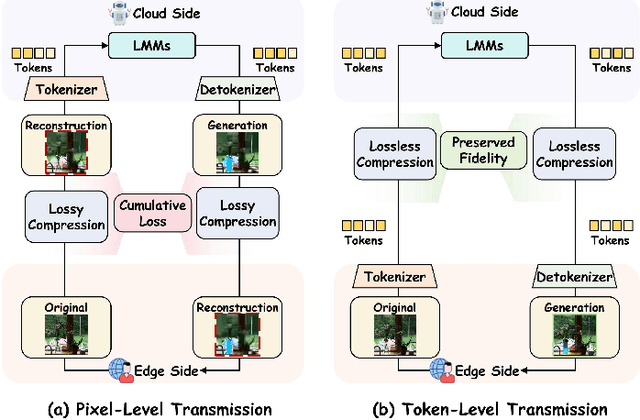
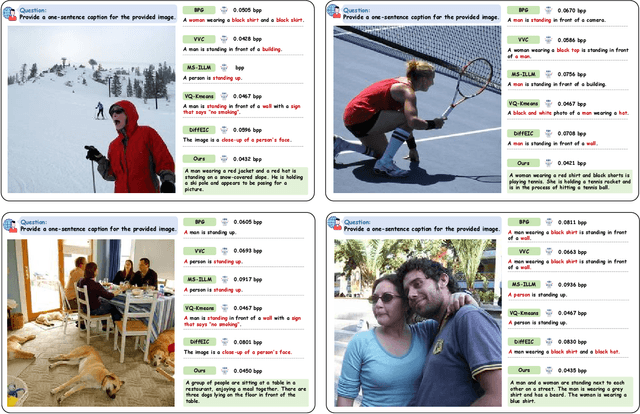
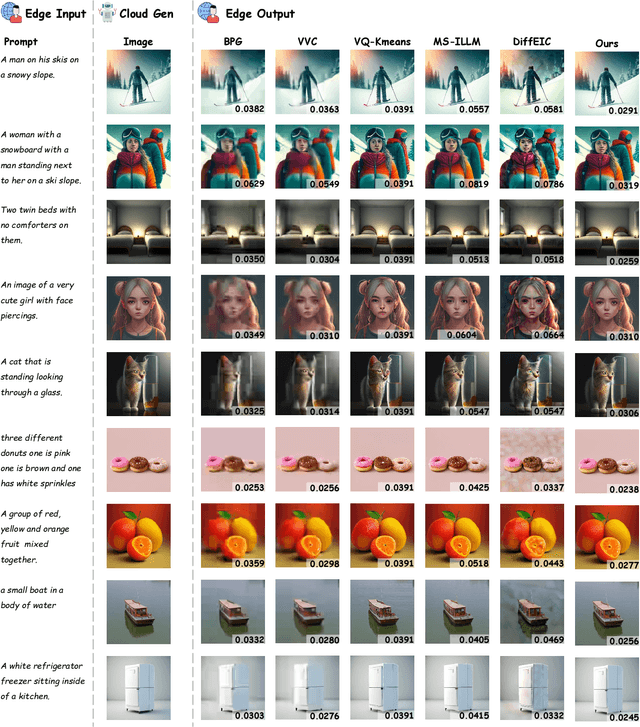
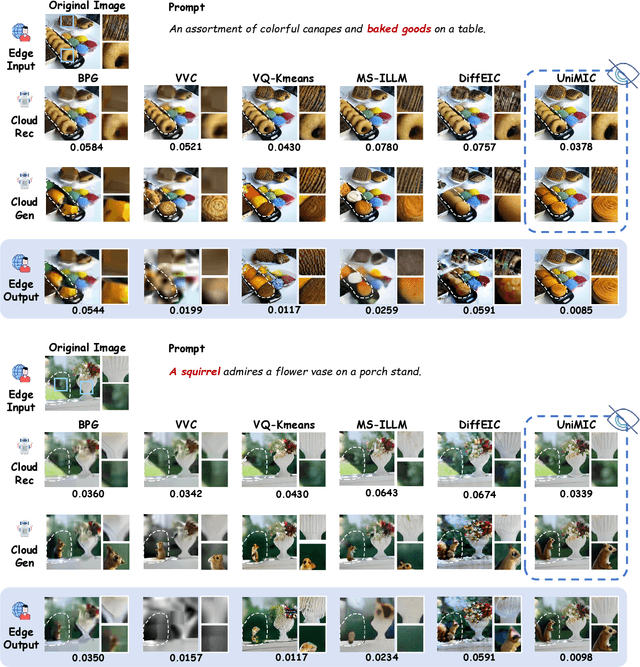
The rapid progress of Large Multimodal Models (LMMs) and cloud-based AI agents is transforming human-AI collaboration into bidirectional, multimodal interaction. However, existing codecs remain optimized for unimodal, one-way communication, resulting in repeated degradation under conventional compress-transmit-reconstruct pipelines. To address this limitation, we propose UniMIC, a Unified token-based Multimodal Interactive Coding framework that bridges edge devices and cloud AI agents. Instead of transmitting raw pixels or plain text, UniMIC employs compact tokenized representations as the communication medium, enabling efficient low-bitrate transmission while maintaining compatibility with LMMs. To further enhance compression, lightweight Transformer-based entropy models with scenario-specific designs-generic, masked, and text-conditioned-effectively minimize inter-token redundancy. Extensive experiments on text-to-image generation, text-guided inpainting, outpainting, and visual question answering show that UniMIC achieves substantial bitrate savings and remains robust even at ultra-low bitrates (<0.05bpp), without compromising downstream task performance. These results establish UniMIC as a practical and forward-looking paradigm for next-generation multimodal interactive communication.
Tuning-Free Image Editing with Fidelity and Editability via Unified Latent Diffusion Model
Apr 08, 2025Balancing fidelity and editability is essential in text-based image editing (TIE), where failures commonly lead to over- or under-editing issues. Existing methods typically rely on attention injections for structure preservation and leverage the inherent text alignment capabilities of pre-trained text-to-image (T2I) models for editability, but they lack explicit and unified mechanisms to properly balance these two objectives. In this work, we introduce UnifyEdit, a tuning-free method that performs diffusion latent optimization to enable a balanced integration of fidelity and editability within a unified framework. Unlike direct attention injections, we develop two attention-based constraints: a self-attention (SA) preservation constraint for structural fidelity, and a cross-attention (CA) alignment constraint to enhance text alignment for improved editability. However, simultaneously applying both constraints can lead to gradient conflicts, where the dominance of one constraint results in over- or under-editing. To address this challenge, we introduce an adaptive time-step scheduler that dynamically adjusts the influence of these constraints, guiding the diffusion latent toward an optimal balance. Extensive quantitative and qualitative experiments validate the effectiveness of our approach, demonstrating its superiority in achieving a robust balance between structure preservation and text alignment across various editing tasks, outperforming other state-of-the-art methods. The source code will be available at https://github.com/CUC-MIPG/UnifyEdit.
Edit Transfer: Learning Image Editing via Vision In-Context Relations
Mar 17, 2025We introduce a new setting, Edit Transfer, where a model learns a transformation from just a single source-target example and applies it to a new query image. While text-based methods excel at semantic manipulations through textual prompts, they often struggle with precise geometric details (e.g., poses and viewpoint changes). Reference-based editing, on the other hand, typically focuses on style or appearance and fails at non-rigid transformations. By explicitly learning the editing transformation from a source-target pair, Edit Transfer mitigates the limitations of both text-only and appearance-centric references. Drawing inspiration from in-context learning in large language models, we propose a visual relation in-context learning paradigm, building upon a DiT-based text-to-image model. We arrange the edited example and the query image into a unified four-panel composite, then apply lightweight LoRA fine-tuning to capture complex spatial transformations from minimal examples. Despite using only 42 training samples, Edit Transfer substantially outperforms state-of-the-art TIE and RIE methods on diverse non-rigid scenarios, demonstrating the effectiveness of few-shot visual relation learning.
EmoAgent: Multi-Agent Collaboration of Plan, Edit, and Critic, for Affective Image Manipulation
Mar 14, 2025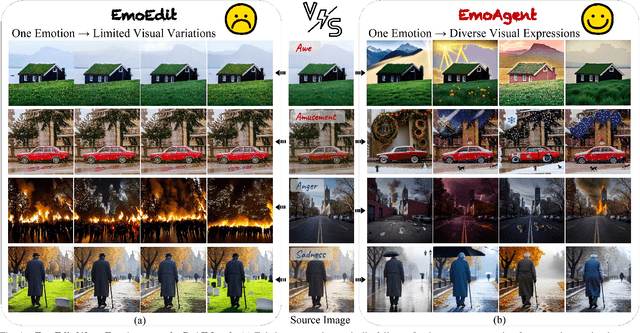
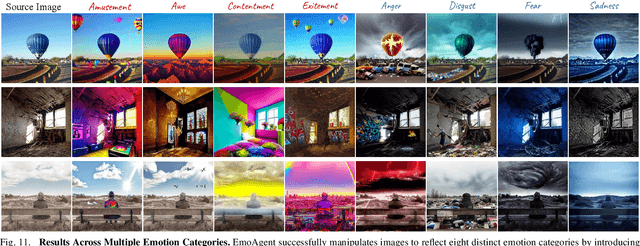
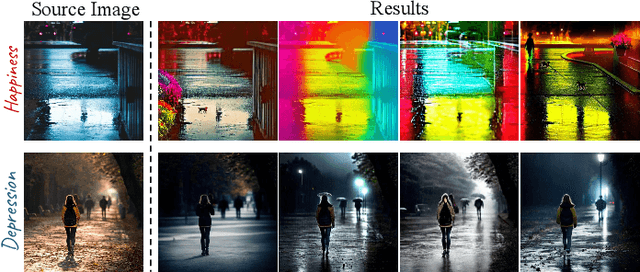
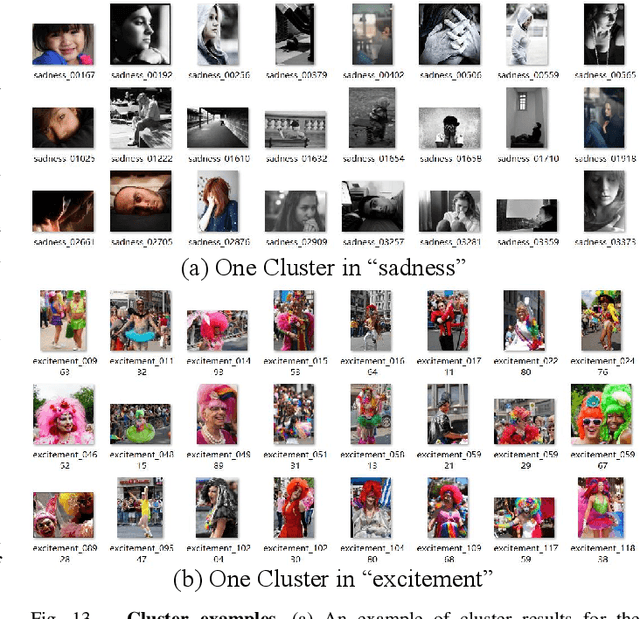
Affective Image Manipulation (AIM) aims to alter an image's emotional impact by adjusting multiple visual elements to evoke specific feelings.Effective AIM is inherently complex, necessitating a collaborative approach that involves identifying semantic cues within source images, manipulating these elements to elicit desired emotional responses, and verifying that the combined adjustments successfully evoke the target emotion.To address these challenges, we introduce EmoAgent, the first multi-agent collaboration framework for AIM. By emulating the cognitive behaviors of a human painter, EmoAgent incorporates three specialized agents responsible for planning, editing, and critical evaluation. Furthermore, we develop an emotion-factor knowledge retriever, a decision-making tree space, and a tool library to enhance EmoAgent's effectiveness in handling AIM. Experiments demonstrate that the proposed multi-agent framework outperforms existing methods, offering more reasonable and effective emotional expression.