 Add to Chrome
 Add to Firefox
 Add to Edge
Towards UAV Detection in the Real World: A New Multispectral Dataset UAVNet-MS and a New Method
May 20, 2026
The proliferation of unmanned aerial vehicles (UAVs) has created urgent demand for precise UAV monitoring. Existing RGB-based systems rely on spatial cues that degrade at small scales, particularly with high inter-type similarity, target-clutter ambiguity, and low contrast. Multispectral imaging (MSI) encodes material-aware spectral signatures, yet MSI-based fine-grained small-UAV detection remains underexplored due to lack of dedicated datasets. We introduce UAVNet-MS, the first multispectral dataset for fine-grained small-UAV detection, comprising 15,618 temporally synchronized RGB-MSI data cubes (1440x1080) with bounding box annotations. The dataset features challenging small objects (93.7% <= 32^2 pixels, average 18^2 pixels, ~0.02% image area) under low contrast. We propose MFDNet, a dual-stream baseline addressing array-induced parallax and spatial-spectral fusion. Extensive evaluation under RGB-only, MSI-only, and RGB+MSI protocols against 20 detectors shows MFDNet achieves +6.2% AP50 improvement over best RGB-only methods, demonstrating spectral cues provide complementary material evidence beyond spatial cues. This work provides foundational dataset, strong baseline, and benchmark for multispectral UAV monitoring research.

SpecDETR: A Transformer-based Hyperspectral Point Object Detection Network
May 16, 2024
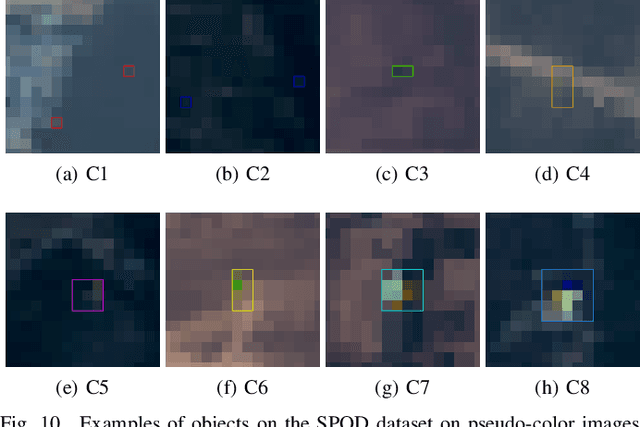
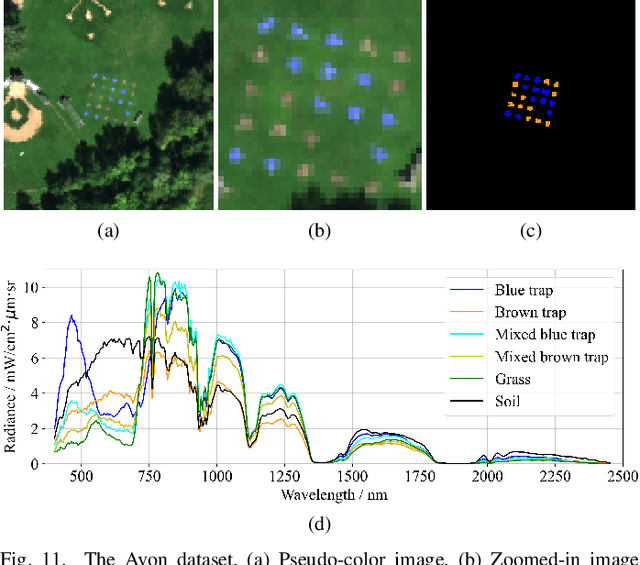
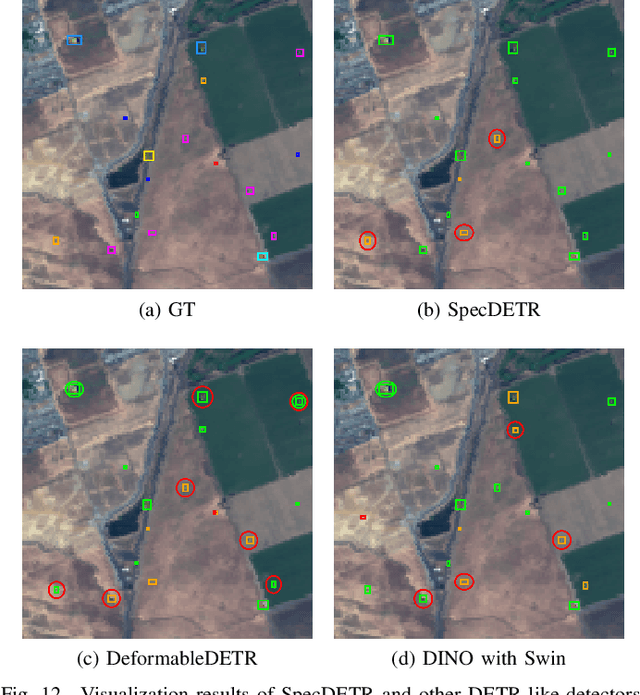
Hyperspectral target detection (HTD) aims to identify specific materials based on spectral information in hyperspectral imagery and can detect point targets, some of which occupy a smaller than one-pixel area. However, existing HTD methods are developed based on per-pixel binary classification, which limits the feature representation capability for point targets. In this paper, we rethink the hyperspectral point target detection from the object detection perspective, and focus more on the object-level prediction capability rather than the pixel classification capability. Inspired by the token-based processing flow of Detection Transformer (DETR), we propose the first specialized network for hyperspectral multi-class point object detection, SpecDETR. Without the backbone part of the current object detection framework, SpecDETR treats the spectral features of each pixel in hyperspectral images as a token and utilizes a multi-layer Transformer encoder with local and global coordination attention modules to extract deep spatial-spectral joint features. SpecDETR regards point object detection as a one-to-many set prediction problem, thereby achieving a concise and efficient DETR decoder that surpasses the current state-of-the-art DETR decoder in terms of parameters and accuracy in point object detection. We develop a simulated hyperSpectral Point Object Detection benchmark termed SPOD, and for the first time, evaluate and compare the performance of current object detection networks and HTD methods on hyperspectral multi-class point object detection. SpecDETR demonstrates superior performance as compared to current object detection networks and HTD methods on the SPOD dataset. Additionally, we validate on a public HTD dataset that by using data simulation instead of manual annotation, SpecDETR can detect real-world single-spectral point objects directly.