 Add to Chrome
 Add to Firefox
 Add to Edge
InnoText: A Unified Model for Visual Text Generation and Editing
Jul 24, 2026
Diffusion models have recently achieved remarkable success in high-fidelity image synthesis, yet their application to visual text generation and editing remains relatively underexplored. Unlike general image generation, visual text tasks demand precise structural regularity and legibility, which may pose additional challenges for small-scale text and non-Latin scripts such as Chinese. Existing UNet-based models often struggle to produce clear and coherent text, while DiT-based models, though more expressive, are typically limited to a single task, which may lead to redundant training pipelines, inconsistent visual styles, and reduced cross-task generalization. To address these challenges, we propose InnoText, a unified DiT-based framework capable of performing both text generation and editing within a single model. We introduce a Font Size-Aware Modulation (FSAM) module to enhance representations across font scales, a Small-Character Aware Augmentation strategy to improve fine-grained fidelity, and a Task-Specific Region Weighted Loss for adaptive optimization. To support training and evaluation, we also construct a high-quality bilingual (English-Chinese) visual text dataset covering diverse fonts, sizes, and backgrounds. Experimental results demonstrate that our method achieves superior generation accuracy and editing quality, producing visually appealing and realistic text images.

Design Your Ad: Personalized Advertising Image and Text Generation with Unified Autoregressive Models
May 12, 2026Generating realistic and user-preferred advertisements is a key challenge in e-commerce. Existing approaches utilize multiple independent models driven by click-through-rate (CTR) to controllably create attractive image or text advertisements. However, their pipelines lack cross-modal perception and rely on CTR that only reflects average preferences. Therefore, we explore jointly generating personalized image-text advertisements from historical click behaviors. We first design a Unified Advertisement Generative model (Uni-AdGen) that employs a single autoregressive framework to produce both advertising images and texts. By incorporating a foreground perception module and instruction tuning, Uni-AdGen enhances the realism of the generated content. To further personalize advertisements, we equip Uni-AdGen with a coarse-to-fine preference understanding module that effectively captures user interests from noisy multimodal historical behaviors to drive personalized generation. Additionally, we construct the first large-scale Personalized Advertising image-text dataset (PAd1M) and introduce a Product Background Similarity (PBS) metric to facilitate training and evaluation. Extensive experiments show that our method outperforms baselines in general and personalized advertisement generation. Our project is available at https://github.com/JD-GenX/Uni-AdGen.
MAPo : Motion-Aware Partitioning of Deformable 3D Gaussian Splatting for High-Fidelity Dynamic Scene Reconstruction
Aug 27, 2025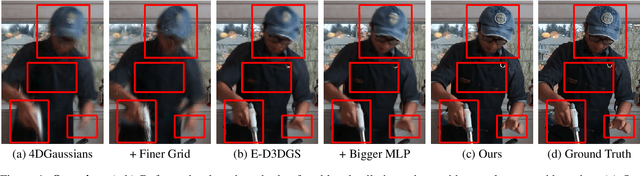
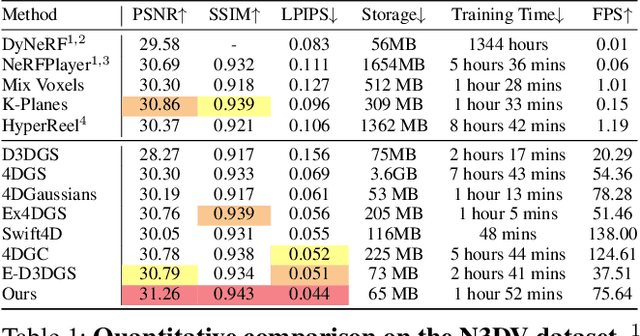
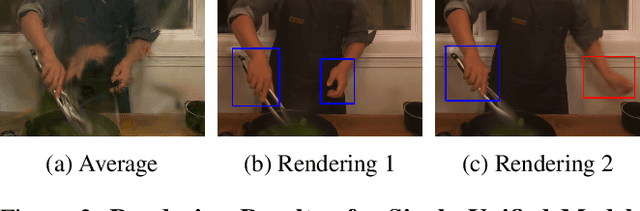
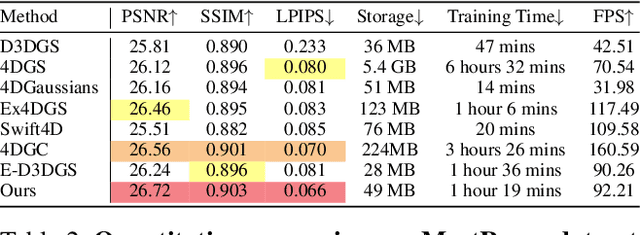
3D Gaussian Splatting, known for enabling high-quality static scene reconstruction with fast rendering, is increasingly being applied to dynamic scene reconstruction. A common strategy involves learning a deformation field to model the temporal changes of a canonical set of 3D Gaussians. However, these deformation-based methods often produce blurred renderings and lose fine motion details in highly dynamic regions due to the inherent limitations of a single, unified model in representing diverse motion patterns. To address these challenges, we introduce Motion-Aware Partitioning of Deformable 3D Gaussian Splatting (MAPo), a novel framework for high-fidelity dynamic scene reconstruction. Its core is a dynamic score-based partitioning strategy that distinguishes between high- and low-dynamic 3D Gaussians. For high-dynamic 3D Gaussians, we recursively partition them temporally and duplicate their deformation networks for each new temporal segment, enabling specialized modeling to capture intricate motion details. Concurrently, low-dynamic 3DGs are treated as static to reduce computational costs. However, this temporal partitioning strategy for high-dynamic 3DGs can introduce visual discontinuities across frames at the partition boundaries. To address this, we introduce a cross-frame consistency loss, which not only ensures visual continuity but also further enhances rendering quality. Extensive experiments demonstrate that MAPo achieves superior rendering quality compared to baselines while maintaining comparable computational costs, particularly in regions with complex or rapid motions.
DropoutGS: Dropping Out Gaussians for Better Sparse-view Rendering
Apr 13, 2025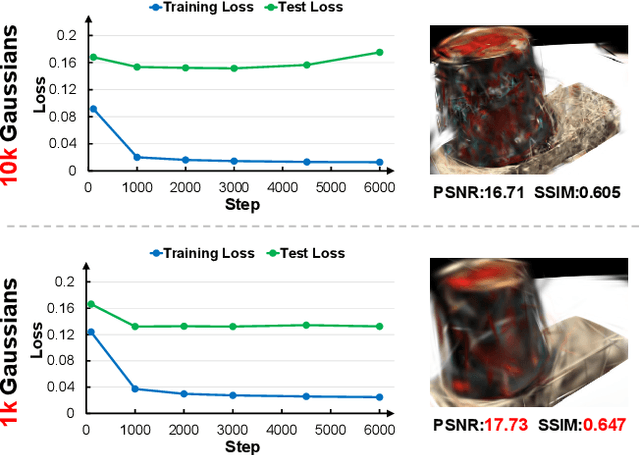
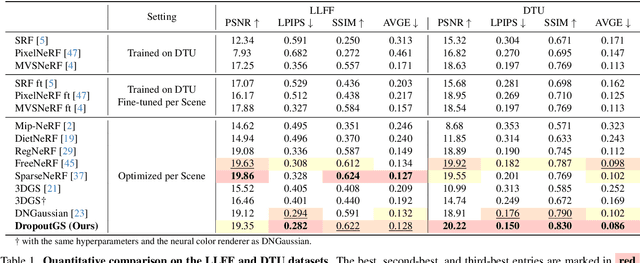
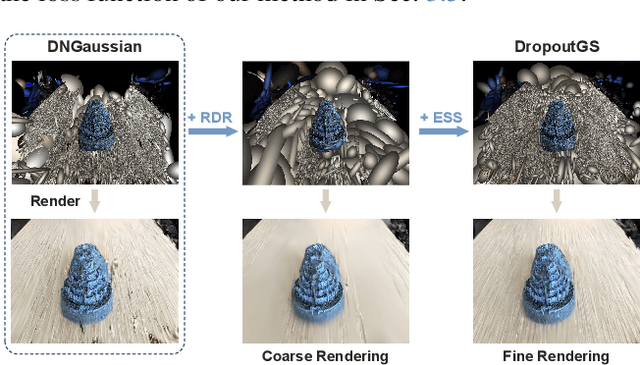
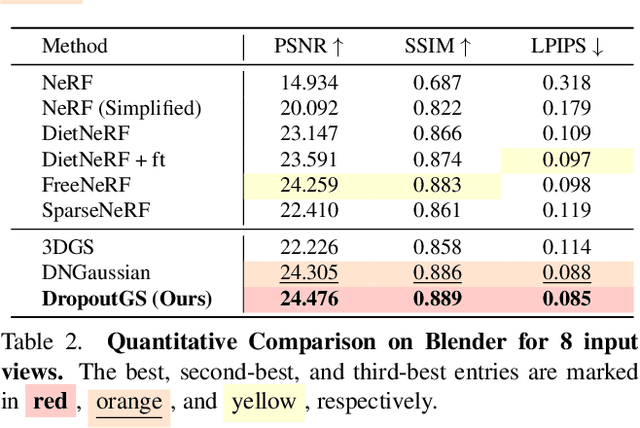
Although 3D Gaussian Splatting (3DGS) has demonstrated promising results in novel view synthesis, its performance degrades dramatically with sparse inputs and generates undesirable artifacts. As the number of training views decreases, the novel view synthesis task degrades to a highly under-determined problem such that existing methods suffer from the notorious overfitting issue. Interestingly, we observe that models with fewer Gaussian primitives exhibit less overfitting under sparse inputs. Inspired by this observation, we propose a Random Dropout Regularization (RDR) to exploit the advantages of low-complexity models to alleviate overfitting. In addition, to remedy the lack of high-frequency details for these models, an Edge-guided Splitting Strategy (ESS) is developed. With these two techniques, our method (termed DropoutGS) provides a simple yet effective plug-in approach to improve the generalization performance of existing 3DGS methods. Extensive experiments show that our DropoutGS produces state-of-the-art performance under sparse views on benchmark datasets including Blender, LLFF, and DTU. The project page is at: https://xuyx55.github.io/DropoutGS/.