 Add to Chrome
 Add to Firefox
 Add to Edge
Activation Space Selectable Kolmogorov-Arnold Networks
Aug 15, 2024
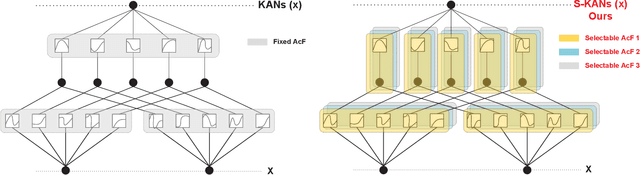
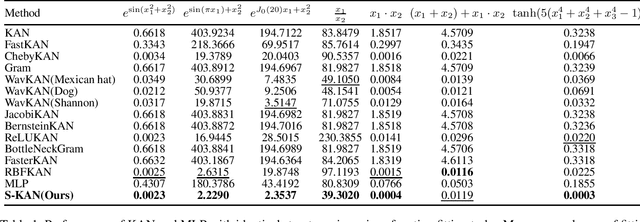
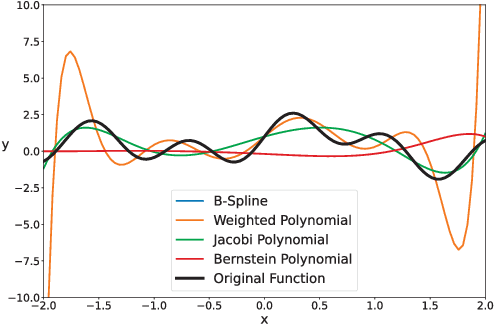
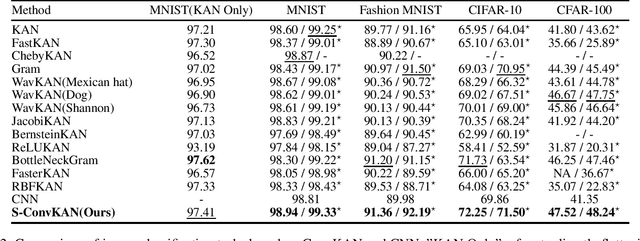
The multilayer perceptron (MLP), a fundamental paradigm in current artificial intelligence, is widely applied in fields such as computer vision and natural language processing. However, the recently proposed Kolmogorov-Arnold Network (KAN), based on nonlinear additive connections, has been proven to achieve performance comparable to MLPs with significantly fewer parameters. Despite this potential, the use of a single activation function space results in reduced performance of KAN and related works across different tasks. To address this issue, we propose an activation space Selectable KAN (S-KAN). S-KAN employs an adaptive strategy to choose the possible activation mode for data at each feedforward KAN node. Our approach outperforms baseline methods in seven representative function fitting tasks and significantly surpasses MLP methods with the same level of parameters. Furthermore, we extend the structure of S-KAN and propose an activation space selectable Convolutional KAN (S-ConvKAN), which achieves leading results on four general image classification datasets. Our method mitigates the performance variability of the original KAN across different tasks and demonstrates through extensive experiments that feedforward KANs with selectable activations can achieve or even exceed the performance of MLP-based methods. This work contributes to the understanding of the data-centric design of new AI paradigms and provides a foundational reference for innovations in KAN-based network architectures.

GEM: Context-Aware Gaze EstiMation with Visual Search Behavior Matching for Chest Radiograph
Aug 10, 2024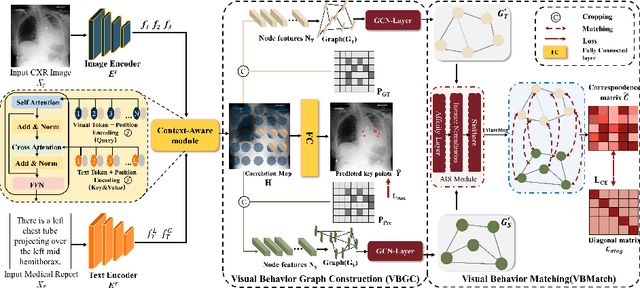

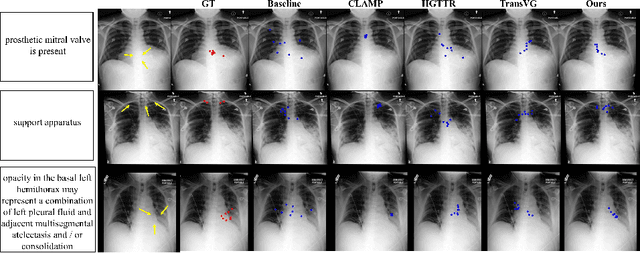

Gaze estimation is pivotal in human scene comprehension tasks, particularly in medical diagnostic analysis. Eye-tracking technology facilitates the recording of physicians' ocular movements during image interpretation, thereby elucidating their visual attention patterns and information-processing strategies. In this paper, we initially define the context-aware gaze estimation problem in medical radiology report settings. To understand the attention allocation and cognitive behavior of radiologists during the medical image interpretation process, we propose a context-aware Gaze EstiMation (GEM) network that utilizes eye gaze data collected from radiologists to simulate their visual search behavior patterns throughout the image interpretation process. It consists of a context-awareness module, visual behavior graph construction, and visual behavior matching. Within the context-awareness module, we achieve intricate multimodal registration by establishing connections between medical reports and images. Subsequently, for a more accurate simulation of genuine visual search behavior patterns, we introduce a visual behavior graph structure, capturing such behavior through high-order relationships (edges) between gaze points (nodes). To maintain the authenticity of visual behavior, we devise a visual behavior-matching approach, adjusting the high-order relationships between them by matching the graph constructed from real and estimated gaze points. Extensive experiments on four publicly available datasets demonstrate the superiority of GEM over existing methods and its strong generalizability, which also provides a new direction for the effective utilization of diverse modalities in medical image interpretation and enhances the interpretability of models in the field of medical imaging. https://github.com/Tiger-SN/GEM
Towards High-resolution 3D Anomaly Detection via Group-Level Feature Contrastive Learning
Aug 08, 2024



High-resolution point clouds~(HRPCD) anomaly detection~(AD) plays a critical role in precision machining and high-end equipment manufacturing. Despite considerable 3D-AD methods that have been proposed recently, they still cannot meet the requirements of the HRPCD-AD task. There are several challenges: i) It is difficult to directly capture HRPCD information due to large amounts of points at the sample level; ii) The advanced transformer-based methods usually obtain anisotropic features, leading to degradation of the representation; iii) The proportion of abnormal areas is very small, which makes it difficult to characterize. To address these challenges, we propose a novel group-level feature-based network, called Group3AD, which has a significantly efficient representation ability. First, we design an Intercluster Uniformity Network~(IUN) to present the mapping of different groups in the feature space as several clusters, and obtain a more uniform distribution between clusters representing different parts of the point clouds in the feature space. Then, an Intracluster Alignment Network~(IAN) is designed to encourage groups within the cluster to be distributed tightly in the feature space. In addition, we propose an Adaptive Group-Center Selection~(AGCS) based on geometric information to improve the pixel density of potential anomalous regions during inference. The experimental results verify the effectiveness of our proposed Group3AD, which surpasses Reg3D-AD by the margin of 5\% in terms of object-level AUROC on Real3D-AD. We provide the code and supplementary information on our website: https://github.com/M-3LAB/Group3AD.
WiNet: Wavelet-based Incremental Learning for Efficient Medical Image Registration
Jul 18, 2024Deep image registration has demonstrated exceptional accuracy and fast inference. Recent advances have adopted either multiple cascades or pyramid architectures to estimate dense deformation fields in a coarse-to-fine manner. However, due to the cascaded nature and repeated composition/warping operations on feature maps, these methods negatively increase memory usage during training and testing. Moreover, such approaches lack explicit constraints on the learning process of small deformations at different scales, thus lacking explainability. In this study, we introduce a model-driven WiNet that incrementally estimates scale-wise wavelet coefficients for the displacement/velocity field across various scales, utilizing the wavelet coefficients derived from the original input image pair. By exploiting the properties of the wavelet transform, these estimated coefficients facilitate the seamless reconstruction of a full-resolution displacement/velocity field via our devised inverse discrete wavelet transform (IDWT) layer. This approach avoids the complexities of cascading networks or composition operations, making our WiNet an explainable and efficient competitor with other coarse-to-fine methods. Extensive experimental results from two 3D datasets show that our WiNet is accurate and GPU efficient. The code is available at https://github.com/x-xc/WiNet .
GM-DF: Generalized Multi-Scenario Deepfake Detection
Jun 28, 2024Existing face forgery detection usually follows the paradigm of training models in a single domain, which leads to limited generalization capacity when unseen scenarios and unknown attacks occur. In this paper, we elaborately investigate the generalization capacity of deepfake detection models when jointly trained on multiple face forgery detection datasets. We first find a rapid degradation of detection accuracy when models are directly trained on combined datasets due to the discrepancy across collection scenarios and generation methods. To address the above issue, a Generalized Multi-Scenario Deepfake Detection framework (GM-DF) is proposed to serve multiple real-world scenarios by a unified model. First, we propose a hybrid expert modeling approach for domain-specific real/forgery feature extraction. Besides, as for the commonality representation, we use CLIP to extract the common features for better aligning visual and textual features across domains. Meanwhile, we introduce a masked image reconstruction mechanism to force models to capture rich forged details. Finally, we supervise the models via a domain-aware meta-learning strategy to further enhance their generalization capacities. Specifically, we design a novel domain alignment loss to strongly align the distributions of the meta-test domains and meta-train domains. Thus, the updated models are able to represent both specific and common real/forgery features across multiple datasets. In consideration of the lack of study of multi-dataset training, we establish a new benchmark leveraging multi-source data to fairly evaluate the models' generalization capacity on unseen scenarios. Both qualitative and quantitative experiments on five datasets conducted on traditional protocols as well as the proposed benchmark demonstrate the effectiveness of our approach.
SSAD: Self-supervised Auxiliary Detection Framework for Panoramic X-ray based Dental Disease Diagnosis
Jun 20, 2024Panoramic X-ray is a simple and effective tool for diagnosing dental diseases in clinical practice. When deep learning models are developed to assist dentist in interpreting panoramic X-rays, most of their performance suffers from the limited annotated data, which requires dentist's expertise and a lot of time cost. Although self-supervised learning (SSL) has been proposed to address this challenge, the two-stage process of pretraining and fine-tuning requires even more training time and computational resources. In this paper, we present a self-supervised auxiliary detection (SSAD) framework, which is plug-and-play and compatible with any detectors. It consists of a reconstruction branch and a detection branch. Both branches are trained simultaneously, sharing the same encoder, without the need for finetuning. The reconstruction branch learns to restore the tooth texture of healthy or diseased teeth, while the detection branch utilizes these learned features for diagnosis. To enhance the encoder's ability to capture fine-grained features, we incorporate the image encoder of SAM to construct a texture consistency (TC) loss, which extracts image embedding from the input and output of reconstruction branch, and then enforces both embedding into the same feature space. Extensive experiments on the public DENTEX dataset through three detection tasks demonstrate that the proposed SSAD framework achieves state-of-the-art performance compared to mainstream object detection methods and SSL methods. The code is available at https://github.com/Dylonsword/SSAD
APSeg: Auto-Prompt Network for Cross-Domain Few-Shot Semantic Segmentatio
Jun 12, 2024Few-shot semantic segmentation (FSS) endeavors to segment unseen classes with only a few labeled samples. Current FSS methods are commonly built on the assumption that their training and application scenarios share similar domains, and their performances degrade significantly while applied to a distinct domain. To this end, we propose to leverage the cutting-edge foundation model, the Segment Anything Model (SAM), for generalization enhancement. The SAM however performs unsatisfactorily on domains that are distinct from its training data, which primarily comprise natural scene images, and it does not support automatic segmentation of specific semantics due to its interactive prompting mechanism. In our work, we introduce APSeg, a novel auto-prompt network for cross-domain few-shot semantic segmentation (CD-FSS), which is designed to be auto-prompted for guiding cross-domain segmentation. Specifically, we propose a Dual Prototype Anchor Transformation (DPAT) module that fuses pseudo query prototypes extracted based on cycle-consistency with support prototypes, allowing features to be transformed into a more stable domain-agnostic space. Additionally, a Meta Prompt Generator (MPG) module is introduced to automatically generate prompt embeddings, eliminating the need for manual visual prompts. We build an efficient model which can be applied directly to target domains without fine-tuning. Extensive experiments on four cross-domain datasets show that our model outperforms the state-of-the-art CD-FSS method by 5.24% and 3.10% in average accuracy on 1-shot and 5-shot settings, respectively.
Simplify Implant Depth Prediction as Video Grounding: A Texture Perceive Implant Depth Prediction Network
Jun 07, 2024


Surgical guide plate is an important tool for the dental implant surgery. However, the design process heavily relies on the dentist to manually simulate the implant angle and depth. When deep neural networks have been applied to assist the dentist quickly locates the implant position, most of them are not able to determine the implant depth. Inspired by the video grounding task which localizes the starting and ending time of the target video segment, in this paper, we simplify the implant depth prediction as video grounding and develop a Texture Perceive Implant Depth Prediction Network (TPNet), which enables us to directly output the implant depth without complex measurements of oral bone. TPNet consists of an implant region detector (IRD) and an implant depth prediction network (IDPNet). IRD is an object detector designed to crop the candidate implant volume from the CBCT, which greatly saves the computation resource. IDPNet takes the cropped CBCT data to predict the implant depth. A Texture Perceive Loss (TPL) is devised to enable the encoder of IDPNet to perceive the texture variation among slices. Extensive experiments on a large dental implant dataset demonstrated that the proposed TPNet achieves superior performance than the existing methods.
Multi-Dataset Multi-Task Learning for COVID-19 Prognosis
May 22, 2024In the fight against the COVID-19 pandemic, leveraging artificial intelligence to predict disease outcomes from chest radiographic images represents a significant scientific aim. The challenge, however, lies in the scarcity of large, labeled datasets with compatible tasks for training deep learning models without leading to overfitting. Addressing this issue, we introduce a novel multi-dataset multi-task training framework that predicts COVID-19 prognostic outcomes from chest X-rays (CXR) by integrating correlated datasets from disparate sources, distant from conventional multi-task learning approaches, which rely on datasets with multiple and correlated labeling schemes. Our framework hypothesizes that assessing severity scores enhances the model's ability to classify prognostic severity groups, thereby improving its robustness and predictive power. The proposed architecture comprises a deep convolutional network that receives inputs from two publicly available CXR datasets, AIforCOVID for severity prognostic prediction and BRIXIA for severity score assessment, and branches into task-specific fully connected output networks. Moreover, we propose a multi-task loss function, incorporating an indicator function, to exploit multi-dataset integration. The effectiveness and robustness of the proposed approach are demonstrated through significant performance improvements in prognosis classification tasks across 18 different convolutional neural network backbones in different evaluation strategies. This improvement is evident over single-task baselines and standard transfer learning strategies, supported by extensive statistical analysis, showing great application potential.
EPL: Empirical Prototype Learning for Deep Face Recognition
May 21, 2024Prototype learning is widely used in face recognition, which takes the row vectors of coefficient matrix in the last linear layer of the feature extraction model as the prototypes for each class. When the prototypes are updated using the facial sample feature gradients in the model training, they are prone to being pulled away from the class center by the hard samples, resulting in decreased overall model performance. In this paper, we explicitly define prototypes as the expectations of sample features in each class and design the empirical prototypes using the existing samples in the dataset. We then devise a strategy to adaptively update these empirical prototypes during the model training based on the similarity between the sample features and the empirical prototypes. Furthermore, we propose an empirical prototype learning (EPL) method, which utilizes an adaptive margin parameter with respect to sample features. EPL assigns larger margins to the normal samples and smaller margins to the hard samples, allowing the learned empirical prototypes to better reflect the class center dominated by the normal samples and finally pull the hard samples towards the empirical prototypes through the learning. The extensive experiments on MFR, IJB-C, LFW, CFP-FP, AgeDB, and MegaFace demonstrate the effectiveness of EPL. Our code is available at $\href{https://github.com/WakingHours-GitHub/EPL}{https://github.com/WakingHours-GitHub/EPL}$.