 Add to Chrome
 Add to Firefox
 Add to Edge
X$^2$Localizer: Cross-grained Alignment for Progressive Cross-view Video Geo-localization
Aug 17, 2026
Cross-view Video Geo-localization (CVG) aims to localize ground-view videos by retrieving their corresponding geo-tagged aerial images. However, CVG approaches rely on fixed-length inputs and post-hoc refinement, hindering online-oriented localization under partial or dynamic observations. In this work, we formulate Progressive Cross-view Video Geo-localization (PCVG) as a deployment-oriented extension and evaluation protocol of CVG, enabling localization under varying temporal budgets, prefix-based inference, random-start evaluation, and long-range localization with interruptions. To explore PCVG, we introduce X$^2$Localizer, a cross-grained alignment framework that jointly supervises global prefix-to-aerial retrieval and token-aggregated frame--aerial-tile matching with a budget-dependent asymmetric objective. Furthermore, we introduce a Sliding-Window Re-Localization (SWRL) strategy that dynamically refreshes candidate regions for failure recovery and long-range deployment without full-sequence reprocessing. Extensive experiments show that X$^2$Localizer preserves conventional full-video performance, with marginal gains of +0.1 Recall@1 and +0.3 Recall@10, while substantially improving early localization. In the challenging single-frame setting, X$^2$Localizer improves coarse retrieval by +4.7 Recall@1 and +11.5 Recall@10 over the previous state-of-the-art method. With SWRL, our approach further enables robust progressive localization under random-start and long-distance scenarios, narrowing the gap between benchmark evaluation and real-world deployment.

Faster or Stronger: Towards Flexible Visual Place Recognition via Weighted Aggregation and Token Pruning
May 19, 2026Visual Place Recognition (VPR) aims to match a query image to reference images of the same place in a large-scale database. Recent state-of-the-art methods employ Vision Transformers (ViTs) as backbone foundation models to extract patch-level features that are robust to viewpoint, illumination, and seasonal variations, which are then aggregated into a compact global descriptor for retrieval. Most existing aggregation methods uniformly pool patch tokens into learned clusters, despite the fact that different clusters often encode distinct spatial or semantic patterns and contribute unequally to VPR performance. To address this limitation, we propose Weighted Aggregated Descriptor (WeiAD), which assigns weights to clusters during aggregation, producing more discriminative global representations. Beyond accuracy, retrieval latency is a critical concern for large-scale deployments and resource-constrained edge devices. Prior work mainly reduces latency by compressing global descriptors, while overlooking the cost of feature extraction, an issue exacerbated by ViT-based backbones. We therefore introduce WeiToP, a VPR-oriented token pruning framework that reduces feature extraction cost via self-distillation, where aggregation-induced token importance supervises a lightweight pruning module attached to an early transformer layer, enabling inference-time token pruning. After a single joint training phase, WeiToP enables plug-and-play token pruning at inference time, allowing flexible and on-demand control over the accuracy-efficiency trade-off without additional training. Moreover, WeiToP outperforms existing token pruning methods adapted from general vision tasks.
More than the Sum: Panorama-Language Models for Adverse Omni-Scenes
Mar 10, 2026Existing vision-language models (VLMs) are tailored for pinhole imagery, stitching multiple narrow field-of-view inputs to piece together a complete omni-scene understanding. Yet, such multi-view perception overlooks the holistic spatial and contextual relationships that a single panorama inherently preserves. In this work, we introduce the Panorama-Language Modeling (PLM)paradigm, a unified $360^\circ$ vision-language reasoning that is more than the sum of its pinhole counterparts. Besides, we present PanoVQA, a large-scale panoramic VQA dataset that involves adverse omni-scenes, enabling comprehensive reasoning under object occlusions and driving accidents. To establish a foundation for PLM, we develop a plug-and-play panoramic sparse attention module that allows existing pinhole-based VLMs to process equirectangular panoramas without retraining. Extensive experiments demonstrate that our PLM achieves superior robustness and holistic reasoning under challenging omni-scenes, yielding understanding greater than the sum of its narrow parts. Project page: https://github.com/InSAI-Lab/PanoVQA.
SGR3 Model: Scene Graph Retrieval-Reasoning Model in 3D
Mar 04, 20263D scene graphs provide a structured representation of object entities and their relationships, enabling high-level interpretation and reasoning for robots while remaining intuitively understandable to humans. Existing approaches for 3D scene graph generation typically combine scene reconstruction with graph neural networks (GNNs). However, such pipelines require multi-modal data that may not always be available, and their reliance on heuristic graph construction can constrain the prediction of relationship triplets. In this work, we introduce a Scene Graph Retrieval-Reasoning Model in 3D (SGR3 Model), a training-free framework that leverages multi-modal large language models (MLLMs) with retrieval-augmented generation (RAG) for semantic scene graph generation. SGR3 Model bypasses the need for explicit 3D reconstruction. Instead, it enhances relational reasoning by incorporating semantically aligned scene graphs retrieved via a ColPali-style cross-modal framework. To improve retrieval robustness, we further introduce a weighted patch-level similarity selection mechanism that mitigates the negative impact of blurry or semantically uninformative regions. Experiments demonstrate that SGR3 Model achieves competitive performance compared to training-free baselines and on par with GNN-based expert models. Moreover, an ablation study on the retrieval module and knowledge base scale reveals that retrieved external information is explicitly integrated into the token generation process, rather than being implicitly internalized through abstraction.
BCE3S: Binary Cross-Entropy Based Tripartite Synergistic Learning for Long-tailed Recognition
Nov 18, 2025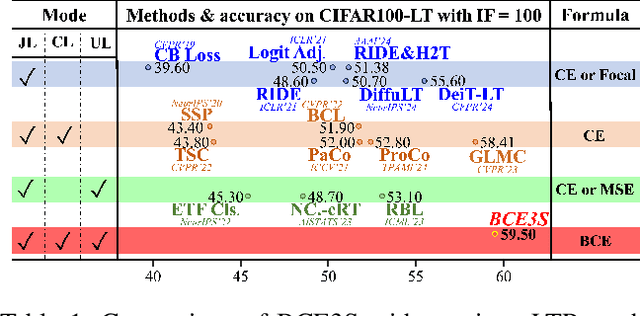
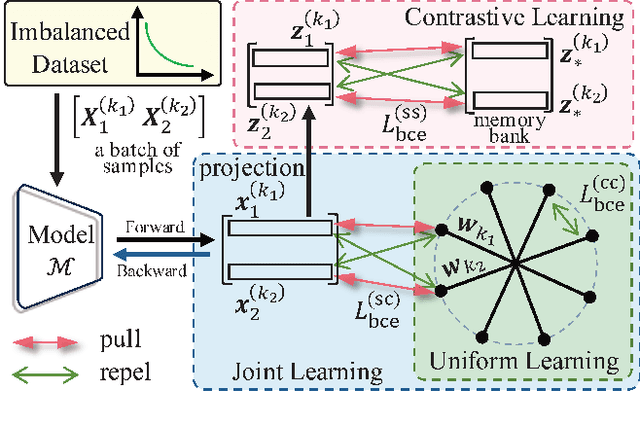
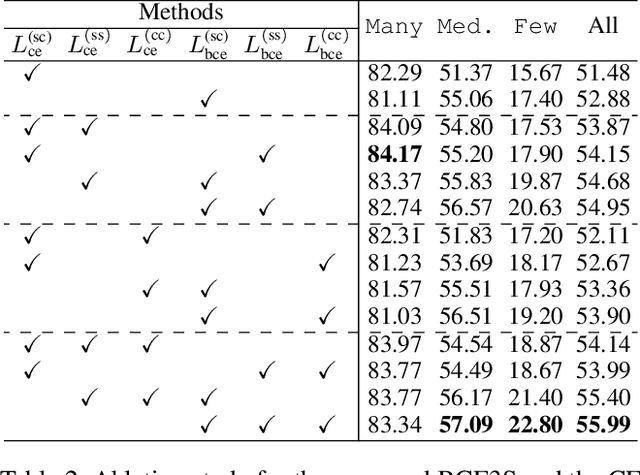
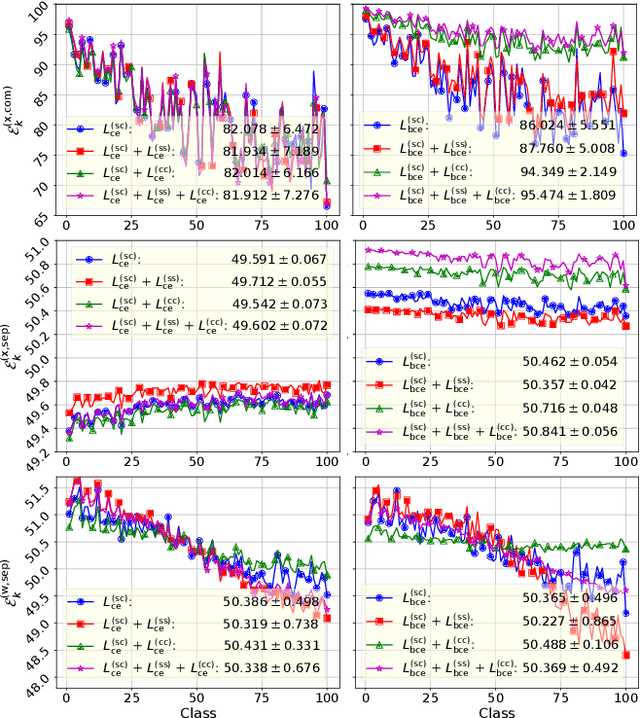
For long-tailed recognition (LTR) tasks, high intra-class compactness and inter-class separability in both head and tail classes, as well as balanced separability among all the classifier vectors, are preferred. The existing LTR methods based on cross-entropy (CE) loss not only struggle to learn features with desirable properties but also couple imbalanced classifier vectors in the denominator of its Softmax, amplifying the imbalance effects in LTR. In this paper, for the LTR, we propose a binary cross-entropy (BCE)-based tripartite synergistic learning, termed BCE3S, which consists of three components: (1) BCE-based joint learning optimizes both the classifier and sample features, which achieves better compactness and separability among features than the CE-based joint learning, by decoupling the metrics between feature and the imbalanced classifier vectors in multiple Sigmoid; (2) BCE-based contrastive learning further improves the intra-class compactness of features; (3) BCE-based uniform learning balances the separability among classifier vectors and interactively enhances the feature properties by combining with the joint learning. The extensive experiments show that the LTR model trained by BCE3S not only achieves higher compactness and separability among sample features, but also balances the classifier's separability, achieving SOTA performance on various long-tailed datasets such as CIFAR10-LT, CIFAR100-LT, ImageNet-LT, and iNaturalist2018.
EPL: Empirical Prototype Learning for Deep Face Recognition
May 21, 2024Prototype learning is widely used in face recognition, which takes the row vectors of coefficient matrix in the last linear layer of the feature extraction model as the prototypes for each class. When the prototypes are updated using the facial sample feature gradients in the model training, they are prone to being pulled away from the class center by the hard samples, resulting in decreased overall model performance. In this paper, we explicitly define prototypes as the expectations of sample features in each class and design the empirical prototypes using the existing samples in the dataset. We then devise a strategy to adaptively update these empirical prototypes during the model training based on the similarity between the sample features and the empirical prototypes. Furthermore, we propose an empirical prototype learning (EPL) method, which utilizes an adaptive margin parameter with respect to sample features. EPL assigns larger margins to the normal samples and smaller margins to the hard samples, allowing the learned empirical prototypes to better reflect the class center dominated by the normal samples and finally pull the hard samples towards the empirical prototypes through the learning. The extensive experiments on MFR, IJB-C, LFW, CFP-FP, AgeDB, and MegaFace demonstrate the effectiveness of EPL. Our code is available at $\href{https://github.com/WakingHours-GitHub/EPL}{https://github.com/WakingHours-GitHub/EPL}$.