 Add to Chrome
 Add to Firefox
 Add to Edge
PruneRAG: Confidence-Guided Query Decomposition Trees for Efficient Retrieval-Augmented Generation
Jan 16, 2026
Retrieval-augmented generation (RAG) has become a powerful framework for enhancing large language models in knowledge-intensive and reasoning tasks. However, as reasoning chains deepen or search trees expand, RAG systems often face two persistent failures: evidence forgetting, where retrieved knowledge is not effectively used, and inefficiency, caused by uncontrolled query expansions and redundant retrieval. These issues reveal a critical gap between retrieval and evidence utilization in current RAG architectures. We propose PruneRAG, a confidence-guided query decomposition framework that builds a structured query decomposition tree to perform stable and efficient reasoning. PruneRAG introduces three key mechanisms: adaptive node expansion that regulates tree width and depth, confidence-guided decisions that accept reliable answers and prune uncertain branches, and fine-grained retrieval that extracts entity-level anchors to improve retrieval precision. Together, these components preserve salient evidence throughout multi-hop reasoning while significantly reducing retrieval overhead. To better analyze evidence misuse, we define the Evidence Forgetting Rate as a metric to quantify cases where golden evidence is retrieved but not correctly used. Extensive experiments across various multi-hop QA benchmarks show that PruneRAG achieves superior accuracy and efficiency over state-of-the-art baselines.

SceneAlign: Aligning Multimodal Reasoning to Scene Graphs in Complex Visual Scenes
Jan 09, 2026Multimodal large language models often struggle with faithful reasoning in complex visual scenes, where intricate entities and relations require precise visual grounding at each step. This reasoning unfaithfulness frequently manifests as hallucinated entities, mis-grounded relations, skipped steps, and over-specified reasoning. Existing preference-based approaches, typically relying on textual perturbations or answer-conditioned rationales, fail to address this challenge as they allow models to exploit language priors to bypass visual grounding. To address this, we propose SceneAlign, a framework that leverages scene graphs as structured visual information to perform controllable structural interventions. By identifying reasoning-critical nodes and perturbing them through four targeted strategies that mimic typical grounding failures, SceneAlign constructs hard negative rationales that remain linguistically plausible but are grounded in inaccurate visual facts. These contrastive pairs are used in Direct Preference Optimization to steer models toward fine-grained, structure-faithful reasoning. Across seven visual reasoning benchmarks, SceneAlign consistently improves answer accuracy and reasoning faithfulness, highlighting the effectiveness of grounding-aware alignment for multimodal reasoning.
Teaching Prompts to Coordinate: Hierarchical Layer-Grouped Prompt Tuning for Continual Learning
Nov 15, 2025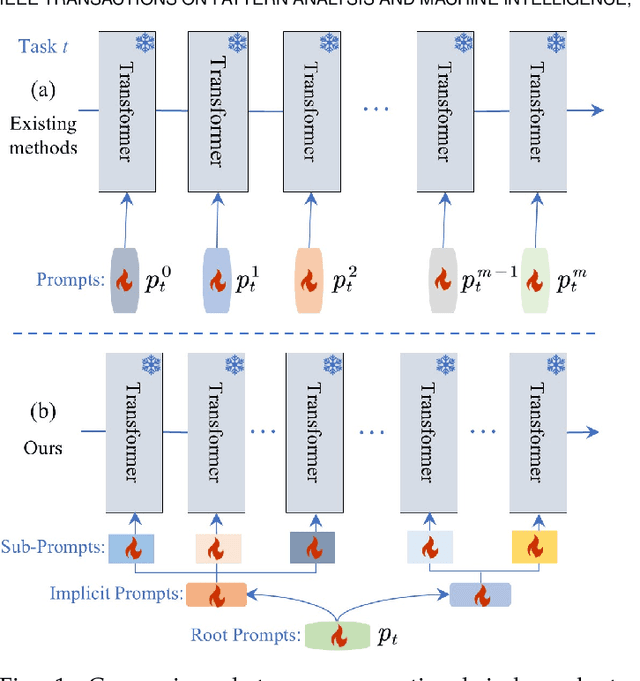
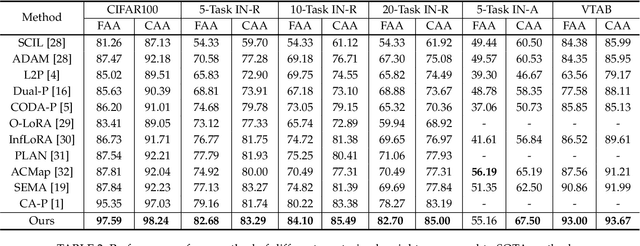
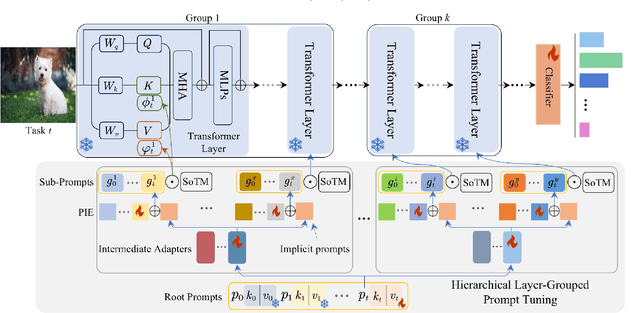
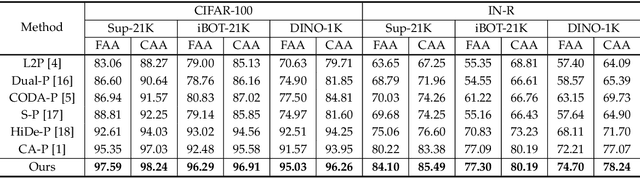
Prompt-based continual learning methods fine-tune only a small set of additional learnable parameters while keeping the pre-trained model's parameters frozen. It enables efficient adaptation to new tasks while mitigating the risk of catastrophic forgetting. These methods typically attach one independent task-specific prompt to each layer of pre-trained models to locally modulate its features, ensuring that the layer's representation aligns with the requirements of the new task. However, although introducing learnable prompts independently at each layer provides high flexibility for adapting to new tasks, this overly flexible tuning could make certain layers susceptible to unnecessary updates. As all prompts till the current task are added together as a final prompt for all seen tasks, the model may easily overwrite feature representations essential to previous tasks, which increases the risk of catastrophic forgetting. To address this issue, we propose a novel hierarchical layer-grouped prompt tuning method for continual learning. It improves model stability in two ways: (i) Layers in the same group share roughly the same prompts, which are adjusted by position encoding. This helps preserve the intrinsic feature relationships and propagation pathways of the pre-trained model within each group. (ii) It utilizes a single task-specific root prompt to learn to generate sub-prompts for each layer group. In this way, all sub-prompts are conditioned on the same root prompt, enhancing their synergy and reducing independence. Extensive experiments across four benchmarks demonstrate that our method achieves favorable performance compared with several state-of-the-art methods.
Self-Supervised Cross-Modal Learning for Image-to-Point Cloud Registration
Sep 19, 2025Bridging 2D and 3D sensor modalities is critical for robust perception in autonomous systems. However, image-to-point cloud (I2P) registration remains challenging due to the semantic-geometric gap between texture-rich but depth-ambiguous images and sparse yet metrically precise point clouds, as well as the tendency of existing methods to converge to local optima. To overcome these limitations, we introduce CrossI2P, a self-supervised framework that unifies cross-modal learning and two-stage registration in a single end-to-end pipeline. First, we learn a geometric-semantic fused embedding space via dual-path contrastive learning, enabling annotation-free, bidirectional alignment of 2D textures and 3D structures. Second, we adopt a coarse-to-fine registration paradigm: a global stage establishes superpoint-superpixel correspondences through joint intra-modal context and cross-modal interaction modeling, followed by a geometry-constrained point-level refinement for precise registration. Third, we employ a dynamic training mechanism with gradient normalization to balance losses for feature alignment, correspondence refinement, and pose estimation. Extensive experiments demonstrate that CrossI2P outperforms state-of-the-art methods by 23.7% on the KITTI Odometry benchmark and by 37.9% on nuScenes, significantly improving both accuracy and robustness.
Ensemble Distribution Distillation for Self-Supervised Human Activity Recognition
Sep 10, 2025Human Activity Recognition (HAR) has seen significant advancements with the adoption of deep learning techniques, yet challenges remain in terms of data requirements, reliability and robustness. This paper explores a novel application of Ensemble Distribution Distillation (EDD) within a self-supervised learning framework for HAR aimed at overcoming these challenges. By leveraging unlabeled data and a partially supervised training strategy, our approach yields an increase in predictive accuracy, robust estimates of uncertainty, and substantial increases in robustness against adversarial perturbation; thereby significantly improving reliability in real-world scenarios without increasing computational complexity at inference. We demonstrate this with an evaluation on several publicly available datasets. The contributions of this work include the development of a self-supervised EDD framework, an innovative data augmentation technique designed for HAR, and empirical validation of the proposed method's effectiveness in increasing robustness and reliability.
Retrieval-Augmented Review Generation for Poisoning Recommender Systems
Aug 21, 2025Recent studies have shown that recommender systems (RSs) are highly vulnerable to data poisoning attacks, where malicious actors inject fake user profiles, including a group of well-designed fake ratings, to manipulate recommendations. Due to security and privacy constraints in practice, attackers typically possess limited knowledge of the victim system and thus need to craft profiles that have transferability across black-box RSs. To maximize the attack impact, the profiles often remains imperceptible. However, generating such high-quality profiles with the restricted resources is challenging. Some works suggest incorporating fake textual reviews to strengthen the profiles; yet, the poor quality of the reviews largely undermines the attack effectiveness and imperceptibility under the practical setting. To tackle the above challenges, in this paper, we propose to enhance the quality of the review text by harnessing in-context learning (ICL) capabilities of multimodal foundation models. To this end, we introduce a demonstration retrieval algorithm and a text style transfer strategy to augment the navie ICL. Specifically, we propose a novel practical attack framework named RAGAN to generate high-quality fake user profiles, which can gain insights into the robustness of RSs. The profiles are generated by a jailbreaker and collaboratively optimized on an instructional agent and a guardian to improve the attack transferability and imperceptibility. Comprehensive experiments on various real-world datasets demonstrate that RAGAN achieves the state-of-the-art poisoning attack performance.
SAND: Boosting LLM Agents with Self-Taught Action Deliberation
Jul 10, 2025Large Language Model (LLM) agents are commonly tuned with supervised finetuning on ReAct-style expert trajectories or preference optimization over pairwise rollouts. Most of these methods focus on imitating specific expert behaviors or promoting chosen reasoning thoughts and actions over rejected ones. However, without reasoning and comparing over alternatives actions, LLM agents finetuned with these methods may over-commit towards seemingly plausible but suboptimal actions due to limited action space exploration. To address this, in this paper we propose Self-taught ActioN Deliberation (SAND) framework, enabling LLM agents to explicitly deliberate over candidate actions before committing to one. To tackle the challenges of when and what to deliberate given large action space and step-level action evaluation, we incorporate self-consistency action sampling and execution-guided action critique to help synthesize step-wise action deliberation thoughts using the base model of the LLM agent. In an iterative manner, the deliberation trajectories are then used to finetune the LLM agent itself. Evaluating on two representative interactive agent tasks, SAND achieves an average 20% improvement over initial supervised finetuning and also outperforms state-of-the-art agent tuning approaches.
Little By Little: Continual Learning via Self-Activated Sparse Mixture-of-Rank Adaptive Learning
Jun 26, 2025
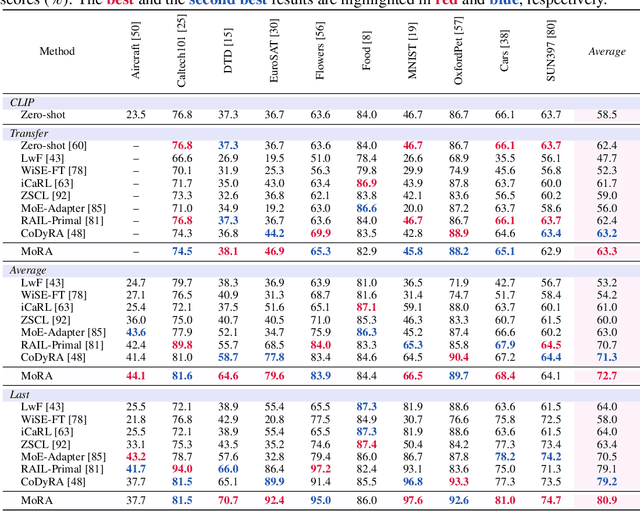
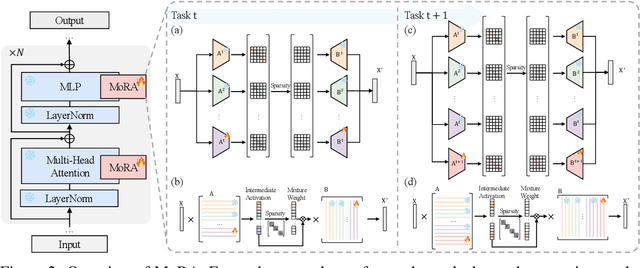
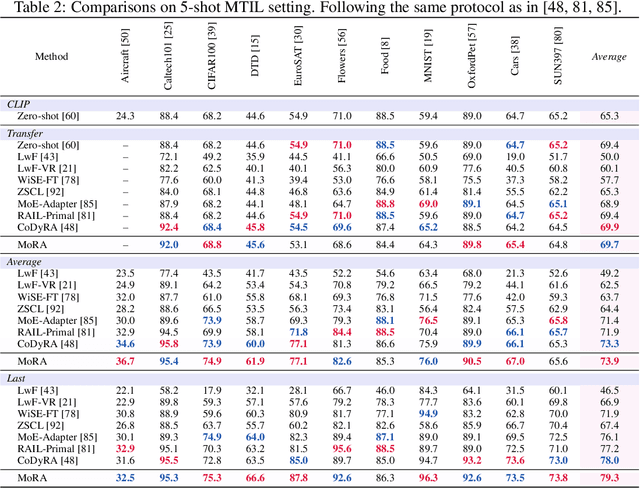
Continual learning (CL) with large pre-trained models is challenged by catastrophic forgetting and task interference. Existing LoRA-based Mixture-of-Experts (MoE) approaches mitigate forgetting by assigning and freezing task-specific adapters, but suffer from interference, redundancy, and ambiguous routing due to coarse adapter-level selection. However, this design introduces three key challenges: 1) Interference: Activating full LoRA experts per input leads to subspace interference and prevents selective reuse of useful components across tasks. 2) Redundancy: Newly added experts often duplicate or contradict existing knowledge due to unnecessary activation of unrelated ranks and insufficient reuse of relevant ones. 3) Ambiguity: Overlapping features across tasks confuse the router, resulting in unstable expert assignments. As more experts accumulate, earlier task routing degrades, accelerating forgetting. We propose MoRA, a Mixture-of-Rank Adaptive learning approach with self-activated and sparse rank activation for CL. Unlike mixing multiple low-rank matrices, MoRA decomposes each rank-r update into r rank-1 components, each treated as an independent expert, enabling fine-grained mixture of rank-1 expert utilization while mitigating interference and redundancy. To avoid ambiguous routing, we propose that each rank-1 expert can infer its own relevance via intermediate activations. Coupled with our proposed rank pruning and activation budgets, MoRA adaptively selects a sparse mixture of ranks per input. We validate MoRA on continual learning tasks with CLIP and large language models (LLMs), analyzing both in-domain learning and out-of-domain forgetting/generalization during fine-tuning. MoRA shows significant effectiveness on enhancing CL with PTMs, and improving generalization while mitigating forgetting.
Efficient and Generalizable Environmental Understanding for Visual Navigation
Jun 18, 2025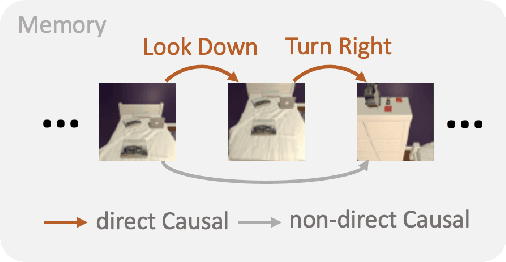
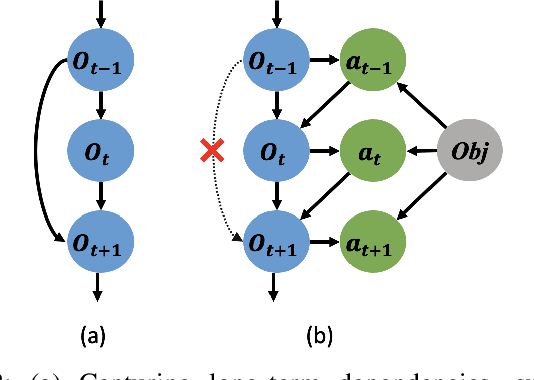
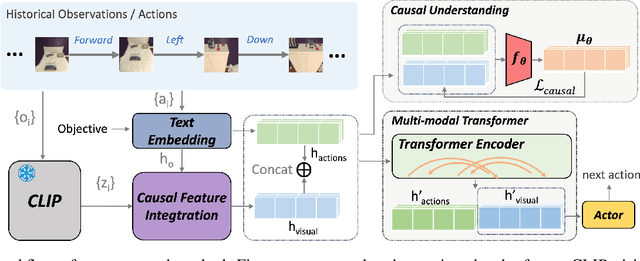
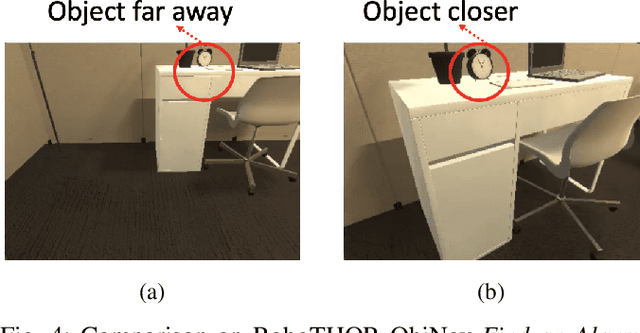
Visual Navigation is a core task in Embodied AI, enabling agents to navigate complex environments toward given objectives. Across diverse settings within Navigation tasks, many necessitate the modelling of sequential data accumulated from preceding time steps. While existing methods perform well, they typically process all historical observations simultaneously, overlooking the internal association structure within the data, which may limit the potential for further improvements in task performance. We address this by examining the unique characteristics of Navigation tasks through the lens of causality, introducing a causal framework to highlight the limitations of conventional sequential methods. Leveraging this insight, we propose Causality-Aware Navigation (CAN), which incorporates a Causal Understanding Module to enhance the agent's environmental understanding capability. Empirical evaluations show that our approach consistently outperforms baselines across various tasks and simulation environments. Extensive ablations studies attribute these gains to the Causal Understanding Module, which generalizes effectively in both Reinforcement and Supervised Learning settings without computational overhead.
Federated In-Context Learning: Iterative Refinement for Improved Answer Quality
Jun 09, 2025For question-answering (QA) tasks, in-context learning (ICL) enables language models to generate responses without modifying their parameters by leveraging examples provided in the input. However, the effectiveness of ICL heavily depends on the availability of high-quality examples, which are often scarce due to data privacy constraints, annotation costs, and distribution disparities. A natural solution is to utilize examples stored on client devices, but existing approaches either require transmitting model parameters - incurring significant communication overhead - or fail to fully exploit local datasets, limiting their effectiveness. To address these challenges, we propose Federated In-Context Learning (Fed-ICL), a general framework that enhances ICL through an iterative, collaborative process. Fed-ICL progressively refines responses by leveraging multi-round interactions between clients and a central server, improving answer quality without the need to transmit model parameters. We establish theoretical guarantees for the convergence of Fed-ICL and conduct extensive experiments on standard QA benchmarks, demonstrating that our proposed approach achieves strong performance while maintaining low communication costs.