 Add to Chrome
 Add to Firefox
 Add to Edge
Sharp First-Order Lower Bounds for Higher-Order Smooth Nonconvex Optimization
Jun 03, 2026
We study the deterministic first-order oracle complexity of finding \(ε\)-stationary points in smooth nonconvex optimization when the objective satisfies higher-order smoothness assumptions. While the classical \(ε^{-2}\) rate is optimal under only Lipschitz gradients, higher-order smoothness leads to accelerated first-order upper bounds, most notably the \(ε^{-7/4}\) rate under Lipschitz Hessians and the \(ε^{-5/3}\) rate under Lipschitz third derivatives. The matching lower bounds, however, have remained open. We resolve this gap by proving a new dimension-free first-order lower bound for higher-order smooth nonconvex functions, valid for every finite smoothness order. In particular, our construction gives a matching \(Ω(ε^{-7/4})\) lower bound in the Hessian-Lipschitz case and a matching \(Ω(ε^{-5/3})\) lower bound in the third-order-smooth regime. The hard instance is based on a \emph{block-chain} mechanism that enforces blockwise oracle revelation while preserving the smoothness structure needed for the scalar hard instance. The lower-bound construction was discovered with the assistance of ChatGPT 5.5 Pro and subsequently verified by the authors.

FERA: Uncertainty-Aware Federated Reasoning for Large Language Models
May 11, 2026Large language models (LLMs) exhibit strong reasoning capabilities when guided by high-quality demonstrations, yet such data is often distributed across organizations that cannot centralize it due to regulatory, proprietary, or institutional constraints. We study federated reasoning, where a server improves multi-step reasoning by coordinating with heterogeneous clients holding private demonstrations, without centralized training or raw data sharing. The key challenge is that client reliability is query-dependent, while the server cannot inspect client data to determine which contributions are trustworthy. To address this, we propose Uncertainty-Aware Federated Reasoning (FERA), a training-free framework based on iterative server-client co-refinement. Across communication rounds, clients generate reasoning traces with lightweight uncertainty estimates, and the server synthesizes them into improved reasoning that is redistributed as context for the next round, progressively improving both server outputs and client-side reasoning. Within each round, Uncertainty-Aware Self-Critique Aggregation (UA-SCA) resolves conflicts among heterogeneous client traces through query-dependent trust weighting and structured cross-client verification. Rather than simply discarding low-quality traces, UA-SCA revises flawed reasoning steps to recover useful information. We provide theoretical guarantees showing that the proposed iterative protocol converges and that uncertainty-aware weighting accelerates convergence. Experiments on multiple reasoning benchmarks show that FERA consistently outperforms both federated training and training-free baselines, achieving progressively higher accuracy across rounds while maintaining communication and computational efficiency.
Adaptive Test-Time Compute Allocation with Evolving In-Context Demonstrations
Apr 22, 2026While scaling test-time compute can substantially improve model performance, existing approaches either rely on static compute allocation or sample from fixed generation distributions. In this work, we introduce a test-time compute allocation framework that jointly adapts where computation is spent and how generation is performed. Our method begins with a warm-up phase that identifies easy queries and assembles an initial pool of question-response pairs from the test set itself. An adaptive phase then concentrates further computation on unresolved queries while reshaping their generation distributions through evolving in-context demonstrations -- conditioning each generation on successful responses from semantically related queries rather than resampling from a fixed distribution. Experiments across math, coding, and reasoning benchmarks demonstrate that our approach consistently outperforms existing baselines while consuming substantially less inference-time compute.
Near-Optimal Second-Order Guarantees for Model-Based Adversarial Imitation Learning
Oct 10, 2025We study online adversarial imitation learning (AIL), where an agent learns from offline expert demonstrations and interacts with the environment online without access to rewards. Despite strong empirical results, the benefits of online interaction and the impact of stochasticity remain poorly understood. We address these gaps by introducing a model-based AIL algorithm (MB-AIL) and establish its horizon-free, second-order sample-complexity guarantees under general function approximations for both expert data and reward-free interactions. These second-order bounds provide an instance-dependent result that can scale with the variance of returns under the relevant policies and therefore tighten as the system approaches determinism. Together with second-order, information-theoretic lower bounds on a newly constructed hard-instance family, we show that MB-AIL attains minimax-optimal sample complexity for online interaction (up to logarithmic factors) with limited expert demonstrations and matches the lower bound for expert demonstrations in terms of the dependence on horizon $H$, precision $\epsilon$ and the policy variance $\sigma^2$. Experiments further validate our theoretical findings and demonstrate that a practical implementation of MB-AIL matches or surpasses the sample efficiency of existing methods.
How to Provably Improve Return Conditioned Supervised Learning?
Jun 10, 2025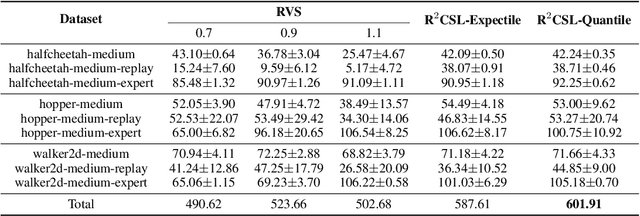
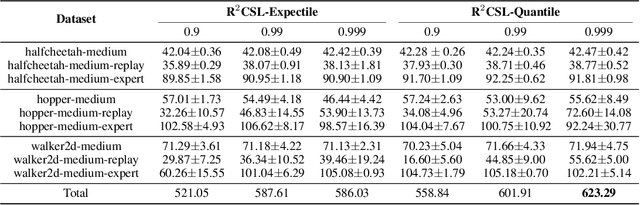
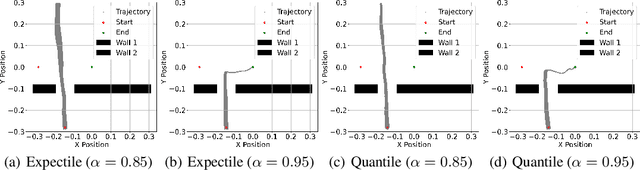
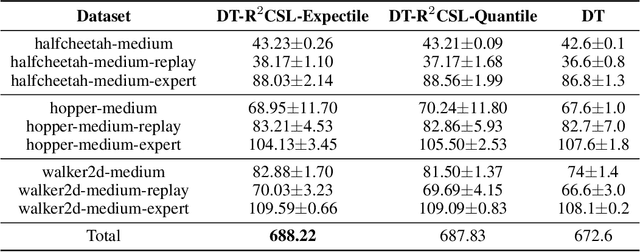
In sequential decision-making problems, Return-Conditioned Supervised Learning (RCSL) has gained increasing recognition for its simplicity and stability in modern decision-making tasks. Unlike traditional offline reinforcement learning (RL) algorithms, RCSL frames policy learning as a supervised learning problem by taking both the state and return as input. This approach eliminates the instability often associated with temporal difference (TD) learning in offline RL. However, RCSL has been criticized for lacking the stitching property, meaning its performance is inherently limited by the quality of the policy used to generate the offline dataset. To address this limitation, we propose a principled and simple framework called Reinforced RCSL. The key innovation of our framework is the introduction of a concept we call the in-distribution optimal return-to-go. This mechanism leverages our policy to identify the best achievable in-dataset future return based on the current state, avoiding the need for complex return augmentation techniques. Our theoretical analysis demonstrates that Reinforced RCSL can consistently outperform the standard RCSL approach. Empirical results further validate our claims, showing significant performance improvements across a range of benchmarks.
Federated In-Context Learning: Iterative Refinement for Improved Answer Quality
Jun 09, 2025For question-answering (QA) tasks, in-context learning (ICL) enables language models to generate responses without modifying their parameters by leveraging examples provided in the input. However, the effectiveness of ICL heavily depends on the availability of high-quality examples, which are often scarce due to data privacy constraints, annotation costs, and distribution disparities. A natural solution is to utilize examples stored on client devices, but existing approaches either require transmitting model parameters - incurring significant communication overhead - or fail to fully exploit local datasets, limiting their effectiveness. To address these challenges, we propose Federated In-Context Learning (Fed-ICL), a general framework that enhances ICL through an iterative, collaborative process. Fed-ICL progressively refines responses by leveraging multi-round interactions between clients and a central server, improving answer quality without the need to transmit model parameters. We establish theoretical guarantees for the convergence of Fed-ICL and conduct extensive experiments on standard QA benchmarks, demonstrating that our proposed approach achieves strong performance while maintaining low communication costs.
Towards Agentic Recommender Systems in the Era of Multimodal Large Language Models
Mar 20, 2025Recent breakthroughs in Large Language Models (LLMs) have led to the emergence of agentic AI systems that extend beyond the capabilities of standalone models. By empowering LLMs to perceive external environments, integrate multimodal information, and interact with various tools, these agentic systems exhibit greater autonomy and adaptability across complex tasks. This evolution brings new opportunities to recommender systems (RS): LLM-based Agentic RS (LLM-ARS) can offer more interactive, context-aware, and proactive recommendations, potentially reshaping the user experience and broadening the application scope of RS. Despite promising early results, fundamental challenges remain, including how to effectively incorporate external knowledge, balance autonomy with controllability, and evaluate performance in dynamic, multimodal settings. In this perspective paper, we first present a systematic analysis of LLM-ARS: (1) clarifying core concepts and architectures; (2) highlighting how agentic capabilities -- such as planning, memory, and multimodal reasoning -- can enhance recommendation quality; and (3) outlining key research questions in areas such as safety, efficiency, and lifelong personalization. We also discuss open problems and future directions, arguing that LLM-ARS will drive the next wave of RS innovation. Ultimately, we foresee a paradigm shift toward intelligent, autonomous, and collaborative recommendation experiences that more closely align with users' evolving needs and complex decision-making processes.
Provable Zero-Shot Generalization in Offline Reinforcement Learning
Mar 11, 2025

In this work, we study offline reinforcement learning (RL) with zero-shot generalization property (ZSG), where the agent has access to an offline dataset including experiences from different environments, and the goal of the agent is to train a policy over the training environments which performs well on test environments without further interaction. Existing work showed that classical offline RL fails to generalize to new, unseen environments. We propose pessimistic empirical risk minimization (PERM) and pessimistic proximal policy optimization (PPPO), which leverage pessimistic policy evaluation to guide policy learning and enhance generalization. We show that both PERM and PPPO are capable of finding a near-optimal policy with ZSG. Our result serves as a first step in understanding the foundation of the generalization phenomenon in offline reinforcement learning.
Breaking the $\log(1/Δ_2)$ Barrier: Better Batched Best Arm Identification with Adaptive Grids
Jan 29, 2025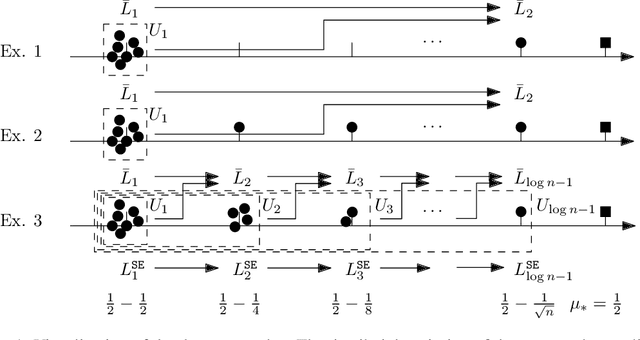
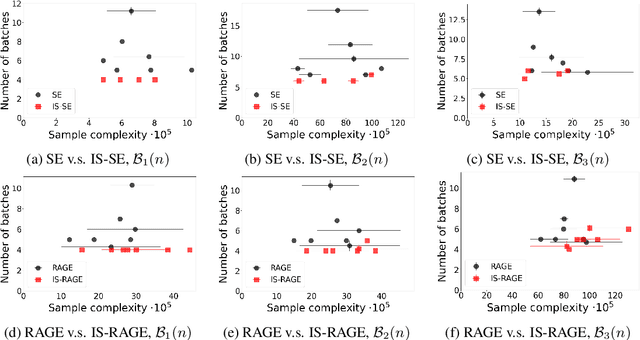
We investigate the problem of batched best arm identification in multi-armed bandits, where we aim to identify the best arm from a set of $n$ arms while minimizing both the number of samples and batches. We introduce an algorithm that achieves near-optimal sample complexity and features an instance-sensitive batch complexity, which breaks the $\log(1/\Delta_2)$ barrier. The main contribution of our algorithm is a novel sample allocation scheme that effectively balances exploration and exploitation for batch sizes. Experimental results indicate that our approach is more batch-efficient across various setups. We also extend this framework to the problem of batched best arm identification in linear bandits and achieve similar improvements.
Return Augmented Decision Transformer for Off-Dynamics Reinforcement Learning
Oct 30, 2024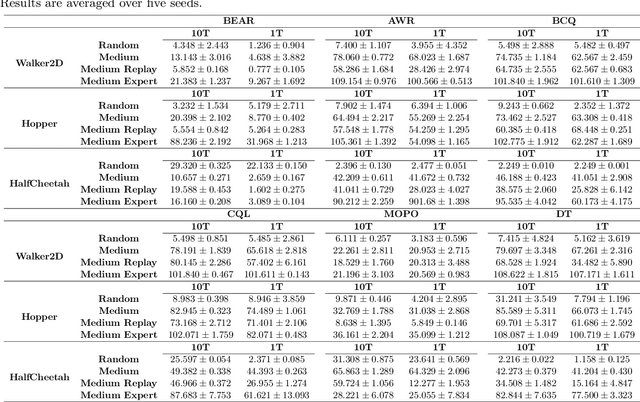
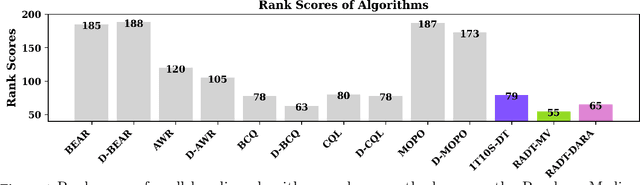

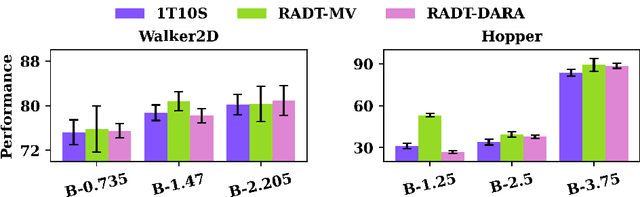
We study offline off-dynamics reinforcement learning (RL) to utilize data from an easily accessible source domain to enhance policy learning in a target domain with limited data. Our approach centers on return-conditioned supervised learning (RCSL), particularly focusing on the decision transformer (DT), which can predict actions conditioned on desired return guidance and complete trajectory history. Previous works tackle the dynamics shift problem by augmenting the reward in the trajectory from the source domain to match the optimal trajectory in the target domain. However, this strategy can not be directly applicable in RCSL owing to (1) the unique form of the RCSL policy class, which explicitly depends on the return, and (2) the absence of a straightforward representation of the optimal trajectory distribution. We propose the Return Augmented Decision Transformer (RADT) method, where we augment the return in the source domain by aligning its distribution with that in the target domain. We provide the theoretical analysis demonstrating that the RCSL policy learned from RADT achieves the same level of suboptimality as would be obtained without a dynamics shift. We introduce two practical implementations RADT-DARA and RADT-MV respectively. Extensive experiments conducted on D4RL datasets reveal that our methods generally outperform dynamic programming based methods in off-dynamics RL scenarios.