 Add to Chrome
 Add to Firefox
 Add to Edge
Semantic-based Internet of Embodied Intelligence: Visions and Frontiers
Jul 01, 2026
Recent advances in generative artificial intelligence (AI) and embodied intelligence (EI) enable autonomous agents to interact with the physical world. However, scaling these systems into networks of multiple agents, namely the Internet of EI (IoEI), faces critical bottlenecks. These include the overhead of massive multimodal data transmission and the decoupling of logical reasoning from physical constraints. To address these challenges, we envision the Semantic-based IoEI (SIoEI), which leverages semantic information as a unified metric throughout the agent lifecycle. We systematically define four key dimensions of EI: perception, intelligence, control, and communication. We further elaborate how semantic empowerment revolutionizes environmental perception, cognition and task planning, action generation and robust control, and communication and networking. We also present a case study to verify that, the semantic-empowered end-to-end process significantly improves channel robustness and reduces end-to-end latency for EI. Finally, we outline critical open research directions for the SIoEI paradigm.

Evolving Intelligent Complex Systems via Intellicise Networks: Architecture, Technologies, and Pathways
Jul 01, 2026Future engineering infrastructures are evolving into large-scale, open, heterogeneous, and wirelessly interconnected complex systems. These systems present significant challenges in optimizing network resource utilization, managing high-dimensional information spaces, and accommodating diverse business requirements. Intellicise networks, characterized by Intent-driven operation, semantic-native capability, and distributed intelligence, offer a promising paradigm for enabling such intelligent complex systems. We provide a systematic exploration of future intelligent complex systems from the perspective of intellicise networks. Specifically, we propose a cross-domain intelligent communication network architecture based on intellicise networks, grounded in information theory, systems theory, game theory, and cybernetics. The architecture comprises a cross-layer organizational framework, multi-functional planes, and novel information flows. The cross-layer framework defines the vertical evolution from perception and cognition to decision, while the control, user, data, computation, intelligence, and security planes deliver horizontal intellicise capabilities. Moreover, data, knowledge, model, and task flows interconnect the various layers and planes, forming a closed-loop process that derives simplicity from high-level intelligene while concurrently pursuing enhanced. Building on this architecture, we review key enabling technologies, tracing their evolution from semantic extraction to intent understanding, from heterogeneous resource integration to self-configuration and self-optimization, from generative artificial intelligence (AI) to agentic AI, and from embodied AI to symbodied AI. Additionally, we present a case study on intellicise networks for embodied agent communications and discuss representative applications and services for intelligent complex systems.
Towards Semantic-based Agent Communication Networks: Vision, Technologies, and Challenges
Mar 25, 2026The International Telecommunication Union (ITU) identifies "Artificial Intelligence (AI) and Communication" as one of six key usage scenarios for 6G. Agentic AI, characterized by its ca-pabilities in multi-modal environmental sensing, complex task coordination, and continuous self-optimization, is anticipated to drive the evolution toward agent-based communication net-works. Semantic communication (SemCom), in turn, has emerged as a transformative paradigm that offers task-oriented efficiency, enhanced reliability in complex environments, and dynamic adaptation in resource allocation. However, comprehensive reviews that trace their technologi-cal evolution in the contexts of agent communications remain scarce. Addressing this gap, this paper systematically explores the role of semantics in agent communication networks. We first propose a novel architecture for semantic-based agent communication networks, structured into three layers, four entities, and four stages. Three wireless agent network layers define the logical structure and organization of entity interactions: the intention extraction and understanding layer, the semantic encoding and processing layer, and the distributed autonomy and collabora-tion layer. Across these layers, four AI agent entities, namely embodied agents, communication agents, network agents, and application agents, coexist and perform distinct tasks. Furthermore, four operational stages of semantic-enhanced agentic AI systems, namely perception, memory, reasoning, and action, form a cognitive cycle guiding agent behavior. Based on the proposed architecture, we provide a comprehensive review of the state-of-the-art on how semantics en-hance agent communication networks. Finally, we identify key challenges and present potential solutions to offer directional guidance for future research in this emerging field.
Intellicise Wireless Networks Meet Agentic AI: A Security and Privacy Perspective
Feb 17, 2026Intellicise (Intelligent and Concise) wireless network is the main direction of the evolution of future mobile communication systems, a perspective now widely acknowledged across academia and industry. As a key technology within it, Agentic AI has garnered growing attention due to its advanced cognitive capabilities, enabled through continuous perception-memory-reasoning-action cycles. This paper first analyses the unique advantages that Agentic AI introduces to intellicise wireless networks. We then propose a structured taxonomy for Agentic AI-enhanced secure intellicise wireless networks. Building on this framework, we identify emerging security and privacy challenges introduced by Agentic AI and summarize targeted strategies to address these vulnerabilities. A case study further demonstrates Agentic AI's efficacy in defending against intelligent eavesdropping attacks. Finally, we outline key open research directions to guide future exploration in this field.
Two-Timescale Design for AP Mode Selection of Cooperative ISAC Networks
Dec 29, 2024


As an emerging technology, cooperative bi-static integrated sensing and communication (ISAC) is promising to achieve high-precision sensing, high-rate communication as well as self-interference (SI) avoidance. This paper investigates the two-timescale design for access point (AP) mode selection to realize the full potential of the cooperative bi-static ISAC network with low system overhead, where the beamforming at the APs is adapted to the rapidly-changing instantaneous channel state information (CSI), while the AP mode is adapted to the slowly-changing statistical CSI. We first apply the minimum mean square error (MMSE) estimator to estimate the channel between the APs and the channels from the APs to the user equipments (UEs). Then we adopt the low-complexity maximum ratio transmission (MRT) beamforming and the maximum ratio combining (MRC) detector, and derive the closed-form expressions of the communication rate and the sensing signal-to-interference-plus-noise-ratio (SINR). We formulate a non-convex integer optimization problem to maximize the minimum sensing SINR under the communication quality of service (QoS) constraints. McCormick envelope relaxation and successive convex approximation (SCA) techniques are applied to solve the challenging non-convex integer optimization problem. Simulation results validate the closed-form expressions and prove the convergence and effectiveness of the proposed AP mode selection scheme.
Throughput Maximization for Movable Antenna Systems with Movement Delay Consideration
Nov 21, 2024
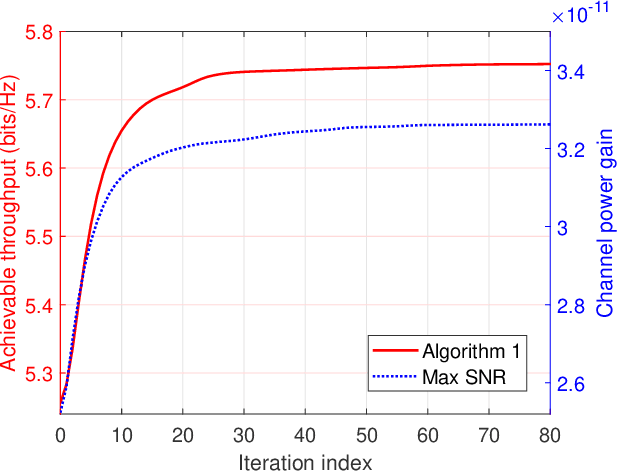
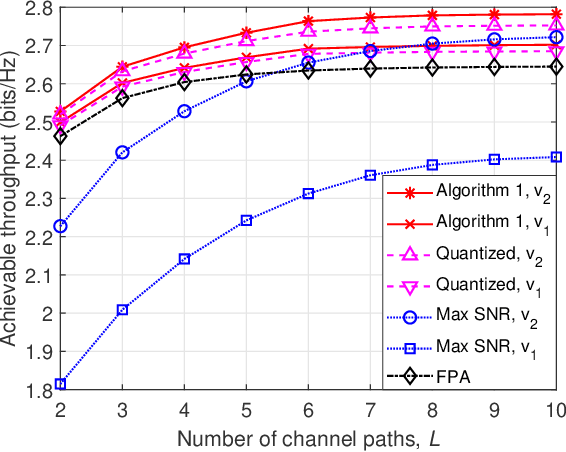
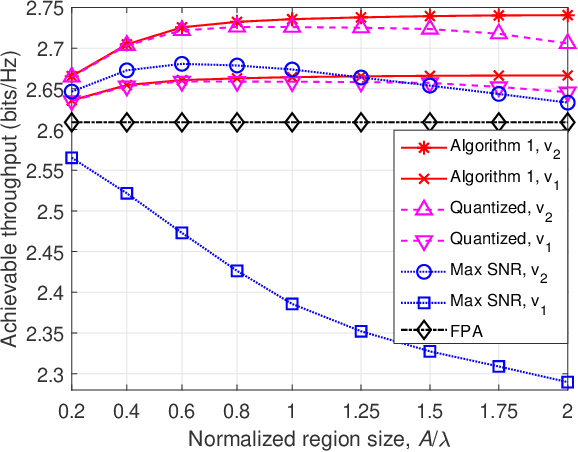
In this paper, we model the minimum achievable throughput within a transmission block of restricted duration and aim to maximize it in movable antenna (MA)-enabled multiuser downlink communications. Particularly, we account for the antenna moving delay caused by mechanical movement, which has not been fully considered in previous studies, and reveal the trade-off between the delay and signal-to-interference-plus-noise ratio at users. To this end, we first consider a single-user setup to analyze the necessity of antenna movement. By quantizing the virtual angles of arrival, we derive the requisite region size for antenna moving, design the initial MA position, and elucidate the relationship between quantization resolution and moving region size. Furthermore, an efficient algorithm is developed to optimize MA position via successive convex approximation, which is subsequently extended to the general multiuser setup. Numerical results demonstrate that the proposed algorithms outperform fixed-position antenna schemes and existing ones without consideration of movement delay. Additionally, our algorithms exhibit excellent adaptability and stability across various transmission block durations and moving region sizes, and are robust to different antenna moving speeds. This allows the hardware cost of MA-aided systems to be reduced by employing low rotational speed motors.
Movable Antenna Enhanced Networked Full-Duplex Integrated Sensing and Communication System
Nov 14, 2024

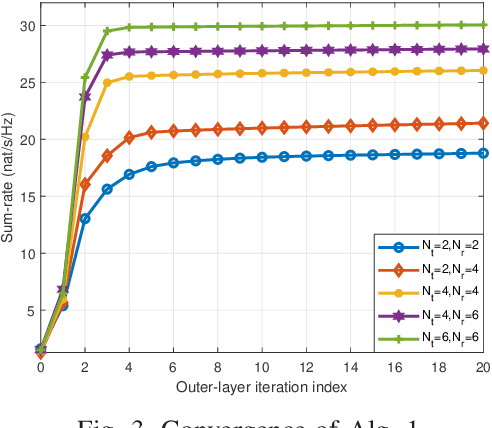
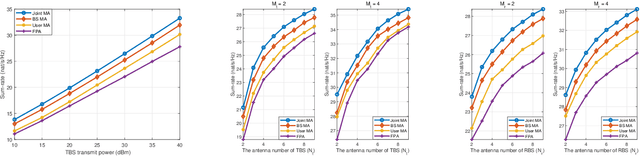
Integrated sensing and communication (ISAC) is envisioned as a key technology for future sixth-generation (6G) networks. Classical ISAC system considering monostatic and/or bistatic settings will inevitably degrade both communication and sensing performance due to the limited service coverage and easily blocked transmission paths. Besides, existing ISAC studies usually focus on downlink (DL) or uplink (UL) communication demands and unable to achieve the systematic DL and UL communication tasks. These challenges can be overcome by networked FD ISAC framework. Moreover, ISAC generally considers the trade-off between communication and sensing, unavoidably leading to a loss in communication performance. This shortcoming can be solved by the emerging movable antenna (MA) technology. In this paper, we utilize the MA to promote communication capability with guaranteed sensing performance via jointly designing beamforming, power allocation, receiving filters and MA configuration towards maximizing sum rate. The optimization problem is highly difficult due to the unique channel model deriving from the MA. To resolve this challenge, via leveraging the cutting-the-edge majorization-minimization (MM) method, we develop an efficient solution that optimizes all variables via convex optimization techniques. Extensive simulation results verify the effectiveness of our proposed algorithms and demonstrate the substantial performance promotion by deploying MA in the networked FD ISAC system.
Discrete RIS Enhanced Space Shift Keying MIMO System via Reflecting Beamforming Optimization
Nov 01, 2024


In this paper, a discrete reconfigurable intelligent surface (RIS)-assisted spatial shift keying (SSK) multiple-input multiple-output (MIMO) scheme is investigated, in which a direct link between the transmitter and the receiver is considered. To improve the reliability of the RIS-SSK-MIMO scheme, we formulate an objective function based on minimizing the average bit error probability (ABEP). Since the reflecting phase shift of RIS is discrete, it is difficult to address this problem directly. To this end, we optimize the RIS phase shift to maximize the Euclidean distance between the minimum constellations by applying the successive convex approximation (SCA) and penaltyalternating optimization method. Simulation results verify the superiority of the proposed RIS-SSK-MIMO scheme and demonstrate the impact of the number of RIS elements, the number of phase quantization bits, and the number of receive and transmit antennas in terms of reliability.
Empowering Over-the-Air Personalized Federated Learning via RIS
Aug 22, 2024Over-the-air computation (AirComp) integrates analog communication with task-oriented computation, serving as a key enabling technique for communication-efficient federated learning (FL) over wireless networks. However, AirComp-enabled FL (AirFL) with a single global consensus model fails to address the data heterogeneity in real-life FL scenarios with non-independent and identically distributed local datasets. In this paper, we introduce reconfigurable intelligent surface (RIS) technology to enable efficient personalized AirFL, mitigating the data heterogeneity issue. First, we achieve statistical interference elimination across different clusters in the personalized AirFL framework via RIS phase shift configuration. Then, we propose two personalized aggregation schemes involving power control and denoising factor design from the perspectives of first- and second-order moments, respectively, to enhance the FL convergence. Numerical results validate the superior performance of our proposed schemes over existing baselines.
Deep Generative Modeling Reshapes Compression and Transmission: From Efficiency to Resiliency
Jun 10, 2024
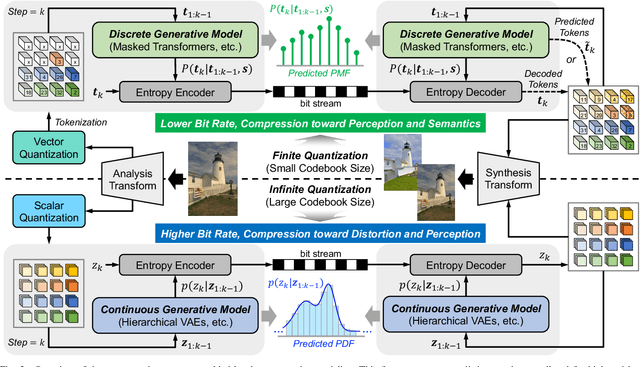

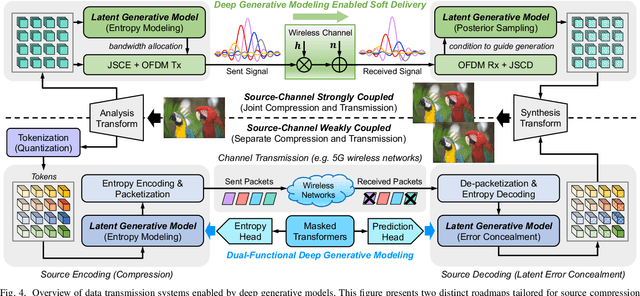
Information theory and machine learning are inextricably linked and have even been referred to as "two sides of the same coin". One particularly elegant connection is the essential equivalence between probabilistic generative modeling and data compression or transmission. In this article, we reveal the dual-functionality of deep generative models that reshapes both data compression for efficiency and transmission error concealment for resiliency. We present how the contextual predictive capabilities of powerful generative models can be well positioned to be strong compressors and estimators. In this sense, we advocate for viewing the deep generative modeling problem through the lens of end-to-end communications, and evaluate the compression and error restoration capabilities of foundation generative models. We show that the kernel of many large generative models is powerful predictor that can capture complex relationships among semantic latent variables, and the communication viewpoints provide novel insights into semantic feature tokenization, contextual learning, and usage of deep generative models. In summary, our article highlights the essential connections of generative AI to source and channel coding techniques, and motivates researchers to make further explorations in this emerging topic.