 Add to Chrome
 Add to Firefox
 Add to Edge
Evolving Intelligent Complex Systems via Intellicise Networks: Architecture, Technologies, and Pathways
Jul 01, 2026
Future engineering infrastructures are evolving into large-scale, open, heterogeneous, and wirelessly interconnected complex systems. These systems present significant challenges in optimizing network resource utilization, managing high-dimensional information spaces, and accommodating diverse business requirements. Intellicise networks, characterized by Intent-driven operation, semantic-native capability, and distributed intelligence, offer a promising paradigm for enabling such intelligent complex systems. We provide a systematic exploration of future intelligent complex systems from the perspective of intellicise networks. Specifically, we propose a cross-domain intelligent communication network architecture based on intellicise networks, grounded in information theory, systems theory, game theory, and cybernetics. The architecture comprises a cross-layer organizational framework, multi-functional planes, and novel information flows. The cross-layer framework defines the vertical evolution from perception and cognition to decision, while the control, user, data, computation, intelligence, and security planes deliver horizontal intellicise capabilities. Moreover, data, knowledge, model, and task flows interconnect the various layers and planes, forming a closed-loop process that derives simplicity from high-level intelligene while concurrently pursuing enhanced. Building on this architecture, we review key enabling technologies, tracing their evolution from semantic extraction to intent understanding, from heterogeneous resource integration to self-configuration and self-optimization, from generative artificial intelligence (AI) to agentic AI, and from embodied AI to symbodied AI. Additionally, we present a case study on intellicise networks for embodied agent communications and discuss representative applications and services for intelligent complex systems.

Effective Depth in Joint Source-Channel Coding: An Implicit Equilibrium Analysis
Jun 30, 2026A fundamental design question in deep joint source-channel coding (Deep JSCC) remains insufficiently explored: given a channel signal-to-noise ratio (SNR), what effective computation depth is required for semantic reconstruction? Existing Deep JSCC systems typically employ fixed-depth neural architectures selected through empirical hyperparameter tuning, which may lead to unnecessary computation under favorable channel conditions and insufficient refinement under severe channel noise. This paper proposes \emph{Implicit-JSCC}, an implicit equilibrium framework in which semantic encoding and decoding are formulated as fixed-point equilibrium processes. The effective encoder and decoder depths are determined by residual-based solver convergence rather than manually predefined layer numbers, while parameter sharing across equilibrium iterations enables depth-independent parameter complexity. To analyze the resulting effective-depth behavior, we develop a Gaussian-process-inspired kernel evolution framework that models equilibrium iterations as an effective-depth propagation process. Since channel noise is injected between the encoder and decoder, the analysis tracks channel-induced representation perturbations across receiver-side equilibrium iterations and derives a theory-guided depth--SNR relationship. After offline calibration of the system-specific parameters, the resulting model characterizes the required receiver-side refinement depth under different SNRs. Extensive experiments show that Implicit-JSCC achieves competitive reconstruction performance while enabling residual-based adaptive inference and controllable computation--quality tradeoffs. The depth--SNR model further provides a characterization of the SNR-dependent refinement depth required to reach a prescribed perturbation tolerance.
Adapting Vision-Language Models for Neutrino Event Classification in High-Energy Physics
Sep 11, 2025Recent advances in Large Language Models (LLMs) have demonstrated their remarkable capacity to process and reason over structured and unstructured data modalities beyond natural language. In this work, we explore the applications of Vision Language Models (VLMs), specifically a fine-tuned variant of LLaMa 3.2, to the task of identifying neutrino interactions in pixelated detector data from high-energy physics (HEP) experiments. We benchmark this model against a state-of-the-art convolutional neural network (CNN) architecture, similar to those used in the NOvA and DUNE experiments, which have achieved high efficiency and purity in classifying electron and muon neutrino events. Our evaluation considers both the classification performance and interpretability of the model predictions. We find that VLMs can outperform CNNs, while also providing greater flexibility in integrating auxiliary textual or semantic information and offering more interpretable, reasoning-based predictions. This work highlights the potential of VLMs as a general-purpose backbone for physics event classification, due to their high performance, interpretability, and generalizability, which opens new avenues for integrating multimodal reasoning in experimental neutrino physics.
Fine-Tuning Vision-Language Models for Neutrino Event Analysis in High-Energy Physics Experiments
Aug 26, 2025Recent progress in large language models (LLMs) has shown strong potential for multimodal reasoning beyond natural language. In this work, we explore the use of a fine-tuned Vision-Language Model (VLM), based on LLaMA 3.2, for classifying neutrino interactions from pixelated detector images in high-energy physics (HEP) experiments. We benchmark its performance against an established CNN baseline used in experiments like NOvA and DUNE, evaluating metrics such as classification accuracy, precision, recall, and AUC-ROC. Our results show that the VLM not only matches or exceeds CNN performance but also enables richer reasoning and better integration of auxiliary textual or semantic context. These findings suggest that VLMs offer a promising general-purpose backbone for event classification in HEP, paving the way for multimodal approaches in experimental neutrino physics.
Hybrid Bit and Semantic Communications
Apr 30, 2024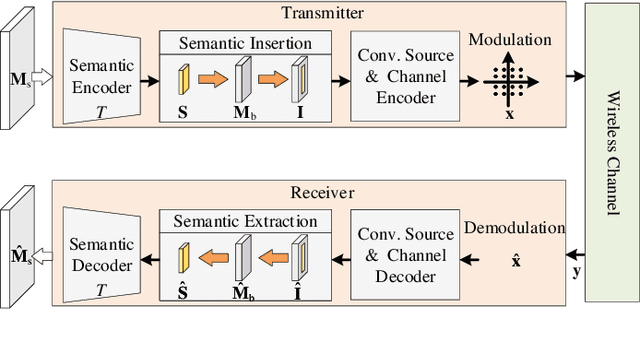
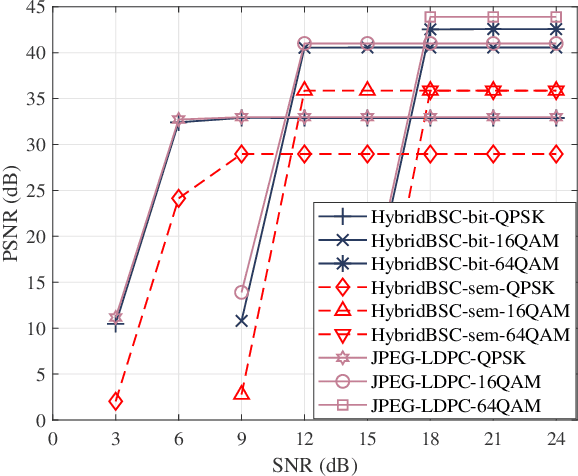
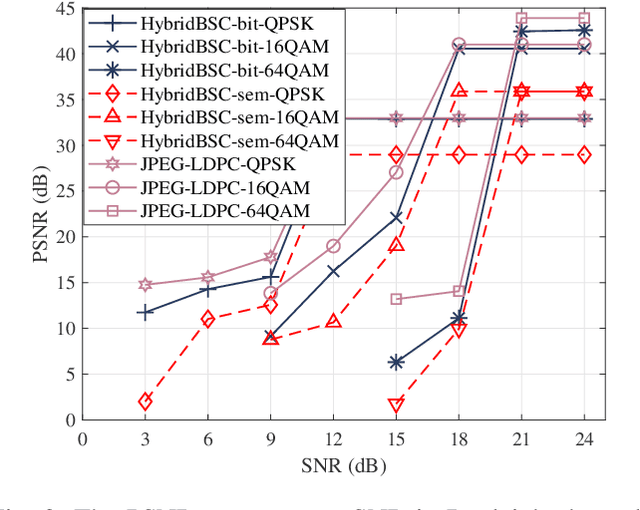
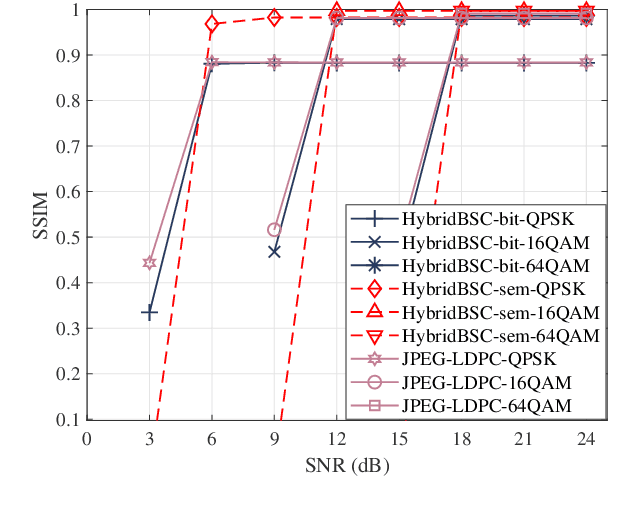
Semantic communication technology is regarded as a method surpassing the Shannon limit of bit transmission, capable of effectively enhancing transmission efficiency. However, current approaches that directly map content to transmission symbols are challenging to deploy in practice, imposing significant limitations on the development of semantic communication. To address this challenge, we propose a hybrid bit and semantic communication system, named HybridBSC, in which encoded semantic information is inserted into bit information for transmission via conventional digital communication systems utilizing same spectrum resources. The system can be easily deployed using existing communication architecture to achieve bit and semantic information transmission. Particularly, we design a semantic insertion and extraction scheme to implement this strategy. Furthermore, we conduct experimental validation based on the pluto-based software defined radio (SDR) platform in a real wireless channel, demonstrating that the proposed strategy can simultaneously transmit semantic and bit information.
Two-Way Semantic Transmission of Images without Feedback
Jun 15, 2023As a competitive technology for 6G, semantic communications can significantly improve transmission efficiency. However, many existing semantic communication systems require information feedback during the training coding process, resulting in a significant communication overhead. In this article, we consider a two-way semantic communication (TW-SC) system, where information feedback can be omitted by exploiting the weight reciprocity in the transceiver. Particularly, the channel simulator and semantic transceiver are implemented on both TW-SC nodes and the channel distribution is modeled by a conditional generative adversarial network. Simulation results demonstrate that the proposed TW-SC system performs closing to the state-of-the-art one-way semantic communication systems but requiring no feedback between the transceiver in the training process.
Distributed Two-tier DRL Framework for Cell-Free Network: Association, Beamforming and Power Allocation
Mar 22, 2023Intelligent wireless networks have long been expected to have self-configuration and self-optimization capabilities to adapt to various environments and demands. In this paper, we develop a novel distributed hierarchical deep reinforcement learning (DHDRL) framework with two-tier control networks in different timescales to optimize the long-term spectrum efficiency (SE) of the downlink cell-free multiple-input single-output (MISO) network, consisting of multiple distributed access points (AP) and user terminals (UT). To realize the proposed two-tier control strategy, we decompose the optimization problem into two sub-problems, AP-UT association (AUA) as well as beamforming and power allocation (BPA), resulting in a Markov decision process (MDP) and Partially Observable MDP (POMDP). The proposed method consists of two neural networks. At the system level, a distributed high-level neural network is introduced to optimize wireless network structure on a large timescale. While at the link level, a distributed low-level neural network is proposed to mitigate inter-AP interference and improve the transmission performance on a small timescale. Numerical results show that our method is effective for high-dimensional problems, in terms of spectrum efficiency, signaling overhead as well as satisfaction probability, and generalize well to diverse multi-object problems.
Image Quality Assessment for Omnidirectional Cross-reference Stitching
Apr 23, 2019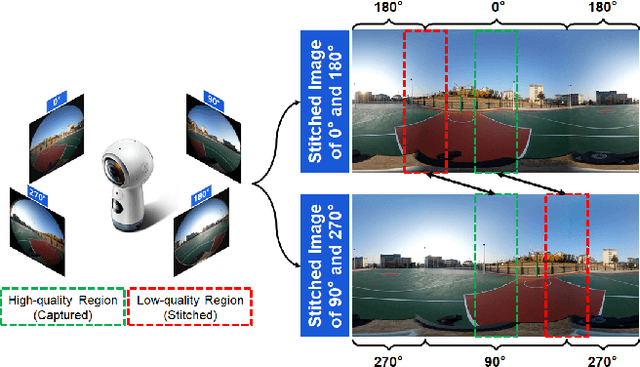
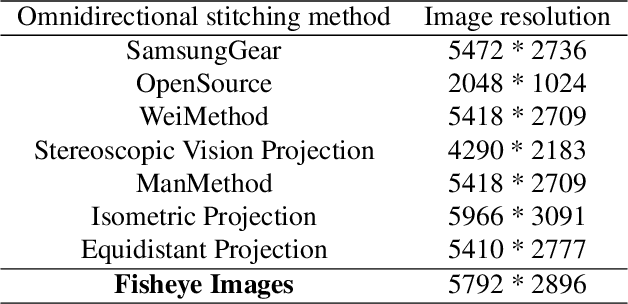

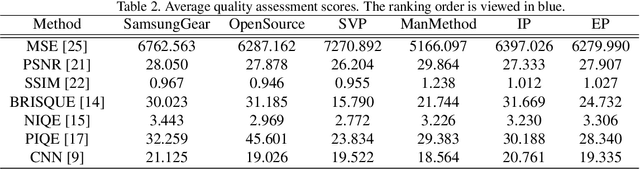
Along with the development of virtual reality (VR), omnidirectional images play an important role in producing multimedia content with immersive experience. However, despite various existing approaches for omnidirectional image stitching, how to quantitatively assess the quality of stitched images is still insufficiently explored. To address this problem, we establish a novel omnidirectional image dataset containing stitched images as well as dual-fisheye images captured from standard quarters of 0$^\circ$, 90$^\circ$, 180$^\circ$ and 270$^\circ$. In this manner, when evaluating the quality of an image stitched from a pair of fisheye images (e.g., 0$^\circ$ and 180$^\circ$), the other pair of fisheye images (e.g., 90$^\circ$ and 270$^\circ$) can be used as the cross-reference to provide ground-truth observations of the stitching regions. Based on this dataset, we further benchmark six widely used stitching models with seven evaluation metrics for IQA. To the best of our knowledge, it is the first dataset that focuses on assessing the stitching quality of omnidirectional images.