 Add to Chrome
 Add to Firefox
 Add to Edge
MagicDriveDiT: High-Resolution Long Video Generation for Autonomous Driving with Adaptive Control
Nov 21, 2024
The rapid advancement of diffusion models has greatly improved video synthesis, especially in controllable video generation, which is essential for applications like autonomous driving. However, existing methods are limited by scalability and how control conditions are integrated, failing to meet the needs for high-resolution and long videos for autonomous driving applications. In this paper, we introduce MagicDriveDiT, a novel approach based on the DiT architecture, and tackle these challenges. Our method enhances scalability through flow matching and employs a progressive training strategy to manage complex scenarios. By incorporating spatial-temporal conditional encoding, MagicDriveDiT achieves precise control over spatial-temporal latents. Comprehensive experiments show its superior performance in generating realistic street scene videos with higher resolution and more frames. MagicDriveDiT significantly improves video generation quality and spatial-temporal controls, expanding its potential applications across various tasks in autonomous driving.

TAPT: Test-Time Adversarial Prompt Tuning for Robust Inference in Vision-Language Models
Nov 20, 2024Large pre-trained Vision-Language Models (VLMs) such as CLIP have demonstrated excellent zero-shot generalizability across various downstream tasks. However, recent studies have shown that the inference performance of CLIP can be greatly degraded by small adversarial perturbations, especially its visual modality, posing significant safety threats. To mitigate this vulnerability, in this paper, we propose a novel defense method called Test-Time Adversarial Prompt Tuning (TAPT) to enhance the inference robustness of CLIP against visual adversarial attacks. TAPT is a test-time defense method that learns defensive bimodal (textual and visual) prompts to robustify the inference process of CLIP. Specifically, it is an unsupervised method that optimizes the defensive prompts for each test sample by minimizing a multi-view entropy and aligning adversarial-clean distributions. We evaluate the effectiveness of TAPT on 11 benchmark datasets, including ImageNet and 10 other zero-shot datasets, demonstrating that it enhances the zero-shot adversarial robustness of the original CLIP by at least 48.9% against AutoAttack (AA), while largely maintaining performance on clean examples. Moreover, TAPT outperforms existing adversarial prompt tuning methods across various backbones, achieving an average robustness improvement of at least 36.6%.
Relational Contrastive Learning and Masked Image Modeling for Scene Text Recognition
Nov 19, 2024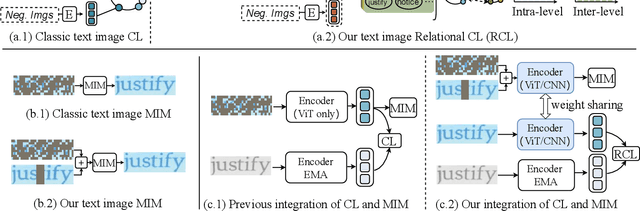
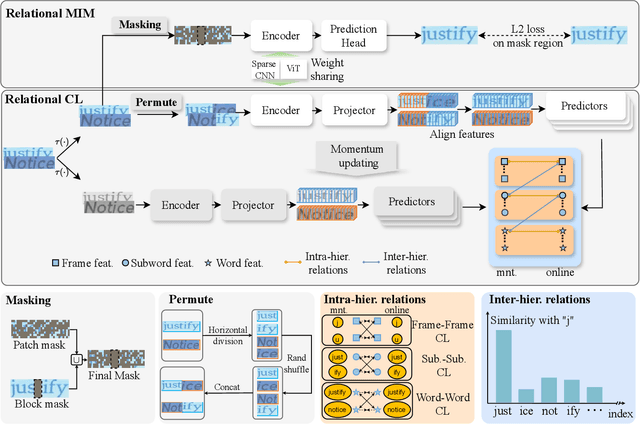
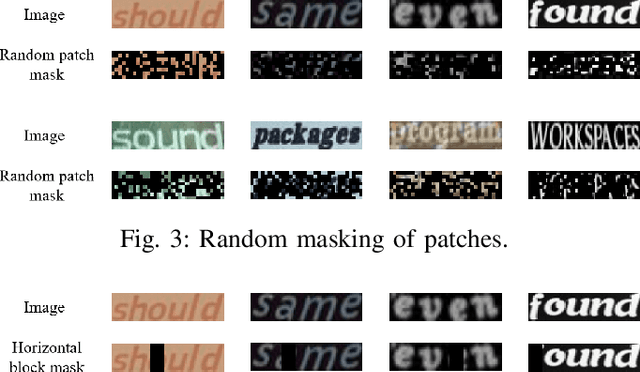
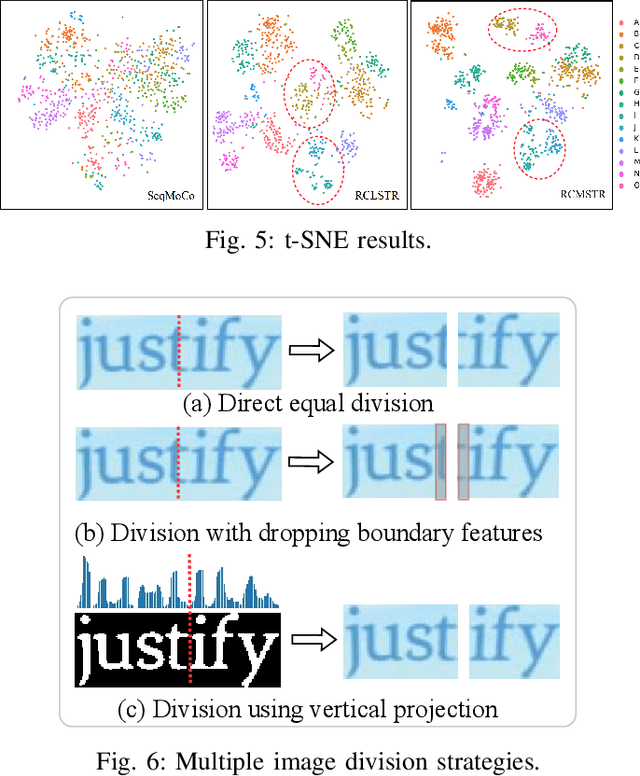
Context-aware methods have achieved remarkable advancements in supervised scene text recognition by leveraging semantic priors from words. Considering the heterogeneity of text and background in STR, we propose that such contextual priors can be reinterpreted as the relations between textual elements, serving as effective self-supervised labels for representation learning. However, textual relations are restricted to the finite size of the dataset due to lexical dependencies, which causes over-fitting problem, thus compromising the representation quality. To address this, our work introduces a unified framework of Relational Contrastive Learning and Masked Image Modeling for STR (RCMSTR), which explicitly models the enriched textual relations. For the RCL branch, we first introduce the relational rearrangement module to cultivate new relations on the fly. Based on this, we further conduct relational contrastive learning to model the intra- and inter-hierarchical relations for frames, sub-words and words. On the other hand, MIM can naturally boost the context information via masking, where we find that the block masking strategy is more effective for STR. For the effective integration of RCL and MIM, we also introduce a novel decoupling design aimed at mitigating the impact of masked images on contrastive learning. Additionally, to enhance the compatibility of MIM with CNNs, we propose the adoption of sparse convolutions and directly sharing the weights with dense convolutions in training. The proposed RCMSTR demonstrates superior performance in various evaluation protocols for different STR-related downstream tasks, outperforming the existing state-of-the-art self-supervised STR techniques. Ablation studies and qualitative experimental results further validate the effectiveness of our method. The code and pre-trained models will be available at https://github.com/ThunderVVV/RCMSTR .
FedCoLLM: A Parameter-Efficient Federated Co-tuning Framework for Large and Small Language Models
Nov 18, 2024
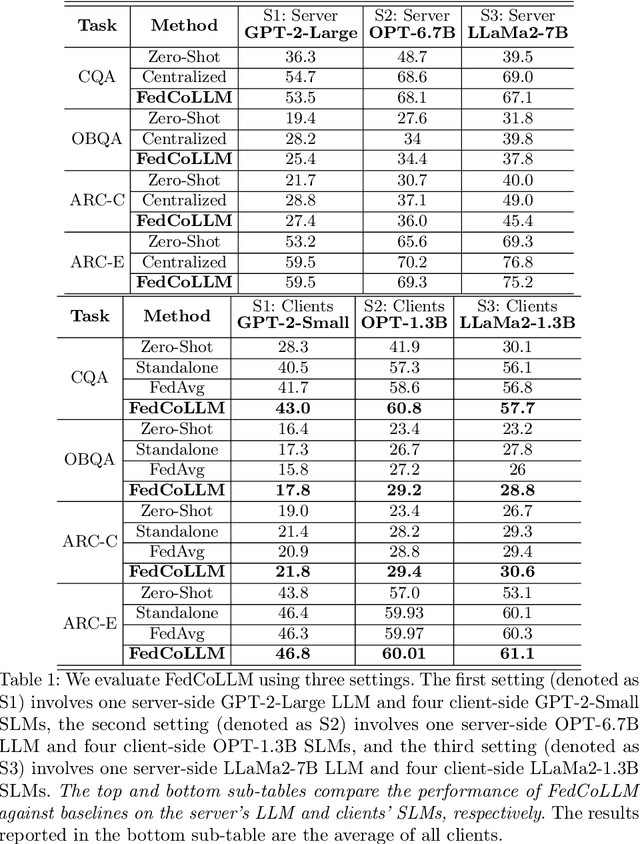

By adapting Large Language Models (LLMs) to domain-specific tasks or enriching them with domain-specific knowledge, we can fully harness the capabilities of LLMs. Nonetheless, a gap persists in achieving simultaneous mutual enhancement between the server's LLM and the downstream clients' Small Language Models (SLMs). To address this, we propose FedCoLLM, a novel and parameter-efficient federated framework designed for co-tuning LLMs and SLMs. This approach is aimed at adaptively transferring server-side LLMs knowledge to clients' SLMs while simultaneously enriching the LLMs with domain insights from the clients. To accomplish this, FedCoLLM utilizes lightweight adapters in conjunction with SLMs, facilitating knowledge exchange between server and clients in a manner that respects data privacy while also minimizing computational and communication overhead. Our evaluation of FedCoLLM, utilizing various public LLMs and SLMs across a range of NLP text generation tasks, reveals that the performance of clients' SLMs experiences notable improvements with the assistance of the LLMs. Simultaneously, the LLMs enhanced via FedCoLLM achieves comparable performance to that obtained through direct fine-tuning on clients' data.
Playing Language Game with LLMs Leads to Jailbreaking
Nov 16, 2024


The advent of large language models (LLMs) has spurred the development of numerous jailbreak techniques aimed at circumventing their security defenses against malicious attacks. An effective jailbreak approach is to identify a domain where safety generalization fails, a phenomenon known as mismatched generalization. In this paper, we introduce two novel jailbreak methods based on mismatched generalization: natural language games and custom language games, both of which effectively bypass the safety mechanisms of LLMs, with various kinds and different variants, making them hard to defend and leading to high attack rates. Natural language games involve the use of synthetic linguistic constructs and the actions intertwined with these constructs, such as the Ubbi Dubbi language. Building on this phenomenon, we propose the custom language games method: by engaging with LLMs using a variety of custom rules, we successfully execute jailbreak attacks across multiple LLM platforms. Extensive experiments demonstrate the effectiveness of our methods, achieving success rates of 93% on GPT-4o, 89% on GPT-4o-mini and 83% on Claude-3.5-Sonnet. Furthermore, to investigate the generalizability of safety alignments, we fine-tuned Llama-3.1-70B with the custom language games to achieve safety alignment within our datasets and found that when interacting through other language games, the fine-tuned models still failed to identify harmful content. This finding indicates that the safety alignment knowledge embedded in LLMs fails to generalize across different linguistic formats, thus opening new avenues for future research in this area.
LLM App Squatting and Cloning
Nov 12, 2024Impersonation tactics, such as app squatting and app cloning, have posed longstanding challenges in mobile app stores, where malicious actors exploit the names and reputations of popular apps to deceive users. With the rapid growth of Large Language Model (LLM) stores like GPT Store and FlowGPT, these issues have similarly surfaced, threatening the integrity of the LLM app ecosystem. In this study, we present the first large-scale analysis of LLM app squatting and cloning using our custom-built tool, LLMappCrazy. LLMappCrazy covers 14 squatting generation techniques and integrates Levenshtein distance and BERT-based semantic analysis to detect cloning by analyzing app functional similarities. Using this tool, we generated variations of the top 1000 app names and found over 5,000 squatting apps in the dataset. Additionally, we observed 3,509 squatting apps and 9,575 cloning cases across six major platforms. After sampling, we find that 18.7% of the squatting apps and 4.9% of the cloning apps exhibited malicious behavior, including phishing, malware distribution, fake content dissemination, and aggressive ad injection.
Unified Triplet-Level Hallucination Evaluation for Large Vision-Language Models
Oct 30, 2024Despite the outstanding performance in vision-language reasoning, Large Vision-Language Models (LVLMs) might generate hallucinated contents that do not exist in the given image. Most existing LVLM hallucination benchmarks are constrained to evaluate the object-related hallucinations. However, the potential hallucination on the relations between two objects, i.e., relation hallucination, still lacks investigation. To remedy that, in this paper we design a unified framework to measure object and relation hallucination in LVLMs simultaneously. The core idea of our framework is to conduct hallucination evaluation on (object, relation, object) triplets extracted from LVLMs' responses, and thus, could be easily generalized to different vision-language tasks. Based on our framework, we further introduce Tri-HE, a novel Triplet-level Hallucination Evaluation benchmark which can be used to study both object and relation hallucination at the same time. We conduct comprehensive evaluations on Tri-HE and observe that the relation hallucination issue is even more serious than object hallucination among existing LVLMs, highlighting a previously neglected problem towards reliable LVLMs. Moreover, based on our findings, we design a simple yet effective training-free approach to mitigate hallucinations for LVLMs, with which, we exceed all open-sourced counterparts on Tri-HE, achieving comparable performance with the powerful GPT-4V. Our dataset and code for the reproduction of our experiments are available publicly at https://github.com/wujunjie1998/Tri-HE.
Shopping MMLU: A Massive Multi-Task Online Shopping Benchmark for Large Language Models
Oct 28, 2024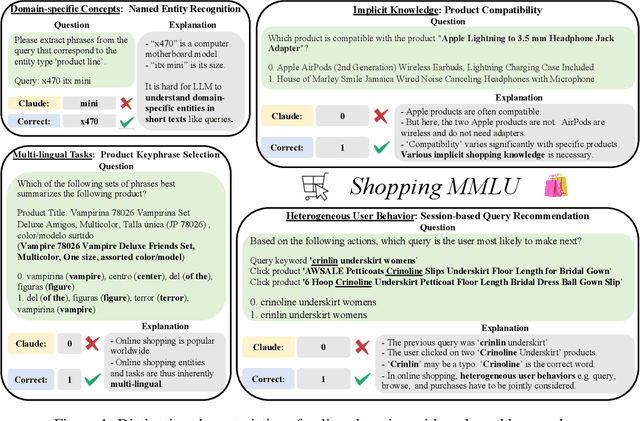
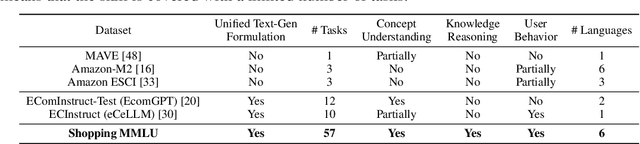
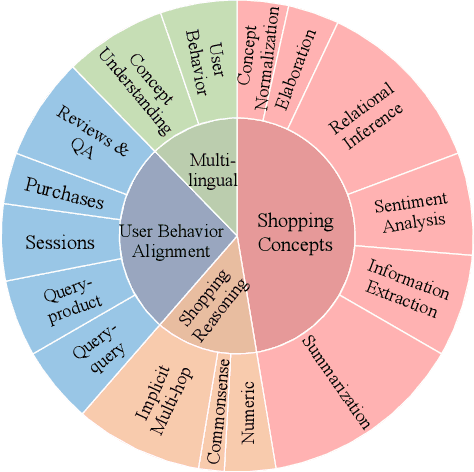
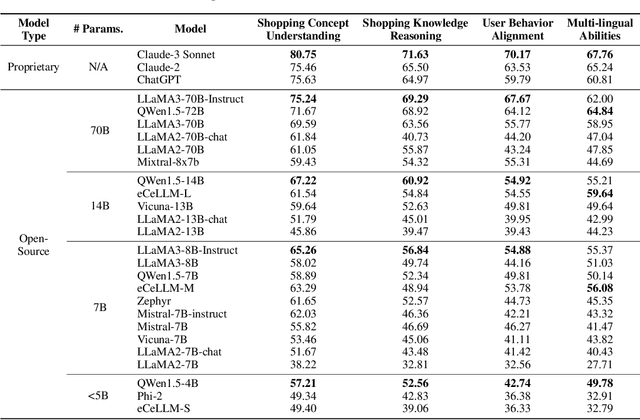
Online shopping is a complex multi-task, few-shot learning problem with a wide and evolving range of entities, relations, and tasks. However, existing models and benchmarks are commonly tailored to specific tasks, falling short of capturing the full complexity of online shopping. Large Language Models (LLMs), with their multi-task and few-shot learning abilities, have the potential to profoundly transform online shopping by alleviating task-specific engineering efforts and by providing users with interactive conversations. Despite the potential, LLMs face unique challenges in online shopping, such as domain-specific concepts, implicit knowledge, and heterogeneous user behaviors. Motivated by the potential and challenges, we propose Shopping MMLU, a diverse multi-task online shopping benchmark derived from real-world Amazon data. Shopping MMLU consists of 57 tasks covering 4 major shopping skills: concept understanding, knowledge reasoning, user behavior alignment, and multi-linguality, and can thus comprehensively evaluate the abilities of LLMs as general shop assistants. With Shopping MMLU, we benchmark over 20 existing LLMs and uncover valuable insights about practices and prospects of building versatile LLM-based shop assistants. Shopping MMLU can be publicly accessed at https://github.com/KL4805/ShoppingMMLU. In addition, with Shopping MMLU, we host a competition in KDD Cup 2024 with over 500 participating teams. The winning solutions and the associated workshop can be accessed at our website https://amazon-kddcup24.github.io/.
FRTree Planner: Robot Navigation in Cluttered and Unknown Environments with Tree of Free Regions
Oct 26, 2024

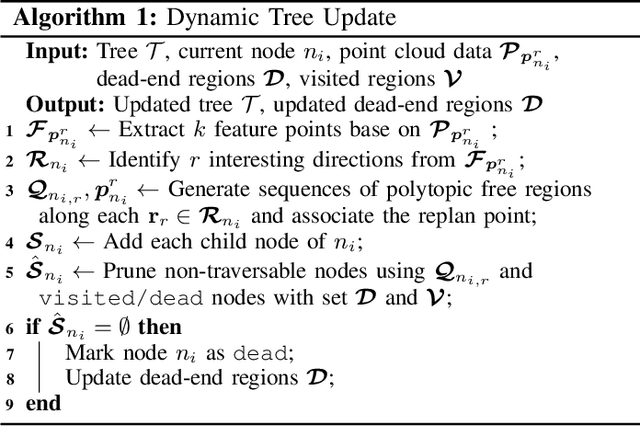

In this work, we present FRTree planner, a novel robot navigation framework that leverages a tree structure of free regions, specifically designed for navigation in cluttered and unknown environments with narrow passages. The framework continuously incorporates real-time perceptive information to identify distinct navigation options and dynamically expands the tree toward explorable and traversable directions. This dynamically constructed tree incrementally encodes the geometric and topological information of the collision-free space, enabling efficient selection of the intermediate goals, navigating around dead-end situations, and avoidance of dynamic obstacles without a prior map. Crucially, our method performs a comprehensive analysis of the geometric relationship between free regions and the robot during online replanning. In particular, the planner assesses the accessibility of candidate passages based on the robot's geometries, facilitating the effective selection of the most viable intermediate goals through accessible narrow passages while minimizing unnecessary detours. By combining the free region information with a bi-level trajectory optimization tailored for robots with specific geometries, our approach generates robust and adaptable obstacle avoidance strategies in confined spaces. Through extensive simulations and real-world experiments, FRTree demonstrates its superiority over benchmark methods in generating safe, efficient motion plans through highly cluttered and unknown terrains with narrow gaps.
CompassJudger-1: All-in-one Judge Model Helps Model Evaluation and Evolution
Oct 21, 2024



Efficient and accurate evaluation is crucial for the continuous improvement of large language models (LLMs). Among various assessment methods, subjective evaluation has garnered significant attention due to its superior alignment with real-world usage scenarios and human preferences. However, human-based evaluations are costly and lack reproducibility, making precise automated evaluators (judgers) vital in this process. In this report, we introduce \textbf{CompassJudger-1}, the first open-source \textbf{all-in-one} judge LLM. CompassJudger-1 is a general-purpose LLM that demonstrates remarkable versatility. It is capable of: 1. Performing unitary scoring and two-model comparisons as a reward model; 2. Conducting evaluations according to specified formats; 3. Generating critiques; 4. Executing diverse tasks like a general LLM. To assess the evaluation capabilities of different judge models under a unified setting, we have also established \textbf{JudgerBench}, a new benchmark that encompasses various subjective evaluation tasks and covers a wide range of topics. CompassJudger-1 offers a comprehensive solution for various evaluation tasks while maintaining the flexibility to adapt to diverse requirements. Both CompassJudger and JudgerBench are released and available to the research community athttps://github.com/open-compass/CompassJudger. We believe that by open-sourcing these tools, we can foster collaboration and accelerate progress in LLM evaluation methodologies.