 Add to Chrome
 Add to Firefox
 Add to Edge
LatentRevise: Learning from Zero-Hit Reasoning
Jun 29, 2026
Reinforcement learning with verifiable rewards (RLVR) is bottlenecked by hard prompts on which correct trajectories have low probability, so sampling misses them within a practical budget and leaves the policy update with little useful signal. We frame such zero-hit prompts as RLVR's sampling frontier, where new reasoning behavior is most valuable yet least likely to be sampled. Importantly, failed rollouts can be informative: they expose where the model's reasoning went wrong. We introduce LatentRevise, a first-order latent revision method that recovers training signal for this zero-hit regime. Given a failed rollout and the gold answer as an anchor, LatentRevise optimizes the input embeddings of its reasoning prefix under two complementary gradients, moving the prefix away from the failed continuation and toward the gold answer. The optimization is constrained to the convex hull of the model's vocabulary embeddings, so each update moves the latent toward a real token embedding rather than an arbitrary feature direction. We find that continuations from the revised prefix lengthen, exhibit self-reflection, and reach correct answers missed by the original rollouts. Used as training data, these trajectories improve SFT and RLVR on math benchmarks over standard baselines.

EvolMem: A Cognitive-Driven Benchmark for Multi-Session Dialogue Memory
Jan 07, 2026Despite recent advances in understanding and leveraging long-range conversational memory, existing benchmarks still lack systematic evaluation of large language models(LLMs) across diverse memory dimensions, particularly in multi-session settings. In this work, we propose EvolMem, a new benchmark for assessing multi-session memory capabilities of LLMs and agent systems. EvolMem is grounded in cognitive psychology and encompasses both declarative and non-declarative memory, further decomposed into multiple fine-grained abilities. To construct the benchmark, we introduce a hybrid data synthesis framework that consists of topic-initiated generation and narrative-inspired transformations. This framework enables scalable generation of multi-session conversations with controllable complexity, accompanied by sample-specific evaluation guidelines. Extensive evaluation reveals that no LLM consistently outperforms others across all memory dimensions. Moreover, agent memory mechanisms do not necessarily enhance LLMs' capabilities and often exhibit notable efficiency limitations. Data and code will be released at https://github.com/shenye7436/EvolMem.
Towards Omni-RAG: Comprehensive Retrieval-Augmented Generation for Large Language Models in Medical Applications
Jan 05, 2025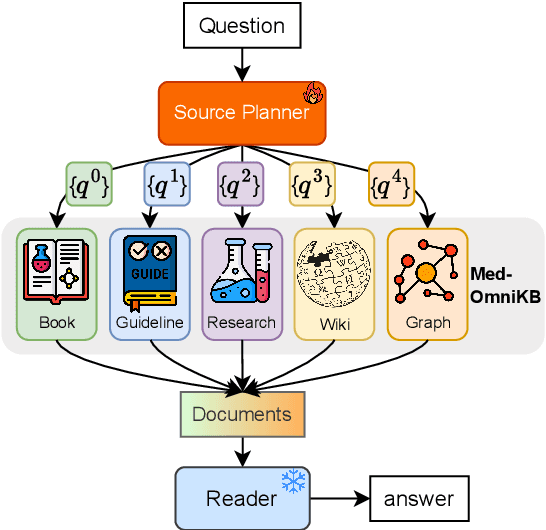
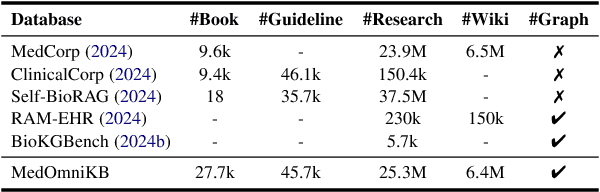
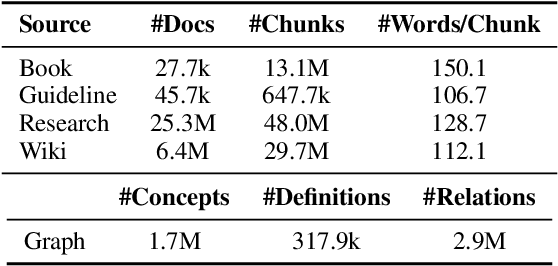
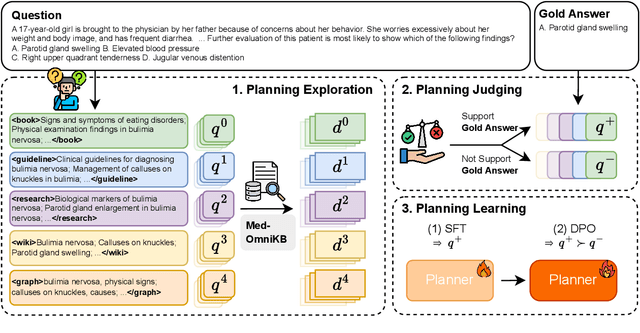
Large language models (LLMs) hold promise for addressing healthcare challenges but often generate hallucinations due to limited integration of medical knowledge. Incorporating external medical knowledge is therefore critical, especially considering the breadth and complexity of medical content, which necessitates effective multi-source knowledge acquisition. We address this challenge by framing it as a source planning problem, where the task is to formulate context-appropriate queries tailored to the attributes of diverse knowledge sources. Existing approaches either overlook source planning or fail to achieve it effectively due to misalignment between the model's expectation of the sources and their actual content. To bridge this gap, we present MedOmniKB, a comprehensive repository comprising multigenre and multi-structured medical knowledge sources. Leveraging these sources, we propose the Source Planning Optimisation (SPO) method, which enhances multi-source utilisation through explicit planning optimisation. Our approach involves enabling an expert model to explore and evaluate potential plans while training a smaller model to learn source alignment using positive and negative planning samples. Experimental results demonstrate that our method substantially improves multi-source planning performance, enabling the optimised small model to achieve state-of-the-art results in leveraging diverse medical knowledge sources.