 Add to Chrome
 Add to Firefox
 Add to Edge
Earth-o1: A Grid-free Observation-native Atmospheric World Model
May 07, 2026
Despite the unprecedented volume of multimodal data provided by modern Earth observation systems, our ability to model atmospheric dynamics remains constrained. Traditional modeling frameworks force heterogeneous measurements into predefined spatial grids, inherently limiting the full exploitation of raw sensor data and creating severe computational bottlenecks. Here we present Earth-o1, an observation-native atmospheric world model that overcomes these structural limitations. Rather than relying on conventional atmospheric dynamical modeling systems or traditional data assimilation, Earth-o1 directly learns the continuous, three-dimensional physical evolution of the Earth system from ungridded observational data. By integrating diverse sensor inputs into a unified, grid-free dynamical field, the model autonomously advances the atmospheric state in space and time. We show that this fundamentally distinct paradigm enables direct, real-time forecasting and cross-sensor inference without the overhead of explicit numerical solvers. In hindcast evaluations, Earth-o1 achieves surface forecast skill comparable to the operational Integrated Forecasting System (IFS). These results establish that continuous, observation-driven world models -- a new class of fully observation-native geophysical simulators -- can match the fidelity of established physical frameworks, providing a scalable data-driven foundation for a digital twin of the Earth.

Omni-Weather: Unified Multimodal Foundation Model for Weather Generation and Understanding
Dec 25, 2025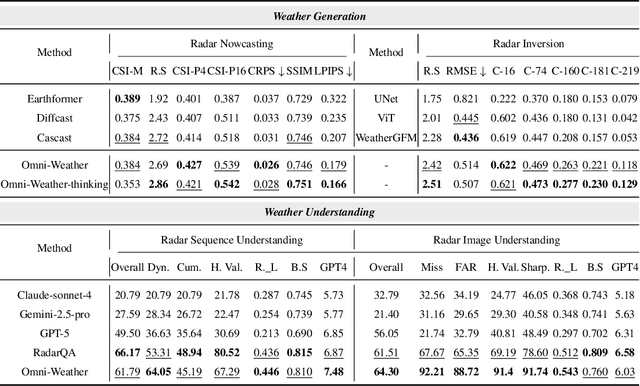
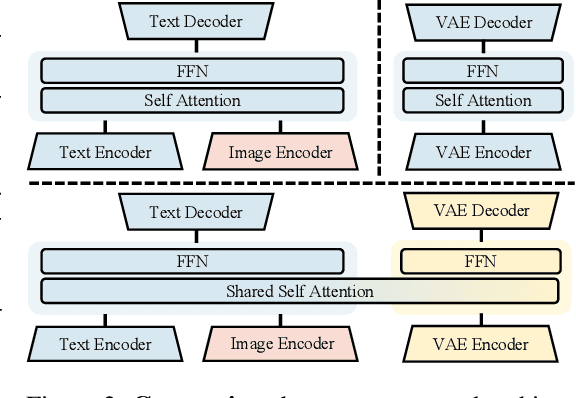
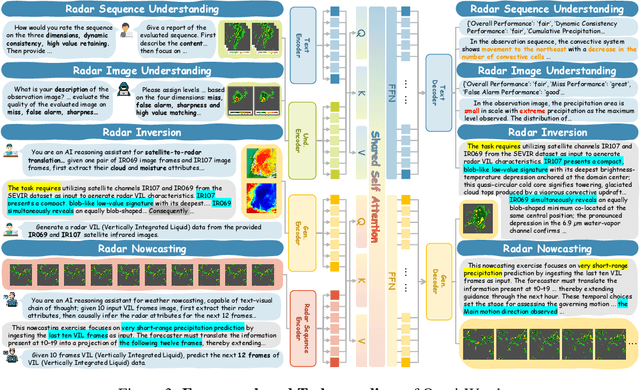
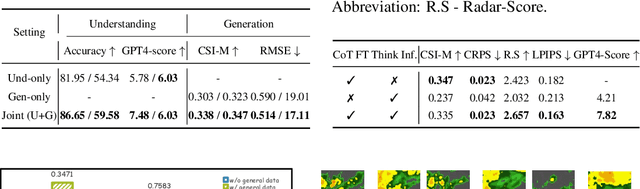
Weather modeling requires both accurate prediction and mechanistic interpretation, yet existing methods treat these goals in isolation, separating generation from understanding. To address this gap, we present Omni-Weather, the first multimodal foundation model that unifies weather generation and understanding within a single architecture. Omni-Weather integrates a radar encoder for weather generation tasks, followed by unified processing using a shared self-attention mechanism. Moreover, we construct a Chain-of-Thought dataset for causal reasoning in weather generation, enabling interpretable outputs and improved perceptual quality. Extensive experiments show Omni-Weather achieves state-of-the-art performance in both weather generation and understanding. Our findings further indicate that generative and understanding tasks in the weather domain can mutually enhance each other. Omni-Weather also demonstrates the feasibility and value of unifying weather generation and understanding.
Probing Scientific General Intelligence of LLMs with Scientist-Aligned Workflows
Dec 18, 2025Despite advances in scientific AI, a coherent framework for Scientific General Intelligence (SGI)-the ability to autonomously conceive, investigate, and reason across scientific domains-remains lacking. We present an operational SGI definition grounded in the Practical Inquiry Model (PIM: Deliberation, Conception, Action, Perception) and operationalize it via four scientist-aligned tasks: deep research, idea generation, dry/wet experiments, and experimental reasoning. SGI-Bench comprises over 1,000 expert-curated, cross-disciplinary samples inspired by Science's 125 Big Questions, enabling systematic evaluation of state-of-the-art LLMs. Results reveal gaps: low exact match (10--20%) in deep research despite step-level alignment; ideas lacking feasibility and detail; high code executability but low execution result accuracy in dry experiments; low sequence fidelity in wet protocols; and persistent multimodal comparative-reasoning challenges. We further introduce Test-Time Reinforcement Learning (TTRL), which optimizes retrieval-augmented novelty rewards at inference, enhancing hypothesis novelty without reference answer. Together, our PIM-grounded definition, workflow-centric benchmark, and empirical insights establish a foundation for AI systems that genuinely participate in scientific discovery.
SynWeather: Weather Observation Data Synthesis across Multiple Regions and Variables via a General Diffusion Transformer
Nov 15, 2025With the advancement of meteorological instruments, abundant data has become available. Current approaches are typically focus on single-variable, single-region tasks and primarily rely on deterministic modeling. This limits unified synthesis across variables and regions, overlooks cross-variable complementarity and often leads to over-smoothed results. To address above challenges, we introduce SynWeather, the first dataset designed for Unified Multi-region and Multi-variable Weather Observation Data Synthesis. SynWeather covers four representative regions: the Continental United States, Europe, East Asia, and Tropical Cyclone regions, as well as provides high-resolution observations of key weather variables, including Composite Radar Reflectivity, Hourly Precipitation, Visible Light, and Microwave Brightness Temperature. In addition, we introduce SynWeatherDiff, a general and probabilistic weather synthesis model built upon the Diffusion Transformer framework to address the over-smoothed problem. Experiments on the SynWeather dataset demonstrate the effectiveness of our network compared with both task-specific and general models.
RadarQA: Multi-modal Quality Analysis of Weather Radar Forecasts
Aug 17, 2025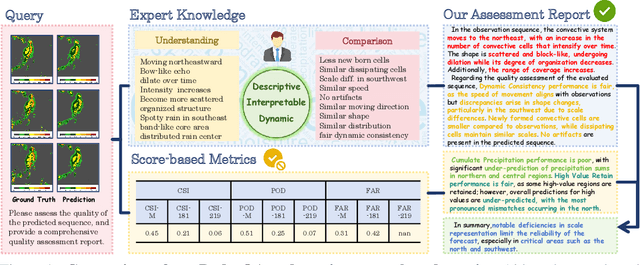
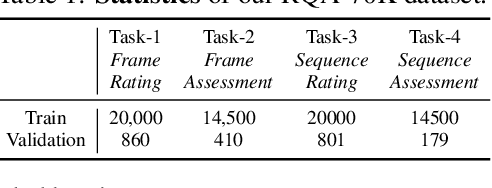
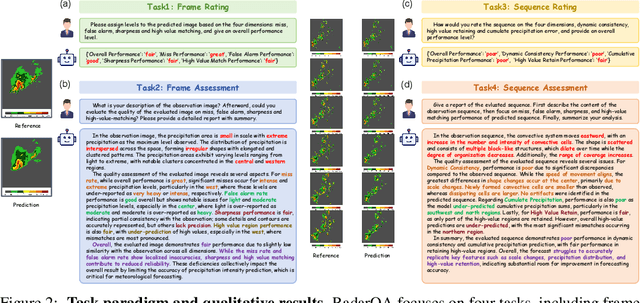
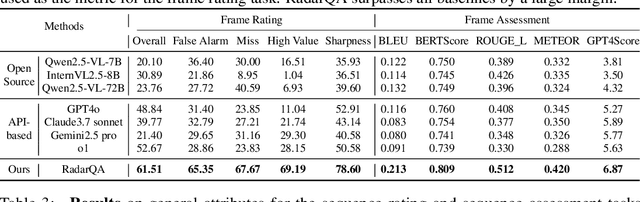
Quality analysis of weather forecasts is an essential topic in meteorology. Although traditional score-based evaluation metrics can quantify certain forecast errors, they are still far from meteorological experts in terms of descriptive capability, interpretability, and understanding of dynamic evolution. With the rapid development of Multi-modal Large Language Models (MLLMs), these models become potential tools to overcome the above challenges. In this work, we introduce an MLLM-based weather forecast analysis method, RadarQA, integrating key physical attributes with detailed assessment reports. We introduce a novel and comprehensive task paradigm for multi-modal quality analysis, encompassing both single frame and sequence, under both rating and assessment scenarios. To support training and benchmarking, we design a hybrid annotation pipeline that combines human expert labeling with automated heuristics. With such an annotation method, we construct RQA-70K, a large-scale dataset with varying difficulty levels for radar forecast quality evaluation. We further design a multi-stage training strategy that iteratively improves model performance at each stage. Extensive experiments show that RadarQA outperforms existing general MLLMs across all evaluation settings, highlighting its potential for advancing quality analysis in weather prediction.
Align-DA: Align Score-based Atmospheric Data Assimilation with Multiple Preferences
May 28, 2025Data assimilation (DA) aims to estimate the full state of a dynamical system by combining partial and noisy observations with a prior model forecast, commonly referred to as the background. In atmospheric applications, this problem is fundamentally ill-posed due to the sparsity of observations relative to the high-dimensional state space. Traditional methods address this challenge by simplifying background priors to regularize the solution, which are empirical and require continual tuning for application. Inspired by alignment techniques in text-to-image diffusion models, we propose Align-DA, which formulates DA as a generative process and uses reward signals to guide background priors, replacing manual tuning with data-driven alignment. Specifically, we train a score-based model in the latent space to approximate the background-conditioned prior, and align it using three complementary reward signals for DA: (1) assimilation accuracy, (2) forecast skill initialized from the assimilated state, and (3) physical adherence of the analysis fields. Experiments with multiple reward signals demonstrate consistent improvements in analysis quality across different evaluation metrics and observation-guidance strategies. These results show that preference alignment, implemented as a soft constraint, can automatically adapt complex background priors tailored to DA, offering a promising new direction for advancing the field.
Transforming Weather Data from Pixel to Latent Space
Mar 09, 2025The increasing impact of climate change and extreme weather events has spurred growing interest in deep learning for weather research. However, existing studies often rely on weather data in pixel space, which presents several challenges such as smooth outputs in model outputs, limited applicability to a single pressure-variable subset (PVS), and high data storage and computational costs. To address these challenges, we propose a novel Weather Latent Autoencoder (WLA) that transforms weather data from pixel space to latent space, enabling efficient weather task modeling. By decoupling weather reconstruction from downstream tasks, WLA improves the accuracy and sharpness of weather task model results. The incorporated Pressure-Variable Unified Module transforms multiple PVS into a unified representation, enhancing the adaptability of the model in multiple weather scenarios. Furthermore, weather tasks can be performed in a low-storage latent space of WLA rather than a high-storage pixel space, thus significantly reducing data storage and computational costs. Through extensive experimentation, we demonstrate its superior compression and reconstruction performance, enabling the creation of the ERA5-latent dataset with unified representations of multiple PVS from ERA5 data. The compressed full PVS in the ERA5-latent dataset reduces the original 244.34 TB of data to 0.43 TB. The downstream task further demonstrates that task models can apply to multiple PVS with low data costs in latent space and achieve superior performance compared to models in pixel space. Code, ERA5-latent data, and pre-trained models are available at https://anonymous.4open.science/r/Weather-Latent-Autoencoder-8467.
WeatherGFM: Learning A Weather Generalist Foundation Model via In-context Learning
Nov 08, 2024


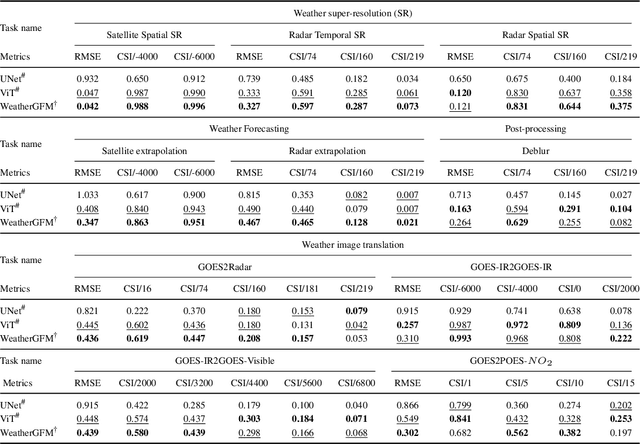
The Earth's weather system encompasses intricate weather data modalities and diverse weather understanding tasks, which hold significant value to human life. Existing data-driven models focus on single weather understanding tasks (e.g., weather forecasting). Although these models have achieved promising results, they fail to tackle various complex tasks within a single and unified model. Moreover, the paradigm that relies on limited real observations for a single scenario hinders the model's performance upper bound. In response to these limitations, we draw inspiration from the in-context learning paradigm employed in state-of-the-art visual foundation models and large language models. In this paper, we introduce the first generalist weather foundation model (WeatherGFM), designed to address a wide spectrum of weather understanding tasks in a unified manner. More specifically, we initially unify the representation and definition of the diverse weather understanding tasks. Subsequently, we devised weather prompt formats to manage different weather data modalities, namely single, multiple, and temporal modalities. Finally, we adopt a visual prompting question-answering paradigm for the training of unified weather understanding tasks. Extensive experiments indicate that our WeatherGFM can effectively handle up to ten weather understanding tasks, including weather forecasting, super-resolution, weather image translation, and post-processing. Our method also showcases generalization ability on unseen tasks.
PostCast: Generalizable Postprocessing for Precipitation Nowcasting via Unsupervised Blurriness Modeling
Oct 08, 2024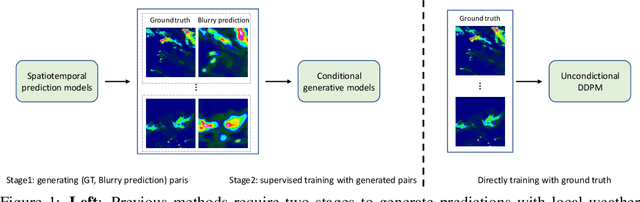
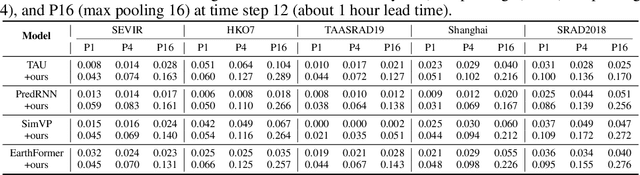
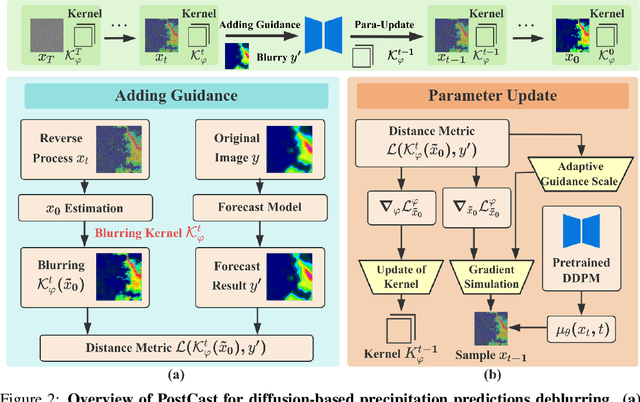

Precipitation nowcasting plays a pivotal role in socioeconomic sectors, especially in severe convective weather warnings. Although notable progress has been achieved by approaches mining the spatiotemporal correlations with deep learning, these methods still suffer severe blurriness as the lead time increases, which hampers accurate predictions for extreme precipitation. To alleviate blurriness, researchers explore generative methods conditioned on blurry predictions. However, the pairs of blurry predictions and corresponding ground truth need to be generated in advance, making the training pipeline cumbersome and limiting the generality of generative models within blur modes that appear in training data. By rethinking the blurriness in precipitation nowcasting as a blur kernel acting on predictions, we propose an unsupervised postprocessing method to eliminate the blurriness without the requirement of training with the pairs of blurry predictions and corresponding ground truth. Specifically, we utilize blurry predictions to guide the generation process of a pre-trained unconditional denoising diffusion probabilistic model (DDPM) to obtain high-fidelity predictions with eliminated blurriness. A zero-shot blur kernel estimation mechanism and an auto-scale denoise guidance strategy are introduced to adapt the unconditional DDPM to any blurriness modes varying from datasets and lead times in precipitation nowcasting. Extensive experiments are conducted on 7 precipitation radar datasets, demonstrating the generality and superiority of our method.
WeatherFormer: Empowering Global Numerical Weather Forecasting with Space-Time Transformer
Sep 21, 2024Numerical Weather Prediction (NWP) system is an infrastructure that exerts considerable impacts on modern society.Traditional NWP system, however, resolves it by solving complex partial differential equations with a huge computing cluster, resulting in tons of carbon emission. Exploring efficient and eco-friendly solutions for NWP attracts interest from Artificial Intelligence (AI) and earth science communities. To narrow the performance gap between the AI-based methods and physic predictor, this work proposes a new transformer-based NWP framework, termed as WeatherFormer, to model the complex spatio-temporal atmosphere dynamics and empowering the capability of data-driven NWP. WeatherFormer innovatively introduces the space-time factorized transformer blocks to decrease the parameters and memory consumption, in which Position-aware Adaptive Fourier Neural Operator (PAFNO) is proposed for location sensible token mixing. Besides, two data augmentation strategies are utilized to boost the performance and decrease training consumption. Extensive experiments on WeatherBench dataset show WeatherFormer achieves superior performance over existing deep learning methods and further approaches the most advanced physical model.