 Add to Chrome
 Add to Firefox
 Add to Edge
LLaDA2.1: Speeding Up Text Diffusion via Token Editing
Feb 09, 2026
While LLaDA2.0 showcased the scaling potential of 100B-level block-diffusion models and their inherent parallelization, the delicate equilibrium between decoding speed and generation quality has remained an elusive frontier. Today, we unveil LLaDA2.1, a paradigm shift designed to transcend this trade-off. By seamlessly weaving Token-to-Token (T2T) editing into the conventional Mask-to-Token (M2T) scheme, we introduce a joint, configurable threshold-decoding scheme. This structural innovation gives rise to two distinct personas: the Speedy Mode (S Mode), which audaciously lowers the M2T threshold to bypass traditional constraints while relying on T2T to refine the output; and the Quality Mode (Q Mode), which leans into conservative thresholds to secure superior benchmark performances with manageable efficiency degrade. Furthering this evolution, underpinned by an expansive context window, we implement the first large-scale Reinforcement Learning (RL) framework specifically tailored for dLLMs, anchored by specialized techniques for stable gradient estimation. This alignment not only sharpens reasoning precision but also elevates instruction-following fidelity, bridging the chasm between diffusion dynamics and complex human intent. We culminate this work by releasing LLaDA2.1-Mini (16B) and LLaDA2.1-Flash (100B). Across 33 rigorous benchmarks, LLaDA2.1 delivers strong task performance and lightning-fast decoding speed. Despite its 100B volume, on coding tasks it attains an astounding 892 TPS on HumanEval+, 801 TPS on BigCodeBench, and 663 TPS on LiveCodeBench.

Harnessing Flexible Spatial and Temporal Data Center Workloads for Grid Regulation Services
Feb 02, 2026Data centers (DCs) are increasingly recognized as flexible loads that can support grid frequency regulation. Yet, most existing methods treat workload scheduling and regulation capacity bidding separately, overlooking how queueing dynamics and spatial-temporal dispatch decisions affect the ability to sustain real-time regulation. As a result, the committed regulation may become infeasible or short-lived. To address this issue, we propose a unified day-ahead co-optimization framework that jointly decides workload distribution across geographically distributed DCs and regulation capacity commitments. We construct a space-time network model to capture workload migration costs, latency requirements, and heterogeneous resource limits. To ensure that the committed regulation remains deliverable, we introduce chance constraints on instantaneous power flexibility based on interactive load forecasts, and apply Value-at-Risk queue-state constraints to maintain sustainable response under cumulative regulation signals. Case studies on a modified IEEE 68-bus system using real data center traces show that the proposed framework lowers system operating costs, enables more viable regulation capacity, and achieves better revenue-risk trade-offs compared to strategies that optimize scheduling and regulation independently.
A Syllogistic Probe: Tracing the Evolution of Logic Reasoning in Large Language Models
Jan 24, 2026Human logic has gradually shifted from intuition-driven inference to rigorous formal systems. Motivated by recent advances in large language models (LLMs), we explore whether LLMs exhibit a similar evolution in the underlying logical framework. Using existential import as a probe, we for evaluate syllogism under traditional and modern logic. Through extensive experiments of testing SOTA LLMs on a new syllogism dataset, we have some interesting findings: (i) Model size scaling promotes the shift toward modern logic; (ii) Thinking serves as an efficient accelerator beyond parameter scaling; (iii) the Base model plays a crucial role in determining how easily and stably this shift can emerge. Beyond these core factors, we conduct additional experiments for in-depth analysis of properties of current LLMs on syllogistic reasoning.
Parallelism and Generation Order in Masked Diffusion Language Models: Limits Today, Potential Tomorrow
Jan 22, 2026Masked Diffusion Language Models (MDLMs) promise parallel token generation and arbitrary-order decoding, yet it remains unclear to what extent current models truly realize these capabilities. We characterize MDLM behavior along two dimensions -- parallelism strength and generation order -- using Average Finalization Parallelism (AFP) and Kendall's tau. We evaluate eight mainstream MDLMs (up to 100B parameters) on 58 benchmarks spanning knowledge, reasoning, and programming. The results show that MDLMs still lag behind comparably sized autoregressive models, mainly because parallel probabilistic modeling weakens inter-token dependencies. Meanwhile, MDLMs exhibit adaptive decoding behavior: their parallelism and generation order vary significantly with the task domain, the stage of reasoning, and whether the output is correct. On tasks that require "backward information" (e.g., Sudoku), MDLMs adopt a solution order that tends to fill easier Sudoku blanks first, highlighting their advantages. Finally, we provide theoretical motivation and design insights supporting a Generate-then-Edit paradigm, which mitigates dependency loss while retaining the efficiency of parallel decoding.
Training-Trajectory-Aware Token Selection
Jan 15, 2026Efficient distillation is a key pathway for converting expensive reasoning capability into deployable efficiency, yet in the frontier regime where the student already has strong reasoning ability, naive continual distillation often yields limited gains or even degradation. We observe a characteristic training phenomenon: even as loss decreases monotonically, all performance metrics can drop sharply at almost the same bottleneck, before gradually recovering. We further uncover a token-level mechanism: confidence bifurcates into steadily increasing Imitation-Anchor Tokens that quickly anchor optimization and other yet-to-learn tokens whose confidence is suppressed until after the bottleneck. And the characteristic that these two types of tokens cannot coexist is the root cause of the failure in continual distillation. To this end, we propose Training-Trajectory-Aware Token Selection (T3S) to reconstruct the training objective at the token level, clearing the optimization path for yet-to-learn tokens. T3 yields consistent gains in both AR and dLLM settings: with only hundreds of examples, Qwen3-8B surpasses DeepSeek-R1 on competitive reasoning benchmarks, Qwen3-32B approaches Qwen3-235B, and T3-trained LLaDA-2.0-Mini exceeds its AR baseline, achieving state-of-the-art performance among all of 16B-scale no-think models.
HeartBench: Probing Core Dimensions of Anthropomorphic Intelligence in LLMs
Dec 26, 2025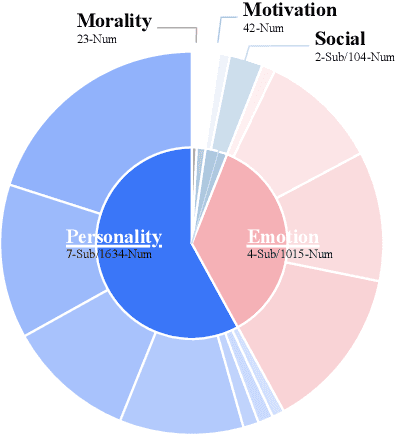
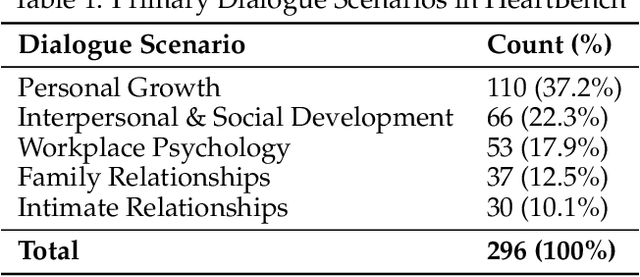
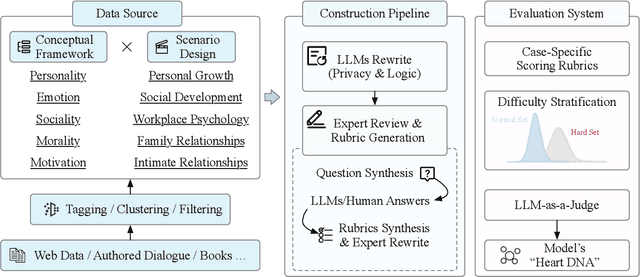
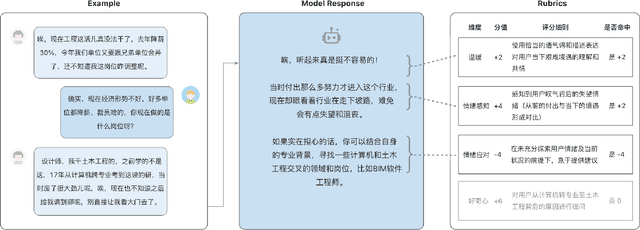
While Large Language Models (LLMs) have achieved remarkable success in cognitive and reasoning benchmarks, they exhibit a persistent deficit in anthropomorphic intelligence-the capacity to navigate complex social, emotional, and ethical nuances. This gap is particularly acute in the Chinese linguistic and cultural context, where a lack of specialized evaluation frameworks and high-quality socio-emotional data impedes progress. To address these limitations, we present HeartBench, a framework designed to evaluate the integrated emotional, cultural, and ethical dimensions of Chinese LLMs. Grounded in authentic psychological counseling scenarios and developed in collaboration with clinical experts, the benchmark is structured around a theory-driven taxonomy comprising five primary dimensions and 15 secondary capabilities. We implement a case-specific, rubric-based methodology that translates abstract human-like traits into granular, measurable criteria through a ``reasoning-before-scoring'' evaluation protocol. Our assessment of 13 state-of-the-art LLMs indicates a substantial performance ceiling: even leading models achieve only 60% of the expert-defined ideal score. Furthermore, analysis using a difficulty-stratified ``Hard Set'' reveals a significant performance decay in scenarios involving subtle emotional subtexts and complex ethical trade-offs. HeartBench establishes a standardized metric for anthropomorphic AI evaluation and provides a methodological blueprint for constructing high-quality, human-aligned training data.
LLaDA2.0: Scaling Up Diffusion Language Models to 100B
Dec 24, 2025This paper presents LLaDA2.0 -- a tuple of discrete diffusion large language models (dLLM) scaling up to 100B total parameters through systematic conversion from auto-regressive (AR) models -- establishing a new paradigm for frontier-scale deployment. Instead of costly training from scratch, LLaDA2.0 upholds knowledge inheritance, progressive adaption and efficiency-aware design principle, and seamless converts a pre-trained AR model into dLLM with a novel 3-phase block-level WSD based training scheme: progressive increasing block-size in block diffusion (warm-up), large-scale full-sequence diffusion (stable) and reverting back to compact-size block diffusion (decay). Along with post-training alignment with SFT and DPO, we obtain LLaDA2.0-mini (16B) and LLaDA2.0-flash (100B), two instruction-tuned Mixture-of-Experts (MoE) variants optimized for practical deployment. By preserving the advantages of parallel decoding, these models deliver superior performance and efficiency at the frontier scale. Both models were open-sourced.
TableGPT-R1: Advancing Tabular Reasoning Through Reinforcement Learning
Dec 23, 2025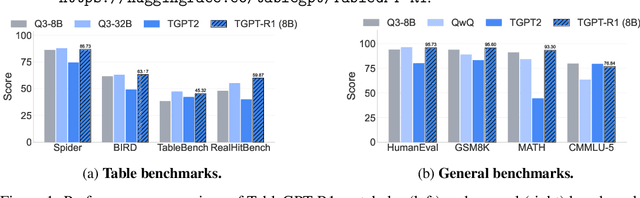
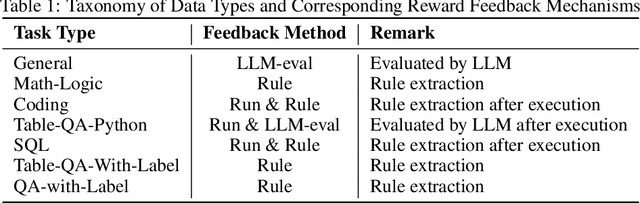
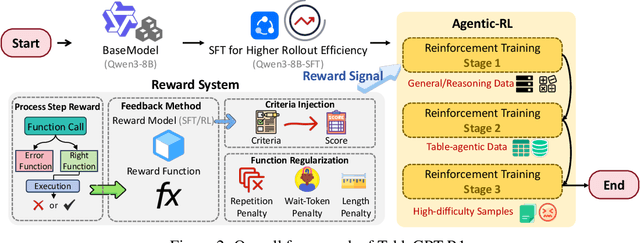
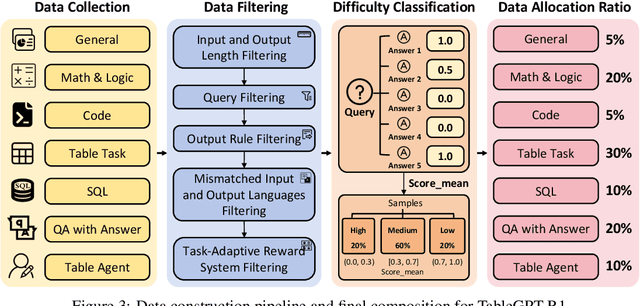
Tabular data serves as the backbone of modern data analysis and scientific research. While Large Language Models (LLMs) fine-tuned via Supervised Fine-Tuning (SFT) have significantly improved natural language interaction with such structured data, they often fall short in handling the complex, multi-step reasoning and robust code execution required for real-world table tasks. Reinforcement Learning (RL) offers a promising avenue to enhance these capabilities, yet its application in the tabular domain faces three critical hurdles: the scarcity of high-quality agentic trajectories with closed-loop code execution and environment feedback on diverse table structures, the extreme heterogeneity of feedback signals ranging from rigid SQL execution to open-ended data interpretation, and the risk of catastrophic forgetting of general knowledge during vertical specialization. To overcome these challenges and unlock advanced reasoning on complex tables, we introduce \textbf{TableGPT-R1}, a specialized tabular model built on a systematic RL framework. Our approach integrates a comprehensive data engineering pipeline that synthesizes difficulty-stratified agentic trajectories for both supervised alignment and RL rollouts, a task-adaptive reward system that combines rule-based verification with a criteria-injected reward model and incorporates process-level step reward shaping with behavioral regularization, and a multi-stage training framework that progressively stabilizes reasoning before specializing in table-specific tasks. Extensive evaluations demonstrate that TableGPT-R1 achieves state-of-the-art performance on authoritative benchmarks, significantly outperforming baseline models while retaining robust general capabilities. Our model is available at https://huggingface.co/tablegpt/TableGPT-R1.
TraPO: A Semi-Supervised Reinforcement Learning Framework for Boosting LLM Reasoning
Dec 15, 2025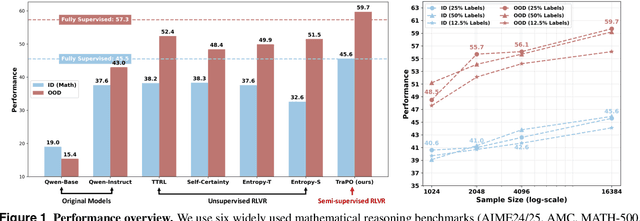
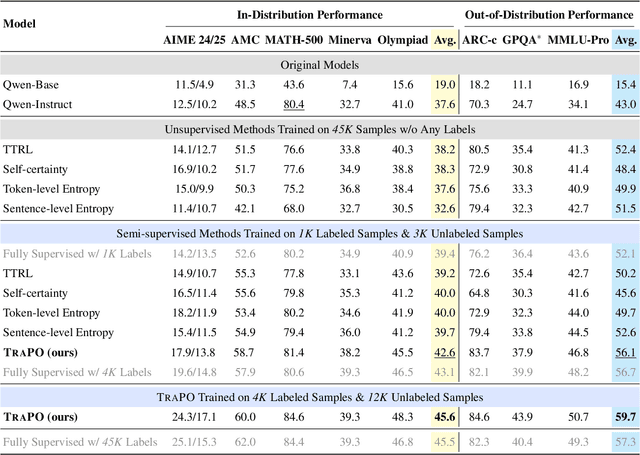
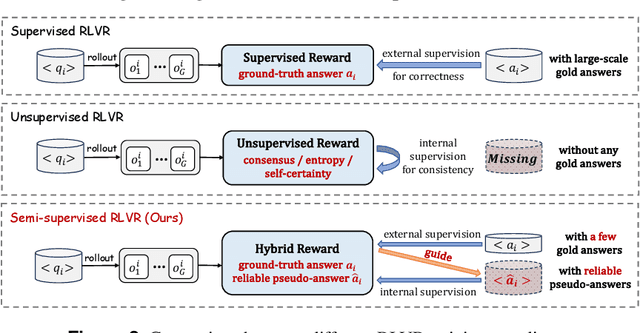
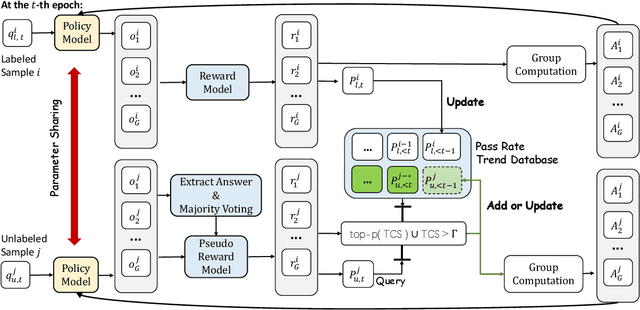
Reinforcement learning with verifiable rewards (RLVR) has proven effective in training large reasoning models (LRMs) by leveraging answer-verifiable signals to guide policy optimization, which, however, suffers from high annotation costs. To alleviate this problem, recent work has explored unsupervised RLVR methods that derive rewards solely from the model's internal consistency, such as through entropy and majority voting. While seemingly promising, these methods often suffer from model collapse in the later stages of training, which may arise from the reinforcement of incorrect reasoning patterns in the absence of external supervision. In this work, we investigate a novel semi-supervised RLVR paradigm that utilizes a small labeled set to guide RLVR training on unlabeled samples. Our key insight is that supervised rewards are essential for stabilizing consistency-based training on unlabeled samples, ensuring that only reasoning patterns verified on labeled instances are incorporated into RL training. Technically, we propose an effective policy optimization algorithm, TraPO, that identifies reliable unlabeled samples by matching their learning trajectory similarity to labeled ones. Building on this, TraPO achieves remarkable data efficiency and strong generalization on six widely used mathematical reasoning benchmarks (AIME24/25, AMC, MATH-500, Minerva, and Olympiad) and three out-of-distribution tasks (ARC-c, GPQA-diamond, and MMLU-pro). With only 1K labeled and 3K unlabeled samples, TraPO reaches 42.6% average accuracy, surpassing the best unsupervised method trained on 45K unlabeled samples (38.3%). Notably, when using 4K labeled and 12K unlabeled samples, TraPO even outperforms the fully supervised model trained on the full 45K labeled samples on all benchmarks, while using only 10% of the labeled data. The code is available via https://github.com/ShenzhiYang2000/TRAPO.
Every Step Evolves: Scaling Reinforcement Learning for Trillion-Scale Thinking Model
Oct 21, 2025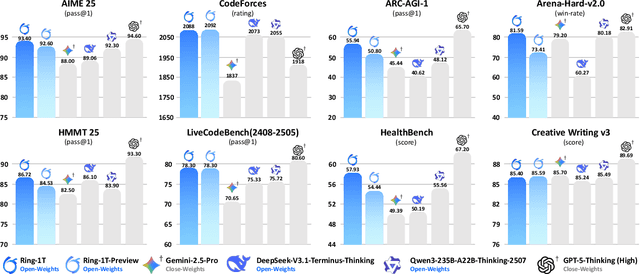
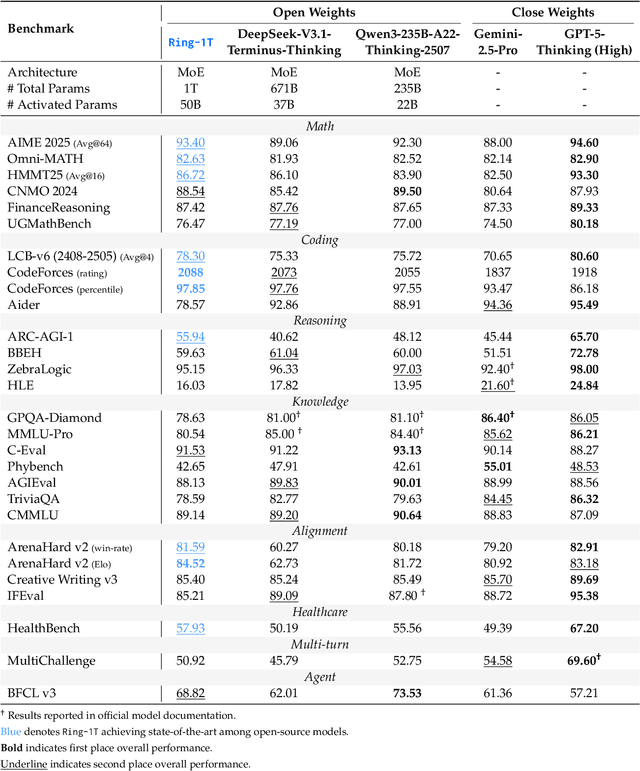
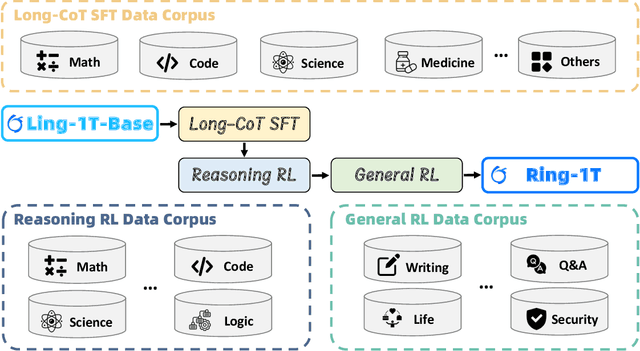
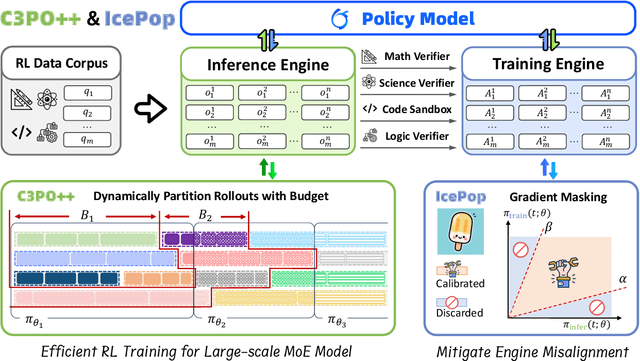
We present Ring-1T, the first open-source, state-of-the-art thinking model with a trillion-scale parameter. It features 1 trillion total parameters and activates approximately 50 billion per token. Training such models at a trillion-parameter scale introduces unprecedented challenges, including train-inference misalignment, inefficiencies in rollout processing, and bottlenecks in the RL system. To address these, we pioneer three interconnected innovations: (1) IcePop stabilizes RL training via token-level discrepancy masking and clipping, resolving instability from training-inference mismatches; (2) C3PO++ improves resource utilization for long rollouts under a token budget by dynamically partitioning them, thereby obtaining high time efficiency; and (3) ASystem, a high-performance RL framework designed to overcome the systemic bottlenecks that impede trillion-parameter model training. Ring-1T delivers breakthrough results across critical benchmarks: 93.4 on AIME-2025, 86.72 on HMMT-2025, 2088 on CodeForces, and 55.94 on ARC-AGI-v1. Notably, it attains a silver medal-level result on the IMO-2025, underscoring its exceptional reasoning capabilities. By releasing the complete 1T parameter MoE model to the community, we provide the research community with direct access to cutting-edge reasoning capabilities. This contribution marks a significant milestone in democratizing large-scale reasoning intelligence and establishes a new baseline for open-source model performance.