 Add to Chrome
 Add to Firefox
 Add to Edge
GeoMin: Data-Efficient Semi-Supervised RLVR via Geometric Distribution Modeling
Jun 03, 2026
Reinforcement learning with verifiable rewards (RLVR) significantly advances LLM reasoning, yet it faces a dilemma: standard supervised scaling is throttled by high annotation costs, while unsupervised alternatives suffer from severe model collapse. Recent semi-supervised RLVR methods address this by using a small labeled set to guide unlabeled data, achieving a promising trade-off between training efficacy and annotation cost. However, they suffer from a severe data-efficiency bottleneck due to the reliance on coarse performance heuristics, leaving a vast majority of valuable instances underutilized. To this end, we propose GeoMin, which models global feature distributions on labeled data to decode the structural discrepancy between correct and incorrect rollouts, thereby establishing a robust prior to assess the reliability of self-reward signals and fully unleash the potential of unlabeled data. Empirically, GeoMin outperforms the strongest baselines by +4.1% and even surpasses fully supervised models with only 10% of the annotations, demonstrating remarkable data efficiency.

Smart Picks in the Dark: Towards Efficient RLVR for Reasoning via Tracing Metacognitive Pivots
Jun 03, 2026Reinforcement learning with verifiable rewards (RLVR) has greatly advanced large reasoning models (LRMs), but it requires timely training on a huge fully-annotated dataset. To this end, data-efficient RLVR methods have been widely studied from two perspectives: (i) data selection methods identify a small subset of "golden" samples that yield near-full-data performance, but they rely on a pre-existing pool of labeled data. (ii) unsupervised RLVR methods train the model using its own internal supervision signals on large-scale unlabeled data, yet they exhibit suboptimal performance. Accordingly, we investigate the "pick in the dark" setup for RLVR, which aims to select, without prior supervision, unlabeled samples that are most beneficial for training and worthy of annotation. Through systematic analysis, we demonstrate that smart picks hinge on a well-calibrated uncertainty estimator to enable strategic partitioning of data for adaptive training regimes. Building on this insight, we propose PivotTrace, a three-way data triage framework that leverages attention dynamics to trace metacognitive pivots during reasoning. By precisely quantifying uncertainty through pivot density, PivotTrace achieves automated data routing to synergistically maximize both annotation and training efficiency. Empirically, PivotTrace surpasses the fully supervised LRM with only 29.3% annotated samples and 2.75 faster convergence.
TraPO: A Semi-Supervised Reinforcement Learning Framework for Boosting LLM Reasoning
Dec 15, 2025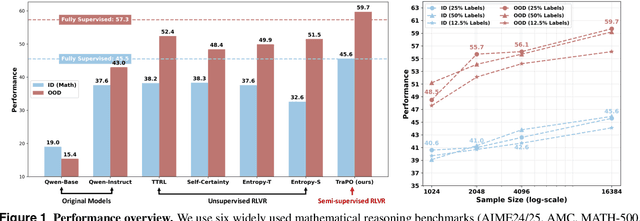
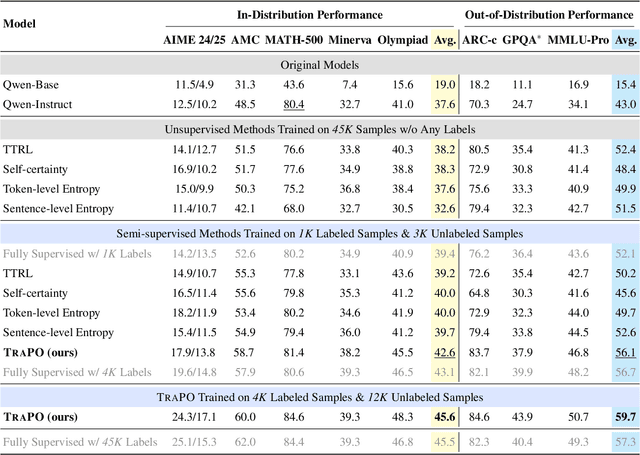
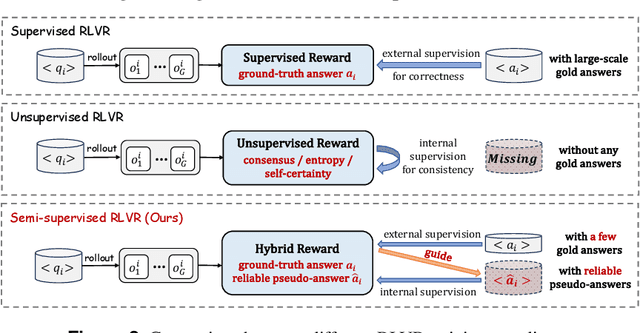
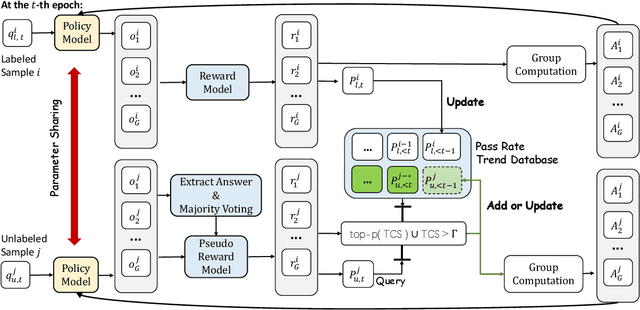
Reinforcement learning with verifiable rewards (RLVR) has proven effective in training large reasoning models (LRMs) by leveraging answer-verifiable signals to guide policy optimization, which, however, suffers from high annotation costs. To alleviate this problem, recent work has explored unsupervised RLVR methods that derive rewards solely from the model's internal consistency, such as through entropy and majority voting. While seemingly promising, these methods often suffer from model collapse in the later stages of training, which may arise from the reinforcement of incorrect reasoning patterns in the absence of external supervision. In this work, we investigate a novel semi-supervised RLVR paradigm that utilizes a small labeled set to guide RLVR training on unlabeled samples. Our key insight is that supervised rewards are essential for stabilizing consistency-based training on unlabeled samples, ensuring that only reasoning patterns verified on labeled instances are incorporated into RL training. Technically, we propose an effective policy optimization algorithm, TraPO, that identifies reliable unlabeled samples by matching their learning trajectory similarity to labeled ones. Building on this, TraPO achieves remarkable data efficiency and strong generalization on six widely used mathematical reasoning benchmarks (AIME24/25, AMC, MATH-500, Minerva, and Olympiad) and three out-of-distribution tasks (ARC-c, GPQA-diamond, and MMLU-pro). With only 1K labeled and 3K unlabeled samples, TraPO reaches 42.6% average accuracy, surpassing the best unsupervised method trained on 45K unlabeled samples (38.3%). Notably, when using 4K labeled and 12K unlabeled samples, TraPO even outperforms the fully supervised model trained on the full 45K labeled samples on all benchmarks, while using only 10% of the labeled data. The code is available via https://github.com/ShenzhiYang2000/TRAPO.