 Add to Chrome
 Add to Firefox
 Add to Edge
HopRefusalBench: Diagnosing Refusal Failures in Search-Augmented Agents for Multi-Hop Reasoning
Aug 02, 2026
Search-augmented large language model agents are increasingly capable of solving knowledge-intensive tasks, but their behavior when a multi-hop question is fundamentally unanswerable remains poorly understood. Existing abstention benchmarks largely expose defects at the surface of single-hop queries and therefore cannot reveal failures that emerge only after valid intermediate reasoning and retrieval. We introduce HopRefusalBench, the first controlled benchmark of refusal within multi-hop search, comprising 889 unanswerable questions constructed from KILT-grounded entity paths. It crosses three causes of unanswerability (answer unknown, false premise, and underspecified context) with root, middle, and terminal topologies, making premise verification, intermediate-bridge validation, and terminal stopping separately observable. We further propose a final-outcome taxonomy spanning target-aware refusal, pseudo-refusal, hallucinated completion, and search-budget exhaustion, together with source-aware trajectory metrics for post-trigger continuation and token waste. Across ten frontier proprietary and open-weight models in search-augmented mode, the best model achieves a target-aware correct halting rate (TCHR) of only 42.9%. Root and middle items are consistently harder than terminal items, and all models attain their highest TCHR on false premises and their lowest on underspecified questions. Yet when pooled across categories, 84.7--98.4% of each model's explicit refusal-like responses identify the correct rationale, localizing the main bottleneck to committing to an appropriate non-answer; failed trajectories instead diverge into hallucination or search-budget exhaustion. These results establish refusal in multi-hop search as a consequential evaluation problem and provide a foundation for diagnosing and improving the reliability of search-augmented agents.

EviSD: Evidence-Conditioned Self-Distillation for Search-Augmented Agents
Aug 02, 2026Outcome-based reinforcement learning enables search-augmented language agents to learn from verifiable final answers, but its trajectory-level credit cannot distinguish the contributions of individual actions in a multi-turn search process. We propose EviSD, an evidence-conditioned self-distillation framework that uses instance-level supporting evidence as privileged information for search actions and golden answers as complementary privilege for answer actions. During training, the student samples actions from the original context, while the same model re-scores them as a privileged teacher under an action-aligned context. EviSD converts the detached teacher--student gap into a bounded correction to the outcome-derived GRPO advantage and applies it only to generated action spans. This design localizes privileged guidance while preserving the update direction determined by the outcome reward, without an auxiliary distillation objective or any change at inference time. Across seven question-answering benchmarks and three backbones spanning model scales and generations, EviSD achieves the highest macro-average Exact Match in all evaluated settings, outperforming the strongest compared methods by 1.3--2.3 points while modulating only 6.7%--15.1% of response tokens. Code is available at https://github.com/JiananXie/EviSD.
OPRD: On-Policy Representation Distillation
Jun 04, 2026On-policy distillation (OPD) supervises the student only in output space by matching next-token probabilities. This output-only paradigm has two limits: (1) sampling variance from Monte Carlo KL estimates over large vocabularies (e.g., Qwen's ~150k tokens) persists throughout training, and (2) it treats the teacher as a black-box, discarding all intermediate hidden states after the LM head. We propose On-Policy Representation Distillation (OPRD), which lifts distillation into hidden-state space by aligning student and teacher representations across selected layers on the same rollouts, bypassing the LM head entirely. Theoretically, OPRD eliminates sampling variance and provides richer per-layer structural information. Empirically, OPRD closes the student-teacher gap on AIME 2024/2025 and AIMO, while output-space OPD baselines plateau below the teacher. OPRD also trains 1.44x faster and uses 54% less memory than top-k OPD. Code: https://github.com/ShenzhiYang2000/OPRD.
GeoMin: Data-Efficient Semi-Supervised RLVR via Geometric Distribution Modeling
Jun 03, 2026Reinforcement learning with verifiable rewards (RLVR) significantly advances LLM reasoning, yet it faces a dilemma: standard supervised scaling is throttled by high annotation costs, while unsupervised alternatives suffer from severe model collapse. Recent semi-supervised RLVR methods address this by using a small labeled set to guide unlabeled data, achieving a promising trade-off between training efficacy and annotation cost. However, they suffer from a severe data-efficiency bottleneck due to the reliance on coarse performance heuristics, leaving a vast majority of valuable instances underutilized. To this end, we propose GeoMin, which models global feature distributions on labeled data to decode the structural discrepancy between correct and incorrect rollouts, thereby establishing a robust prior to assess the reliability of self-reward signals and fully unleash the potential of unlabeled data. Empirically, GeoMin outperforms the strongest baselines by +4.1% and even surpasses fully supervised models with only 10% of the annotations, demonstrating remarkable data efficiency.
Smart Picks in the Dark: Towards Efficient RLVR for Reasoning via Tracing Metacognitive Pivots
Jun 03, 2026Reinforcement learning with verifiable rewards (RLVR) has greatly advanced large reasoning models (LRMs), but it requires timely training on a huge fully-annotated dataset. To this end, data-efficient RLVR methods have been widely studied from two perspectives: (i) data selection methods identify a small subset of "golden" samples that yield near-full-data performance, but they rely on a pre-existing pool of labeled data. (ii) unsupervised RLVR methods train the model using its own internal supervision signals on large-scale unlabeled data, yet they exhibit suboptimal performance. Accordingly, we investigate the "pick in the dark" setup for RLVR, which aims to select, without prior supervision, unlabeled samples that are most beneficial for training and worthy of annotation. Through systematic analysis, we demonstrate that smart picks hinge on a well-calibrated uncertainty estimator to enable strategic partitioning of data for adaptive training regimes. Building on this insight, we propose PivotTrace, a three-way data triage framework that leverages attention dynamics to trace metacognitive pivots during reasoning. By precisely quantifying uncertainty through pivot density, PivotTrace achieves automated data routing to synergistically maximize both annotation and training efficiency. Empirically, PivotTrace surpasses the fully supervised LRM with only 29.3% annotated samples and 2.75 faster convergence.
Can LLMs Learn to Reason Robustly under Noisy Supervision?
Apr 05, 2026Reinforcement Learning with Verifiable Rewards (RLVR) effectively trains reasoning models that rely on abundant perfect labels, but its vulnerability to unavoidable noisy labels due to expert scarcity remains critically underexplored. In this work, we take the first step toward a systematic analysis of noisy label mechanisms in RLVR. In contrast to supervised classification, most RLVR algorithms incorporate a rollout-based condition: a label's influence on training is contingent on whether the current policy can generate rollouts that realize it, a property that naturally extends to noisy labels. Based on this observation, we distinguish two types of noise: inactive noisy labels, which reduce data efficiency, and active noisy labels, which are reinforced and risk skewing the model toward incorrect distributions. From experiments on training with noisy samples, we identify an Early Correctness Coherence phenomenon: although noisy samples begin to lag behind in later stages, accuracy on both clean and noisy samples increases similarly in early training. Motivated by this dynamic, we propose Online Label Refinement (OLR), which progressively corrects potentially noisy labels with majority-voted answers when two conditions hold: a positive slope in the majority answer's rollout pass rate and stable historical consistency across updates, enabling gradual self-correction as the policy improves. We evaluate OLR on six in-distribution mathematical reasoning benchmarks (AIME24/25, AMC, MATH-500, Minerva, and Olympiad) and three out-of-distribution tasks (ARC-c, GPQA-diamond, and MMLU-pro). Across noise ratios from 0.1 to 0.9, OLR consistently improves robustness under both inactive and active noisy-label settings, achieving average gains of 3.6% to 3.9% on in-distribution benchmarks and 3.3% to 4.6% on out-of-distribution evaluations.
TraPO: A Semi-Supervised Reinforcement Learning Framework for Boosting LLM Reasoning
Dec 15, 2025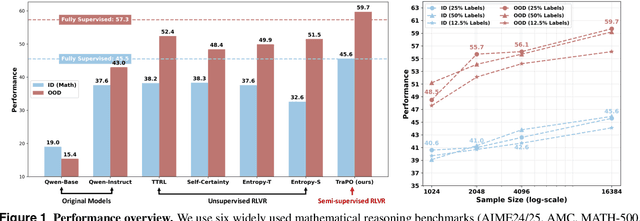
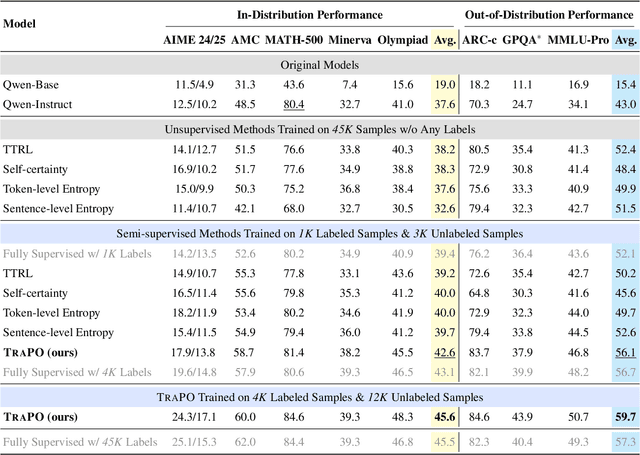
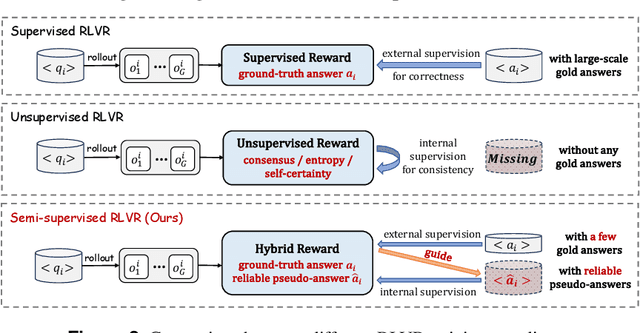
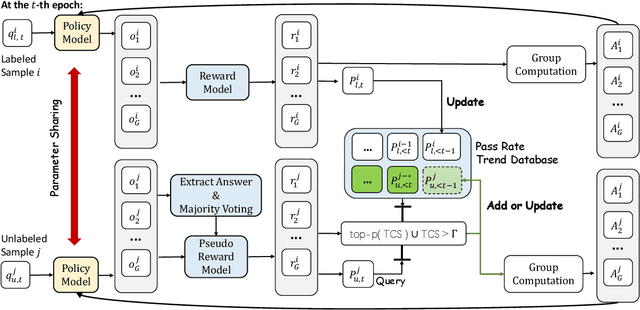
Reinforcement learning with verifiable rewards (RLVR) has proven effective in training large reasoning models (LRMs) by leveraging answer-verifiable signals to guide policy optimization, which, however, suffers from high annotation costs. To alleviate this problem, recent work has explored unsupervised RLVR methods that derive rewards solely from the model's internal consistency, such as through entropy and majority voting. While seemingly promising, these methods often suffer from model collapse in the later stages of training, which may arise from the reinforcement of incorrect reasoning patterns in the absence of external supervision. In this work, we investigate a novel semi-supervised RLVR paradigm that utilizes a small labeled set to guide RLVR training on unlabeled samples. Our key insight is that supervised rewards are essential for stabilizing consistency-based training on unlabeled samples, ensuring that only reasoning patterns verified on labeled instances are incorporated into RL training. Technically, we propose an effective policy optimization algorithm, TraPO, that identifies reliable unlabeled samples by matching their learning trajectory similarity to labeled ones. Building on this, TraPO achieves remarkable data efficiency and strong generalization on six widely used mathematical reasoning benchmarks (AIME24/25, AMC, MATH-500, Minerva, and Olympiad) and three out-of-distribution tasks (ARC-c, GPQA-diamond, and MMLU-pro). With only 1K labeled and 3K unlabeled samples, TraPO reaches 42.6% average accuracy, surpassing the best unsupervised method trained on 45K unlabeled samples (38.3%). Notably, when using 4K labeled and 12K unlabeled samples, TraPO even outperforms the fully supervised model trained on the full 45K labeled samples on all benchmarks, while using only 10% of the labeled data. The code is available via https://github.com/ShenzhiYang2000/TRAPO.
KBQA-R1: Reinforcing Large Language Models for Knowledge Base Question Answering
Dec 10, 2025Knowledge Base Question Answering (KBQA) challenges models to bridge the gap between natural language and strict knowledge graph schemas by generating executable logical forms. While Large Language Models (LLMs) have advanced this field, current approaches often struggle with a dichotomy of failure: they either generate hallucinated queries without verifying schema existence or exhibit rigid, template-based reasoning that mimics synthesized traces without true comprehension of the environment. To address these limitations, we present \textbf{KBQA-R1}, a framework that shifts the paradigm from text imitation to interaction optimization via Reinforcement Learning. Treating KBQA as a multi-turn decision process, our model learns to navigate the knowledge base using a list of actions, leveraging Group Relative Policy Optimization (GRPO) to refine its strategies based on concrete execution feedback rather than static supervision. Furthermore, we introduce \textbf{Referenced Rejection Sampling (RRS)}, a data synthesis method that resolves cold-start challenges by strictly aligning reasoning traces with ground-truth action sequences. Extensive experiments on WebQSP, GrailQA, and GraphQuestions demonstrate that KBQA-R1 achieves state-of-the-art performance, effectively grounding LLM reasoning in verifiable execution.
SecBench: A Comprehensive Multi-Dimensional Benchmarking Dataset for LLMs in Cybersecurity
Dec 30, 2024

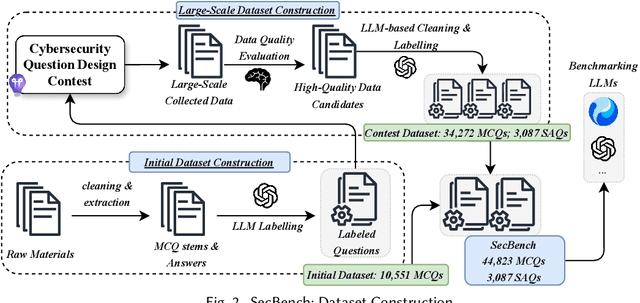
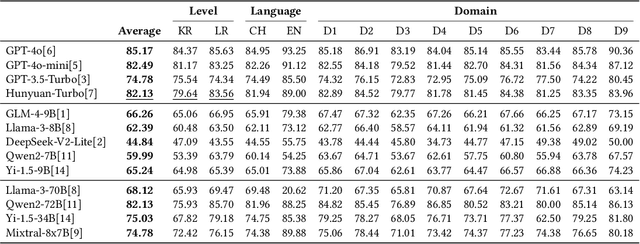
Evaluating Large Language Models (LLMs) is crucial for understanding their capabilities and limitations across various applications, including natural language processing and code generation. Existing benchmarks like MMLU, C-Eval, and HumanEval assess general LLM performance but lack focus on specific expert domains such as cybersecurity. Previous attempts to create cybersecurity datasets have faced limitations, including insufficient data volume and a reliance on multiple-choice questions (MCQs). To address these gaps, we propose SecBench, a multi-dimensional benchmarking dataset designed to evaluate LLMs in the cybersecurity domain. SecBench includes questions in various formats (MCQs and short-answer questions (SAQs)), at different capability levels (Knowledge Retention and Logical Reasoning), in multiple languages (Chinese and English), and across various sub-domains. The dataset was constructed by collecting high-quality data from open sources and organizing a Cybersecurity Question Design Contest, resulting in 44,823 MCQs and 3,087 SAQs. Particularly, we used the powerful while cost-effective LLMs to (1). label the data and (2). constructing a grading agent for automatic evaluation of SAQs.Benchmarking results on 13 SOTA LLMs demonstrate the usability of SecBench, which is arguably the largest and most comprehensive benchmark dataset for LLMs in cybersecurity. More information about SecBench can be found at our website, and the dataset can be accessed via the artifact link.
DiffUTE: Universal Text Editing Diffusion Model
May 19, 2023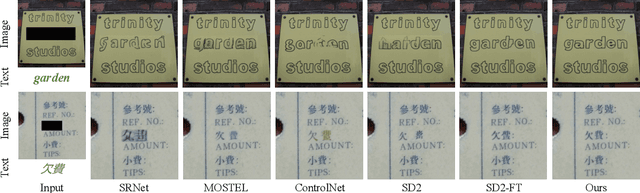
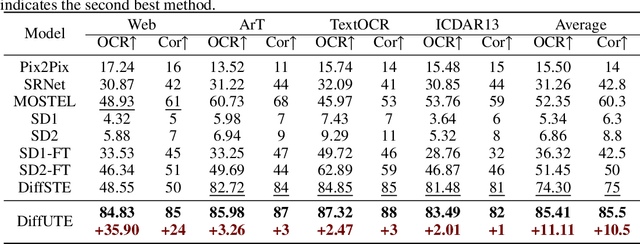
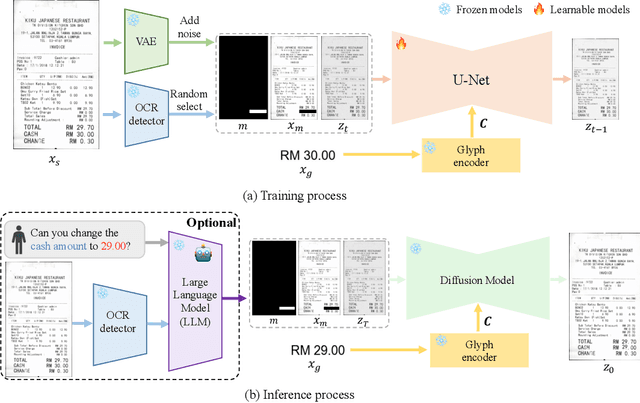
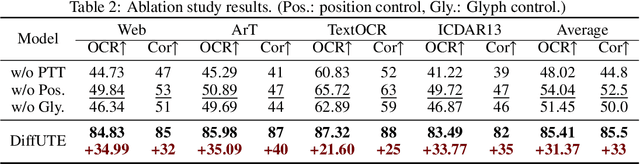
Diffusion model based language-guided image editing has achieved great success recently. However, existing state-of-the-art diffusion models struggle with rendering correct text and text style during generation. To tackle this problem, we propose a universal self-supervised text editing diffusion model (DiffUTE), which aims to replace or modify words in the source image with another one while maintaining its realistic appearance. Specifically, we build our model on a diffusion model and carefully modify the network structure to enable the model for drawing multilingual characters with the help of glyph and position information. Moreover, we design a self-supervised learning framework to leverage large amounts of web data to improve the representation ability of the model. Experimental results show that our method achieves an impressive performance and enables controllable editing on in-the-wild images with high fidelity. Our code will be avaliable in \url{https://github.com/chenhaoxing/DiffUTE}.