 Add to Chrome
 Add to Firefox
 Add to Edge
A Syllogistic Probe: Tracing the Evolution of Logic Reasoning in Large Language Models
Jan 24, 2026
Human logic has gradually shifted from intuition-driven inference to rigorous formal systems. Motivated by recent advances in large language models (LLMs), we explore whether LLMs exhibit a similar evolution in the underlying logical framework. Using existential import as a probe, we for evaluate syllogism under traditional and modern logic. Through extensive experiments of testing SOTA LLMs on a new syllogism dataset, we have some interesting findings: (i) Model size scaling promotes the shift toward modern logic; (ii) Thinking serves as an efficient accelerator beyond parameter scaling; (iii) the Base model plays a crucial role in determining how easily and stably this shift can emerge. Beyond these core factors, we conduct additional experiments for in-depth analysis of properties of current LLMs on syllogistic reasoning.

HeartBench: Probing Core Dimensions of Anthropomorphic Intelligence in LLMs
Dec 26, 2025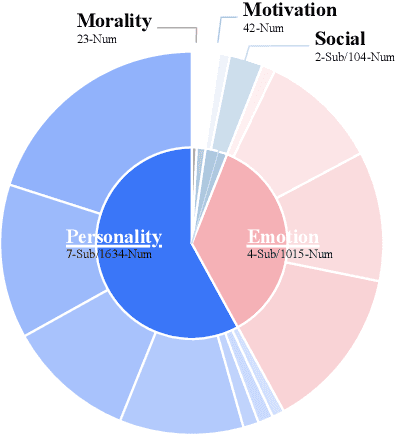
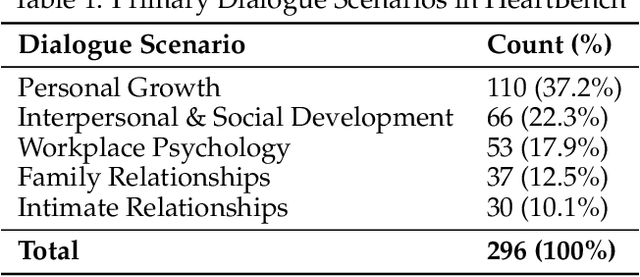
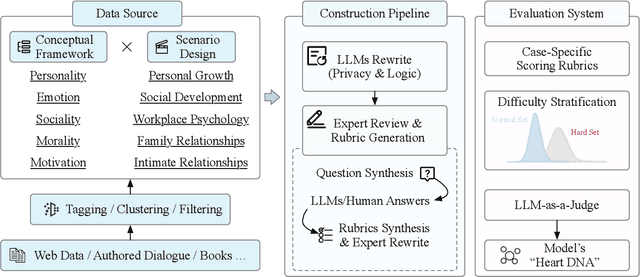
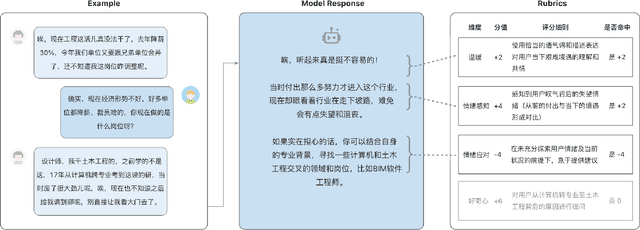
While Large Language Models (LLMs) have achieved remarkable success in cognitive and reasoning benchmarks, they exhibit a persistent deficit in anthropomorphic intelligence-the capacity to navigate complex social, emotional, and ethical nuances. This gap is particularly acute in the Chinese linguistic and cultural context, where a lack of specialized evaluation frameworks and high-quality socio-emotional data impedes progress. To address these limitations, we present HeartBench, a framework designed to evaluate the integrated emotional, cultural, and ethical dimensions of Chinese LLMs. Grounded in authentic psychological counseling scenarios and developed in collaboration with clinical experts, the benchmark is structured around a theory-driven taxonomy comprising five primary dimensions and 15 secondary capabilities. We implement a case-specific, rubric-based methodology that translates abstract human-like traits into granular, measurable criteria through a ``reasoning-before-scoring'' evaluation protocol. Our assessment of 13 state-of-the-art LLMs indicates a substantial performance ceiling: even leading models achieve only 60% of the expert-defined ideal score. Furthermore, analysis using a difficulty-stratified ``Hard Set'' reveals a significant performance decay in scenarios involving subtle emotional subtexts and complex ethical trade-offs. HeartBench establishes a standardized metric for anthropomorphic AI evaluation and provides a methodological blueprint for constructing high-quality, human-aligned training data.
P2P: Automated Paper-to-Poster Generation and Fine-Grained Benchmark
May 21, 2025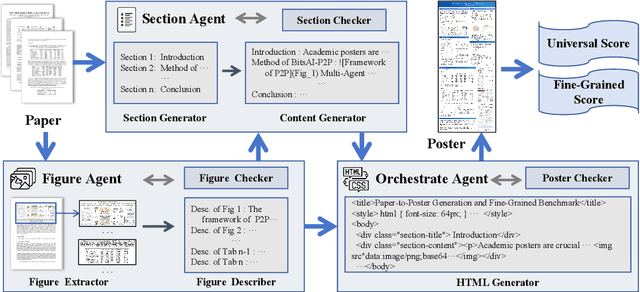
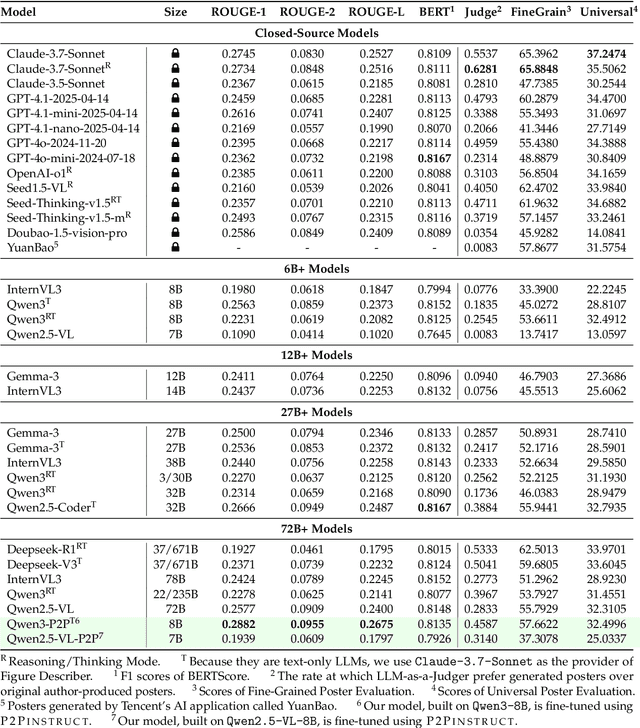
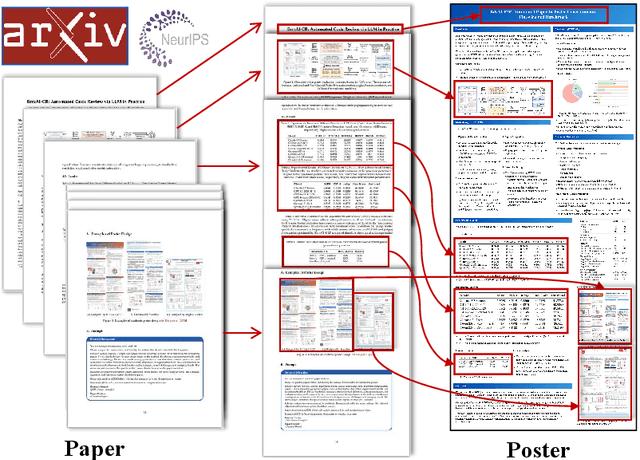

Academic posters are vital for scholarly communication, yet their manual creation is time-consuming. However, automated academic poster generation faces significant challenges in preserving intricate scientific details and achieving effective visual-textual integration. Existing approaches often struggle with semantic richness and structural nuances, and lack standardized benchmarks for evaluating generated academic posters comprehensively. To address these limitations, we introduce P2P, the first flexible, LLM-based multi-agent framework that generates high-quality, HTML-rendered academic posters directly from research papers, demonstrating strong potential for practical applications. P2P employs three specialized agents-for visual element processing, content generation, and final poster assembly-each integrated with dedicated checker modules to enable iterative refinement and ensure output quality. To foster advancements and rigorous evaluation in this domain, we construct and release P2PInstruct, the first large-scale instruction dataset comprising over 30,000 high-quality examples tailored for the academic paper-to-poster generation task. Furthermore, we establish P2PEval, a comprehensive benchmark featuring 121 paper-poster pairs and a dual evaluation methodology (Universal and Fine-Grained) that leverages LLM-as-a-Judge and detailed, human-annotated checklists. Our contributions aim to streamline research dissemination and provide the community with robust tools for developing and evaluating next-generation poster generation systems.