 Add to Chrome
 Add to Firefox
 Add to Edge
Causal Forcing: Autoregressive Diffusion Distillation Done Right for High-Quality Real-Time Interactive Video Generation
Feb 02, 2026
To achieve real-time interactive video generation, current methods distill pretrained bidirectional video diffusion models into few-step autoregressive (AR) models, facing an architectural gap when full attention is replaced by causal attention. However, existing approaches do not bridge this gap theoretically. They initialize the AR student via ODE distillation, which requires frame-level injectivity, where each noisy frame must map to a unique clean frame under the PF-ODE of an AR teacher. Distilling an AR student from a bidirectional teacher violates this condition, preventing recovery of the teacher's flow map and instead inducing a conditional-expectation solution, which degrades performance. To address this issue, we propose Causal Forcing that uses an AR teacher for ODE initialization, thereby bridging the architectural gap. Empirical results show that our method outperforms all baselines across all metrics, surpassing the SOTA Self Forcing by 19.3\% in Dynamic Degree, 8.7\% in VisionReward, and 16.7\% in Instruction Following. Project page and the code: \href{https://thu-ml.github.io/CausalForcing.github.io/}{https://thu-ml.github.io/CausalForcing.github.io/}

GMS-CAVP: Improving Audio-Video Correspondence with Multi-Scale Contrastive and Generative Pretraining
Jan 27, 2026Recent advances in video-audio (V-A) understanding and generation have increasingly relied on joint V-A embeddings, which serve as the foundation for tasks such as cross-modal retrieval and generation. While prior methods like CAVP effectively model semantic and temporal correspondences between modalities using contrastive objectives, their performance remains suboptimal. A key limitation is the insufficient modeling of the dense, multi-scale nature of both video and audio signals, correspondences often span fine- to coarse-grained spatial-temporal structures, which are underutilized in existing frameworks. To this end, we propose GMS-CAVP, a novel framework that combines Multi-Scale Video-Audio Alignment and Multi-Scale Spatial-Temporal Diffusion-based pretraining objectives to enhance V-A correspondence modeling. First, GMS-CAVP introduces a multi-scale contrastive learning strategy that captures semantic and temporal relations across varying granularities. Second, we go beyond traditional contrastive learning by incorporating a diffusion-based generative objective, enabling modality translation and synthesis between video and audio. This unified discriminative-generative formulation facilitates deeper cross-modal understanding and paves the way for high-fidelity generation. Extensive experiments on VGGSound, AudioSet, and Panda70M demonstrate that GMS-CAVP outperforms previous methods in generation and retrieval.
Frequency-aware Neural Representation for Videos
Jan 25, 2026Implicit Neural Representations (INRs) have emerged as a promising paradigm for video compression. However, existing INR-based frameworks typically suffer from inherent spectral bias, which favors low-frequency components and leads to over-smoothed reconstructions and suboptimal rate-distortion performance. In this paper, we propose FaNeRV, a Frequency-aware Neural Representation for videos, which explicitly decouples low- and high-frequency components to enable efficient and faithful video reconstruction. FaNeRV introduces a multi-resolution supervision strategy that guides the network to progressively capture global structures and fine-grained textures through staged supervision . To further enhance high-frequency reconstruction, we propose a dynamic high-frequency injection mechanism that adaptively emphasizes challenging regions. In addition, we design a frequency-decomposed network module to improve feature modeling across different spectral bands. Extensive experiments on standard benchmarks demonstrate that FaNeRV significantly outperforms state-of-the-art INR methods and achieves competitive rate-distortion performance against traditional codecs.
Video Compression with Hierarchical Temporal Neural Representation
Jan 25, 2026Video compression has recently benefited from implicit neural representations (INRs), which model videos as continuous functions. INRs offer compact storage and flexible reconstruction, providing a promising alternative to traditional codecs. However, most existing INR-based methods treat the temporal dimension as an independent input, limiting their ability to capture complex temporal dependencies. To address this, we propose a Hierarchical Temporal Neural Representation for Videos, TeNeRV. TeNeRV integrates short- and long-term dependencies through two key components. First, an Inter-Frame Feature Fusion (IFF) module aggregates features from adjacent frames, enforcing local temporal coherence and capturing fine-grained motion. Second, a GoP-Adaptive Modulation (GAM) mechanism partitions videos into Groups-of-Pictures and learns group-specific priors. The mechanism modulates network parameters, enabling adaptive representations across different GoPs. Extensive experiments demonstrate that TeNeRV consistently outperforms existing INR-based methods in rate-distortion performance, validating the effectiveness of our proposed approach.
Think-Then-Generate: Reasoning-Aware Text-to-Image Diffusion with LLM Encoders
Jan 15, 2026Recent progress in text-to-image (T2I) diffusion models (DMs) has enabled high-quality visual synthesis from diverse textual prompts. Yet, most existing T2I DMs, even those equipped with large language model (LLM)-based text encoders, remain text-pixel mappers -- they employ LLMs merely as text encoders, without leveraging their inherent reasoning capabilities to infer what should be visually depicted given the textual prompt. To move beyond such literal generation, we propose the think-then-generate (T2G) paradigm, where the LLM-based text encoder is encouraged to reason about and rewrite raw user prompts; the states of the rewritten prompts then serve as diffusion conditioning. To achieve this, we first activate the think-then-rewrite pattern of the LLM encoder with a lightweight supervised fine-tuning process. Subsequently, the LLM encoder and diffusion backbone are co-optimized to ensure faithful reasoning about the context and accurate rendering of the semantics via Dual-GRPO. In particular, the text encoder is reinforced using image-grounded rewards to infer and recall world knowledge, while the diffusion backbone is pushed to produce semantically consistent and visually coherent images. Experiments show substantial improvements in factual consistency, semantic alignment, and visual realism across reasoning-based image generation and editing benchmarks, achieving 0.79 on WISE score, nearly on par with GPT-4. Our results constitute a promising step toward next-generation unified models with reasoning, expression, and demonstration capacities.
Nightmare Dreamer: Dreaming About Unsafe States And Planning Ahead
Jan 08, 2026Reinforcement Learning (RL) has shown remarkable success in real-world applications, particularly in robotics control. However, RL adoption remains limited due to insufficient safety guarantees. We introduce Nightmare Dreamer, a model-based Safe RL algorithm that addresses safety concerns by leveraging a learned world model to predict potential safety violations and plan actions accordingly. Nightmare Dreamer achieves nearly zero safety violations while maximizing rewards. Nightmare Dreamer outperforms model-free baselines on Safety Gymnasium tasks using only image observations, achieving nearly a 20x improvement in efficiency.
Omni2Sound: Towards Unified Video-Text-to-Audio Generation
Jan 06, 2026Training a unified model integrating video-to-audio (V2A), text-to-audio (T2A), and joint video-text-to-audio (VT2A) generation offers significant application flexibility, yet faces two unexplored foundational challenges: (1) the scarcity of high-quality audio captions with tight A-V-T alignment, leading to severe semantic conflict between multimodal conditions, and (2) cross-task and intra-task competition, manifesting as an adverse V2A-T2A performance trade-off and modality bias in the VT2A task. First, to address data scarcity, we introduce SoundAtlas, a large-scale dataset (470k pairs) that significantly outperforms existing benchmarks and even human experts in quality. Powered by a novel agentic pipeline, it integrates Vision-to-Language Compression to mitigate visual bias of MLLMs, a Junior-Senior Agent Handoff for a 5 times cost reduction, and rigorous Post-hoc Filtering to ensure fidelity. Consequently, SoundAtlas delivers semantically rich and temporally detailed captions with tight V-A-T alignment. Second, we propose Omni2Sound, a unified VT2A diffusion model supporting flexible input modalities. To resolve the inherent cross-task and intra-task competition, we design a three-stage multi-task progressive training schedule that converts cross-task competition into joint optimization and mitigates modality bias in the VT2A task, maintaining both audio-visual alignment and off-screen audio generation faithfulness. Finally, we construct VGGSound-Omni, a comprehensive benchmark for unified evaluation, including challenging off-screen tracks. With a standard DiT backbone, Omni2Sound achieves unified SOTA performance across all three tasks within a single model, demonstrating strong generalization across benchmarks with heterogeneous input conditions. The project page is at https://swapforward.github.io/Omni2Sound.
Vidarc: Embodied Video Diffusion Model for Closed-loop Control
Dec 19, 2025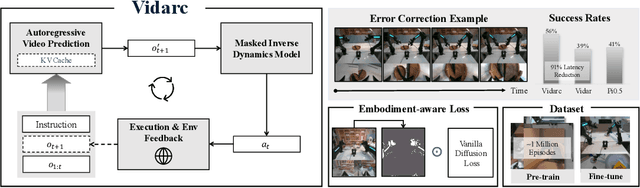
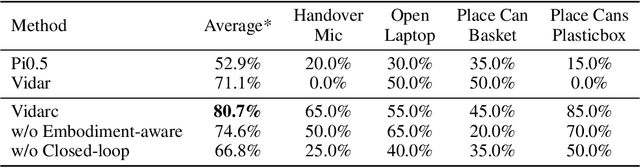
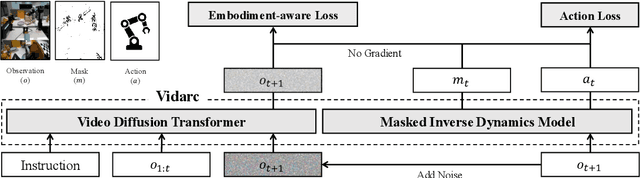
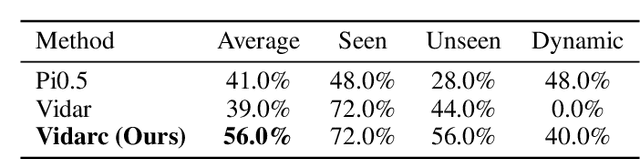
Robotic arm manipulation in data-scarce settings is a highly challenging task due to the complex embodiment dynamics and diverse contexts. Recent video-based approaches have shown great promise in capturing and transferring the temporal and physical interactions by pre-training on Internet-scale video data. However, such methods are often not optimized for the embodiment-specific closed-loop control, typically suffering from high latency and insufficient grounding. In this paper, we present Vidarc (Video Diffusion for Action Reasoning and Closed-loop Control), a novel autoregressive embodied video diffusion approach augmented by a masked inverse dynamics model. By grounding video predictions with action-relevant masks and incorporating real-time feedback through cached autoregressive generation, Vidarc achieves fast, accurate closed-loop control. Pre-trained on one million cross-embodiment episodes, Vidarc surpasses state-of-the-art baselines, achieving at least a 15% higher success rate in real-world deployment and a 91% reduction in latency. We also highlight its robust generalization and error correction capabilities across previously unseen robotic platforms.
TurboDiffusion: Accelerating Video Diffusion Models by 100-200 Times
Dec 18, 2025We introduce TurboDiffusion, a video generation acceleration framework that can speed up end-to-end diffusion generation by 100-200x while maintaining video quality. TurboDiffusion mainly relies on several components for acceleration: (1) Attention acceleration: TurboDiffusion uses low-bit SageAttention and trainable Sparse-Linear Attention (SLA) to speed up attention computation. (2) Step distillation: TurboDiffusion adopts rCM for efficient step distillation. (3) W8A8 quantization: TurboDiffusion quantizes model parameters and activations to 8 bits to accelerate linear layers and compress the model. In addition, TurboDiffusion incorporates several other engineering optimizations. We conduct experiments on the Wan2.2-I2V-14B-720P, Wan2.1-T2V-1.3B-480P, Wan2.1-T2V-14B-720P, and Wan2.1-T2V-14B-480P models. Experimental results show that TurboDiffusion achieves 100-200x speedup for video generation even on a single RTX 5090 GPU, while maintaining comparable video quality. The GitHub repository, which includes model checkpoints and easy-to-use code, is available at https://github.com/thu-ml/TurboDiffusion.
Motus: A Unified Latent Action World Model
Dec 15, 2025While a general embodied agent must function as a unified system, current methods are built on isolated models for understanding, world modeling, and control. This fragmentation prevents unifying multimodal generative capabilities and hinders learning from large-scale, heterogeneous data. In this paper, we propose Motus, a unified latent action world model that leverages existing general pretrained models and rich, sharable motion information. Motus introduces a Mixture-of-Transformer (MoT) architecture to integrate three experts (i.e., understanding, video generation, and action) and adopts a UniDiffuser-style scheduler to enable flexible switching between different modeling modes (i.e., world models, vision-language-action models, inverse dynamics models, video generation models, and video-action joint prediction models). Motus further leverages the optical flow to learn latent actions and adopts a recipe with three-phase training pipeline and six-layer data pyramid, thereby extracting pixel-level "delta action" and enabling large-scale action pretraining. Experiments show that Motus achieves superior performance against state-of-the-art methods in both simulation (a +15% improvement over X-VLA and a +45% improvement over Pi0.5) and real-world scenarios(improved by +11~48%), demonstrating unified modeling of all functionalities and priors significantly benefits downstream robotic tasks.