 Add to Chrome
 Add to Firefox
 Add to Edge
MirrorPPR: Exemplar-Based Portrait Photo Retouching
Jun 28, 2026
While text-guided image editing has made remarkable progress, it remains limited in structural portrait retouching. Textual descriptions struggle to convey fine-grained changes to facial features and body proportions. To address this gap, we introduce Exemplar-Based Portrait Photo Retouching, where the model is given an exemplar pair and tasked with inferring and applying the same retouching operations to a new query image. Existing exemplar-based editing methods primarily focus on tasks with pronounced visual transformations. In contrast, structural portrait retouching involves extremely delicate and localized modifications, making accurate extraction and transfer of these edits challenging. To tackle this, we propose MirrorPPR, a novel framework designed to capture and transfer subtle structural retouching operations. Our method uses a Retouching Operation Extractor to capture the subtle differences from the exemplar pair. The extracted representations are then injected into a pre-trained Diffusion Transformer (DiT) through a connector and Low-Rank Adaptation (LoRA) modules. Furthermore, constructing perfectly aligned cross-identity training pairs is severely hindered by operation misalignment. To overcome this, we propose an advanced data self-augmentation paradigm that ensures strictly aligned retouching operations. To alleviate data scarcity and support this novel task, we introduce MirrorPPR47M, a large-scale dataset with over 47 million retouched pairs. By structuring the dataset into simulated and professional subsets, we enable progressive curriculum learning to smoothly optimize the network. Extensive experiments demonstrate that MirrorPPR significantly outperforms existing baselines in both retouching quality and identity preservation. The project page is available at https://sjtu-deng-lab.github.io/MirrorPPR.

LatentUM: Unleashing the Potential of Interleaved Cross-Modal Reasoning via a Latent-Space Unified Model
Apr 02, 2026Unified models (UMs) hold promise for their ability to understand and generate content across heterogeneous modalities. Compared to merely generating visual content, the use of UMs for interleaved cross-modal reasoning is more promising and valuable, e.g., for solving understanding problems that require dense visual thinking, improving visual generation through self-reflection, or modeling visual dynamics of the physical world guided by stepwise action interventions. However, existing UMs necessitate pixel decoding as a bridge due to their disjoint visual representations for understanding and generation, which is both ineffective and inefficient. In this paper, we introduce LatentUM, a novel unified model that represents all modalities within a shared semantic latent space, eliminating the need for pixel-space mediation between visual understanding and generation. This design naturally enables flexible interleaved cross-modal reasoning and generation. Beyond improved computational efficiency, the shared representation substantially alleviates codec bias and strengthens cross-modal alignment, allowing LatentUM to achieve state-of-the-art performance on the Visual Spatial Planning benchmark, push the limits of visual generation through self-reflection, and support world modeling by predicting future visual states within the shared semantic latent space.
Think-Then-Generate: Reasoning-Aware Text-to-Image Diffusion with LLM Encoders
Jan 15, 2026Recent progress in text-to-image (T2I) diffusion models (DMs) has enabled high-quality visual synthesis from diverse textual prompts. Yet, most existing T2I DMs, even those equipped with large language model (LLM)-based text encoders, remain text-pixel mappers -- they employ LLMs merely as text encoders, without leveraging their inherent reasoning capabilities to infer what should be visually depicted given the textual prompt. To move beyond such literal generation, we propose the think-then-generate (T2G) paradigm, where the LLM-based text encoder is encouraged to reason about and rewrite raw user prompts; the states of the rewritten prompts then serve as diffusion conditioning. To achieve this, we first activate the think-then-rewrite pattern of the LLM encoder with a lightweight supervised fine-tuning process. Subsequently, the LLM encoder and diffusion backbone are co-optimized to ensure faithful reasoning about the context and accurate rendering of the semantics via Dual-GRPO. In particular, the text encoder is reinforced using image-grounded rewards to infer and recall world knowledge, while the diffusion backbone is pushed to produce semantically consistent and visually coherent images. Experiments show substantial improvements in factual consistency, semantic alignment, and visual realism across reasoning-based image generation and editing benchmarks, achieving 0.79 on WISE score, nearly on par with GPT-4. Our results constitute a promising step toward next-generation unified models with reasoning, expression, and demonstration capacities.
Orthus: Autoregressive Interleaved Image-Text Generation with Modality-Specific Heads
Nov 28, 2024
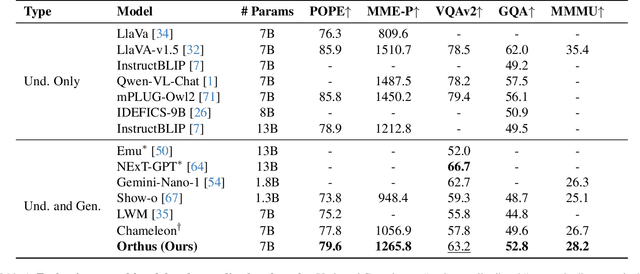

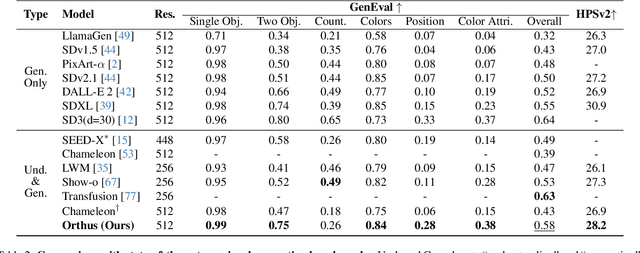
We introduce Orthus, an autoregressive (AR) transformer that excels in generating images given textual prompts, answering questions based on visual inputs, and even crafting lengthy image-text interleaved contents. Unlike prior arts on unified multimodal modeling, Orthus simultaneously copes with discrete text tokens and continuous image features under the AR modeling principle. The continuous treatment of visual signals minimizes the information loss for both image understanding and generation while the fully AR formulation renders the characterization of the correlation between modalities straightforward. The key mechanism enabling Orthus to leverage these advantages lies in its modality-specific heads -- one regular language modeling (LM) head predicts discrete text tokens and one diffusion head generates continuous image features conditioning on the output of the backbone. We devise an efficient strategy for building Orthus -- by substituting the Vector Quantization (VQ) operation in the existing unified AR model with a soft alternative, introducing a diffusion head, and tuning the added modules to reconstruct images, we can create an Orthus-base model effortlessly (e.g., within mere 72 A100 GPU hours). Orthus-base can further embrace post-training to better model interleaved images and texts. Empirically, Orthus surpasses competing baselines including Show-o and Chameleon across standard benchmarks, achieving a GenEval score of 0.58 and an MME-P score of 1265.8 using 7B parameters. Orthus also shows exceptional mixed-modality generation capabilities, reflecting the potential for handling intricate practical generation tasks.