 Add to Chrome
 Add to Firefox
 Add to Edge
OmniVAE: An Audio-Video VAE with Cross-Modal Alignment for Joint Generation
Jul 26, 2026
Recent generative models are moving beyond silent video or standalone audio synthesis toward the joint generation of synchronized audio and video. Despite this progress, jointly generating audio and video with fine-grained cross-modal correspondence remains challenging due to their fundamental structural differences. Most existing methods use audio and video VAEs trained separately. As a result, the two latent spaces lack cross-modal alignment, leaving the downstream generative model to learn cross-modal synchronization from scratch. We present OmniVAE, a jointly trained audio-video VAE that learns fine-grained semantic alignment between audio and video latent representations. Beyond reconstruction, OmniVAE uses a segment-level audio-video contrastive objective to capture temporal-semantic correspondence and align the two latent spaces. In parallel, it distills features from pretrained modality-specific semantic encoders into each modality, improving the downstream learnability of both latent spaces. Extensive experiments show that both objectives consistently improve the learnability of the latent spaces, translating into higher generation quality and more accurate cross-modal synchronization in downstream text-to-audio-video generation. These findings underscore the importance of learning unified representations as a foundation for omnimodal modeling.1

MOSS-Audio Technical Report
Jun 01, 2026MOSS-Audio is a unified audio-language model for speech, environmental sound, and music understanding, supporting audio captioning, time-aware question answering, timestamped transcription, and audio-grounded reasoning. MOSS-Audio couples a dedicated audio encoder with a modality adapter and a large language model: the encoder produces 12.5 Hz temporal representations, the adapter projects them into the decoder space, and the decoder generates autoregressive text outputs. Two design choices are central to the system: \textbf{DeepStack cross-layer feature injection}, which exposes the decoder to acoustic information from multiple encoder depths, and \textbf{time markers}, which provide explicit temporal cues by inserting timestamp markers into the audio-token stream. At the data level, we design an event-preserving audio annotation pipeline that segments raw audio at coherent event boundaries, applies branch-specific annotation to speech, music, and general audio, and merges the results into unified captions for pretraining. The intermediate branch-specific captions are further retained to support the construction of task-oriented SFT data. The model is pretrained on large-scale audio-language data, with time-aware objectives incorporated to support temporal grounding, and then undergoes multi-stage post-training to enhance instruction following and audio-grounded reasoning. We release 4B and 8B variants in both Instruct and Thinking configurations. MOSS-Audio achieves strong performance across general audio understanding, speech captioning, ASR, and timestamped ASR, positioning it as a promising understanding foundation for future voice agents.
MOSS-TTSD: Text to Spoken Dialogue Generation
Mar 20, 2026Spoken dialogue generation is crucial for applications like podcasts, dynamic commentary, and entertainment content, but poses significant challenges compared to single-utterance text-to-speech (TTS). Key requirements include accurate turn-taking, cross-turn acoustic consistency, and long-form stability, which current models often fail to address due to a lack of dialogue context modeling. To bridge this gap, we present MOSS-TTSD, a spoken dialogue synthesis model designed for expressive, multi-party conversational speech across multiple languages. With enhanced long-context modeling, MOSS-TTSD generates long-form spoken conversations from dialogue scripts with explicit speaker tags, supporting up to 60 minutes of single-pass synthesis, multi-party dialogue with up to 5 speakers, and zero-shot voice cloning from a short reference audio clip. The model supports various mainstream languages, including English and Chinese, and is adapted to several long-form scenarios. Additionally, to address limitations of existing evaluation methods, we propose TTSD-eval, an objective evaluation framework based on forced alignment that measures speaker attribution accuracy and speaker similarity without relying on speaker diarization tools. Both objective and subjective evaluation results show that MOSS-TTSD surpasses strong open-source and proprietary baselines in dialogue synthesis.
RIS-Enhanced Information-Decoupled Symbiotic Radio Over Broadcasting Signals
Jan 18, 2026This paper studies a reconfigurable intelligent surface (RIS)-enhanced decoupled symbiotic radio (SR) system in which a primary transmitter delivers common data to multiple primary receivers (PRs), while a RIS-based backscatter device sends secondary data to a backscatter receiver (BRx). Unlike conventional SR, the BRx performs energy detection and never decodes the primary signal, thereby removing ambiguity and preventing exposure of the primary payload to unintended receivers. In this paper, we formulate the problem as the minimization of the transmit power subject to a common broadcast rate constraint across all PRs and a bit error rate (BER) constraint at the BRx. The problem is nonconvex due to the unit-modulus RIS constraint and coupled quadratic forms. Leveraging a rate-balanced reformulation and a monotonic BER ratio characterization, we develop a low-complexity penalty-based block coordinate descent algorithm with closed-form updates. Numerical results show fast convergence of the proposed algorithm and reduced power consumption of the considered RIS-enhanced information-decoupled SR system over conventional SR baselines.
YuE: Scaling Open Foundation Models for Long-Form Music Generation
Mar 11, 2025We tackle the task of long-form music generation--particularly the challenging \textbf{lyrics-to-song} problem--by introducing YuE, a family of open foundation models based on the LLaMA2 architecture. Specifically, YuE scales to trillions of tokens and generates up to five minutes of music while maintaining lyrical alignment, coherent musical structure, and engaging vocal melodies with appropriate accompaniment. It achieves this through (1) track-decoupled next-token prediction to overcome dense mixture signals, (2) structural progressive conditioning for long-context lyrical alignment, and (3) a multitask, multiphase pre-training recipe to converge and generalize. In addition, we redesign the in-context learning technique for music generation, enabling versatile style transfer (e.g., converting Japanese city pop into an English rap while preserving the original accompaniment) and bidirectional generation. Through extensive evaluation, we demonstrate that YuE matches or even surpasses some of the proprietary systems in musicality and vocal agility. In addition, fine-tuning YuE enables additional controls and enhanced support for tail languages. Furthermore, beyond generation, we show that YuE's learned representations can perform well on music understanding tasks, where the results of YuE match or exceed state-of-the-art methods on the MARBLE benchmark. Keywords: lyrics2song, song generation, long-form, foundation model, music generation
Data Mixing Laws: Optimizing Data Mixtures by Predicting Language Modeling Performance
Mar 25, 2024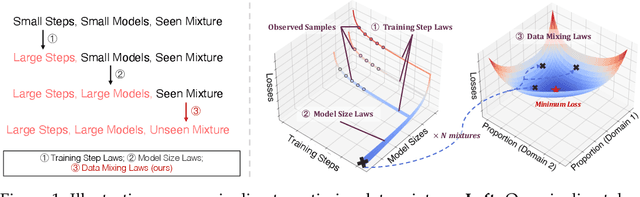
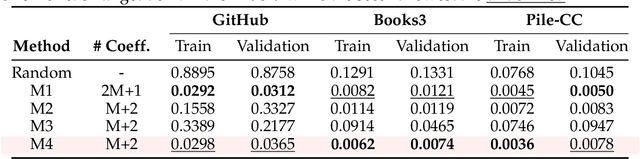
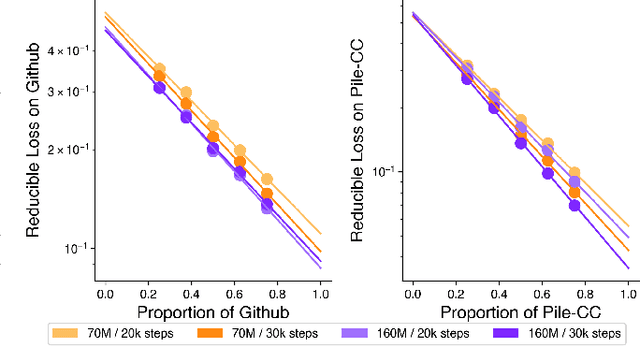
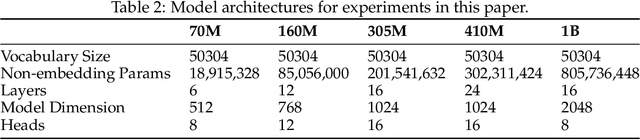
Pretraining data of large language models composes multiple domains (e.g., web texts, academic papers, codes), whose mixture proportions crucially impact the competence of outcome models. While existing endeavors rely on heuristics or qualitative strategies to tune the proportions, we discover the quantitative predictability of model performance regarding the mixture proportions in function forms, which we refer to as the data mixing laws. Fitting such functions on sample mixtures unveils model performance on unseen mixtures before actual runs, thus guiding the selection of an ideal data mixture. Furthermore, we propose nested use of the scaling laws of training steps, model sizes, and our data mixing law to enable predicting the performance of large models trained on massive data under various mixtures with only small-scale training. Moreover, experimental results verify that our method effectively optimizes the training mixture of a 1B model trained for 100B tokens in RedPajama, reaching a performance comparable to the one trained for 48% more steps on the default mixture. Extending the application of data mixing laws to continual training accurately predicts the critical mixture proportion that avoids catastrophic forgetting and outlooks the potential for dynamic data schedules
AnyGPT: Unified Multimodal LLM with Discrete Sequence Modeling
Feb 26, 2024


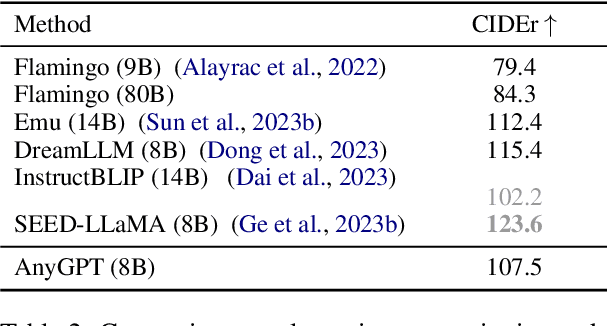
We introduce AnyGPT, an any-to-any multimodal language model that utilizes discrete representations for the unified processing of various modalities, including speech, text, images, and music. AnyGPT can be trained stably without any alterations to the current large language model (LLM) architecture or training paradigms. Instead, it relies exclusively on data-level preprocessing, facilitating the seamless integration of new modalities into LLMs, akin to the incorporation of new languages. We build a multimodal text-centric dataset for multimodal alignment pre-training. Utilizing generative models, we synthesize the first large-scale any-to-any multimodal instruction dataset. It consists of 108k samples of multi-turn conversations that intricately interweave various modalities, thus equipping the model to handle arbitrary combinations of multimodal inputs and outputs. Experimental results demonstrate that AnyGPT is capable of facilitating any-to-any multimodal conversation while achieving performance comparable to specialized models across all modalities, proving that discrete representations can effectively and conveniently unify multiple modalities within a language model. Demos are shown in https://junzhan2000.github.io/AnyGPT.github.io/
SpeechGPT-Gen: Scaling Chain-of-Information Speech Generation
Jan 25, 2024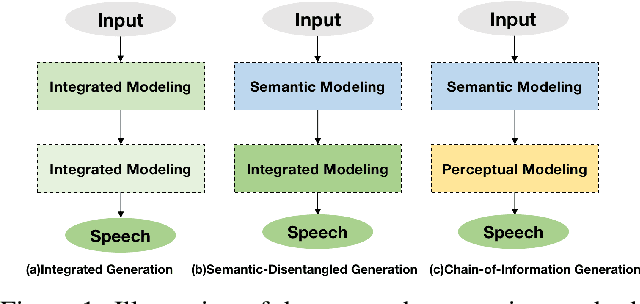
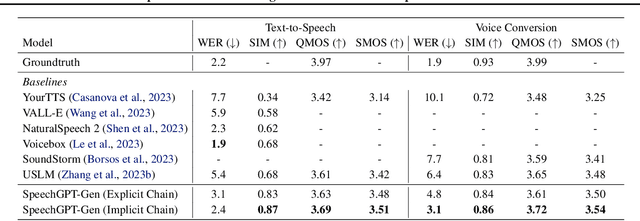
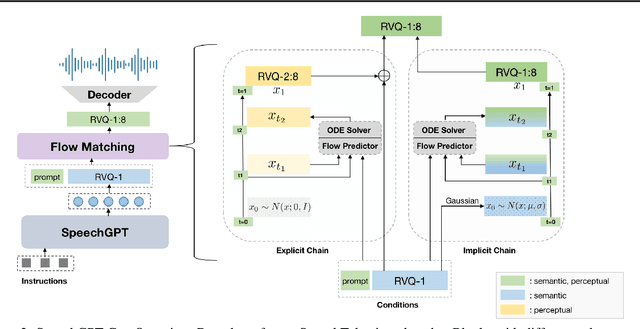
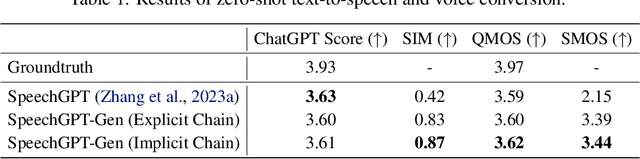
Benefiting from effective speech modeling, current Speech Large Language Models (SLLMs) have demonstrated exceptional capabilities in in-context speech generation and efficient generalization to unseen speakers. However, the prevailing information modeling process is encumbered by certain redundancies, leading to inefficiencies in speech generation. We propose Chain-of-Information Generation (CoIG), a method for decoupling semantic and perceptual information in large-scale speech generation. Building on this, we develop SpeechGPT-Gen, an 8-billion-parameter SLLM efficient in semantic and perceptual information modeling. It comprises an autoregressive model based on LLM for semantic information modeling and a non-autoregressive model employing flow matching for perceptual information modeling. Additionally, we introduce the novel approach of infusing semantic information into the prior distribution to enhance the efficiency of flow matching. Extensive experimental results demonstrate that SpeechGPT-Gen markedly excels in zero-shot text-to-speech, zero-shot voice conversion, and speech-to-speech dialogue, underscoring CoIG's remarkable proficiency in capturing and modeling speech's semantic and perceptual dimensions. Code and models are available at https://github.com/0nutation/SpeechGPT.
SpeechGPT: Empowering Large Language Models with Intrinsic Cross-Modal Conversational Abilities
May 19, 2023Multi-modal large language models are regarded as a crucial step towards Artificial General Intelligence (AGI) and have garnered significant interest with the emergence of ChatGPT. However, current speech-language models typically adopt the cascade paradigm, preventing inter-modal knowledge transfer. In this paper, we propose SpeechGPT, a large language model with intrinsic cross-modal conversational abilities, capable of perceiving and generating multi-model content. With discrete speech representations, we first construct SpeechInstruct, a large-scale cross-modal speech instruction dataset. Additionally, we employ a three-stage training strategy that includes modality-adaptation pre-training, cross-modal instruction fine-tuning, and chain-of-modality instruction fine-tuning. The experimental results demonstrate that SpeechGPT has an impressive capacity to follow multi-modal human instructions and highlight the potential of handling multiple modalities with one model. Demos are shown in https://0nutation.github.io/SpeechGPT.github.io/.
HFN: Heterogeneous Feature Network for Multivariate Time Series Anomaly Detection
Nov 02, 2022Network or physical attacks on industrial equipment or computer systems may cause massive losses. Therefore, a quick and accurate anomaly detection (AD) based on monitoring data, especially the multivariate time-series (MTS) data, is of great significance. As the key step of anomaly detection for MTS data, learning the relations among different variables has been explored by many approaches. However, most of the existing approaches do not consider the heterogeneity between variables, that is, different types of variables (continuous numerical variables, discrete categorical variables or hybrid variables) may have different and distinctive edge distributions. In this paper, we propose a novel semi-supervised anomaly detection framework based on a heterogeneous feature network (HFN) for MTS, learning heterogeneous structure information from a mass of unlabeled time-series data to improve the accuracy of anomaly detection, and using attention coefficient to provide an explanation for the detected anomalies. Specifically, we first combine the embedding similarity subgraph generated by sensor embedding and feature value similarity subgraph generated by sensor values to construct a time-series heterogeneous graph, which fully utilizes the rich heterogeneous mutual information among variables. Then, a prediction model containing nodes and channel attentions is jointly optimized to obtain better time-series representations. This approach fuses the state-of-the-art technologies of heterogeneous graph structure learning (HGSL) and representation learning. The experiments on four sensor datasets from real-world applications demonstrate that our approach detects the anomalies more accurately than those baseline approaches, thus providing a basis for the rapid positioning of anomalies.