 Add to Chrome
 Add to Firefox
 Add to Edge
SP-Mind: An Autonomous Reasoning Agent for Spatial Proteomics Analysis
Jun 23, 2026
Spatial proteomics enables single-cell-resolution characterization of protein expression within tissue architecture, playing a critical role in understanding tumor microenvironments and guiding precision medicine. However, current analysis workflows remain fragmented, requiring expert manual orchestration of heterogeneous tools and limiting research scalability and reproducibility. We present SP-Mind, the first autonomous AI agent designed to unify the spatial proteomics analysis pipeline, from raw multiplexed tissue imaging to downstream phenotype discovery. Equipped with expert-curated biological analysis skills and specialized computational tools, SP-Mind converts natural-language queries into end-to-end analytical workflows without task-specific fine-tuning. To rigorously evaluate its capabilities, we introduce SP-Bench, a comprehensive benchmark spanning diverse tissue types, comprising 102 tasks across 18 distinct categories. Through extensive evaluation on SP-Bench and established downstream tasks, SP-Mind achieves state-of-the-art performance compared to existing open-source biomedical agent baselines.

MOSS-TTSD: Text to Spoken Dialogue Generation
Mar 20, 2026Spoken dialogue generation is crucial for applications like podcasts, dynamic commentary, and entertainment content, but poses significant challenges compared to single-utterance text-to-speech (TTS). Key requirements include accurate turn-taking, cross-turn acoustic consistency, and long-form stability, which current models often fail to address due to a lack of dialogue context modeling. To bridge this gap, we present MOSS-TTSD, a spoken dialogue synthesis model designed for expressive, multi-party conversational speech across multiple languages. With enhanced long-context modeling, MOSS-TTSD generates long-form spoken conversations from dialogue scripts with explicit speaker tags, supporting up to 60 minutes of single-pass synthesis, multi-party dialogue with up to 5 speakers, and zero-shot voice cloning from a short reference audio clip. The model supports various mainstream languages, including English and Chinese, and is adapted to several long-form scenarios. Additionally, to address limitations of existing evaluation methods, we propose TTSD-eval, an objective evaluation framework based on forced alignment that measures speaker attribution accuracy and speaker similarity without relying on speaker diarization tools. Both objective and subjective evaluation results show that MOSS-TTSD surpasses strong open-source and proprietary baselines in dialogue synthesis.
MOSS-TTS Technical Report
Mar 18, 2026This technical report presents MOSS-TTS, a speech generation foundation model built on a scalable recipe: discrete audio tokens, autoregressive modeling, and large-scale pretraining. Built on MOSS-Audio-Tokenizer, a causal Transformer tokenizer that compresses 24 kHz audio to 12.5 fps with variable-bitrate RVQ and unified semantic-acoustic representations, we release two complementary generators: MOSS-TTS, which emphasizes structural simplicity, scalability, and long-context/control-oriented deployment, and MOSS-TTS-Local-Transformer, which introduces a frame-local autoregressive module for higher modeling efficiency, stronger speaker preservation, and a shorter time to first audio. Across multilingual and open-domain settings, MOSS-TTS supports zero-shot voice cloning, token-level duration control, phoneme-/pinyin-level pronunciation control, smooth code-switching, and stable long-form generation. This report summarizes the design, training recipe, and empirical characteristics of the released models.
Generative Technology for Human Emotion Recognition: A Scope Review
Jul 04, 2024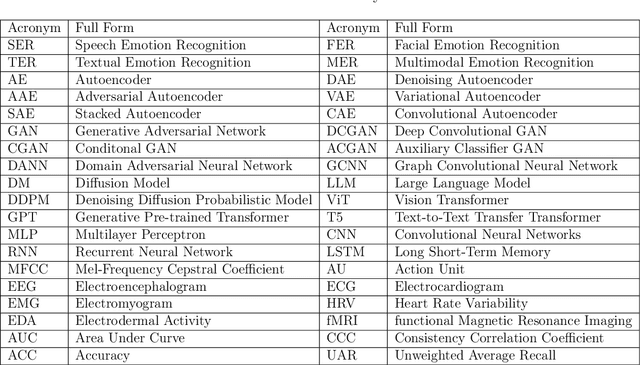
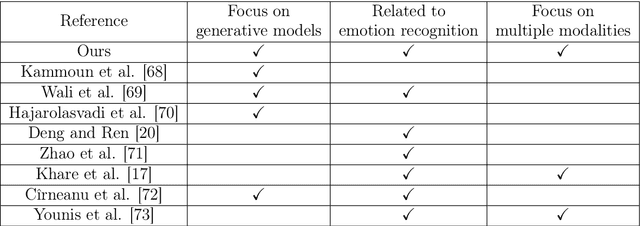

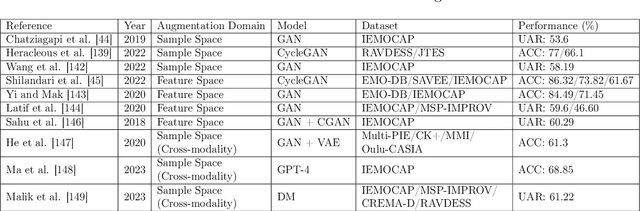
Affective computing stands at the forefront of artificial intelligence (AI), seeking to imbue machines with the ability to comprehend and respond to human emotions. Central to this field is emotion recognition, which endeavors to identify and interpret human emotional states from different modalities, such as speech, facial images, text, and physiological signals. In recent years, important progress has been made in generative models, including Autoencoder, Generative Adversarial Network, Diffusion Model, and Large Language Model. These models, with their powerful data generation capabilities, emerge as pivotal tools in advancing emotion recognition. However, up to now, there remains a paucity of systematic efforts that review generative technology for emotion recognition. This survey aims to bridge the gaps in the existing literature by conducting a comprehensive analysis of over 320 research papers until June 2024. Specifically, this survey will firstly introduce the mathematical principles of different generative models and the commonly used datasets. Subsequently, through a taxonomy, it will provide an in-depth analysis of how generative techniques address emotion recognition based on different modalities in several aspects, including data augmentation, feature extraction, semi-supervised learning, cross-domain, etc. Finally, the review will outline future research directions, emphasizing the potential of generative models to advance the field of emotion recognition and enhance the emotional intelligence of AI systems.