 Add to Chrome
 Add to Firefox
 Add to Edge
Enhanced Multimodal RAG-LLM for Accurate Visual Question Answering
Dec 30, 2024


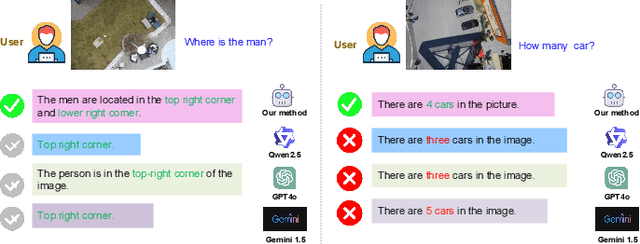

Multimodal large language models (MLLMs), such as GPT-4o, Gemini, LLaVA, and Flamingo, have made significant progress in integrating visual and textual modalities, excelling in tasks like visual question answering (VQA), image captioning, and content retrieval. They can generate coherent and contextually relevant descriptions of images. However, they still face challenges in accurately identifying and counting objects and determining their spatial locations, particularly in complex scenes with overlapping or small objects. To address these limitations, we propose a novel framework based on multimodal retrieval-augmented generation (RAG), which introduces structured scene graphs to enhance object recognition, relationship identification, and spatial understanding within images. Our framework improves the MLLM's capacity to handle tasks requiring precise visual descriptions, especially in scenarios with challenging perspectives, such as aerial views or scenes with dense object arrangements. Finally, we conduct extensive experiments on the VG-150 dataset that focuses on first-person visual understanding and the AUG dataset that involves aerial imagery. The results show that our approach consistently outperforms existing MLLMs in VQA tasks, which stands out in recognizing, localizing, and quantifying objects in different spatial contexts and provides more accurate visual descriptions.

ECG-guided individual identification via PPG
Dec 30, 2024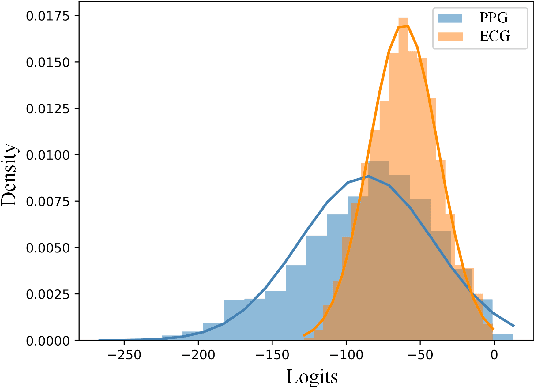


Photoplethsmography (PPG)-based individual identification aiming at recognizing humans via intrinsic cardiovascular activities has raised extensive attention due to its high security and resistance to mimicry. However, this kind of technology witnesses unpromising results due to the limitation of low information density. To this end, electrocardiogram (ECG) signals have been introduced as a novel modality to enhance the density of input information. Specifically, a novel cross-modal knowledge distillation framework is implemented to propagate discriminate knowledge from ECG modality to PPG modality without incurring additional computational demands at the inference phase. Furthermore, to ensure efficient knowledge propagation, Contrastive Language-Image Pre-training (CLIP)-based knowledge alignment and cross-knowledge assessment modules are proposed respectively. Comprehensive experiments are conducted and results show our framework outperforms the baseline model with the improvement of 2.8% and 3.0% in terms of overall accuracy on seen- and unseen individual recognitions.
HammerBench: Fine-Grained Function-Calling Evaluation in Real Mobile Device Scenarios
Dec 21, 2024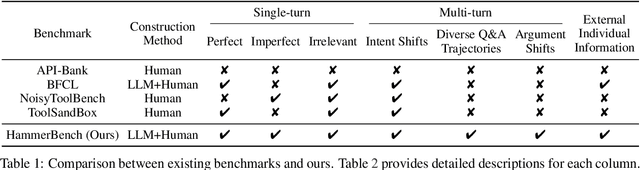
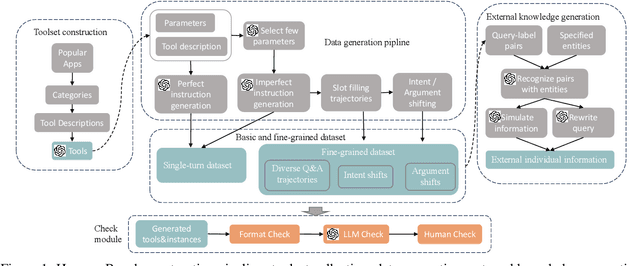
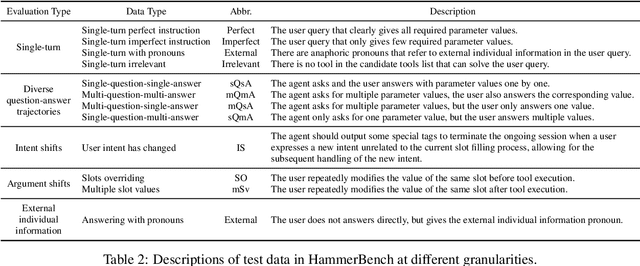
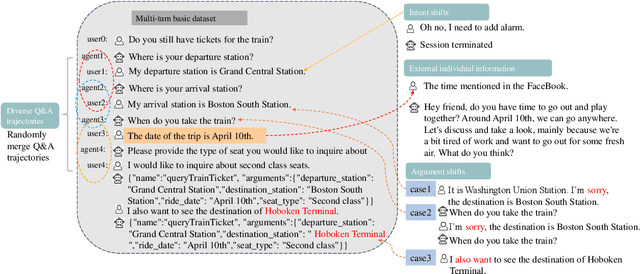
Evaluating the capabilities of large language models (LLMs) in human-LLM interactions remains challenging due to the inherent complexity and openness of dialogue processes. This paper introduces HammerBench, a novel benchmarking framework designed to assess the function-calling ability of LLMs more effectively in such interactions. We model a wide range of real-world user scenarios on mobile devices, encompassing imperfect instructions, diverse question-answer trajectories, intent/argument shifts, and the use of external individual information through pronouns. To construct the corresponding datasets, we propose a comprehensive pipeline that involves LLM-generated data and multiple rounds of human validation, ensuring high data quality. Additionally, we decompose the conversations into function-calling snapshots, enabling a fine-grained evaluation of each turn. We evaluate several popular LLMs using HammerBench and highlight different performance aspects. Our empirical findings reveal that errors in parameter naming constitute the primary factor behind conversation failures across different data types.
STAIR: Manipulating Collaborative and Multimodal Information for E-Commerce Recommendation
Dec 16, 2024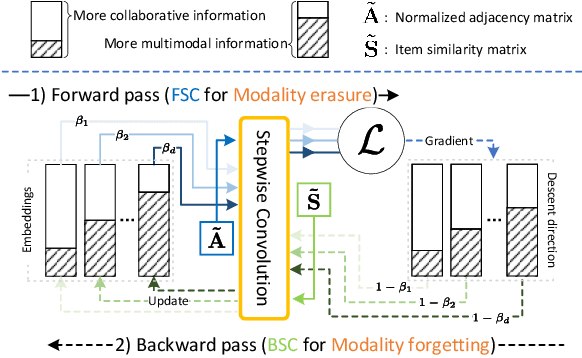
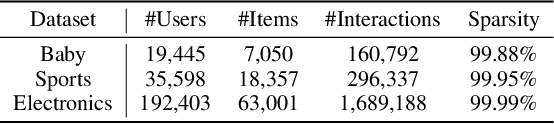
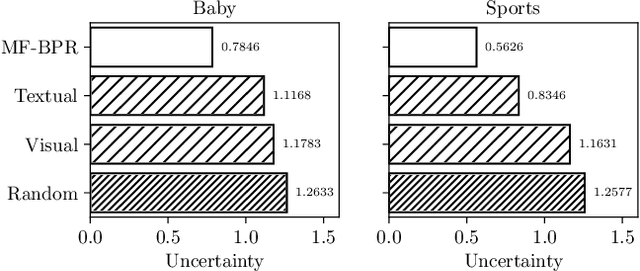
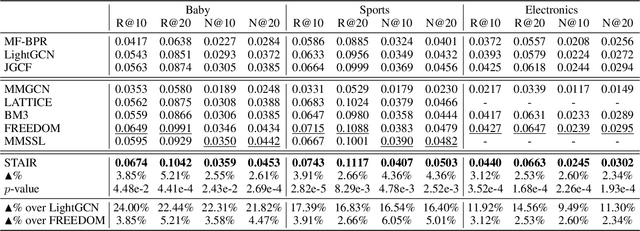
While the mining of modalities is the focus of most multimodal recommendation methods, we believe that how to fully utilize both collaborative and multimodal information is pivotal in e-commerce scenarios where, as clarified in this work, the user behaviors are rarely determined entirely by multimodal features. In order to combine the two distinct types of information, some additional challenges are encountered: 1) Modality erasure: Vanilla graph convolution, which proves rather useful in collaborative filtering, however erases multimodal information; 2) Modality forgetting: Multimodal information tends to be gradually forgotten as the recommendation loss essentially facilitates the learning of collaborative information. To this end, we propose a novel approach named STAIR, which employs a novel STepwise grAph convolution to enable a co-existence of collaborative and multimodal Information in e-commerce Recommendation. Besides, it starts with the raw multimodal features as an initialization, and the forgetting problem can be significantly alleviated through constrained embedding updates. As a result, STAIR achieves state-of-the-art recommendation performance on three public e-commerce datasets with minimal computational and memory costs. Our code is available at https://github.com/yhhe2004/STAIR.
Why Not Together? A Multiple-Round Recommender System for Queries and Items
Dec 14, 2024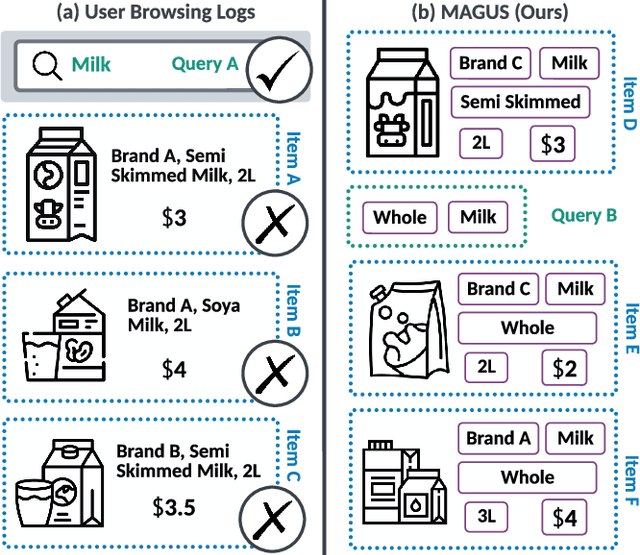
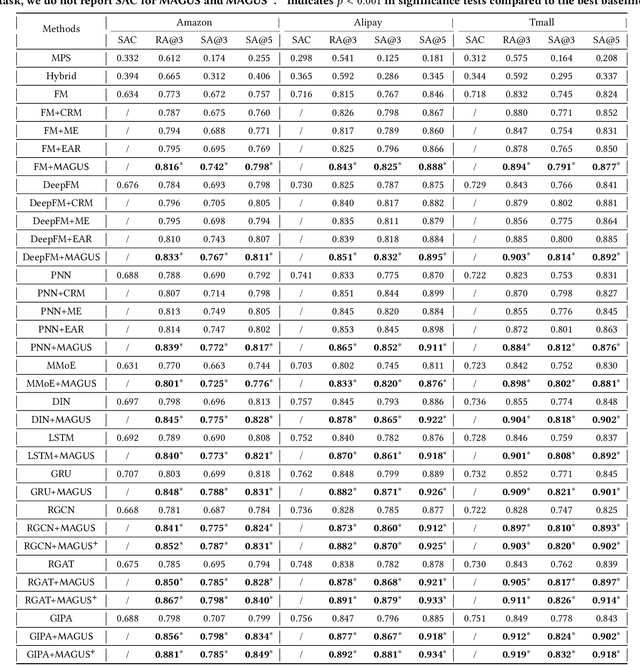
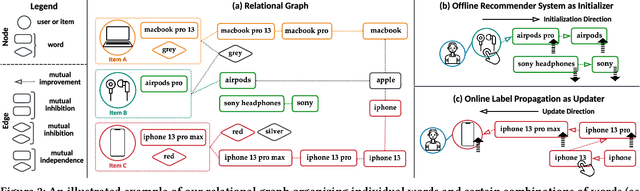
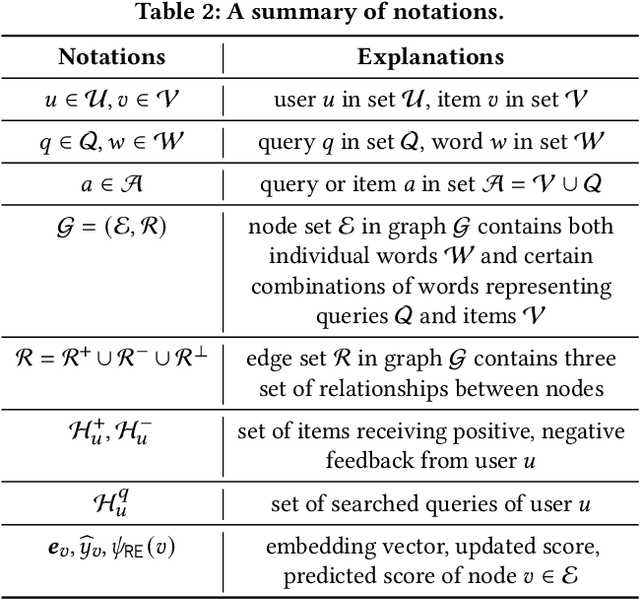
A fundamental technique of recommender systems involves modeling user preferences, where queries and items are widely used as symbolic representations of user interests. Queries delineate user needs at an abstract level, providing a high-level description, whereas items operate on a more specific and concrete level, representing the granular facets of user preference. While practical, both query and item recommendations encounter the challenge of sparse user feedback. To this end, we propose a novel approach named Multiple-round Auto Guess-and-Update System (MAGUS) that capitalizes on the synergies between both types, allowing us to leverage both query and item information to form user interests. This integrated system introduces a recursive framework that could be applied to any recommendation method to exploit queries and items in historical interactions and to provide recommendations for both queries and items in each interaction round. Empirical results from testing 12 different recommendation methods demonstrate that integrating queries into item recommendations via MAGUS significantly enhances the efficiency, with which users can identify their preferred items during multiple-round interactions.
MEATRD: Multimodal Anomalous Tissue Region Detection Enhanced with Spatial Transcriptomics
Dec 14, 2024The detection of anomalous tissue regions (ATRs) within affected tissues is crucial in clinical diagnosis and pathological studies. Conventional automated ATR detection methods, primarily based on histology images alone, falter in cases where ATRs and normal tissues have subtle visual differences. The recent spatial transcriptomics (ST) technology profiles gene expressions across tissue regions, offering a molecular perspective for detecting ATRs. However, there is a dearth of ATR detection methods that effectively harness complementary information from both histology images and ST. To address this gap, we propose MEATRD, a novel ATR detection method that integrates histology image and ST data. MEATRD is trained to reconstruct image patches and gene expression profiles of normal tissue spots (inliers) from their multimodal embeddings, followed by learning a one-class classification AD model based on latent multimodal reconstruction errors. This strategy harmonizes the strengths of reconstruction-based and one-class classification approaches. At the heart of MEATRD is an innovative masked graph dual-attention transformer (MGDAT) network, which not only facilitates cross-modality and cross-node information sharing but also addresses the model over-generalization issue commonly seen in reconstruction-based AD methods. Additionally, we demonstrate that modality-specific, task-relevant information is collated and condensed in multimodal bottleneck encoding generated in MGDAT, marking the first theoretical analysis of the informational properties of multimodal bottleneck encoding. Extensive evaluations across eight real ST datasets reveal MEATRD's superior performance in ATR detection, surpassing various state-of-the-art AD methods. Remarkably, MEATRD also proves adept at discerning ATRs that only show slight visual deviations from normal tissues.
CNNSum: Exploring Long-Context Summarization with Large Language Models in Chinese Novels
Dec 11, 2024


Large Language Models (LLMs) have been well-researched in many long-context tasks. However, due to high annotation costs, high-quality long-context summary datasets for training or evaluation are scarce, limiting further research. In this work, we introduce CNNSum, a new multi-scale Chinese long-context novel summarization benchmark, including four subsets, length covering 16k to 128k, 695 samples in total, the annotations are human-driven. We evaluate commercial and open-source models on CNNSum and conduct a detailed analysis. Based on the observations, we further conduct fine-tuning exploration with short-context summary data. In our study: (1) GPT-4o underperformed, due to excessive subjective commentary. (2) Currently, long-context summarization mainly relies on memory ability, small LLMs with stable longer context lengths are the most cost-effective. Using long data concatenated from short-context summaries makes a significant improvement. (3) Prompt templates may cause a large performance gap but can be mitigated through fine-tuning. (4) Fine-tuned Chat or Instruction versions may harm the Base model and further fine-tuning cannot bridge performance gap. (5) while models with RoPE base scaling exhibit strong extrapolation potential, their performance may vary significantly when combined with other interpolation methods and need careful selection. (6) CNNSum provides more reliable and insightful evaluation results than other benchmarks. We release CNNSum to advance research in this field (https://github.com/CxsGhost/CNNSum).
StyleMark: A Robust Watermarking Method for Art Style Images Against Black-Box Arbitrary Style Transfer
Dec 10, 2024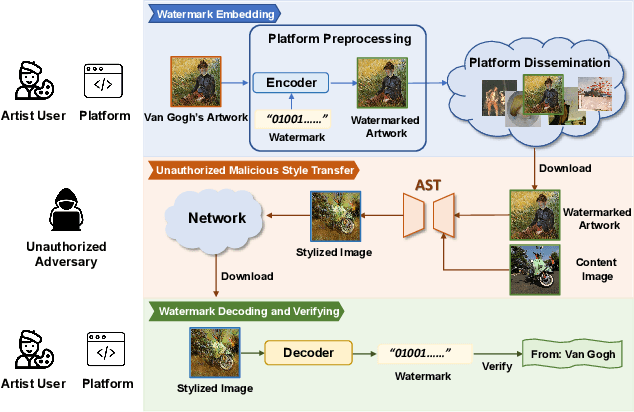

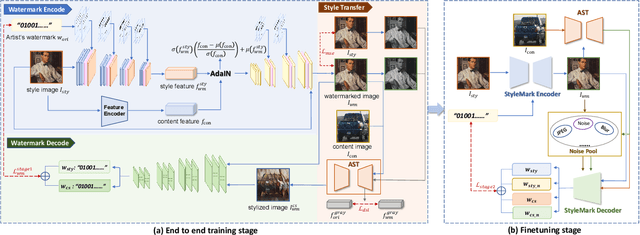
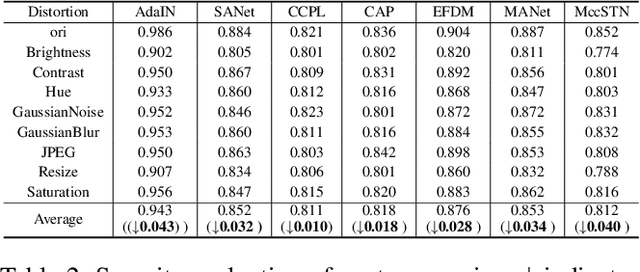
Arbitrary Style Transfer (AST) achieves the rendering of real natural images into the painting styles of arbitrary art style images, promoting art communication. However, misuse of unauthorized art style images for AST may infringe on artists' copyrights. One countermeasure is robust watermarking, which tracks image propagation by embedding copyright watermarks into carriers. Unfortunately, AST-generated images lose the structural and semantic information of the original style image, hindering end-to-end robust tracking by watermarks. To fill this gap, we propose StyleMark, the first robust watermarking method for black-box AST, which can be seamlessly applied to art style images achieving precise attribution of artistic styles after AST. Specifically, we propose a new style watermark network that adjusts the mean activations of style features through multi-scale watermark embedding, thereby planting watermark traces into the shared style feature space of style images. Furthermore, we design a distribution squeeze loss, which constrain content statistical feature distortion, forcing the reconstruction network to focus on integrating style features with watermarks, thus optimizing the intrinsic watermark distribution. Finally, based on solid end-to-end training, StyleMark mitigates the optimization conflict between robustness and watermark invisibility through decoder fine-tuning under random noise. Experimental results demonstrate that StyleMark exhibits significant robustness against black-box AST and common pixel-level distortions, while also securely defending against malicious adaptive attacks.
ProVision: Programmatically Scaling Vision-centric Instruction Data for Multimodal Language Models
Dec 09, 2024
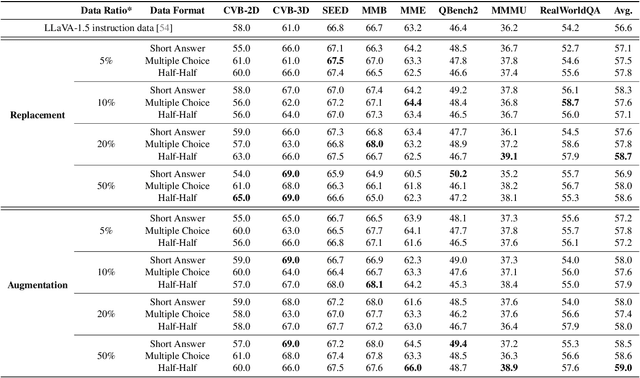
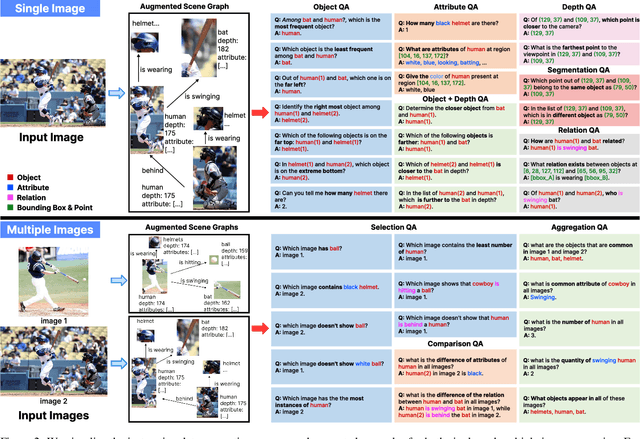
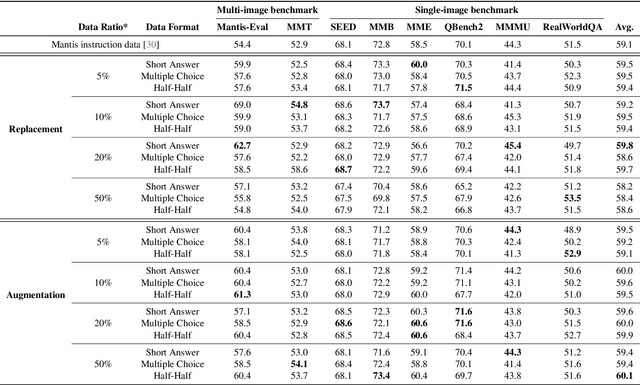
With the rise of multimodal applications, instruction data has become critical for training multimodal language models capable of understanding complex image-based queries. Existing practices rely on powerful but costly large language models (LLMs) or multimodal language models (MLMs) to produce instruction data. These are often prone to hallucinations, licensing issues and the generation process is often hard to scale and interpret. In this work, we present a programmatic approach that employs scene graphs as symbolic representations of images and human-written programs to systematically synthesize vision-centric instruction data. Our approach ensures the interpretability and controllability of the data generation process and scales efficiently while maintaining factual accuracy. By implementing a suite of 24 single-image, 14 multi-image instruction generators, and a scene graph generation pipeline, we build a scalable, cost-effective system: ProVision which produces diverse question-answer pairs concerning objects, attributes, relations, depth, etc., for any given image. Applied to Visual Genome and DataComp datasets, we generate over 10 million instruction data points, ProVision-10M, and leverage them in both pretraining and instruction tuning stages of MLMs. When adopted in the instruction tuning stage, our single-image instruction data yields up to a 7% improvement on the 2D split and 8% on the 3D split of CVBench, along with a 3% increase in performance on QBench2, RealWorldQA, and MMMU. Our multi-image instruction data leads to an 8% improvement on Mantis-Eval. Incorporation of our data in both pre-training and fine-tuning stages of xGen-MM-4B leads to an averaged improvement of 1.6% across 11 benchmarks.
CNNSum: Exploring Long-Conext Summarization with Large Language Models in Chinese Novels
Dec 05, 2024Large Language Models (LLMs) have been well-researched in many long-context tasks. However, due to high annotation costs, high-quality long-context summary datasets for training or evaluation are scarce, limiting further research. In this work, we introduce CNNSum, a new multi-scale Chinese long-context novel summarization benchmark, including four subsets, length covering 16k\textasciitilde128k, 695 samples in total, the annotations are human-driven. We evaluate commercial and open-source models on CNNSum and conduct a detailed analysis. Based on the observations, we further conduct fine-tuning exploration with short-context summary data. In our study: (1) GPT-4o underperformed, due to excessive subjective commentary. (2) Currently, long-context summarization mainly relies on memory ability, small LLMs with stable longer context lengths are the most cost-effective. Using long data concatenated from short-context summaries makes a significant improvement. (3) Prompt templates may cause a large performance gap but can be mitigated through fine-tuning. (4) Fine-tuned Chat or Instruction versions may harm the Base model and further fine-tuning cannot bridge performance gap. (5) while models with RoPE base scaling exhibit strong extrapolation potential, their performance may vary significantly when combined with other interpolation methods and need careful selection. (6) CNNSum provides more reliable and insightful evaluation results than other benchmarks. We release CNNSum to advance research in this field.