 Add to Chrome
 Add to Firefox
 Add to Edge
From Performance to Practice: Knowledge-Distilled Segmentator for On-Premises Clinical Workflows
Jan 14, 2026
Deploying medical image segmentation models in routine clinical workflows is often constrained by on-premises infrastructure, where computational resources are fixed and cloud-based inference may be restricted by governance and security policies. While high-capacity models achieve strong segmentation accuracy, their computational demands hinder practical deployment and long-term maintainability in hospital environments. We present a deployment-oriented framework that leverages knowledge distillation to translate a high-performing segmentation model into a scalable family of compact student models, without modifying the inference pipeline. The proposed approach preserves architectural compatibility with existing clinical systems while enabling systematic capacity reduction. The framework is evaluated on a multi-site brain MRI dataset comprising 1,104 3D volumes, with independent testing on 101 curated cases, and is further examined on abdominal CT to assess cross-modality generalizability. Under aggressive parameter reduction (94%), the distilled student model preserves nearly all of the teacher's segmentation accuracy (98.7%), while achieving substantial efficiency gains, including up to a 67% reduction in CPU inference latency without additional deployment overhead. These results demonstrate that knowledge distillation provides a practical and reliable pathway for converting research-grade segmentation models into maintainable, deployment-ready components for on-premises clinical workflows in real-world health systems.

Online Trajectory Optimization for Arbitrary-Shaped Mobile Robots via Polynomial Separating Hypersurfaces
Jan 14, 2026An emerging class of trajectory optimization methods enforces collision avoidance by jointly optimizing the robot's configuration and a separating hyperplane. However, as linear separators only apply to convex sets, these methods require convex approximations of both the robot and obstacles, which becomes an overly conservative assumption in cluttered and narrow environments. In this work, we unequivocally remove this limitation by introducing nonlinear separating hypersurfaces parameterized by polynomial functions. We first generalize the classical separating hyperplane theorem and prove that any two disjoint bounded closed sets in Euclidean space can be separated by a polynomial hypersurface, serving as the theoretical foundation for nonlinear separation of arbitrary geometries. Building on this result, we formulate a nonlinear programming (NLP) problem that jointly optimizes the robot's trajectory and the coefficients of the separating polynomials, enabling geometry-aware collision avoidance without conservative convex simplifications. The optimization remains efficiently solvable using standard NLP solvers. Simulation and real-world experiments with nonconvex robots demonstrate that our method achieves smooth, collision-free, and agile maneuvers in environments where convex-approximation baselines fail.
HATIR: Heat-Aware Diffusion for Turbulent Infrared Video Super-Resolution
Jan 08, 2026Infrared video has been of great interest in visual tasks under challenging environments, but often suffers from severe atmospheric turbulence and compression degradation. Existing video super-resolution (VSR) methods either neglect the inherent modality gap between infrared and visible images or fail to restore turbulence-induced distortions. Directly cascading turbulence mitigation (TM) algorithms with VSR methods leads to error propagation and accumulation due to the decoupled modeling of degradation between turbulence and resolution. We introduce HATIR, a Heat-Aware Diffusion for Turbulent InfraRed Video Super-Resolution, which injects heat-aware deformation priors into the diffusion sampling path to jointly model the inverse process of turbulent degradation and structural detail loss. Specifically, HATIR constructs a Phasor-Guided Flow Estimator, rooted in the physical principle that thermally active regions exhibit consistent phasor responses over time, enabling reliable turbulence-aware flow to guide the reverse diffusion process. To ensure the fidelity of structural recovery under nonuniform distortions, a Turbulence-Aware Decoder is proposed to selectively suppress unstable temporal cues and enhance edge-aware feature aggregation via turbulence gating and structure-aware attention. We built FLIR-IVSR, the first dataset for turbulent infrared VSR, comprising paired LR-HR sequences from a FLIR T1050sc camera (1024 X 768) spanning 640 diverse scenes with varying camera and object motion conditions. This encourages future research in infrared VSR. Project page: https://github.com/JZ0606/HATIR
LLM Agent Framework for Intelligent Change Analysis in Urban Environment using Remote Sensing Imagery
Jan 06, 2026Existing change detection methods often lack the versatility to handle diverse real-world queries and the intelligence for comprehensive analysis. This paper presents a general agent framework, integrating Large Language Models (LLM) with vision foundation models to form ChangeGPT. A hierarchical structure is employed to mitigate hallucination. The agent was evaluated on a curated dataset of 140 questions categorized by real-world scenarios, encompassing various question types (e.g., Size, Class, Number) and complexities. The evaluation assessed the agent's tool selection ability (Precision/Recall) and overall query accuracy (Match). ChangeGPT, especially with a GPT-4-turbo backend, demonstrated superior performance, achieving a 90.71 % Match rate. Its strength lies particularly in handling change-related queries requiring multi-step reasoning and robust tool selection. Practical effectiveness was further validated through a real-world urban change monitoring case study in Qianhai Bay, Shenzhen. By providing intelligence, adaptability, and multi-type change analysis, ChangeGPT offers a powerful solution for decision-making in remote sensing applications.
Vision-Language-Action Models for Autonomous Driving: Past, Present, and Future
Dec 18, 2025Autonomous driving has long relied on modular "Perception-Decision-Action" pipelines, where hand-crafted interfaces and rule-based components often break down in complex or long-tailed scenarios. Their cascaded design further propagates perception errors, degrading downstream planning and control. Vision-Action (VA) models address some limitations by learning direct mappings from visual inputs to actions, but they remain opaque, sensitive to distribution shifts, and lack structured reasoning or instruction-following capabilities. Recent progress in Large Language Models (LLMs) and multimodal learning has motivated the emergence of Vision-Language-Action (VLA) frameworks, which integrate perception with language-grounded decision making. By unifying visual understanding, linguistic reasoning, and actionable outputs, VLAs offer a pathway toward more interpretable, generalizable, and human-aligned driving policies. This work provides a structured characterization of the emerging VLA landscape for autonomous driving. We trace the evolution from early VA approaches to modern VLA frameworks and organize existing methods into two principal paradigms: End-to-End VLA, which integrates perception, reasoning, and planning within a single model, and Dual-System VLA, which separates slow deliberation (via VLMs) from fast, safety-critical execution (via planners). Within these paradigms, we further distinguish subclasses such as textual vs. numerical action generators and explicit vs. implicit guidance mechanisms. We also summarize representative datasets and benchmarks for evaluating VLA-based driving systems and highlight key challenges and open directions, including robustness, interpretability, and instruction fidelity. Overall, this work aims to establish a coherent foundation for advancing human-compatible autonomous driving systems.
Benchmarking and Adapting On-Device Large Language Models for Clinical Decision Support
Dec 18, 2025Large language models (LLMs) have rapidly advanced in clinical decision-making, yet the deployment of proprietary systems is hindered by privacy concerns and reliance on cloud-based infrastructure. Open-source alternatives allow local inference but often require large model sizes that limit their use in resource-constrained clinical settings. Here, we benchmark two on-device LLMs, gpt-oss-20b and gpt-oss-120b, across three representative clinical tasks: general disease diagnosis, specialty-specific (ophthalmology) diagnosis and management, and simulation of human expert grading and evaluation. We compare their performance with state-of-the-art proprietary models (GPT-5 and o4-mini) and a leading open-source model (DeepSeek-R1), and we further evaluate the adaptability of on-device systems by fine-tuning gpt-oss-20b on general diagnostic data. Across tasks, gpt-oss models achieve performance comparable to or exceeding DeepSeek-R1 and o4-mini despite being substantially smaller. In addition, fine-tuning remarkably improves the diagnostic accuracy of gpt-oss-20b, enabling it to approach the performance of GPT-5. These findings highlight the potential of on-device LLMs to deliver accurate, adaptable, and privacy-preserving clinical decision support, offering a practical pathway for broader integration of LLMs into routine clinical practice.
nuPlan-R: A Closed-Loop Planning Benchmark for Autonomous Driving via Reactive Multi-Agent Simulation
Nov 13, 2025Recent advances in closed-loop planning benchmarks have significantly improved the evaluation of autonomous vehicles. However, existing benchmarks still rely on rule-based reactive agents such as the Intelligent Driver Model (IDM), which lack behavioral diversity and fail to capture realistic human interactions, leading to oversimplified traffic dynamics. To address these limitations, we present nuPlan-R, a new reactive closed-loop planning benchmark that integrates learning-based reactive multi-agent simulation into the nuPlan framework. Our benchmark replaces the rule-based IDM agents with noise-decoupled diffusion-based reactive agents and introduces an interaction-aware agent selection mechanism to ensure both realism and computational efficiency. Furthermore, we extend the benchmark with two additional metrics to enable a more comprehensive assessment of planning performance. Extensive experiments demonstrate that our reactive agent model produces more realistic, diverse, and human-like traffic behaviors, leading to a benchmark environment that better reflects real-world interactive driving. We further reimplement a collection of rule-based, learning-based, and hybrid planning approaches within our nuPlan-R benchmark, providing a clearer reflection of planner performance in complex interactive scenarios and better highlighting the advantages of learning-based planners in handling complex and dynamic scenarios. These results establish nuPlan-R as a new standard for fair, reactive, and realistic closed-loop planning evaluation. We will open-source the code for the new benchmark.
An Intention-driven Lane Change Framework Considering Heterogeneous Dynamic Cooperation in Mixed-traffic Environment
Sep 26, 2025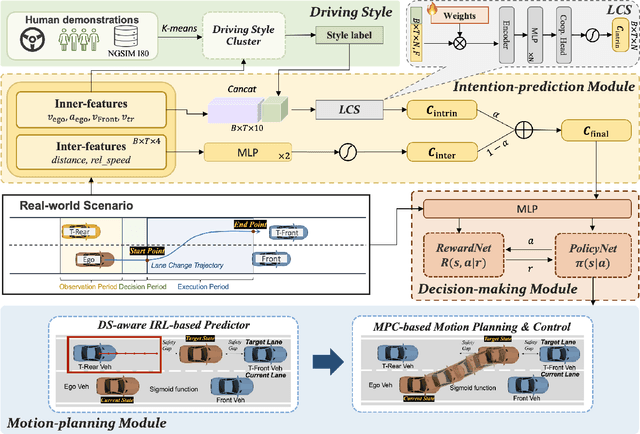
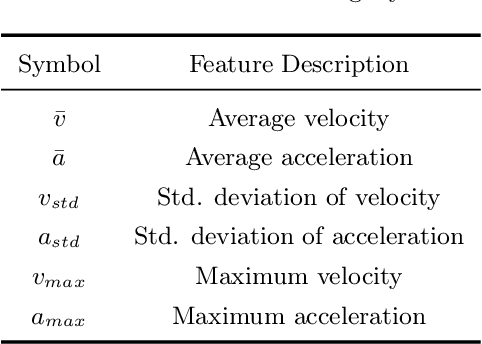
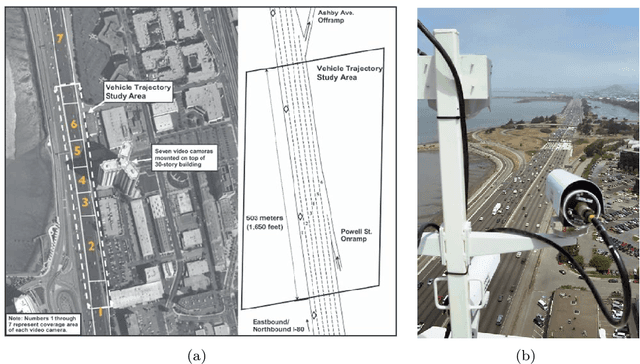
In mixed-traffic environments, where autonomous vehicles (AVs) interact with diverse human-driven vehicles (HVs), unpredictable intentions and heterogeneous behaviors make safe and efficient lane change maneuvers highly challenging. Existing methods often oversimplify these interactions by assuming uniform patterns. We propose an intention-driven lane change framework that integrates driving-style recognition, cooperation-aware decision-making, and coordinated motion planning. A deep learning classifier trained on the NGSIM dataset identifies human driving styles in real time. A cooperation score with intrinsic and interactive components estimates surrounding drivers' intentions and quantifies their willingness to cooperate with the ego vehicle. Decision-making combines behavior cloning with inverse reinforcement learning to determine whether a lane change should be initiated. For trajectory generation, model predictive control is integrated with IRL-based intention inference to produce collision-free and socially compliant maneuvers. Experiments show that the proposed model achieves 94.2\% accuracy and 94.3\% F1-score, outperforming rule-based and learning-based baselines by 4-15\% in lane change recognition. These results highlight the benefit of modeling inter-driver heterogeneity and demonstrate the potential of the framework to advance context-aware and human-like autonomous driving in complex traffic environments.
Semantic-LiDAR-Inertial-Wheel Odometry Fusion for Robust Localization in Large-Scale Dynamic Environments
Sep 18, 2025Reliable, drift-free global localization presents significant challenges yet remains crucial for autonomous navigation in large-scale dynamic environments. In this paper, we introduce a tightly-coupled Semantic-LiDAR-Inertial-Wheel Odometry fusion framework, which is specifically designed to provide high-precision state estimation and robust localization in large-scale dynamic environments. Our framework leverages an efficient semantic-voxel map representation and employs an improved scan matching algorithm, which utilizes global semantic information to significantly reduce long-term trajectory drift. Furthermore, it seamlessly fuses data from LiDAR, IMU, and wheel odometry using a tightly-coupled multi-sensor fusion Iterative Error-State Kalman Filter (iESKF). This ensures reliable localization without experiencing abnormal drift. Moreover, to tackle the challenges posed by terrain variations and dynamic movements, we introduce a 3D adaptive scaling strategy that allows for flexible adjustments to wheel odometry measurement weights, thereby enhancing localization precision. This study presents extensive real-world experiments conducted in a one-million-square-meter automated port, encompassing 3,575 hours of operational data from 35 Intelligent Guided Vehicles (IGVs). The results consistently demonstrate that our system outperforms state-of-the-art LiDAR-based localization methods in large-scale dynamic environments, highlighting the framework's reliability and practical value.
SEG-Parking: Towards Safe, Efficient, and Generalizable Autonomous Parking via End-to-End Offline Reinforcement Learning
Sep 17, 2025Autonomous parking is a critical component for achieving safe and efficient urban autonomous driving. However, unstructured environments and dynamic interactions pose significant challenges to autonomous parking tasks. To address this problem, we propose SEG-Parking, a novel end-to-end offline reinforcement learning (RL) framework to achieve interaction-aware autonomous parking. Notably, a specialized parking dataset is constructed for parking scenarios, which include those without interference from the opposite vehicle (OV) and complex ones involving interactions with the OV. Based on this dataset, a goal-conditioned state encoder is pretrained to map the fused perception information into the latent space. Then, an offline RL policy is optimized with a conservative regularizer that penalizes out-of-distribution actions. Extensive closed-loop experiments are conducted in the high-fidelity CARLA simulator. Comparative results demonstrate the superior performance of our framework with the highest success rate and robust generalization to out-of-distribution parking scenarios. The related dataset and source code will be made publicly available after the paper is accepted.