 Add to Chrome
 Add to Firefox
 Add to Edge
Interactive World Simulator for Robot Policy Training and Evaluation
Mar 09, 2026
Action-conditioned video prediction models (often referred to as world models) have shown strong potential for robotics applications, but existing approaches are often slow and struggle to capture physically consistent interactions over long horizons, limiting their usefulness for scalable robot policy training and evaluation. We present Interactive World Simulator, a framework for building interactive world models from a moderate-sized robot interaction dataset. Our approach leverages consistency models for both image decoding and latent-space dynamics prediction, enabling fast and stable simulation of physical interactions. In our experiments, the learned world models produce interaction-consistent pixel-level predictions and support stable long-horizon interactions for more than 10 minutes at 15 FPS on a single RTX 4090 GPU. Our framework enables scalable demonstration collection solely within the world models to train state-of-the-art imitation policies. Through extensive real-world evaluation across diverse tasks involving rigid objects, deformable objects, object piles, and their interactions, we find that policies trained on world-model-generated data perform comparably to those trained on the same amount of real-world data. Additionally, we evaluate policies both within the world models and in the real world across diverse tasks, and observe a strong correlation between simulated and real-world performance. Together, these results establish the Interactive World Simulator as a stable and physically consistent surrogate for scalable robotic data generation and faithful, reproducible policy evaluation.

HoMMI: Learning Whole-Body Mobile Manipulation from Human Demonstrations
Mar 03, 2026We present Whole-Body Mobile Manipulation Interface (HoMMI), a data collection and policy learning framework that learns whole-body mobile manipulation directly from robot-free human demonstrations. We augment UMI interfaces with egocentric sensing to capture the global context required for mobile manipulation, enabling portable, robot-free, and scalable data collection. However, naively incorporating egocentric sensing introduces a larger human-to-robot embodiment gap in both observation and action spaces, making policy transfer difficult. We explicitly bridge this gap with a cross-embodiment hand-eye policy design, including an embodiment agnostic visual representation; a relaxed head action representation; and a whole-body controller that realizes hand-eye trajectories through coordinated whole-body motion under robot-specific physical constraints. Together, these enable long-horizon mobile manipulation tasks requiring bimanual and whole-body coordination, navigation, and active perception. Results are best viewed on: https://hommi-robot.github.io
A Systematic Study of Data Modalities and Strategies for Co-training Large Behavior Models for Robot Manipulation
Feb 01, 2026Large behavior models have shown strong dexterous manipulation capabilities by extending imitation learning to large-scale training on multi-task robot data, yet their generalization remains limited by the insufficient robot data coverage. To expand this coverage without costly additional data collection, recent work relies on co-training: jointly learning from target robot data and heterogeneous data modalities. However, how different co-training data modalities and strategies affect policy performance remains poorly understood. We present a large-scale empirical study examining five co-training data modalities: standard vision-language data, dense language annotations for robot trajectories, cross-embodiment robot data, human videos, and discrete robot action tokens across single- and multi-phase training strategies. Our study leverages 4,000 hours of robot and human manipulation data and 50M vision-language samples to train vision-language-action policies. We evaluate 89 policies over 58,000 simulation rollouts and 2,835 real-world rollouts. Our results show that co-training with forms of vision-language and cross-embodiment robot data substantially improves generalization to distribution shifts, unseen tasks, and language following, while discrete action token variants yield no significant benefits. Combining effective modalities produces cumulative gains and enables rapid adaptation to unseen long-horizon dexterous tasks via fine-tuning. Training exclusively on robot data degrades the visiolinguistic understanding of the vision-language model backbone, while co-training with effective modalities restores these capabilities. Explicitly conditioning action generation on chain-of-thought traces learned from co-training data does not improve performance in our simulation benchmark. Together, these results provide practical guidance for building scalable generalist robot policies.
ERA: Transforming VLMs into Embodied Agents via Embodied Prior Learning and Online Reinforcement Learning
Oct 14, 2025Recent advances in embodied AI highlight the potential of vision language models (VLMs) as agents capable of perception, reasoning, and interaction in complex environments. However, top-performing systems rely on large-scale models that are costly to deploy, while smaller VLMs lack the necessary knowledge and skills to succeed. To bridge this gap, we present \textit{Embodied Reasoning Agent (ERA)}, a two-stage framework that integrates prior knowledge learning and online reinforcement learning (RL). The first stage, \textit{Embodied Prior Learning}, distills foundational knowledge from three types of data: (1) Trajectory-Augmented Priors, which enrich existing trajectory data with structured reasoning generated by stronger models; (2) Environment-Anchored Priors, which provide in-environment knowledge and grounding supervision; and (3) External Knowledge Priors, which transfer general knowledge from out-of-environment datasets. In the second stage, we develop an online RL pipeline that builds on these priors to further enhance agent performance. To overcome the inherent challenges in agent RL, including long horizons, sparse rewards, and training instability, we introduce three key designs: self-summarization for context management, dense reward shaping, and turn-level policy optimization. Extensive experiments on both high-level planning (EB-ALFRED) and low-level control (EB-Manipulation) tasks demonstrate that ERA-3B surpasses both prompting-based large models and previous training-based baselines. Specifically, it achieves overall improvements of 8.4\% on EB-ALFRED and 19.4\% on EB-Manipulation over GPT-4o, and exhibits strong generalization to unseen tasks. Overall, ERA offers a practical path toward scalable embodied intelligence, providing methodological insights for future embodied AI systems.
CART-MPC: Coordinating Assistive Devices for Robot-Assisted Transferring with Multi-Agent Model Predictive Control
Jan 19, 2025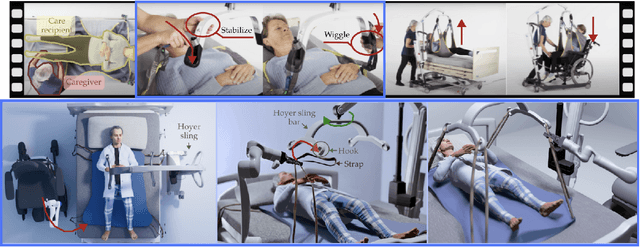
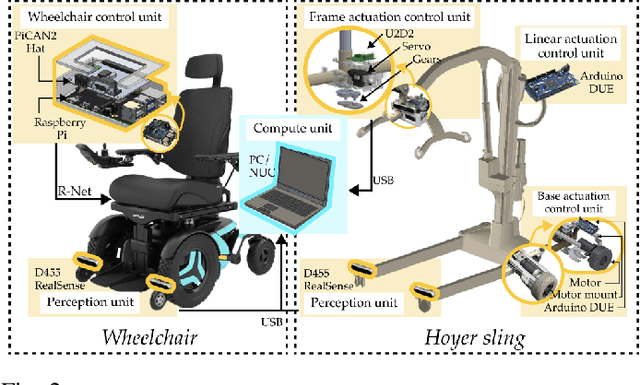
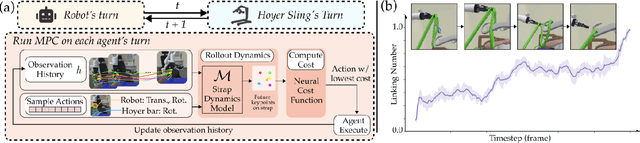
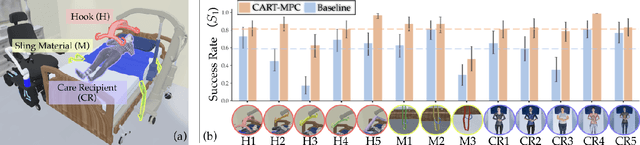
Bed-to-wheelchair transferring is a ubiquitous activity of daily living (ADL), but especially challenging for caregiving robots with limited payloads. We develop a novel algorithm that leverages the presence of other assistive devices: a Hoyer sling and a wheelchair for coarse manipulation of heavy loads, alongside a robot arm for fine-grained manipulation of deformable objects (Hoyer sling straps). We instrument the Hoyer sling and wheelchair with actuators and sensors so that they can become intelligent agents in the algorithm. We then focus on one subtask of the transferring ADL -- tying Hoyer sling straps to the sling bar -- that exemplifies the challenges of transfer: multi-agent planning, deformable object manipulation, and generalization to varying hook shapes, sling materials, and care recipient bodies. To address these challenges, we propose CART-MPC, a novel algorithm based on turn-taking multi-agent model predictive control that uses a learned neural dynamics model for a keypoint-based representation of the deformable Hoyer sling strap, and a novel cost function that leverages linking numbers from knot theory and neural amortization to accelerate inference. We validate it in both RCareWorld simulation and real-world environments. In simulation, CART-MPC successfully generalizes across diverse hook designs, sling materials, and care recipient body shapes. In the real world, we show zero-shot sim-to-real generalization capabilities to tie deformable Hoyer sling straps on a sling bar towards transferring a manikin from a hospital bed to a wheelchair. See our website for supplementary materials: https://emprise.cs.cornell.edu/cart-mpc/.
Plan-Guided Reinforcement Learning for Whole-Body Manipulation
Oct 18, 2023Synthesizing complex whole-body manipulation behaviors has fundamental challenges due to the rapidly growing combinatorics inherent to contact interaction planning. While model-based methods have shown promising results in solving long-horizon manipulation tasks, they often work under strict assumptions, such as known model parameters, oracular observation of the environment state, and simplified dynamics, resulting in plans that cannot easily transfer to hardware. Learning-based approaches, such as imitation learning (IL) and reinforcement learning (RL), have been shown to be robust when operating over in-distribution states; however, they need heavy human supervision. Specifically, model-free RL requires a tedious reward-shaping process. IL methods, on the other hand, rely on human demonstrations that involve advanced teleoperation methods. In this work, we propose a plan-guided reinforcement learning (PGRL) framework to combine the advantages of model-based planning and reinforcement learning. Our method requires minimal human supervision because it relies on plans generated by model-based planners to guide the exploration in RL. In exchange, RL derives a more robust policy thanks to domain randomization. We test this approach on a whole-body manipulation task on Punyo, an upper-body humanoid robot with compliant, air-filled arm coverings, to pivot and lift a large box. Our preliminary results indicate that the proposed methodology is promising to address challenges that remain difficult for either model- or learning-based strategies alone.