 Add to Chrome
 Add to Firefox
 Add to Edge
Beyond Failure Recovery: An Engagement-Aware Human-in-the-loop Framework for Robotic Systems
Jun 16, 2026
Conventional human-in-the-loop approaches typically involve users only when a robot encounters failure or uncertainty, treating humans primarily as tools for improving robot performance. However, in many human-centered robotics settings, interaction should support engagement by keeping users involved in decision-making rather than limiting them to failure-driven interventions. This is particularly compelling in physical caregiving, where mobility limitations can reduce users' ability to intervene or modulate the robot's behavior in the moment. As a result, failure-driven interaction policies may relegate users to passive observers for long stretches of the task. For example, a user with mobility limitations may feel less engaged when being continuously and passively fed by a robot. At the same time, overly frequent interaction can be tiring and increase the user's workload. To address this trade-off, we propose Engagement-aware MPC (E-MPC), a user-engagement-aware method that plans interaction to maintain engagement while respecting a workload constraint. E-MPC leverages a user interaction dynamics model that captures how user engagement evolves as a function of both the frequency and type of interaction. Rather than requesting input only when difficulties arise during task execution, the robot proactively considers the user's preferred level of engagement throughout the task, balancing autonomy and interaction while ensuring task success. We evaluate E-MPC in simulation with several ablations and baseline comparisons. Results demonstrate the effectiveness of our approach across diverse user personas. In addition, we conduct a real-world user study with participants with emulated mobility limitations on a robot-assisted bite acquisition system, showing that E-MPC improves user experience while maintaining task success.
* Project website at https://emprise.cs.cornell.edu/empc

GamiBench: Evaluating Spatial Reasoning and 2D-to-3D Planning Capabilities of MLLMs with Origami Folding Tasks
Dec 22, 2025Multimodal large language models (MLLMs) are proficient in perception and instruction-following, but they still struggle with spatial reasoning: the ability to mentally track and manipulate objects across multiple views and over time. Spatial reasoning is a key component of human intelligence, but most existing benchmarks focus on static images or final outputs, failing to account for the sequential and viewpoint-dependent nature of this skill. To close this gap, we introduce GamiBench, a benchmark designed to evaluate spatial reasoning and 2D-to-3D planning in MLLMs through origami-inspired folding tasks. GamiBench includes 186 regular and 186 impossible 2D crease patterns paired with their corresponding 3D folded shapes, produced from six distinct viewpoints across three visual question-answering (VQA) tasks: predicting 3D fold configurations, distinguishing valid viewpoints, and detecting impossible patterns. Unlike previous benchmarks that assess only final predictions, GamiBench holistically evaluates the entire reasoning process--measuring cross-view consistency, physical feasibility through impossible-fold detection, and interpretation of intermediate folding steps. It further introduces new diagnostic metrics--viewpoint consistency (VC) and impossible fold selection rate (IFSR)--to measure how well models handle folds of varying complexity. Our experiments show that even leading models such as GPT-5 and Gemini-2.5-Pro struggle on single-step spatial understanding. These contributions establish a standardized framework for evaluating geometric understanding and spatial reasoning in MLLMs. Dataset and code: https://github.com/stvngo/GamiBench.
CART-MPC: Coordinating Assistive Devices for Robot-Assisted Transferring with Multi-Agent Model Predictive Control
Jan 19, 2025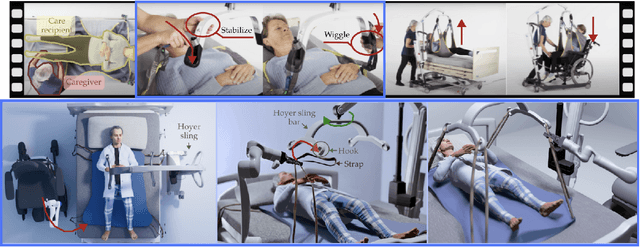
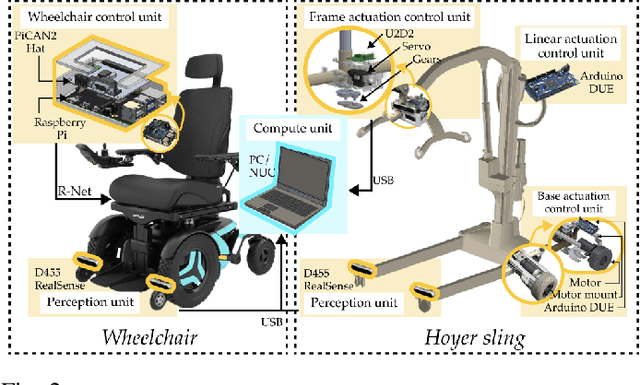
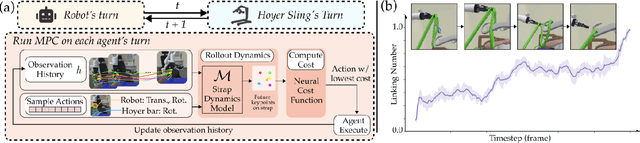
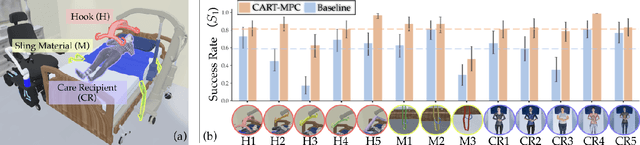
Bed-to-wheelchair transferring is a ubiquitous activity of daily living (ADL), but especially challenging for caregiving robots with limited payloads. We develop a novel algorithm that leverages the presence of other assistive devices: a Hoyer sling and a wheelchair for coarse manipulation of heavy loads, alongside a robot arm for fine-grained manipulation of deformable objects (Hoyer sling straps). We instrument the Hoyer sling and wheelchair with actuators and sensors so that they can become intelligent agents in the algorithm. We then focus on one subtask of the transferring ADL -- tying Hoyer sling straps to the sling bar -- that exemplifies the challenges of transfer: multi-agent planning, deformable object manipulation, and generalization to varying hook shapes, sling materials, and care recipient bodies. To address these challenges, we propose CART-MPC, a novel algorithm based on turn-taking multi-agent model predictive control that uses a learned neural dynamics model for a keypoint-based representation of the deformable Hoyer sling strap, and a novel cost function that leverages linking numbers from knot theory and neural amortization to accelerate inference. We validate it in both RCareWorld simulation and real-world environments. In simulation, CART-MPC successfully generalizes across diverse hook designs, sling materials, and care recipient body shapes. In the real world, we show zero-shot sim-to-real generalization capabilities to tie deformable Hoyer sling straps on a sling bar towards transferring a manikin from a hospital bed to a wheelchair. See our website for supplementary materials: https://emprise.cs.cornell.edu/cart-mpc/.
SWE-bench Multimodal: Do AI Systems Generalize to Visual Software Domains?
Oct 04, 2024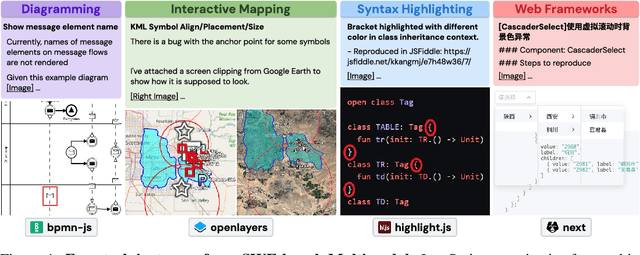
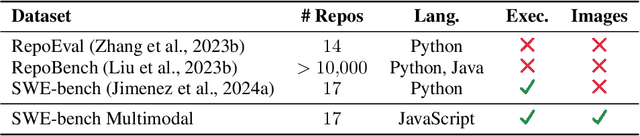
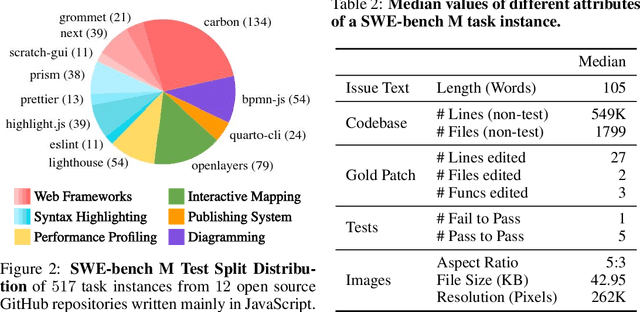
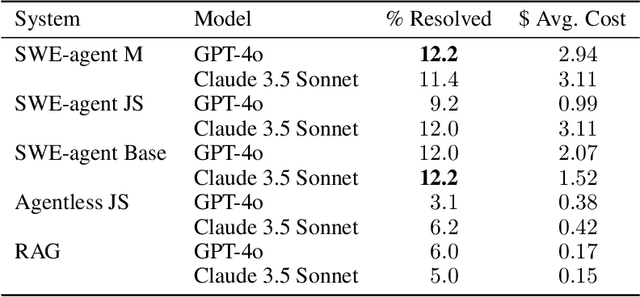
Autonomous systems for software engineering are now capable of fixing bugs and developing features. These systems are commonly evaluated on SWE-bench (Jimenez et al., 2024a), which assesses their ability to solve software issues from GitHub repositories. However, SWE-bench uses only Python repositories, with problem statements presented predominantly as text and lacking visual elements such as images. This limited coverage motivates our inquiry into how existing systems might perform on unrepresented software engineering domains (e.g., front-end, game development, DevOps), which use different programming languages and paradigms. Therefore, we propose SWE-bench Multimodal (SWE-bench M), to evaluate systems on their ability to fix bugs in visual, user-facing JavaScript software. SWE-bench M features 617 task instances collected from 17 JavaScript libraries used for web interface design, diagramming, data visualization, syntax highlighting, and interactive mapping. Each SWE-bench M task instance contains at least one image in its problem statement or unit tests. Our analysis finds that top-performing SWE-bench systems struggle with SWE-bench M, revealing limitations in visual problem-solving and cross-language generalization. Lastly, we show that SWE-agent's flexible language-agnostic features enable it to substantially outperform alternatives on SWE-bench M, resolving 12% of task instances compared to 6% for the next best system.