 Add to Chrome
 Add to Firefox
 Add to Edge
TACTIC: Tactile and Vision Conditioned Contact-Centric Control for Whole-Arm Manipulation
Jul 13, 2026
Whole-arm manipulation involves direct contact with the environment while the robot completes a task by distributing contact across multiple links as contacts form, slide, and break. This setting breaks common implicit assumptions in many learning-based manipulation pipelines: arm configuration tightly couples motion and contact forces, contact state is partially observed under occlusion, and purely learned rollouts can become physically inconsistent under distribution shift because many multi-link contact configurations are sparsely represented in the data. To address this, we propose TACTIC (Tactile and Vision Conditioned Contact-Centric Control), a receding-horizon controller for whole-arm manipulation. TACTIC uses a contact-centric hybrid predictive model that combines RGB-D, distributed tactile sensing, and a compact 2D proximity representation. The model couples a learned, action-conditioned latent dynamics model with analytical kinematics through contact Jacobians, enabling rollouts of future contact configurations and interaction forces. TACTIC integrates these rollouts into a sampling-based MPC planner with contact-aware action sampling: contact Jacobian-based projections steer sampled action sequences toward force-modulating directions, and objectives defined over predicted proximity and interaction forces trade task progress against whole-arm force regulation. We evaluate TACTIC in simulation against state-of-the-art model-based and model-free methods, and perform ablations that isolate the contribution of each design choice. TACTIC consistently outperforms other methods. We further demonstrate real-world performance on a robot with distributed tactile sensing across three whole-arm manipulation tasks that require multi-contact trajectories: turning over and repositioning a manikin, and goal-reaching in a 3D dynamic maze. Website: https://emprise.cs.cornell.edu/tactic

CART-MPC: Coordinating Assistive Devices for Robot-Assisted Transferring with Multi-Agent Model Predictive Control
Jan 19, 2025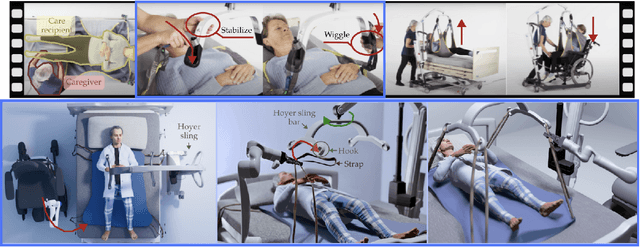
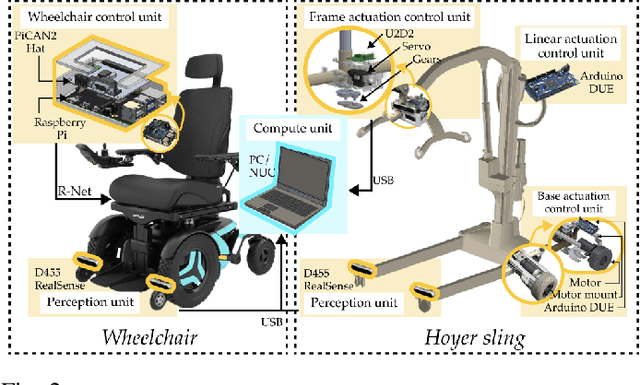
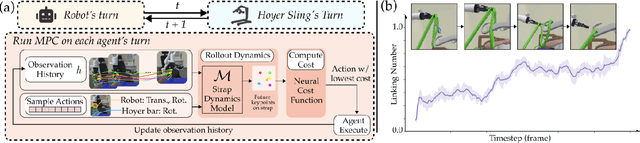
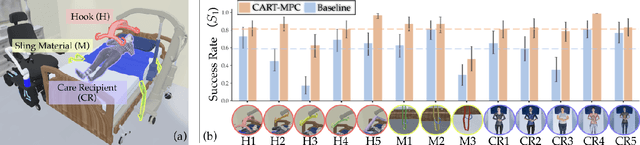
Bed-to-wheelchair transferring is a ubiquitous activity of daily living (ADL), but especially challenging for caregiving robots with limited payloads. We develop a novel algorithm that leverages the presence of other assistive devices: a Hoyer sling and a wheelchair for coarse manipulation of heavy loads, alongside a robot arm for fine-grained manipulation of deformable objects (Hoyer sling straps). We instrument the Hoyer sling and wheelchair with actuators and sensors so that they can become intelligent agents in the algorithm. We then focus on one subtask of the transferring ADL -- tying Hoyer sling straps to the sling bar -- that exemplifies the challenges of transfer: multi-agent planning, deformable object manipulation, and generalization to varying hook shapes, sling materials, and care recipient bodies. To address these challenges, we propose CART-MPC, a novel algorithm based on turn-taking multi-agent model predictive control that uses a learned neural dynamics model for a keypoint-based representation of the deformable Hoyer sling strap, and a novel cost function that leverages linking numbers from knot theory and neural amortization to accelerate inference. We validate it in both RCareWorld simulation and real-world environments. In simulation, CART-MPC successfully generalizes across diverse hook designs, sling materials, and care recipient body shapes. In the real world, we show zero-shot sim-to-real generalization capabilities to tie deformable Hoyer sling straps on a sling bar towards transferring a manikin from a hospital bed to a wheelchair. See our website for supplementary materials: https://emprise.cs.cornell.edu/cart-mpc/.