 Add to Chrome
 Add to Firefox
 Add to Edge
AVA-Encoder: Towards Agent-Native Video Representation Learning
Aug 12, 2026
Creative agents still lack an effective way to learn from high-quality human films, limiting their ability to produce cinematic-grade videos. A key challenge is the absence of a structured video representation that is both faithful to film content and directly usable for agentic reasoning and manipulation. To address the challenge, we propose the Agentic Video Auto-Encoder (AVA-Encoder), a framework for learning agent-native video representations via agentic auto-encoding. AVA-Encoder transforms a video into a knowledge graph (KG) representation and then reconstructs it back into video. Its hierarchy and state nodes store structured text, while a linked asset layer holds generated images, audio, and video. Typed edges preserve the relations between these text descriptions and assets in a form that agents can easily understand, query, and edit. The video reconstruction differences drive a textual-gradient optimization framework, which expresses evaluation feedback as natural-language update directions for Data-Independent Encoding Policy Pseudo-Training in the outer loop and optional Data-Dependent KG Representation Refinement in the test-time inner loop. Extensive experiments show that AVA-Encoder improves by 20.7 percentage points over the strongest external baseline. In the controlled policy-only setting, its pseudo-trained shot-level Agentic Video Encoder policy also outperforms a carefully human-tuned policy while using 74.3% fewer system-prompt tokens. We release the complete AVA-Encoder framework, a reliable agentic video reconstruction benchmark, and the first dataset of high-quality film KG representations.

What to Edit Next: Visually Aligned Image-Editing Follow-Up Suggestions in Conversational Systems
Aug 03, 2026Conversational assistants increasingly recommend follow-up edits to help users continue a task. Existing systems primarily target text-only interactions, leaving image-creation conversations underexplored. In image-creation tasks, useful follow-up edit suggestions must reflect user preferences, offer diverse directions, and remain executable on the current image. We collected 100,000 real multi-turn image-creation conversation samples from Qwen App and found that 80.1% are image-dependent, underscoring the need for multimodal recommendation. We address this setting with a three-stage framework. In Stage 1, we use real online data to build a human-reviewed table of appropriate follow-up editing intents, then create SFT targets and fine-tune a multimodal policy. In Stage 2, to align rule-guided SFT suggestions with actual user choices, we use user click feedback to optimize the policy through multi-objective reinforcement learning. In Stage 3, to reduce visual inconsistencies between suggested edits and the current image, we introduce a visual verifier as additional training supervision. Extensive experiments demonstrate that our framework significantly outperforms baselines on both automatic and human evaluations. In a live user-randomized A/B test with millions of users, our final framework reduces visual inconsistency from 3.7% to 0.9%. Furthermore, it significantly improves recommendation CTR by 32.70%, image take-away rate by 16.32%, and average conversation turns per user by 39.90% (all p<0.05).
Rethinking Classifier-Free Guidance in On-Policy Diffusion Distillation
Jul 27, 2026On-policy distillation (OPD) adapts diffusion models by querying a teacher along trajectories generated by the current student, but how it should behave under classifier-free guidance (CFG), a default component of modern diffusion systems, remains poorly understood. Existing OPD methods naturally extend velocity matching to the CFG-composed prediction, directly matching teacher and student guided velocities. We show that this objective is under-identified at the branch level: positive- and negative-branch errors can compensate in the guided prediction. Through two contrasting cases, we find that naive matching remains effective under shared negative conditioning, where both branch errors decrease jointly. When the model's native CFG schema retains privileged information in the teacher's negative branch that is unavailable to the student, however, this joint reduction breaks down and the composed objective induces antagonistic branch-error dynamics, reducing the positive-branch error while increasing the negative-branch error. We term this failure mode Negative Branch Asymmetry (NBA). To address NBA, we introduce Positive--Direction Matching (PDM), a branch-aware OPD objective that separately constrains the positive prediction and the CFG conditional direction. We apply PDM to dense-to-sparse video control, where naive guided matching is highly sensitive to inference guidance scales, while branch-aware supervision enables more robust and effective knowledge transfer.
DLLG: Dynamic Logit-Level Gating of LLM Experts
Jun 03, 2026Leveraging multiple specialized LLMs can combine complementary strengths, but existing approaches trade adaptability for stability: routing commits prematurely, heuristic ensembling depends on fragile proxies, and parameter merging introduces interference. We propose DLLG (Dynamic Logit-Level Gating), a dynamic logit-level ensembling framework that learns token-level expert fusion from sparse response-level supervision. A lightweight gating module predicts step-wise fusion weights, linking trajectory-level correctness to generation without token-level labels or expert retraining. Across diverse reasoning and code benchmarks, DLLG consistently outperforms strong routing, heuristic ensembling, and parameter-merging baselines across model scales, highlighting learned logit-level fusion as a robust and scalable paradigm for integrating specialized experts.
CyCLeGen: Cycle-Consistent Layout Prediction and Image Generation in Vision Foundation Models
Mar 16, 2026We present CyCLeGen, a unified vision-language foundation model capable of both image understanding and image generation within a single autoregressive framework. Unlike existing vision models that depend on separate modules for perception and synthesis, CyCLeGen adopts a fully integrated architecture that enforces cycle-consistent learning through image->layout->image and layout->image->layout generation loops. This unified formulation introduces two key advantages: introspection, enabling the model to reason about its own generations, and data efficiency, allowing self-improvement via synthetic supervision under a reinforcement learning objective guided by cycle consistency. Extensive experiments show that CyCLeGen achieves significant gains across diverse image understanding and generation benchmarks, highlighting the potential of unified vision-language foundation models.
YOLO-Count: Differentiable Object Counting for Text-to-Image Generation
Aug 01, 2025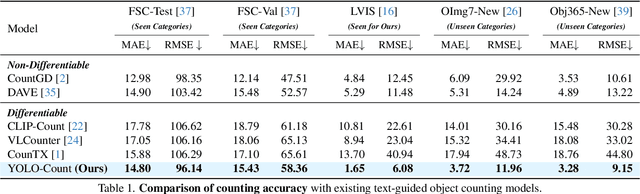
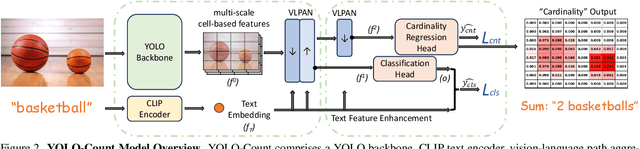
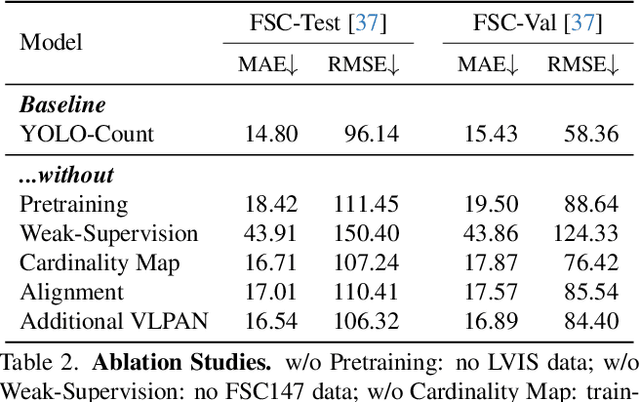
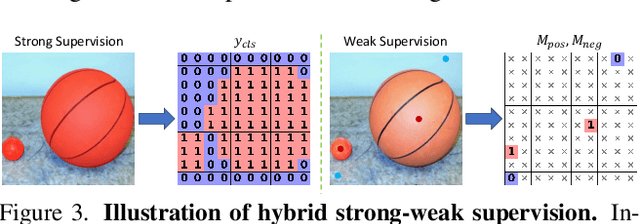
We propose YOLO-Count, a differentiable open-vocabulary object counting model that tackles both general counting challenges and enables precise quantity control for text-to-image (T2I) generation. A core contribution is the 'cardinality' map, a novel regression target that accounts for variations in object size and spatial distribution. Leveraging representation alignment and a hybrid strong-weak supervision scheme, YOLO-Count bridges the gap between open-vocabulary counting and T2I generation control. Its fully differentiable architecture facilitates gradient-based optimization, enabling accurate object count estimation and fine-grained guidance for generative models. Extensive experiments demonstrate that YOLO-Count achieves state-of-the-art counting accuracy while providing robust and effective quantity control for T2I systems.
Generalize or Detect? Towards Robust Semantic Segmentation Under Multiple Distribution Shifts
Nov 06, 2024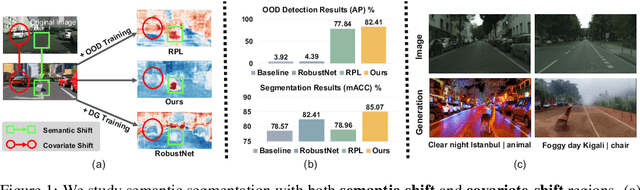
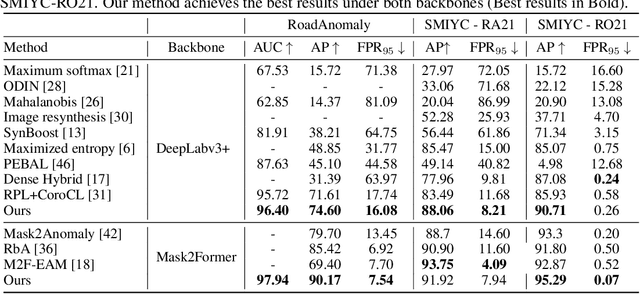

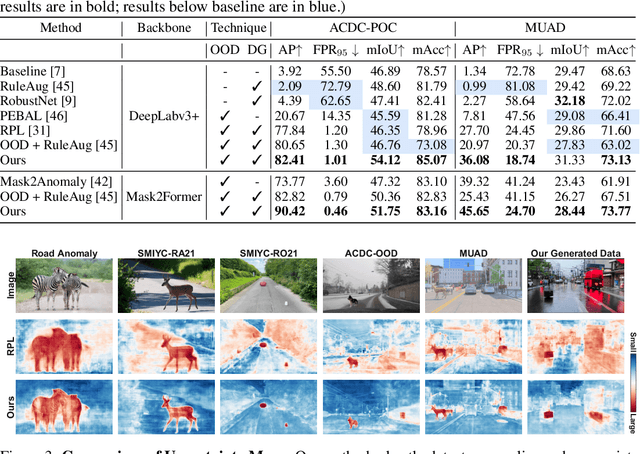
In open-world scenarios, where both novel classes and domains may exist, an ideal segmentation model should detect anomaly classes for safety and generalize to new domains. However, existing methods often struggle to distinguish between domain-level and semantic-level distribution shifts, leading to poor out-of-distribution (OOD) detection or domain generalization performance. In this work, we aim to equip the model to generalize effectively to covariate-shift regions while precisely identifying semantic-shift regions. To achieve this, we design a novel generative augmentation method to produce coherent images that incorporate both anomaly (or novel) objects and various covariate shifts at both image and object levels. Furthermore, we introduce a training strategy that recalibrates uncertainty specifically for semantic shifts and enhances the feature extractor to align features associated with domain shifts. We validate the effectiveness of our method across benchmarks featuring both semantic and domain shifts. Our method achieves state-of-the-art performance across all benchmarks for both OOD detection and domain generalization. Code is available at https://github.com/gaozhitong/MultiShiftSeg.
Gradient-Map-Guided Adaptive Domain Generalization for Cross Modality MRI Segmentation
Nov 16, 2023Cross-modal MRI segmentation is of great value for computer-aided medical diagnosis, enabling flexible data acquisition and model generalization. However, most existing methods have difficulty in handling local variations in domain shift and typically require a significant amount of data for training, which hinders their usage in practice. To address these problems, we propose a novel adaptive domain generalization framework, which integrates a learning-free cross-domain representation based on image gradient maps and a class prior-informed test-time adaptation strategy for mitigating local domain shift. We validate our approach on two multi-modal MRI datasets with six cross-modal segmentation tasks. Across all the task settings, our method consistently outperforms competing approaches and shows a stable performance even with limited training data.