 Add to Chrome
 Add to Firefox
 Add to Edge
Bayesian control for coding agents
Jun 23, 2026
Modern coding agents pair LLM generators with various tools, including cheap diagnostics and expensive verifiers. The tool-use decisions are typically governed by orchestrators that often use fixed rules and ignore uncertainty. We formulate orchestration as cost-sensitive sequential hypothesis testing: a Bayesian controller maintains a belief over candidate correctness and dynamically decides whether to gather more evidence, refine the candidate, verify it, or stop. Across six generators and nine coding benchmarks, Bayesian control proves to be most valuable when verification is costly and critics are informative but imperfect. Beyond control, the belief state yields an interpretable correctness score that outperforms token-probability and raw tool-success baselines for uncertainty quantification.

ThinkBooster: A Unified Framework for Seamless Test-Time Scaling of LLM Reasoning
Jun 05, 2026Test-time compute (TTC) scaling has emerged as a powerful paradigm for improving large language model (LLM) reasoning by allocating additional compute during inference, e.g., via multi-sample generation and verifier-based reranking. Existing TTC scaling strategies and reasoning scorers remain fragmented, evaluated under inconsistent protocols, and are rarely analyzed through the lens of quality-cost trade-offs. We introduce ThinkBooster, a unified framework for seamless test-time compute scaling of LLM reasoning, which consists of (i) a modular Python library implementing state-of-the-art TTC scaling strategy and scorer families, (ii) a benchmark that jointly evaluates performance and computational efficiency, and (iii) a deployable OpenAI-compatible proxy service that enables drop-in integration of adaptive reasoning into real-world applications. We further provide a demo visual debugger for inspecting the reasoning trajectories, intermediate selection decisions, and alternative reasoning paths. Empirical results on mathematical and coding tasks reveal the performance-compute trade-offs of TTC scaling strategies and scoring methods and demonstrate that ThinkBooster provides practical gains in real-world tasks. The code is available online under an MIT license.
Uncertainty Quantification for Large Language Diffusion Models
May 14, 2026Large Language Diffusion Models (LLDMs) are emerging as an alternative to autoregressive models, offering faster inference through higher parallelism. Similar to autoregressive LLMs, they remain prone to hallucinations, making reliable uncertainty quantification (UQ) crucial for safe deployment. However, existing UQ methods are fundamentally misaligned with this new paradigm: they assume autoregressive factorization or use expensive repeated sampling, negating the efficiency of LLDMs. In this work, we present the first systematic study of UQ for LLDMs and propose lightweight, zero-shot uncertainty signals derived from the iterative denoising process, leveraging intermediate generations, token remasking dynamics, and denoising complexity. We further adapt a state-of-the-art UQ method to LLDMs by combining masked diffusion likelihoods with trajectory-based semantic dissimilarity. We prove that expected trajectory dissimilarity lower bounds the masked diffusion training objective, which motivates its usage as an uncertainty score. Comprehensive experiments across three tasks, eight datasets, and two models show that our method achieves a great cost-performance trade-off: it approaches the strongest sampling-based baselines while incurring up to 100x lower computational overhead. Our work demonstrates that LLDMs can deliver both fast inference and reliable hallucination detection simultaneously.
Leveraging LLM Parametric Knowledge for Fact Checking without Retrieval
Mar 05, 2026Trustworthiness is a core research challenge for agentic AI systems built on Large Language Models (LLMs). To enhance trust, natural language claims from diverse sources, including human-written text, web content, and model outputs, are commonly checked for factuality by retrieving external knowledge and using an LLM to verify the faithfulness of claims to the retrieved evidence. As a result, such methods are constrained by retrieval errors and external data availability, while leaving the models intrinsic fact-verification capabilities largely unused. We propose the task of fact-checking without retrieval, focusing on the verification of arbitrary natural language claims, independent of their source. To study this setting, we introduce a comprehensive evaluation framework focused on generalization, testing robustness to (i) long-tail knowledge, (ii) variation in claim sources, (iii) multilinguality, and (iv) long-form generation. Across 9 datasets, 18 methods and 3 models, our experiments indicate that logit-based approaches often underperform compared to those that leverage internal model representations. Building on this finding, we introduce INTRA, a method that exploits interactions between internal representations and achieves state-of-the-art performance with strong generalization. More broadly, our work establishes fact-checking without retrieval as a promising research direction that can complement retrieval-based frameworks, improve scalability, and enable the use of such systems as reward signals during training or as components integrated into the generation process.
When Models Lie, We Learn: Multilingual Span-Level Hallucination Detection with PsiloQA
Oct 06, 2025Hallucination detection remains a fundamental challenge for the safe and reliable deployment of large language models (LLMs), especially in applications requiring factual accuracy. Existing hallucination benchmarks often operate at the sequence level and are limited to English, lacking the fine-grained, multilingual supervision needed for a comprehensive evaluation. In this work, we introduce PsiloQA, a large-scale, multilingual dataset annotated with span-level hallucinations across 14 languages. PsiloQA is constructed through an automated three-stage pipeline: generating question-answer pairs from Wikipedia using GPT-4o, eliciting potentially hallucinated answers from diverse LLMs in a no-context setting, and automatically annotating hallucinated spans using GPT-4o by comparing against golden answers and retrieved context. We evaluate a wide range of hallucination detection methods -- including uncertainty quantification, LLM-based tagging, and fine-tuned encoder models -- and show that encoder-based models achieve the strongest performance across languages. Furthermore, PsiloQA demonstrates effective cross-lingual generalization and supports robust knowledge transfer to other benchmarks, all while being significantly more cost-efficient than human-annotated datasets. Our dataset and results advance the development of scalable, fine-grained hallucination detection in multilingual settings.
Uncertainty-Aware Attention Heads: Efficient Unsupervised Uncertainty Quantification for LLMs
May 26, 2025Large language models (LLMs) exhibit impressive fluency, but often produce critical errors known as "hallucinations". Uncertainty quantification (UQ) methods are a promising tool for coping with this fundamental shortcoming. Yet, existing UQ methods face challenges such as high computational overhead or reliance on supervised learning. Here, we aim to bridge this gap. In particular, we propose RAUQ (Recurrent Attention-based Uncertainty Quantification), an unsupervised approach that leverages intrinsic attention patterns in transformers to detect hallucinations efficiently. By analyzing attention weights, we identified a peculiar pattern: drops in attention to preceding tokens are systematically observed during incorrect generations for certain "uncertainty-aware" heads. RAUQ automatically selects such heads, recurrently aggregates their attention weights and token-level confidences, and computes sequence-level uncertainty scores in a single forward pass. Experiments across 4 LLMs and 12 question answering, summarization, and translation tasks demonstrate that RAUQ yields excellent results, outperforming state-of-the-art UQ methods using minimal computational overhead (<1% latency). Moreover, it requires no task-specific labels and no careful hyperparameter tuning, offering plug-and-play real-time hallucination detection in white-box LLMs.
A Head to Predict and a Head to Question: Pre-trained Uncertainty Quantification Heads for Hallucination Detection in LLM Outputs
May 13, 2025Large Language Models (LLMs) have the tendency to hallucinate, i.e., to sporadically generate false or fabricated information. This presents a major challenge, as hallucinations often appear highly convincing and users generally lack the tools to detect them. Uncertainty quantification (UQ) provides a framework for assessing the reliability of model outputs, aiding in the identification of potential hallucinations. In this work, we introduce pre-trained UQ heads: supervised auxiliary modules for LLMs that substantially enhance their ability to capture uncertainty compared to unsupervised UQ methods. Their strong performance stems from the powerful Transformer architecture in their design and informative features derived from LLM attention maps. Experimental evaluation shows that these heads are highly robust and achieve state-of-the-art performance in claim-level hallucination detection across both in-domain and out-of-domain prompts. Moreover, these modules demonstrate strong generalization to languages they were not explicitly trained on. We pre-train a collection of UQ heads for popular LLM series, including Mistral, Llama, and Gemma 2. We publicly release both the code and the pre-trained heads.
Uncertainty-aware abstention in medical diagnosis based on medical texts
Feb 25, 2025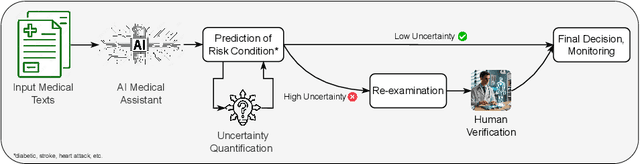
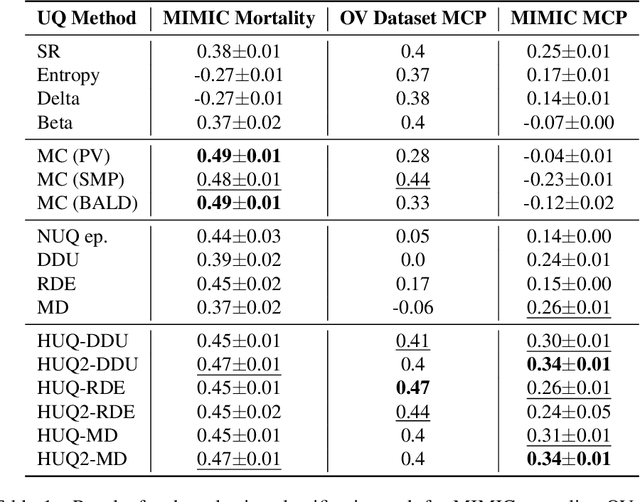
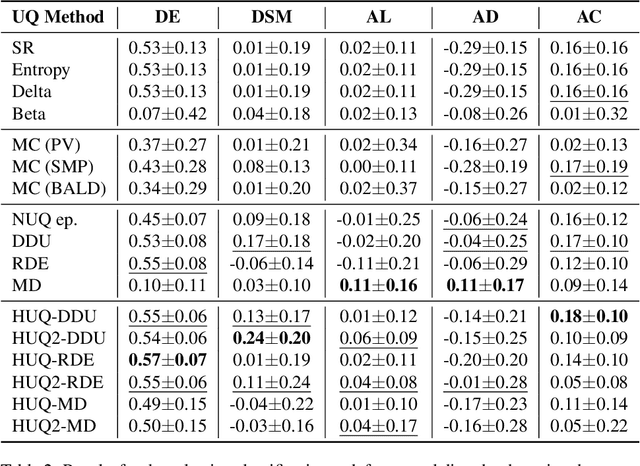
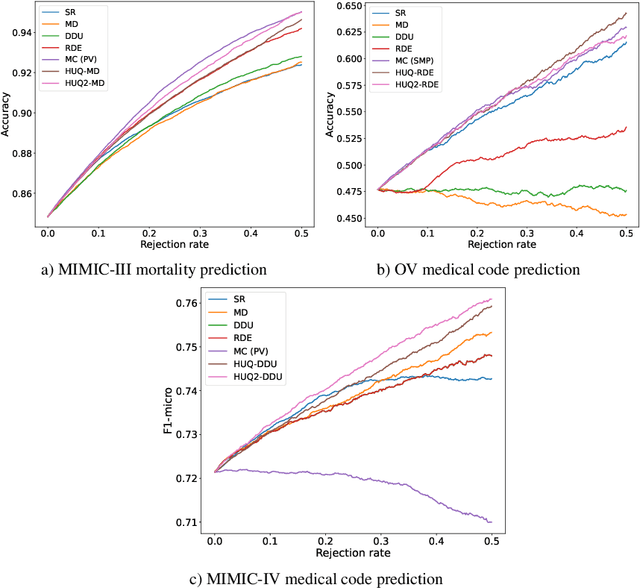
This study addresses the critical issue of reliability for AI-assisted medical diagnosis. We focus on the selection prediction approach that allows the diagnosis system to abstain from providing the decision if it is not confident in the diagnosis. Such selective prediction (or abstention) approaches are usually based on the modeling predictive uncertainty of machine learning models involved. This study explores uncertainty quantification in machine learning models for medical text analysis, addressing diverse tasks across multiple datasets. We focus on binary mortality prediction from textual data in MIMIC-III, multi-label medical code prediction using ICD-10 codes from MIMIC-IV, and multi-class classification with a private outpatient visits dataset. Additionally, we analyze mental health datasets targeting depression and anxiety detection, utilizing various text-based sources, such as essays, social media posts, and clinical descriptions. In addition to comparing uncertainty methods, we introduce HUQ-2, a new state-of-the-art method for enhancing reliability in selective prediction tasks. Our results provide a detailed comparison of uncertainty quantification methods. They demonstrate the effectiveness of HUQ-2 in capturing and evaluating uncertainty, paving the way for more reliable and interpretable applications in medical text analysis.
Token-Level Density-Based Uncertainty Quantification Methods for Eliciting Truthfulness of Large Language Models
Feb 20, 2025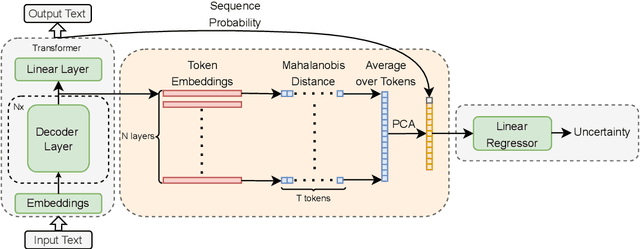

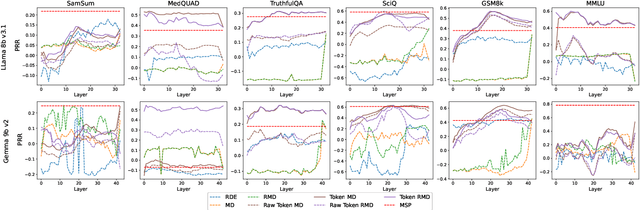
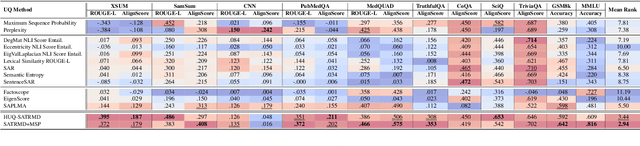
Uncertainty quantification (UQ) is a prominent approach for eliciting truthful answers from large language models (LLMs). To date, information-based and consistency-based UQ have been the dominant UQ methods for text generation via LLMs. Density-based methods, despite being very effective for UQ in text classification with encoder-based models, have not been very successful with generative LLMs. In this work, we adapt Mahalanobis Distance (MD) - a well-established UQ technique in classification tasks - for text generation and introduce a new supervised UQ method. Our method extracts token embeddings from multiple layers of LLMs, computes MD scores for each token, and uses linear regression trained on these features to provide robust uncertainty scores. Through extensive experiments on eleven datasets, we demonstrate that our approach substantially improves over existing UQ methods, providing accurate and computationally efficient uncertainty scores for both sequence-level selective generation and claim-level fact-checking tasks. Our method also exhibits strong generalization to out-of-domain data, making it suitable for a wide range of LLM-based applications.
Unconditional Truthfulness: Learning Conditional Dependency for Uncertainty Quantification of Large Language Models
Aug 20, 2024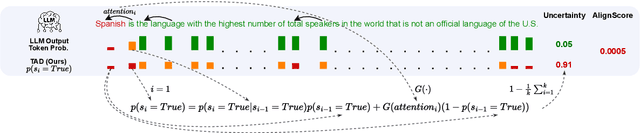
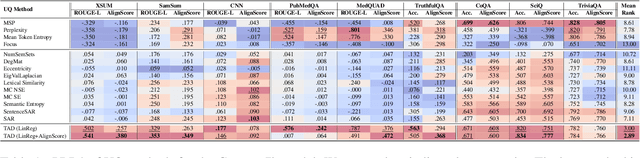
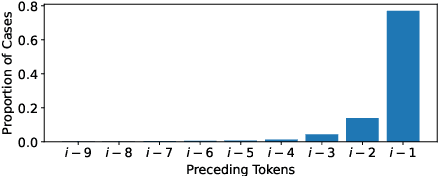
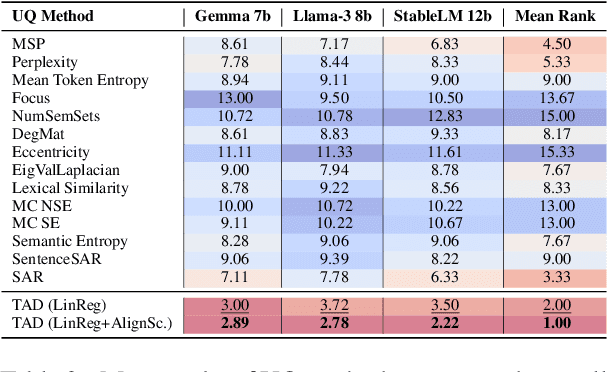
Uncertainty quantification (UQ) is a perspective approach to detecting Large Language Model (LLM) hallucinations and low quality output. In this work, we address one of the challenges of UQ in generation tasks that arises from the conditional dependency between the generation steps of an LLM. We propose to learn this dependency from data. We train a regression model, which target variable is the gap between the conditional and the unconditional generation confidence. During LLM inference, we use this learned conditional dependency model to modulate the uncertainty of the current generation step based on the uncertainty of the previous step. Our experimental evaluation on nine datasets and three LLMs shows that the proposed method is highly effective for uncertainty quantification, achieving substantial improvements over rivaling approaches.