 Add to Chrome
 Add to Firefox
 Add to Edge
PathBench: A comprehensive comparison benchmark for pathology foundation models towards precision oncology
May 26, 2025
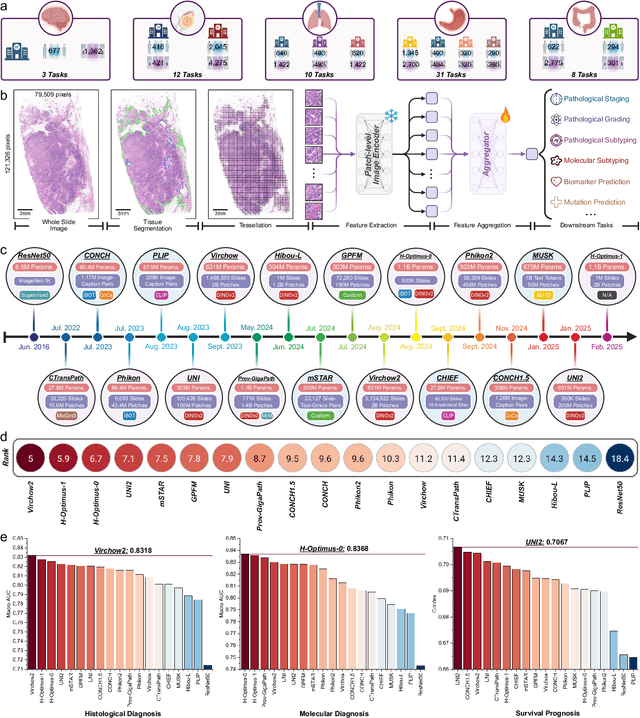
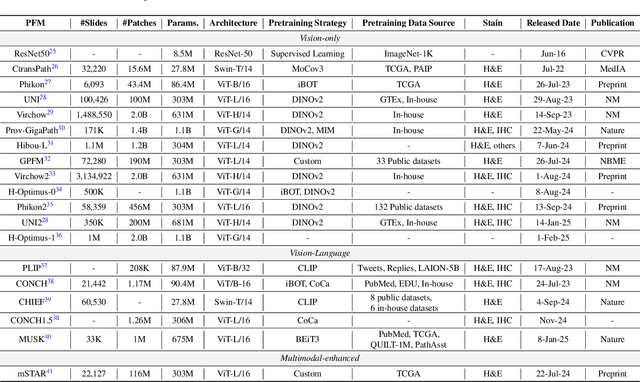
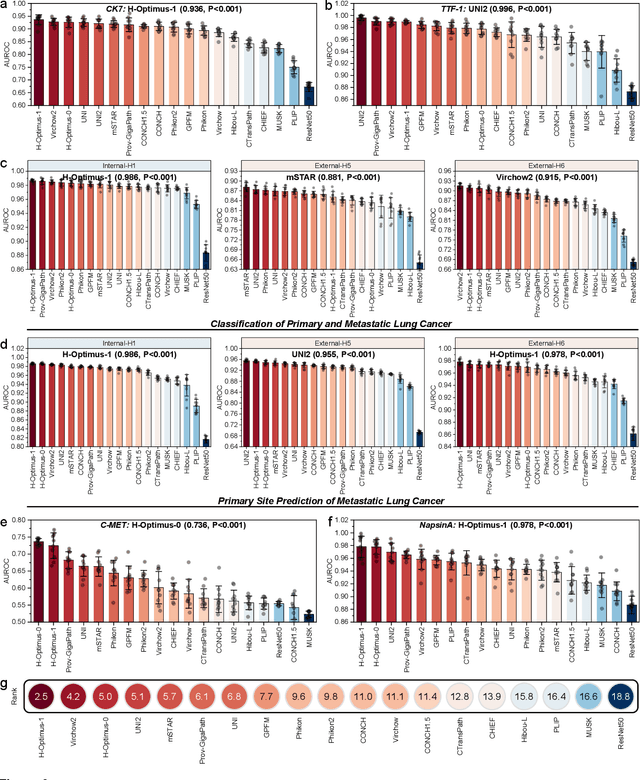
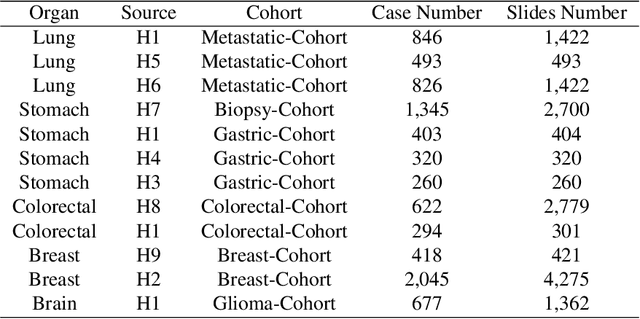
The emergence of pathology foundation models has revolutionized computational histopathology, enabling highly accurate, generalized whole-slide image analysis for improved cancer diagnosis, and prognosis assessment. While these models show remarkable potential across cancer diagnostics and prognostics, their clinical translation faces critical challenges including variability in optimal model across cancer types, potential data leakage in evaluation, and lack of standardized benchmarks. Without rigorous, unbiased evaluation, even the most advanced PFMs risk remaining confined to research settings, delaying their life-saving applications. Existing benchmarking efforts remain limited by narrow cancer-type focus, potential pretraining data overlaps, or incomplete task coverage. We present PathBench, the first comprehensive benchmark addressing these gaps through: multi-center in-hourse datasets spanning common cancers with rigorous leakage prevention, evaluation across the full clinical spectrum from diagnosis to prognosis, and an automated leaderboard system for continuous model assessment. Our framework incorporates large-scale data, enabling objective comparison of PFMs while reflecting real-world clinical complexity. All evaluation data comes from private medical providers, with strict exclusion of any pretraining usage to avoid data leakage risks. We have collected 15,888 WSIs from 8,549 patients across 10 hospitals, encompassing over 64 diagnosis and prognosis tasks. Currently, our evaluation of 19 PFMs shows that Virchow2 and H-Optimus-1 are the most effective models overall. This work provides researchers with a robust platform for model development and offers clinicians actionable insights into PFM performance across diverse clinical scenarios, ultimately accelerating the translation of these transformative technologies into routine pathology practice.

Reasoning-OCR: Can Large Multimodal Models Solve Complex Logical Reasoning Problems from OCR Cues?
May 19, 2025Large Multimodal Models (LMMs) have become increasingly versatile, accompanied by impressive Optical Character Recognition (OCR) related capabilities. Existing OCR-related benchmarks emphasize evaluating LMMs' abilities of relatively simple visual question answering, visual-text parsing, etc. However, the extent to which LMMs can deal with complex logical reasoning problems based on OCR cues is relatively unexplored. To this end, we introduce the Reasoning-OCR benchmark, which challenges LMMs to solve complex reasoning problems based on the cues that can be extracted from rich visual-text. Reasoning-OCR covers six visual scenarios and encompasses 150 meticulously designed questions categorized into six reasoning challenges. Additionally, Reasoning-OCR minimizes the impact of field-specialized knowledge. Our evaluation offers some insights for proprietary and open-source LMMs in different reasoning challenges, underscoring the urgent to improve the reasoning performance. We hope Reasoning-OCR can inspire and facilitate future research on enhancing complex reasoning ability based on OCR cues. Reasoning-OCR is publicly available at https://github.com/Hxyz-123/ReasoningOCR.
LogicOCR: Do Your Large Multimodal Models Excel at Logical Reasoning on Text-Rich Images?
May 18, 2025Recent advances in Large Multimodal Models (LMMs) have significantly improved their reasoning and Optical Character Recognition (OCR) capabilities. However, their performance on complex logical reasoning tasks involving text-rich images remains underexplored. To bridge this gap, we introduce LogicOCR, a benchmark comprising 1,100 multiple-choice questions designed to evaluate LMMs' logical reasoning abilities on text-rich images, while minimizing reliance on domain-specific knowledge (e.g., mathematics). We construct LogicOCR by curating a text corpus from the Chinese National Civil Servant Examination and develop a scalable, automated pipeline to convert it into multimodal samples. First, we design prompt templates to steer GPT-Image-1 to generate images with diverse backgrounds, interleaved text-illustration layouts, and varied fonts, ensuring contextual relevance and visual realism. Then, the generated images are manually verified, with low-quality examples discarded. We evaluate a range of representative open-source and proprietary LMMs under both Chain-of-Thought (CoT) and direct-answer settings. Our multi-dimensional analysis reveals key insights, such as the impact of test-time scaling, input modality differences, and sensitivity to visual-text orientation. Notably, LMMs still lag in multimodal reasoning compared to text-only inputs, indicating that they have not fully bridged visual reading with reasoning. We hope LogicOCR will serve as a valuable resource for advancing multimodal reasoning research. The dataset is available at https://github.com/MiliLab/LogicOCR.
Advances in Radiance Field for Dynamic Scene: From Neural Field to Gaussian Field
May 15, 2025Dynamic scene representation and reconstruction have undergone transformative advances in recent years, catalyzed by breakthroughs in neural radiance fields and 3D Gaussian splatting techniques. While initially developed for static environments, these methodologies have rapidly evolved to address the complexities inherent in 4D dynamic scenes through an expansive body of research. Coupled with innovations in differentiable volumetric rendering, these approaches have significantly enhanced the quality of motion representation and dynamic scene reconstruction, thereby garnering substantial attention from the computer vision and graphics communities. This survey presents a systematic analysis of over 200 papers focused on dynamic scene representation using radiance field, spanning the spectrum from implicit neural representations to explicit Gaussian primitives. We categorize and evaluate these works through multiple critical lenses: motion representation paradigms, reconstruction techniques for varied scene dynamics, auxiliary information integration strategies, and regularization approaches that ensure temporal consistency and physical plausibility. We organize diverse methodological approaches under a unified representational framework, concluding with a critical examination of persistent challenges and promising research directions. By providing this comprehensive overview, we aim to establish a definitive reference for researchers entering this rapidly evolving field while offering experienced practitioners a systematic understanding of both conceptual principles and practical frontiers in dynamic scene reconstruction.
TiMo: Spatiotemporal Foundation Model for Satellite Image Time Series
May 13, 2025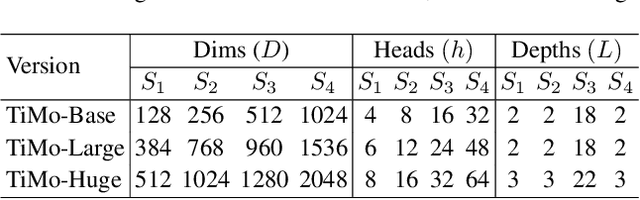
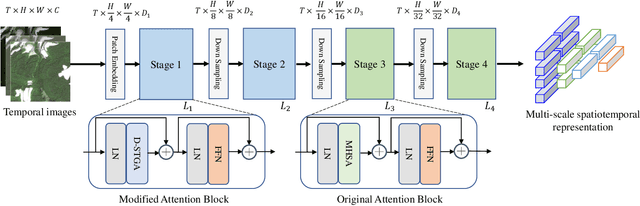
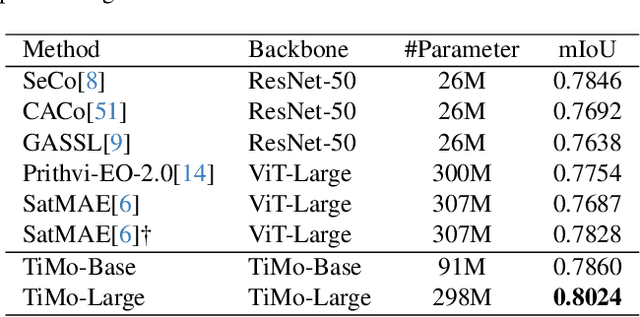
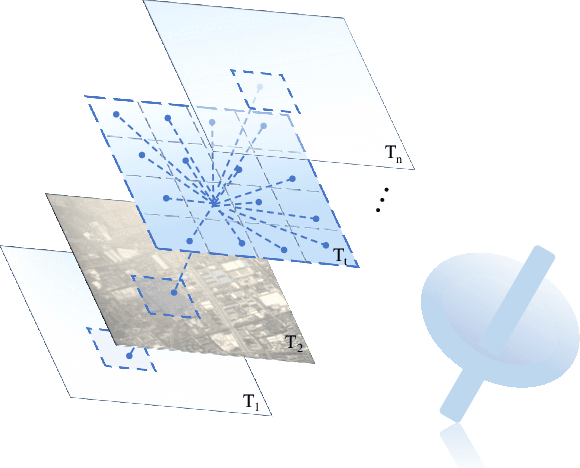
Satellite image time series (SITS) provide continuous observations of the Earth's surface, making them essential for applications such as environmental management and disaster assessment. However, existing spatiotemporal foundation models rely on plain vision transformers, which encode entire temporal sequences without explicitly capturing multiscale spatiotemporal relationships between land objects. This limitation hinders their effectiveness in downstream tasks. To overcome this challenge, we propose TiMo, a novel hierarchical vision transformer foundation model tailored for SITS analysis. At its core, we introduce a spatiotemporal gyroscope attention mechanism that dynamically captures evolving multiscale patterns across both time and space. For pre-training, we curate MillionST, a large-scale dataset of one million images from 100,000 geographic locations, each captured across 10 temporal phases over five years, encompassing diverse geospatial changes and seasonal variations. Leveraging this dataset, we adapt masked image modeling to pre-train TiMo, enabling it to effectively learn and encode generalizable spatiotemporal representations.Extensive experiments across multiple spatiotemporal tasks-including deforestation monitoring, land cover segmentation, crop type classification, and flood detection-demonstrate TiMo's superiority over state-of-the-art methods. Code, model, and dataset will be released at https://github.com/MiliLab/TiMo.
Inter-Diffusion Generation Model of Speakers and Listeners for Effective Communication
May 08, 2025Full-body gestures play a pivotal role in natural interactions and are crucial for achieving effective communication. Nevertheless, most existing studies primarily focus on the gesture generation of speakers, overlooking the vital role of listeners in the interaction process and failing to fully explore the dynamic interaction between them. This paper innovatively proposes an Inter-Diffusion Generation Model of Speakers and Listeners for Effective Communication. For the first time, we integrate the full-body gestures of listeners into the generation framework. By devising a novel inter-diffusion mechanism, this model can accurately capture the complex interaction patterns between speakers and listeners during communication. In the model construction process, based on the advanced diffusion model architecture, we innovatively introduce interaction conditions and the GAN model to increase the denoising step size. As a result, when generating gesture sequences, the model can not only dynamically generate based on the speaker's speech information but also respond in realtime to the listener's feedback, enabling synergistic interaction between the two. Abundant experimental results demonstrate that compared with the current state-of-the-art gesture generation methods, the model we proposed has achieved remarkable improvements in the naturalness, coherence, and speech-gesture synchronization of the generated gestures. In the subjective evaluation experiments, users highly praised the generated interaction scenarios, believing that they are closer to real life human communication situations. Objective index evaluations also show that our model outperforms the baseline methods in multiple key indicators, providing more powerful support for effective communication.
DGSolver: Diffusion Generalist Solver with Universal Posterior Sampling for Image Restoration
Apr 30, 2025Diffusion models have achieved remarkable progress in universal image restoration. While existing methods speed up inference by reducing sampling steps, substantial step intervals often introduce cumulative errors. Moreover, they struggle to balance the commonality of degradation representations and restoration quality. To address these challenges, we introduce \textbf{DGSolver}, a diffusion generalist solver with universal posterior sampling. We first derive the exact ordinary differential equations for generalist diffusion models and tailor high-order solvers with a queue-based accelerated sampling strategy to improve both accuracy and efficiency. We then integrate universal posterior sampling to better approximate manifold-constrained gradients, yielding a more accurate noise estimation and correcting errors in inverse inference. Extensive experiments show that DGSolver outperforms state-of-the-art methods in restoration accuracy, stability, and scalability, both qualitatively and quantitatively. Code and models will be available at https://github.com/MiliLab/DGSolver.
Quadratic Interest Network for Multimodal Click-Through Rate Prediction
Apr 24, 2025Multimodal click-through rate (CTR) prediction is a key technique in industrial recommender systems. It leverages heterogeneous modalities such as text, images, and behavioral logs to capture high-order feature interactions between users and items, thereby enhancing the system's understanding of user interests and its ability to predict click behavior. The primary challenge in this field lies in effectively utilizing the rich semantic information from multiple modalities while satisfying the low-latency requirements of online inference in real-world applications. To foster progress in this area, the Multimodal CTR Prediction Challenge Track of the WWW 2025 EReL@MIR Workshop formulates the problem into two tasks: (1) Task 1 of Multimodal Item Embedding: this task aims to explore multimodal information extraction and item representation learning methods that enhance recommendation tasks; and (2) Task 2 of Multimodal CTR Prediction: this task aims to explore what multimodal recommendation model can effectively leverage multimodal embedding features and achieve better performance. In this paper, we propose a novel model for Task 2, named Quadratic Interest Network (QIN) for Multimodal CTR Prediction. Specifically, QIN employs adaptive sparse target attention to extract multimodal user behavior features, and leverages Quadratic Neural Networks to capture high-order feature interactions. As a result, QIN achieved an AUC of 0.9798 on the leaderboard and ranked second in the competition. The model code, training logs, hyperparameter configurations, and checkpoints are available at https://github.com/salmon1802/QIN.
EmoSEM: Segment and Explain Emotion Stimuli in Visual Art
Apr 22, 2025This paper focuses on a key challenge in visual art understanding: given an art image, the model pinpoints pixel regions that trigger a specific human emotion, and generates linguistic explanations for the emotional arousal. Despite recent advances in art understanding, pixel-level emotion understanding still faces a dual challenge: first, the subjectivity of emotion makes it difficult for general segmentation models like SAM to adapt to emotion-oriented segmentation tasks; and second, the abstract nature of art expression makes it difficult for captioning models to balance pixel-level semantic understanding and emotion reasoning. To solve the above problems, this paper proposes the Emotion stimuli Segmentation and Explanation Model (EmoSEM) to endow the segmentation model SAM with emotion comprehension capability. First, to enable the model to perform segmentation under the guidance of emotional intent well, we introduce an emotional prompt with a learnable mask token as the conditional input for segmentation decoding. Then, we design an emotion projector to establish the association between emotion and visual features. Next, more importantly, to address emotion-visual stimuli alignment, we develop a lightweight prefix projector, a module that fuses the learned emotional mask with the corresponding emotion into a unified representation compatible with the language model. Finally, we input the joint visual, mask, and emotional tokens into the language model and output the emotional explanations. It ensures that the generated interpretations remain semantically and emotionally coherent with the visual stimuli. The method innovatively realizes end-to-end modeling from low-level pixel features to high-level emotion interpretation, providing the first interpretable fine-grained analysis framework for artistic emotion computing. Extensive experiments validate the effectiveness of our model.
Joint Channel Estimation and Signal Detection for MIMO-OFDM: A Novel Data-Aided Approach with Reduced Computational Overhead
Apr 20, 2025
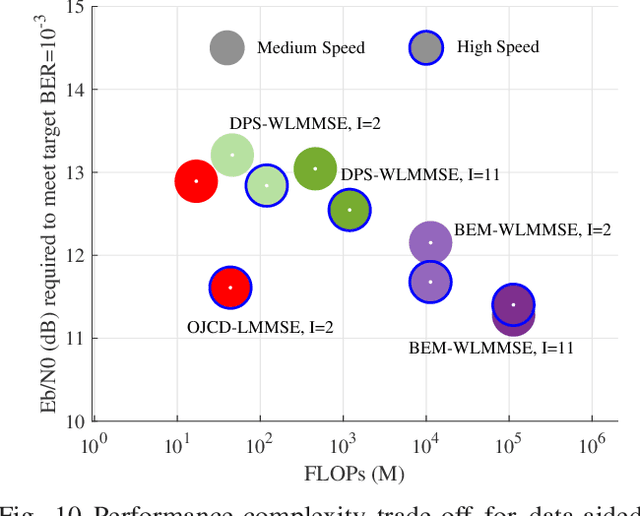
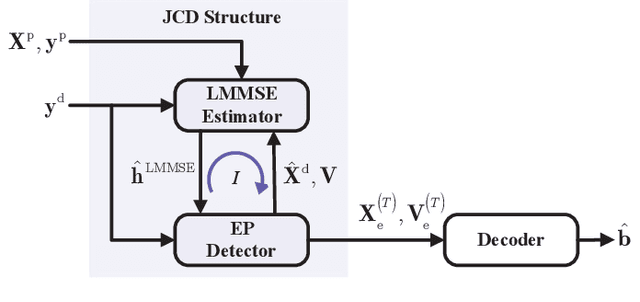
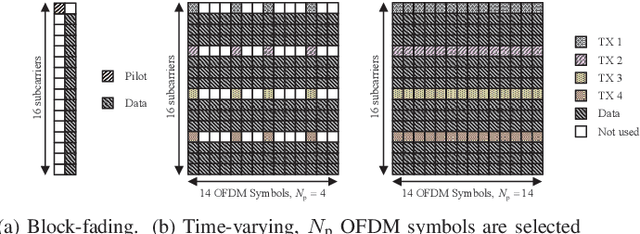
The acquisition of channel state information (CSI) is essential in MIMO-OFDM communication systems. Data-aided enhanced receivers, by incorporating domain knowledge, effectively mitigate performance degradation caused by imperfect CSI, particularly in dynamic wireless environments. However, existing methodologies face notable challenges: they either refine channel estimates within MIMO subsystems separately, which proves ineffective due to deviations from assumptions regarding the time-varying nature of channels, or fully exploit the time-frequency characteristics but incur significantly high computational overhead due to dimensional concatenation. To address these issues, this study introduces a novel data-aided method aimed at reducing complexity, particularly suited for fast-fading scenarios in fifth-generation (5G) and beyond networks. We derive a general form of a data-aided linear minimum mean-square error (LMMSE)-based algorithm, optimized for iterative joint channel estimation and signal detection. Additionally, we propose a computationally efficient alternative to this algorithm, which achieves comparable performance with significantly reduced complexity. Empirical evaluations reveal that our proposed algorithms outperform several state-of-the-art approaches across various MIMO-OFDM configurations, pilot sequence lengths, and in the presence of time variability. Comparative analysis with basis expansion model-based iterative receivers highlights the superiority of our algorithms in achieving an effective trade-off between accuracy and computational complexity.